Council on Energy, Environment and Water Integrated | International | Independent

Suggested citation: Manimaran, Mohana Bharathi and Sumit Prasad. 2026. Whose Transition? Unpacking the Discourse on Transitioning Away from Fossil Fuels in Climate Negotiations. New Delhi: Council on Energy, Environment and Water.
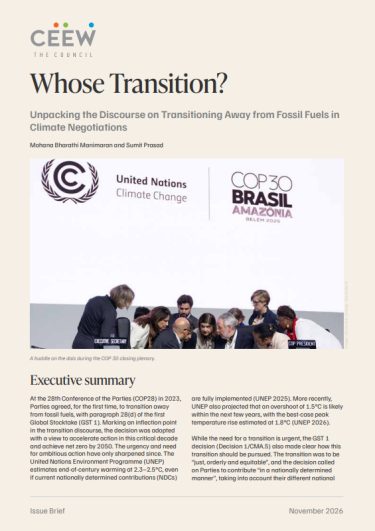
At COP28 in 2023, Parties agreed, for the first time, to transition away from fossil fuels in a “just, orderly and equitable” manner, and “in a nationally determined manner”. Three years later, the COP30 Presidency is developing a roadmap for transitioning away from fossil fuels (TAFF) outside the formal negotiations. This reflects a broader shift towards coalitions and voluntary initiatives, but raises critical questions about whether the transition will be just and equitable, and for whom.
This issue brief traces how the transition discourse has evolved within the UNFCCC, examines what the transition means for the Global South, and analyses the 21 Party submissions to the Presidency’s roadmap. It presents considerations for reconciling ambition and equity, to preserve the space for consensus-based negotiations while enabling delivery under inclusive initiatives.
Also read: Ten Years of Paris Agreement: A Stocktake of Cooperative Climate Initiatives
At the 28th Conference of the Parties (COP28) in 2023, Parties agreed, for the first time, to transition away from fossil fuels, with paragraph 28(d) of the first Global Stocktake (GST 1). Marking an inflection point in the transition discourse, the decision was adopted with a view to accelerate action in this critical decade and achieve net zero by 2050. The urgency and need for ambitious action have only sharpened since. The United Nations Environment Programme (UNEP) estimates end-of-century warming at 2.3–2.5°C, even if current nationally determined contributions (NDCs) are fully implemented (UNEP 2025). More recently, UNEP also projected that an overshoot of 1.5°C is likely within the next few years, with the best-case peak temperature rise estimated at 1.8°C (UNEP 2026).
While the need for a transition is urgent, the GST 1 decision (Decision 1/CMA.5) also made clear how this transition should be pursued. The transition was to be “just, orderly and equitable”, and the decision called on Parties to contribute “in a nationally determined manner”, taking into account their different national circumstances, pathways, and approaches (UNFCCC 2023b, 5–6). Irrespective of the pace of the multilateral process, substantial transition efforts are already underway, including in developing countries (MNRE 2026; Jones and Nana 2026; Yang et al. 2026).
Three years after the GST decision, the COP30 Presidency is now developing a roadmap for transitioning away from fossil fuels (TAFF) outside the negotiations. This reflects a broader shift towards coalitions and implementation beyond formal negotiations. However, for transitions, the process has implications for whether the transition is ultimately just, orderly, and equitable. In this context, this brief draws on a review of United Nations Framework Convention on Climate Change (UNFCCC) decisions, the associated literature, and an analysis of the 21 Party submissions made to the Presidency as of July 2026 to examine the evolution of the transition discourse within the UNFCCC, the scope of what the transition means for the Global South, and key observations from the Parties’ submissions. In doing so, it presents considerations for reconciling ambition and equity in the transition discourse to preserve the scope for consensus-based negotiations while enabling delivery under inclusive initiatives.
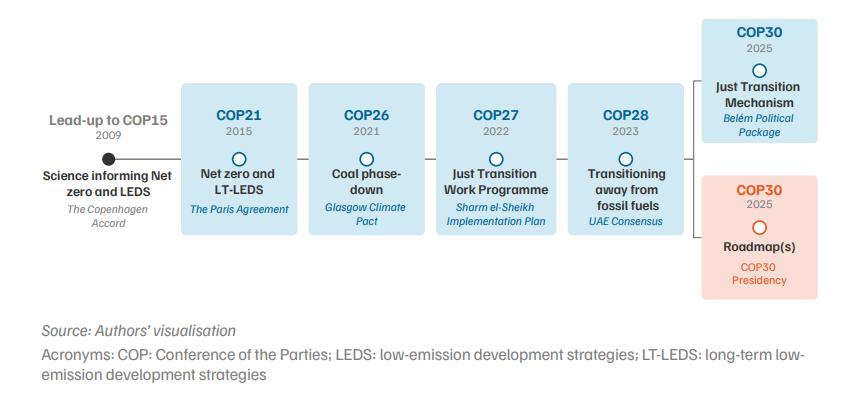
The question of transitioning predates COP28 (see Figure ES1). The Paris Agreement established two foundational channels for long-term ambition: net zero under Article 4.1 and long-term low-emission development strategies (LT-LEDS) under Article 4.19. The Glasgow Climate Pact at COP26 subsequently referenced phasing down unabated coal power. The Sharm el-Sheikh Implementation Plan at COP27 established the Just Transition Work Programme (JTWP), extending the agenda to include energy, livelihoods, and social protection. The UAE Consensus at COP28 then brought the transition discourse into the GST decision. For the first time it brought explicit attention to the emissions source, signalling the beginning of the end of the fossil-fuel era (UNFCCC 2023a). At COP30, Parties agreed to develop a Just Transition Mechanism (JTM) to take forward the work under JTWP, and is to be operationalised at COP31. Together, these decisions, work programmes, and institutions establish both the need to transition and the means of pursuing it. They are grounded in the principle that countries act according to their common but differentiated responsibilities and respective capabilities (CBDR-RC) and in light of their national circumstances.
Figure ES1. Evolution of the transition discourse within UNFCCC negotiations
The call for a roadmap was a parallel development initiated by observer organisations at the Bonn intersessional meeting in June 2025 (ENB 2025). When a negotiated roadmap did not secure consensus at COP30, the Presidency committed to developing one outside the formal negotiations. Two processes have since emerged. The first was the First Conference on Transitioning Away from Fossil Fuels, convened in Santa Marta in April 2026 by Colombia and the Netherlands with the support of the COP30 Presidency. It brought together 57 developed and developing countries but did not invite several major Global South economies, including China and India (IISD 2026; Dunne 2026). The second is the Presidency’s own roadmap process, informed by Party and non-Party submissions and structured dialogues.
These voluntary initiatives reflect a broader shift towards implementation and cooperation beyond formal negotiation spaces. However, concerns remain about the potential influence of these processes on formal negotiation outcomes, particularly for developing countries that are not participating. At the 64th sessions of the Subsidiary Bodies (SB64), some developing country Parties stated that such initiatives must remain voluntary and must not steer the Convention’s mandates. Collectively, this has created a moment in the transition discourse in which there is consensus on the need for a transition but not on the process intended to guide it.
For emerging markets and developing economies (EMDEs), moving away from fossil fuels involves not one transition but several simultaneous transformations: labour markets, public finances, industry, energy markets, and infrastructure must all change together. While this may be true for every economy, it is more challenging for economies that must undergo these transformations while basic development gaps persist. As of mid-2026, 655 million people still lack access to electricity, 85 per cent of whom are in sub-Saharan Africa (ESMAP 2026).
The labour market implications of these transitions are substantial. India’s coal sector supports around 500,000 mine workers (PIB 2025), and South African coal mining employed nearly 91,000 workers as of 2022 (Minerals Council South Africa n.d.). A green economy could create far more jobs than it displaces (ILO 2022). However, the costs and benefits of the transition are unevenly distributed. India’s NITI Aayog (2026), for instance, reports that fossil-fuel-dependent states such as Jharkhand, Chhattisgarh, and Odisha face greater transition risks, while 75 per cent of installed solar and wind capacity is concentrated in Rajasthan, Gujarat, Maharashtra, Tamil Nadu, and Karnataka. Whether the potential benefits of growth and employment reach the workers and regions experiencing job losses therefore depends on targeted interventions in reskilling, social protection, and, above all, finance.
However, promises of support have not always matched delivery. South Africa’s Just Energy Transition Partnership (JETP) illustrates this gap. Of the USD 14.36 billion international pledges by March 2026, only 42.6 per cent (USD 6.12 billion) had been allocated (JET PMU 2026), compared to the estimated needs of USD 85 billion over 2023–2027 (JET PMU 2023). Importantly, only 7 per cent of pledged finance was in the form of grants, underscoring the model’s reliance on private capital. The existing financing landscape further constrains the transition. Bilateral public climate finance fell by 12 per cent in 2024, even as mobilised private finance rose by 33 per cent (OECD 2026). Developing countries also face mounting fiscal pressures, with government interest payments rising by 102 per cent over the past decade, compared with a 39 per cent increase in revenues (UNCTAD 2026). Financing clean energy is also structurally more expensive: the cost of capital for utility-scale solar can be two to three times higher in key emerging economies than in advanced economies or China, and is reflective of the real and perceived risks at the country, sectoral and project levels (IEA 2023).
Technology access presents a similar constraint. The Group of Twenty (G20) countries accounted for around 91 per cent of environmental technology patents granted between 2000 and 2021, with just five countries (China, Japan, the United States, the Republic of Korea, and Germany) accounting for around 85 per cent (Gupta et al. 2023). Critical minerals needed for low-carbon technologies are also highly concentrated geographically, with 15 countries1 accounting for 55–90 per cent of global reserves and 70–95 per cent of production in 2022 (CEEW et al. 2023). In addition, the UNFCCC (2025a) synthesis of over 100 biennial transparency reports shows that technology support is focused mainly on adaptation, with limited coverage of the low-carbon technologies needed for the transition.
First, mandates to guide the transition in alignment with CBDR-RC already exist within the UNFCCC, build on them. Paragraph 28 calls on Parties to contribute to global efforts to phase down unabated coal power, triple renewable energy capacity, double the average annual rate of energy efficiency improvements, and transition away from fossil fuels, among other actions. The JTM, set to be operationalised at COP31, has the scope to cover reskilling, capacity building, and support for affected businesses, economies, and livelihoods. The Technology Implementation Programme adopted at COP30 can support technology transfer and codevelopment. Further, the NDCs and the Enhanced Transparency Framework provides avenues for communicating further updates on transition in a nationally determined manner. Developing new provisions around an already accepted mandate therefore risks diverting attention from strengthening existing mechanisms.
Second, the transition is not merely a matter of substituting energy systems, and the UNFCCC needs to evolve to address its wider implications. UNFCCC treats the transition largely as a mitigationlinked climate goal and it is also reflected in the Participants’ represented in the submission. However transition is closely tied to energy security, supplychain vulnerability, economic growth, and livelihoods. These issues are closely linked to national sovereignty and are deliberated largely outside the UNFCCC, in geopolitical groupings such as the G20 and BRICS (Brazil, Russia, India, China, and South Africa). The UNFCCC’s negotiation formats need to evolve to accommodate these questions, bringing in ministries of power, mines, renewable energy, trade, finance, and external affairs alongside environment ministries. A Subsidiary Body dialogue on the energy security– transition nexus, modelled on the trade dialogues agreed at COP30, could be a starting point.
Finally, economies are already transitioning; what is lacking is the means to accelerate. Concessional and grant finance fall far short of needs. The USD 100 billion goal reported to be met in 2022 (OECD 2024) is still two years late; and the USD 300 billion new collective quantified goal on climate finance (NCQG) for 2035 remains far below developing countries’ estimated annual needs of USD 455–584 billion through 2030 (UNFCCC 2024a). Moreover, investment is unevenly distributed and capital is expensive. The work programme under Article 9, when rendered as an agenda, provides an avenue to enhance accountability and deliver the support obligations established under Article 9.1. Article 6 mechanisms can be explored for mobilising investment. However, South Africa’s JETP experience shows that grant-based financing has one of the highest allocation rates, at 87 per cent across financing instruments5 (JET PMU 2026). The importance of catalytic grant-based financing for the energy transition must therefore be recognised, with such financing actively earmarked under Article 9.1 and through the inclusion of finance in the upcoming operationalisation of the JTM.
In sum, voluntary efforts should remain voluntary and should not be forced into formal negotiations, thereby preserving the space for consensual and equitable action under CBDR-RC. A polycentric landscape involving multiple actors can be a force multiplier. However, acceleration cannot come at the cost of excluding economies for which the transition is not merely a matter of energy substitution. Ultimately, only an inclusive transition can be a just and equitable one.
This CEEW issue brief analyses the 21 Party submissions, representing 115 countries, to the COP30 Presidency’s roadmap on transitioning away from fossil fuels. Most favour working through existing UNFCCC instruments, 90 per cent of represented economies are net fossil-fuel importers, and more than half of global emissions lie outside the process. Economies are already transitioning; the missing piece is the means to accelerate.
For developing economies, moving away from fossil fuels means several transformations at once, across jobs, public finances, industry and infrastructure, while development gaps persist. India’s coal sector alone supports around 500,000 mine workers and contributes over INR 70,000 crore a year to governments. Meanwhile, capital costs are higher, grant finance is scarce, and clean technologies are concentrated in a few countries. It is not a simple question of substituting energy sources.
First, build on mandates that already exist within the UNFCCC, such as the Global Stocktake decision, the Just Transition Mechanism and NDCs. Second, evolve the UNFCCC to address energy security, for instance through a Subsidiary Body dialogue modelled on the trade dialogues. Third, deliver the means, by earmarking catalytic grant-based finance under Article 9.1 and the Just Transition Mechanism.
Voluntary roadmaps should remain voluntary, and COPs should continue to serve as the principal forum for equitable and accountable action. A polycentric climate landscape can accelerate the transition, but acceleration cannot come at the cost of inclusion, for only inclusive transitions can be just and equitable.
How South Asia’s Energy Transition Can Respond to Global Disruptions
Time to develop an Asia-Pacific Green Development Agenda
The India StoryA Green Investment Handbook