Council on Energy, Environment and Water Integrated | International | Independent

Suggested citation: Sukhija, Simran, Sumit Prasad. 2026. Holding up the Mirror: Tracking Climate Action across UNFCCC Negotiating Groups in the Era of Geopolitical Uncertainty. New Delhi: Council on Energy, Environment and Water.
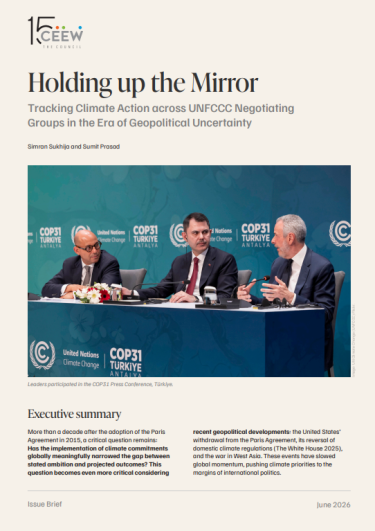
A decade after the Paris Agreement, adopted in 2015 and hailed as the world’s most ambitious climate commitment to limit warming to 1.5°C above pre-industrial levels, the gap between stated ambition and actual action remains stark. This is likely to worsen further due to evolving geopolitical dynamics that have introduced new uncertainties in the global climate regime.
In this issue brief, we analyse the collective progress in climate action achieved by the following negotiating groups within the United Nations Framework Convention on Climate Change (UNFCCC): the Umbrella, the EU, the Environmental Integrity Group (EIG), and the BASIC. These groups critically shape the direction and effectiveness of global climate governance. The study assesses emissions trends before and after the Paris Agreement, progress towards 2030 and 2035 NDC targets, and the pace of reductions needed to reach net zero by 2050.
More than a decade after the adoption of the Paris Agreement in 2015, a critical question remains: Has the implementation of climate commitments globally meaningfully narrowed the gap between stated ambition and projected outcomes? This question becomes even more critical considering recent geopolitical developments: the United States’ withdrawal from the Paris Agreement, its reversal of domestic climate regulations (The White House 2025), and the war in West Asia. These events have slowed global momentum, pushing climate priorities to the margins of international politics.
In this issue brief, we analyse the collective progress in climate action achieved by the following negotiating groups within the United Nations Framework Convention on Climate Change (UNFCCC): the Umbrella, the EU, the Environmental Integrity Group (EIG), and the BASIC. These groups critically shape the direction and effectiveness of global climate governance. However, at present, there is limited understanding of their collective progress, beyond their visibility in coordinating common negotiation positions and setting the climate agenda.
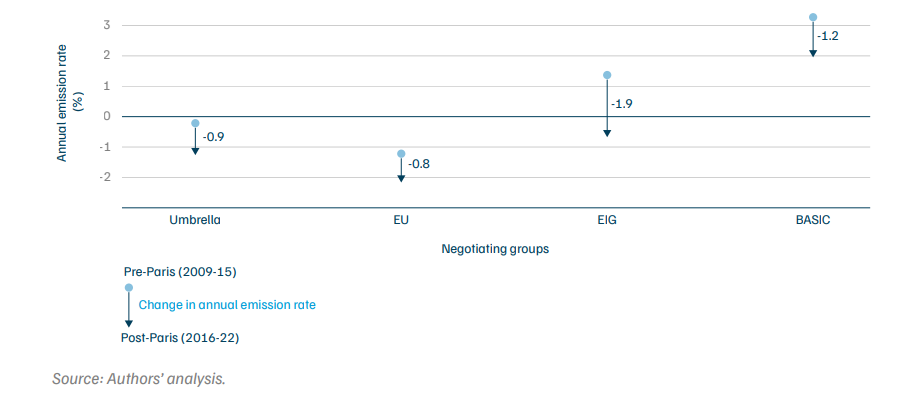
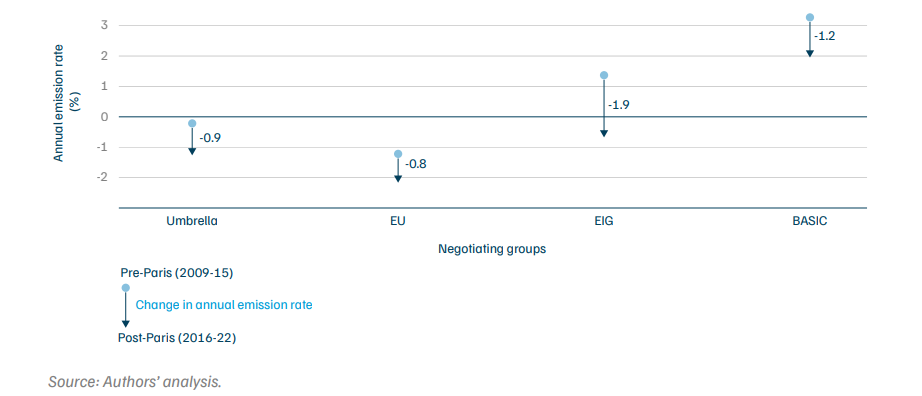
Figure ES1. Annual emission rates decline in the post-Paris era
As we navigate an increasingly dynamic geopolitical landscape, negotiating blocs – such as the Umbrella, the EU, and the EIG – should accelerate short-term actions aligned with their 2035 NDC targets to prevent further overshooting and ensure that climate ambition is backed by sustained implementation efforts. In addition, they need to significantly ramp up year-on-year reduction to ensure there is enough carbon budget left for other countries.
A decade after the Paris Agreement, adopted in 2015 and hailed as the world’s most ambitious climate commitment to limit warming to 1.5°C above pre-industrial levels, the gap between stated ambition and actual action remains stark. The limited efforts over the years have led to escalating impacts, with the world experiencing, on average, one disaster a day over the past five decades, resulting in daily losses of USD 202 million (Jones 2022).
This climate crisis is likely to worsen further due to evolving geopolitical dynamics that have introduced new uncertainties in the global climate regime. The United States’s withdrawal from the Paris Agreement, along with its reversal of domestic climate regulations, shows how political changes can produce rapid and significant policy reversals in the energy transition sphere, raising concerns about accountability and underscoring the fragility of climate cooperation. The war in the West Asia has further halted momentum, pushing climate priorities to the margins of international politics.
Despite these geopolitical uncertainties, the obligation to deliver on climate commitments remains, as the consequences of inaction compound each year. To achieve the goals of the Paris Agreement, countries have been communicating their targets through Nationally Determined Contributions (NDCs). Previously, they set targets for 2030; and last year, they were expected to submit more ambitious targets for 2035 as part of NDC 3.0, informed by the outcomes of the first Global Stocktake.
However, a few questions remain. How are countries performing on their commitments? Which countries in the negotiating groups are on track, and which are falling short? What is the collective progress of these negotiating groups under the United Nations Framework Convention on Climate Change (UNFCCC)? This analysis is important, as these groups influence the direction and effectiveness of global climate governance by building internal coherence, setting the agenda, and holding other groups accountable. While the countries in these groups often have diverse national climate policies, they tend to align strategically within the UNFCCC process to strengthen their collective bargaining power and advance shared interests in climate negotiations.
In this regard, we assess the climate performance of the following key negotiating groups:
We did not include other negotiating groups,11 as they submit at their discretion or due to limited data availability across member countries. We examine progress against national climate commitments to understand each group’s collective progress. For this, we mainly draw on datasets reported by countries in the first Biennial Transparency Reports (BTRs), including data from Common Reporting Tables (CRT) and the Common Tabular Format (CTF), in line with the requirements of the Enhanced Transparency Framework (ETF).
In Section 2, we examine historical emissions trends and assess how emission trajectories have evolved in the pre Paris (2009–15) and post-Paris (2016–22) eras. Next, we evaluate progress against the 2030 and 2035 NDC targets. In Section 4, we analyse the implications of these emissions pathways for achieving net-zero goals. Finally, we conclude this issue brief in Section 5.
Emissions reduction is a central topic of climate debate, and the Global North is expected to make steeper reductions than the Global South. However, at present, there is limited understanding of emissions trends before and after the adoption of the Paris Agreement.
For this analysis, we define the post-Paris era as 2016 22, a timeframe that follows the adoption of the Paris Agreement and aligns with the latest available data. For consistency, we define the pre-Paris era as 2009–15.
Based on the emissions self-reported by countries, we observe that during 2009–22, the BASIC group collectively accounted for more than half of the total emissions (52 per cent) among the groups studied, followed by the Umbrella group (32 per cent), the EU (11 per cent), and the EIG (5 per cent). Within the BASIC, China accounted for 74 per cent of its group’s emissions, while in the Umbrella Group, the US accounted for 63 per cent of its group’s emissions.
Figure 1 compares the annual emission rates of the negotiating groups in the pre-Paris (2009–15) and post Paris (2016–22) eras, showing that all groups had annually decreased emission rates in the post-Paris era.
Among them, the EIG has seen a notable shift, from an annual increase in emission rates by 1.4 per cent in the pre-Paris era to a decrease of about –0.5 per cent in the post-Paris era. The BASIC group also shows a significant shift, as its annual emissions growth rate reduced from 3.3 per cent pre-Paris to 2.1 per cent post-Paris, with India showing signs of progressive decoupling. In addition, both the Umbrella and the EU have shown an increase in the reduction in their annual emission rates, from –0.2 per cent to –1.1 per cent, and from –1.2 per cent to –2 per cent, from the pre-Paris to the post-Paris era, respectively.
Further, the BASIC group emitted 8.5 GtCO₂e less by not following the pre-Paris trends in the post-Paris era. This is equivalent to more than 10 per cent of global emissions in 2022. On the other hand, the Umbrella, the EU, and the EIG reduced emissions by only 3.7 GtCO₂e by not following the pre-Paris trends in the post-Paris era.
Figure 1. Annual emission rates decline in the post-Paris era
The countries within the negotiating groups had submitted their climate targets primarily for 2030. More recently, they have also begun communicating updated targets – NDC 3.0 – signalling the next phase of ambition until 2035. However, it remains to be seen whether they are on track to achieve these targets.
These climate commitments take various forms. Mostly, economy-wide emission-reduction targets were set by the Umbrella, the EU, and the EIG. The BASIC countries have set varied targets in their NDCs, including emissions intensity, emissions peaking, carbon sink creation, and expansion of non-fossil-fuel energy capacity, among others.
In their official reports, these countries provide data on projected emissions and indicators related to NDCs. To reflect on the progress of countries within the Umbrella, the EU, and the EIG, we analysed their projected emissions against their NDC targets. Given the varied nature of NDCs, we used indicators to assess the BASIC group’s current progress.
Countries in the Umbrella, the EU, and the EIG have adopted diverse climate target levels in their NDCs. Meanwhile, the EU has collectively adopted a single NDC, reflecting a collaborative approach to climate action across its 27 member countries. Table 1 shows how countries within these groups are aligning with their targets based on their projected emissions.
Table 1. Only a few countries in the Umbrella, the EU, and EIG are projected to meet their 2030 and 2035 targets
| 2030 | 2035 | |||
|---|---|---|---|---|
| Countries | Target (%) | Projected reduction (%) | Target (%) | Projected reduction (%) |
| Umbrella group | ||||
| Australia | −43 | −42 | — | — |
| Canada | −40 | −29 | −45 | — |
| Iceland | −41 | 33 | −50 | 21 |
| Israel | −27 | −26 | — | — |
| Japan | −46 | −45 | −60 | — |
| Kazakhstan | −15 | −16 | −17 | −21 |
| New Zealand | −50 | −37 | −51 | −52 |
| Norway | −55 | −62 | −70 | −68 |
| Ukraine | −65 | −81 | −65 | −82 |
| United States | −50 | −46 | −61 | −57 |
| United Kingdom | −68 | −60 | −81 | −63 |
| EU | −55 | −51 | −66.25 | −59 |
| EIG | ||||
| Georgia | −47 | −66 | −50 | −68 |
| Liechtenstein | −55 | −47 | −68 | −59 |
| Monaco | −55 | −47 | −67.6 | −60 |
| South Korea | −40 | 4 | −53 | 6 |
| Switzerland | −50 | −31 | — | — |
Source: Authors’ analysis.
he targets are taken from the countries’ respective NDCs. Red represents projected emissions that are not aligned with their target, while green represents those aligned with their targets. Blue represents an increase in projected emissions rather than a reduction as per the target.
We observed that Kazakhstan, Georgia, and Ukraine are projected to meet both their 2030 and 2035 targets. Norway is projected to only meet its 2030 target, whereas New Zealand is projected to meet its 2035 commitment. Other countries, such as Iceland in the Umbrella group and South Korea in the EIG, are projected to increase emissions rather than meet their 2030 and 2035 reduction targets.
Collectively, the Umbrella, the EU, and the EIG are projected to emit 9 per cent more in 2030 than their NDC target levels. For their 2035 target, this is projected to increase to 19 per cent.
Given that many countries are at different stages of meeting their 2030 targets, they need to significantly increase their annual emissions reduction in comparison to reductions achieved before 2022 (between the base year and 2022). For example, within the Umbrella group, the UK would need to more than double its annual emissions reduction rate to 5.4 per cent after 2022, compared to the pre-2022 rate. Similarly, the US and Canada would need to increase their yearly emissions reduction rates by 5 per cent and 6 per cent, respectively, after 2022, compared to their earlier rate. This also holds for the EU, which needs to reduce emissions by 4.8 per cent annually after 2022 – almost four times its earlier rate.
Countries in the BASIC group have diverse national circumstances and reporting capabilities. Their climate commitments reflect different pathways towards emissions reduction. Given their limited reported data, we analysed their current progress against the selfreported NDC indicators for 2030 commitments.
Table 2. The BASIC countries show varying levels of alignment with their 2030 commitments
| Countries | Target | Indicators | Status |
|---|---|---|---|
| Brazil |
|
Reduced GHG emissions (Brazil 2024) | Emissions were 20.4% below 2005 levels as of 2022 (Brazil 2024) |
| China |
|
Reduced energy-related CO2 emissions per GDP (China 2024a) | Reduced by 50.9% from 2005 levels (as of 2021) (China 2024a) |
| Increased forest stock volume (China 2024a) | Achieved ahead of schedule (as of 2021) (China 2024a) | ||
| Share of non-fossil fuels in total energy consumption (China 2024a) | Share reached 17.9% (as of 2023) (China 2024a) | ||
| Total installed wind and solar power capacity (China 2024a) | Achieved ahead of schedule (as of 2024) (China 2024a) | ||
| India |
|
Reduced emissions intensity of GDP (India 2026) | Reduced by 37.38% as of 2022 (India 2026a) |
| Cumulative installed electricity capacity from non-fossil-fuel-based energy resources (India 2026) | Achieved ahead of schedule27 | ||
| Creation of additional carbon sinks (India 2026) | 2.44 billion tCO2e created as of 2022 (India 2026a) | ||
| South Africa |
|
Total annual national GHG emissions and removals, including LULUCF and excluding GHG emissions from natural disturbances (South Africa 2024b) | Emissions were 394.3 MtCO2e as of 2022 (South Africa 2024b) |
Source: Authors’ analysis.
Note: LULUCF - Land Use, Land-Use Change, and Forestry
Table 2 demonstrates that countries in the BASIC group have varying levels of alignment toward their 2030 targets. India shows significant progress, having already exceeded 50 per cent of its cumulative installed electric power capacity from non-fossil fuel sources, and is on track to exceed its target of reducing the emissions intensity of its GDP by 45 per cent by 2030 (Das et al. 2025). Further, it has created an additional carbon sink of 2.44 billion tonnes of CO₂e, moving further towards its target of sequestering 2.5–3 billion tonnes of CO₂e by 2030.
Similarly, China has made substantial progress, already exceeding its target of raising the total installed capacity of wind and solar power to over 1,200 GW by 2030, and of increasing forest stock volume by 6 billion m³ by 203030 from 2005. It has reduced energy-related CO₂ emissions per unit of GDP by about 50.9 per cent relative to 2005 levels, compared to its 2030 reduction target of 65 per cent (People’s Republic of China 2024). In its energy mix, non-fossil fuels accounted for 17.9 per cent.
Also, South Africa seems to be aligning with its target, since its national GHG emissions and removals in 2022 are within its target level. In contrast, Brazil achieved a 20.4 per cent reduction the same year; its 2030 reduction target is 53.1 per cent.
Achieving the 1.5°C goal requires countries to rapidly reduce emissions and achieve net zero by the middle of the century. Around 145 countries have announced or are considering net-zero targets, which collectively represent about 77 per cent of global emissions (Climate Action Tracker 2024). However, this growing convergence in ambition raises a critical question: Is net zero by 2050 achievable?
This can be better understood by examining their annual emissions reductions in relation to the pace required to achieve net zero by 2050. For this analysis, we considered self-reported projections for 2030. Given the limited data on the projections of the BASIC group, our analysis only covers the Umbrella, the EU, and the EIG.
As Figure 2 shows, all three groups need to significantly increase their annual emission reduction after 2030 to achieve net zero by 2050. Within the Umbrella, the United States, followed by Japan and Canada, would need to significantly increase its emissions reductions after 2030, and in the EIG, South Korea would also need to follow a similar path.
Figure 2. Negotiating groups rely on after 2030 reductions to achieve net zero by 2050
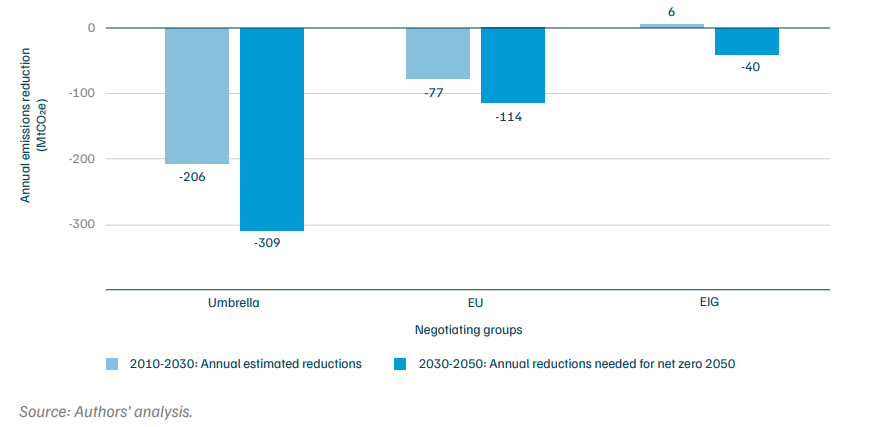
There is a growing disconnect between stated climate ambition in NDCs and projected implementation, particularly among the Umbrella, the EU, and the EIG groups. Emissions trajectories portrayed in BTRs clearly indicate that the major countries in these negotiating groups are not aligned to meet their mitigation targets for both 2030 and 2035. In contrast, the BASIC countries are Figure 2. Negotiating groups rely on after 2030 reductions to achieve net zero by 2050 Source: Authors’ analysis. Holding up the Mirror: Tracking Climate Action across UNFCCC Negotiating Groups in the Era of Geopolitical Uncertainty considered self-reported projections for 2030. Given the limited data on the projections of the BASIC group, our analysis only covers the Umbrella, the EU, and the EIG.33 As Figure 2 shows, all three groups need to significantly increase their annual emission reduction after 2030 to achieve net zero by 2050. Within the Umbrella, the United States, followed by Japan and Canada, would need to significantly increase its emissions reductions after 2030, and in the EIG, South Korea would also need to follow a similar path. more aligned with their 2030 commitments despite their lower historical responsibility and greater developmental constraints. As the climate debate progresses in this dynamic geopolitical context, opportunities should be explored to strengthen and align 2035 NDC targets with accelerated short-term action to prevent the projected overshoot and ensure credible implementation.
This study assesses the climate performance of negotiating groups under the UNFCCC by examining the emissions trends before and after the Paris Agreement, progress towards 2030 and 2035 NDC targets, and the pace of reductions needed to reach net zero by 2050.
The study assesses the climate performance of four key UNFCCC negotiating groups: the Umbrella Group, comprising Australia, Canada, Iceland, Israel, Japan, Kazakhstan, New Zealand, Norway, Ukraine, the United States, and the United Kingdom; the European Union (EU27); the Environmental Integrity Group (EIG), consisting of Georgia, Liechtenstein, Mexico, Monaco, South Korea, and Switzerland; and the BASIC Group, comprising Brazil, China, India, and South Africa.
A Nationally Determined Contribution (NDC) is a country's self-defined climate action plan under the Paris Agreement, outlining its targets for reducing greenhouse gas emissions and adapting to climate change. These are updated every five years.
The study uses countries’ official submissions made to the United Nations Framework Convention on Climate Change (UNFCCC). These include Biennial Transparency Reports, Common Tabular Format (CTF) datasets, and Common Reporting Tables. For the projections dataset, information is drawn from the Common Tabular Format (CTF). Specifically, projections with additional measures from Table 8 have been used; where unavailable, projections with existing measures from Table 7 have been considered.
How South Asia’s Energy Transition Can Respond to Global Disruptions
Time to develop an Asia-Pacific Green Development Agenda

The India StoryA Green Investment Handbook
How to Equitably Scale Up Finance for the Loss and Damage Fund