Council on Energy, Environment and Water Integrated | International | Independent


Suggested citation: Gauba, Shruti, Abhinandan Khajuria, and Dhruv Warrior. 2026. How Can India's Existing Industries Join Clean Energy Supply Chains? Outlining Implications for Industrial Strategy in the Energy Transition. New Delhi: Council on Energy, Environment and Water.
India has built substantial production capacity for solar modules, wind turbines, and battery assembly. However, it still depends on imports for many of the upstream and intermediate components that carry the most technological and commercial value, as earlier CEEW research on clean energy supply chains has shown. Moving into these value chain segments requires capabilities in skills, materials, and machinery that production incentives and tariffs have so far not created at scale.
This white paper examines how India's existing industrial base can support that move. Using the Product Space framework developed by the Harvard Growth Lab, it maps the linkages between solar PV, wind turbine, and lithium-ion battery value chains and the sectors in which India already holds a comparative advantage. It also assesses why a greater focus on clean energy value chains matters beyond the energy sector, using measures of product centrality, complexity, and opportunity gain. The paper closes with five implications for India's industrial policy.
India has sought to position itself as a manufacturing hub for clean energy technologies through a combination of production-linked incentives (PLIs), tariff and non-tariff measures, research and development support, and broader industrial policy interventions. While fiscal support and protectionist interventions have helped scale downstream industries in assembly of final products, India has continually remained importdependent across critical and technologically advanced segments of clean energy manufacturing (CEEW 2024). This is detrimental to India’s broader industrial strategy, as manufacturing’s share of GDP has seen little change over the past decade, and employment generation has remained incremental. India’s Economic Survey 2025–26 underscores this gap, particularly in a context where India accounts for only 2.9 per cent of global manufacturing GVA and 1.8 per cent of exports (PIB 2026a).
Figure ES1. India has the potential to become a leading clean energy manufacturing hub outside China
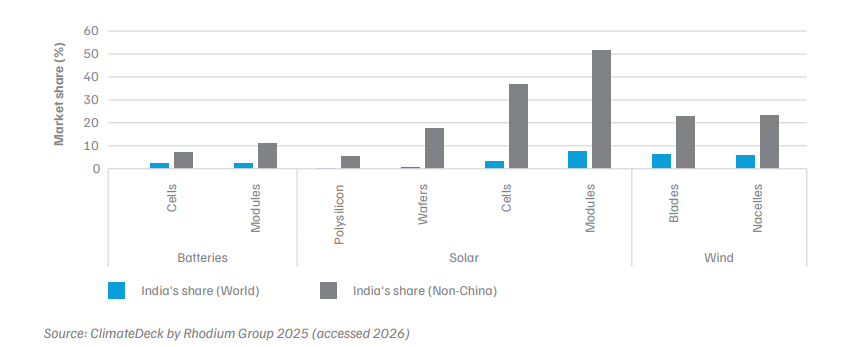
Parallelly, the global demand for clean energy technologies has grown rapidly. Countries are increasingly seeking to secure footholds across clean energy value chains (CEVCs), not only to accelerate decarbonisation, but also to strengthen economic and strategic resilience (CSIS 2022). Since 2018, China, the United States, and the European Union have together accounted for nearly 86 per cent of global clean technology manufacturing investment (BjerkanWade et al. 2026). In this competitive landscape, India’s next phase of growth will depend on whether it can expand its foothold towards complex intermediate products, where required manufacturing knowhow, scale economies, and incumbent advantages remain significantly higher. Success in scaling the value chain as per 2030 targets could position India as one of the most significant manufacturers in the non-China market (Figure ES1).
While the opportunity is real, success is not automatic. Becoming a significant manufacturing hub in upstream and midstream segments requires a more expansive set of capabilities in manpower, materials, and machinery. A substantial body of research highlights that countries tend to move into products requiring similar productive knowledge, supplier ecosystems, machinery, and skill bases, often referred to as the ‘principle of relatedness’ (Pinheiro 2025; Chen, Poncet and Xiong 2017; Li and Neffke 2024). Understanding these industrial linkages can therefore help shape CEVC industrial policy around foundations that already exist.
Clean energy value chains are deeply interconnected with wider manufacturing ecosystems. Components, materials, and technologies used across CEVCs frequently serve multiple downstream sectors, occupying structurally important nodes within production networks. For instance, ball bearings used in wind turbines are also critical to automotive and industrial machinery industries, while rare earth magnets essential for electric vehicles are equally important for defence and other strategic sectors. As a result, the returns to India’s entry in these value chains, and conversely the costs of exclusion, extend far beyond the energy sector itself. Assessing these linkages for solar PV, wind turbines, and lithium-ion batteries, this paper finds outlines two essential findings:
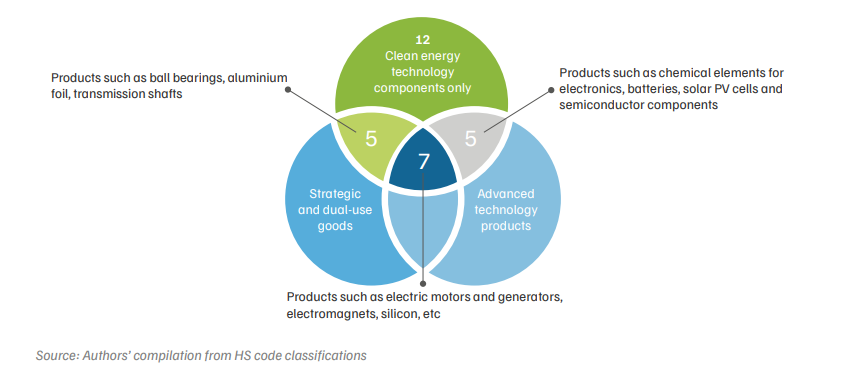
Figure ES2. Overlapping HS classifications indicate that clean energy manufacturing is deeply embedded within broader strategic and industrial ecosystems
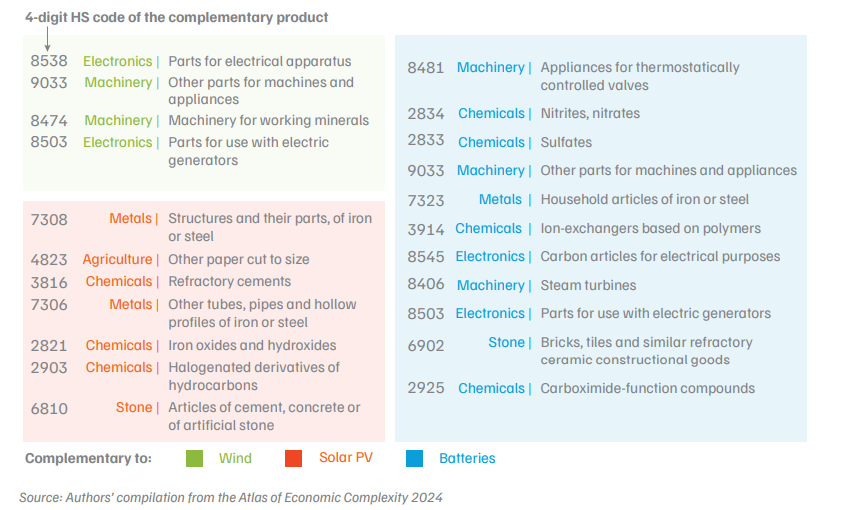
Based on the product space framework developed by the Harvard Growth Lab, this paper maps the linkages between clean energy value chains and India’s existing industrial base (Growth Lab at Harvard 2026). Specifically, it identifies the sectors whose productive capabilities most closely overlap with the requirements of solar PV, wind turbine, and battery manufacturing. Findings suggest that India’s existing strengths in electronics, industrial machinery, metals, chemicals, and precision manufacturing are closely related (Figure ES3). This suggests that several entry points can be built upon capabilities that already exist within the domestic economy. Successful cases show how pre-existing capabilities in related industries are an important enabler—China, Japan, and South Korea consistently dominate multiple clean energy technologies, reflective of underlying strengths in advanced manufacturing and sophisticated chemical production (Net Zero Industrial Policy Lab 2025).
Figure ES3. India’s existing industries feature many competitive product families that can support entry into clean energy manufacturing
At the same time, relatedness metrics should be interpreted as mere signals; they identify where similar capabilities exist, but cannot explain why certain industries have not yet scaled despite apparent alignment with the domestic production structure. Future research should identify different forms of industrial linkages, including shared inputs, capital equipment, labour skills, technical knowledge, and supplier ecosystems, and recognise the bottlenecks constraining their transferability. Mapping these gaps to appropriate policy responses will help accelerate capability diffusion and industrial entry.
The global scale and rationale for industrial policy has evolved; national security, supply chain resilience, and geopolitical positioning now drive intervention in leading economies more than climate-related objectives do (Martín and Evenett 2025). Given India’s ambitions, its approach to the clean energy technology sector has not kept pace with these shifts. The Economic Survey 2025–26 encourages a welcome change in perspective by framing manufacturing capacity as a ‘strategic national asset’. It calls for the state to move beyond its regulatory role and act as a catalyst for structural transformation and technological sovereignty.
Clean energy value chains offer a valuable avenue for translating this vision into practice. Drawing on the analytical findings of this paper, the following implications intend to guide policymakers towards the strategic, institutional, and diagnostic priorities that will shape India’s ability to build globally competitive manufacturing capabilities over the coming decade.
The framework developed in this paper is intended to open a broader diagnostic conversation on industrial strategy. Its relevance extends well beyond clean energy manufacturing: the analytical approach, and the institutional shifts it calls for, are equally applicable to a wider landscape of deep-tech sectors where India’s strategic ambitions increasingly lie.
Complementary industries are established product families that are closely related to a clean energy component, and India already holds a comparative advantage (an RCA of 1 or more) in producing that set of products. Since related products tend to draw on similar skills, machinery, supplier networks, and know-how, firms in these established and related industries are likely to face lower barriers to entering clean energy manufacturing.
Clean energy components are inputs to many other sectors. Bearings, transformers, magnets, semiconductor devices, and graphite products serve automotive, industrial machinery, electronics, and defence value chains as well as energy. Building capability in these products can therefore support industrial upgrading, export competitiveness, and strategic resilience together. The study finds that about 54 per cent of the clean energy value chain products that India does not yet manufacture competitively are linked to advanced technology or strategic and dual-use sectors.
The authors defined clean energy value chain products by their 4-digit HS codes across solar PV, wind turbine, and lithium-ion battery supply chains. For each product, they used the product proximity measure from the Atlas of Economic Complexity to identify the most closely related products. Proximity is based on the probability that countries export two products together.
Proximity indicates where entry is more plausible; it does not rule out strategic bets on less related products. Some clean energy components may be important enough to pursue despite a larger capability gap. Technological change also periodically opens windows in which competitive positions are not yet fixed. The study therefore treats a horizontal, capability-led push as a complement to existing measures and to investment in emerging technologies
Turning these linkages into production means tackling the barriers that keep related firms from making the move: limited information, weak coordination, missing inputs, and institutional gaps. The right response depends on what the linkage is built on. Firms that share inputs or suppliers benefit from industrial clusters and buyer–supplier matching. Shared equipment calls for technology upgradation funds and common facility centres. Shared skills need apprenticeships and reskilling, and shared technical knowledge needs joint ventures, technology licensing, and research support. Coordination across ministries and states, and industrial data that can track emerging sectors, will help direct these measures to the right firms.
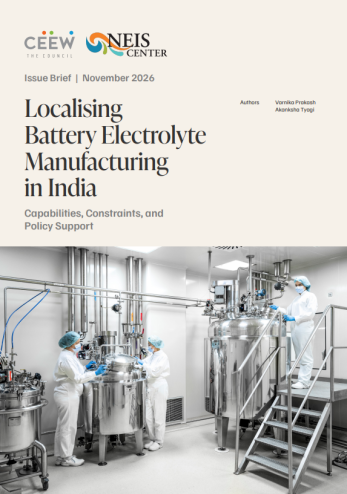
Localising Battery Electrolyte Manufacturing in India
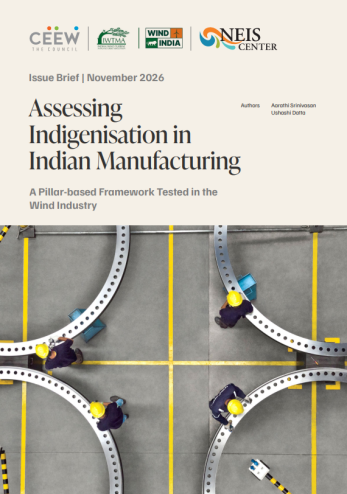
Assessing Indigenisation in Indian Manufacturing
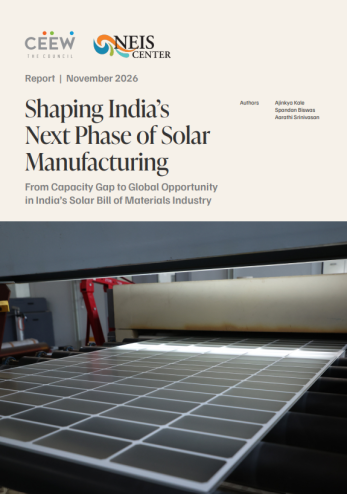
Shaping India’s Next Phase of Solar Manufacturing

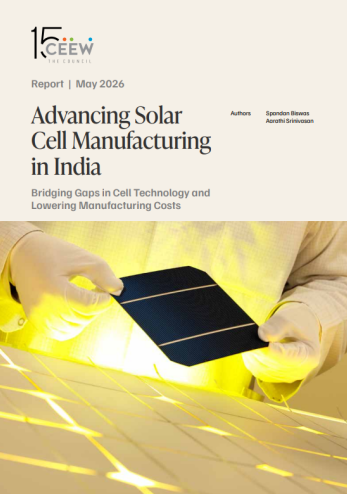
Advancing Solar Cell Manufacturing in India