Council on Energy, Environment and Water Integrated | International | Independent

Suggested Citation: Bagui, Debanjan, Vidyapati Bajpai, Megha Chaudhary, Anuj Hemant Xess, Harshit Pandey, Neha Kumari and Bhawna Tyagi. 2026. Accelerating Distributed Renewable Energy Transition: A Strategic Roadmap for BRICS Cooperation. New Delhi: Council on Energy, Environment and Water.
In 2025, the global power sector reached a major landmark as renewable energy overtook coal for the first time, supplying ~34 per cent of global electricity against coal’s 33 per cent. In this broader shift, distributed renewable energy (DRE) makes a significant contribution, with global distributed solar reaching ~1,200 GW in 2025, more than 40 per cent of total installed solar capacity. Though distributed systems were initially treated as an instrument to provide energy access for remote areas, the conversation has shifted to DRE being strategic infrastructure to improve energy security, grid flexibility, and demand-side decarbonisation. For BRICS, which spans four continents and comprises eleven members, the Roadmap for BRICS Energy Cooperation 2025–2030 explicitly identified DRE as a priority for the first time.
Against this backdrop, this report explores how DRE uptake has evolved across BRICS. It draws on a review of literature, policy and regulatory documents, and secondary data. It assesses the five original members in depth and gives a brief overview of the six newer members. It maps the key drivers of deployment, the policy and regulatory landscape, market maturity and compensation mechanisms, and forward plans. Based on this, it identifies an indicative roadmap for collaboration to accelerate the next phase of DRE growth.
The global power sector reached a major landmark in 2025. Renewable energy (RE) overtook coal marginally for the first time, supplying ~34 per cent of the global total electricity against coal’s 33 per cent (EMBER 2026a). Total deployed RE capacity has crossed 5,000 GW (IRENA 2026). Solar and wind contribute the majority to that (~70 per cent). The recent conflict in the Middle East further exposed the vulnerability of import dependency across the countries and highlights the importance of diversifying the electricity mix. In this broader shift, distributed renewable energy (DRE)1 makes a significant contribution, especially solar. In 2025, global distributed solar reached ~1,200 GW of capacity, contributing more than 40 per cent of total installed solar capacity (IEAPVPS 2026).
Though distributed systems were initially treated as an instrument to provide energy access for remote areas, over time, the conversation has shifted to DRE being strategic infrastructure to improve energy security, grid flexibility, and demand-side decarbonisation. It complements utility scale solar by reducing transmission losses and enabling faster deployment. Beyond immediate outcomes, DRE also creates economic opportunities, supports livelihoods, and fosters an entire green economy around it.
Spanning over four continents and eleven members2 , BRICS provides a strong foundation for scaling DRE, bringing together diverse markets, skilled workforce, abundant resources, and technological capabilities. This report aims to explore how DRE uptake has evolved across BRICS, based on a review of literature, policy and regulatory documents, and secondary data. It maps the key drivers of deployment, policy and regulatory landscape, market maturity and compensation mechanisms, and forward plans to identify an indicative roadmap for collaboration, to accelerate the next phase of DRE growth.
Since its first-ever summit in 2009, energy cooperation has been identified as a key area of BRICS collaboration. Member countries acknowledged the need to diversify energy resources, supplies, and transit routes to reduce market uncertainty, and to cooperate on improving energy efficiency (BRICS 2009). In 2015, energy was formally acknowledged as one of the core pillars of BRICS’s economic partnership. This was followed by the establishment of the Energy Research Cooperation Platform (ERCP) in 2018, which reinforced the importance of advancing energy transitions and the implementation of sustainable development goals (BRICS 2025a). However, DRE has not been explicitly part of it until 2025. The Roadmap for BRICS Energy Cooperation 2025–2030, adopted in May 2025 under Brazil’s presidency, marked an important shift by explicitly identifying DRE as a priority under the broader RE thematic area for the first time (BRICS 2025b). The group identified DRE as a critical instrument for expanding affordable and reliable energy access, particularly in remote and underserved regions, and enabling an equitable and affordable energy transition (BRICS 2025c). In 2026, the BRICS Energy Ministers’ Meeting launched the BRICS Digital Centre of Excellence for Smart Grids and Energy Storage to strengthen cooperation among BRICS nations on grid modernisation, power system resilience, renewable energy integration, and improved energy access through digital technologies (PIB 2026f).
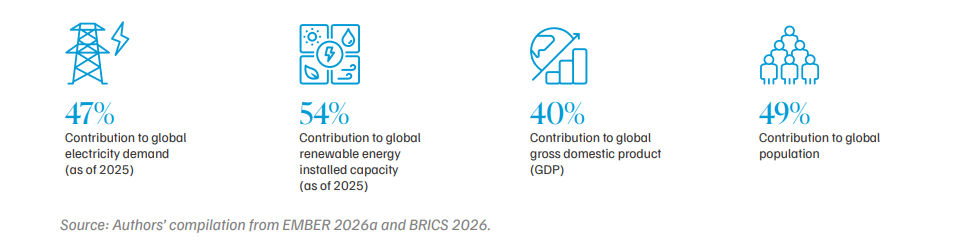
With DRE now explicitly recognised as a priority, considering the group’s substantial economic, demographic, and energy footprint (Figure ES1), BRICS is well positioned to play an important role in strengthening global cooperation on the energy transition (BRICS 2026, EMBER 2026a).
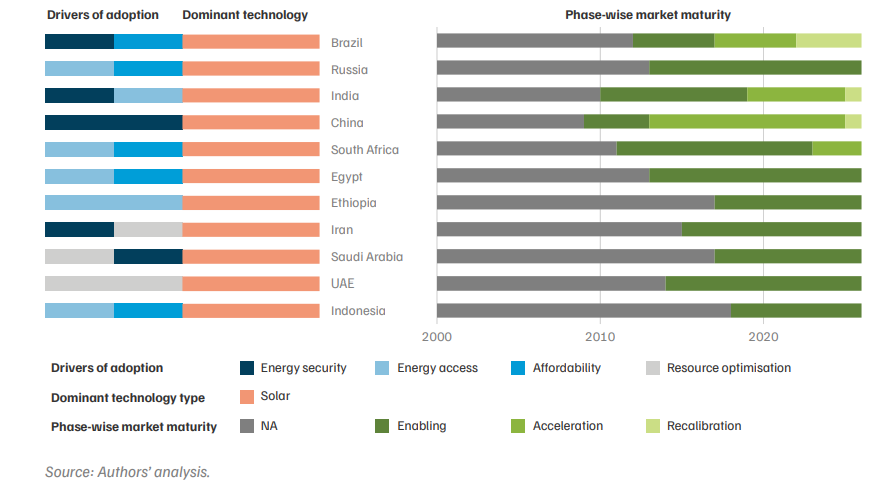
A review of the DRE landscape across BRICS indicates that countries have adopted distributed renewables in response to different national priorities. Four broad pathways emerge (Figure ES2).
Energy security and diversification: In Brazil, China, India, and Iran, DRE has emerged primarily as a response to energy security concerns, and the need to diversify the power sector. However, the underlying drivers differ across these markets—successive droughts and hydrological risks have increased the value of distributed resources in Brazil; coal dependence and the need to absorb growing domestic manufacturing capacity have supported DRE expansion in China; rising electricity demand and import dependence have strengthened the case for DRE in India; and a widening gap between electricity demand and available generation capacity has driven adoption in Iran.
Energy access and remote electrification: In Ethiopia, Indonesia, and Russia, DRE has been driven more by the need to extend energy access to remote and underserved populations where grid connectivity is limited or absent. These challenges reflect the specific geographic and infrastructure constraints of each country, including Ethiopia’s substantial electrification deficit, Indonesia’s dispersed archipelagic geography, and Russia’s isolated northern communities that are difficult to connect to the main grid.
Reliability, affordability, and energy access: South Africa and Egypt represent a third pathway, where DRE adoption has been shaped by a combination of reliability, affordability, and energy access concerns. In South Africa, prolonged load shedding and high retail-electricity tariffs have strengthened the case for distributed generation, while in Egypt, subsidy removal and successive tariff increases have improved the economics of DRE.
System efficiency and resource optimisation: Saudi Arabia and the United Arab Emirates (UAE) form a distinct group, where the adoption of DRE is being pursued primarily to improve system efficiency and reduce reliance on fossil fuels (oil and natural gas) in the domestic power sector.
Figure ES1. Only three BRICS countries—Brazil, India, and China—have achieved mature distributed renewable markets
The diversity of experiences across BRICS provides a basis for cooperation that can complement national efforts to scale distributed renewables. With DRE now explicitly recognised as a priority within BRICS energy cooperation, the group has an opportunity to build on existing institutional mechanisms and translate this recognition into practical areas of collaboration.
Three considerations particularly strengthen the case for such cooperation. First, BRICS members are at different stages of the DRE journey, creating a strong opportunity for cross-country exchange of learning. Countries such as Brazil, China, and India have already a matured market, while several newer members are still establishing their markets. This diversity creates an opportunity for structured knowledge exchange, with insights and best practices from leading economies providing a valuable roadmap for others to develop the DRE market.
Second, the next generation of DRE challenges is common across the group—grid integration and flexibility, demand aggregation, compensation mechanisms, financing, and consumer affordability are emerging priorities across member countries. These challenges create scope for joint work on technologies, business models, standards, financing mechanisms, and regulatory approaches, rather than each country developing solutions independently.
Third, BRICS brings complementary capabilities4 that can be leveraged collectively. China offers manufacturing scale, India has experience in digitally enabled mass deployment, Brazil brings experience from an equitable energy accounting regulatory framework, South Africa has developed innovative market arrangements, and Russia has experience with hybrid systems for remote communities. Connecting these capabilities can help countries accelerate deployment while adapting solutions to their own contexts.
A common roadmap for BRICS cooperation can help translate these complementary strengths and shared priorities into a structured agenda for action, enabling members to accelerate and scale DRE while accounting for their diverse national contexts.
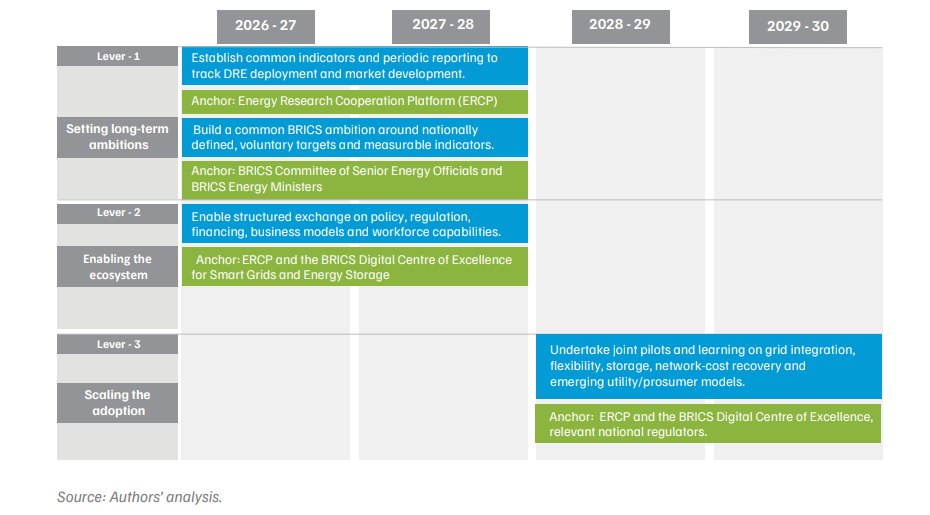
Developing a distributed renewables market rests on three foundations: a shared long-term ambition, an enabling ecosystem, and measures to scale as the sector matures (Figure ES3). The proposed roadmap sets out four action items. Each action leverages existing institutional mechanisms, areas of cooperation, and knowledge-exchange platforms, rather than creating new bodies. Progress is periodically reviewed through a biennial peer-review process that mirrors the group’s established cycle.
Setting shared long-term ambition and measuring progress
Institutional anchor: ERCP
Key deliverables: Common DRE indicators; shared data repository; periodic BRICS DRE data report.
Institutional anchor: BRICS Committee of Senior Energy Officials and BRICS Energy Ministers.
Key deliverables: Shared DRE ambition; common indicators for tracking progress; biennial peer review.
Enabling the ecosystem through knowledge exchange
Institutional anchor: ERCP and the BRICS Digital Centre of Excellence for Smart Grids and Energy Storage, with relevant BRICS knowledge and skilling platforms.
Key deliverables: Knowledge exchange programme; training and practitioner exchanges; workforce skilling and certification initiatives.
Scaling the adoption
Institutional anchor: ERCP and the BRICS Digital Centre of Excellence for Smart Grids and Energy Storage, working with relevant national regulators, utilities, and other institutions.
Key deliverables: Joint pilots; shared learning agenda; practical recommendations and implementation lessons.
The four proposed actions need not be rolled out sequentially. Actions 1 and 3, focused on measurement, knowledge exchange, and skilling, are foundational and can begin immediately in 2026. Action 2, which defines the shared ambition, should follow once the first joint data report is available, since a target that cannot be measured cannot be meaningfully reviewed. Action 4, meanwhile, should be triggered as DRE penetration rises and members begin to face deeper system-integration challenges.
Figure ES2. A four-step indicative roadmap to accelerate distributed renewables uptake among BRICS countries (2026–30)
DRE refers to renewable energy systems located close to the point of electricity consumption and typically connected to the distribution network or operating off-grid. However, the definition and maximum capacity threshold used to classify a system as DRE may vary across countries, depending on national policies and regulatory frameworks.
BRICS comprises five original members: Brazil, Russia, India, China, and South Africa (joined in 2011); six new members: Egypt, Ethiopia, Iran, Saudi Arabia, the United Arab Emirates, and Indonesia. Additionally, BRICS has ten partner countries: Belarus, Bolivia, Cuba, Kazakhstan, Malaysia, Nigeria, Thailand, Uganda, Uzbekistan, and Vietnam.
BRICS countries have adopted distributed renewable energy (DRE) along four broad pathways, each shaped by national priorities. Brazil, China, India and Iran have pursued it for energy security and diversification, while Ethiopia, Indonesia and Russia have used it to reach remote and underserved populations. Concerns about reliability and affordability have driven adoption in South Africa and Egypt. Saudi Arabia and the UAE aim to improve system efficiency and cut domestic oil and gas use.
As DRE penetration rises, members face common challenges in grid integration, distribution-level flexibility, network cost recovery, and lost utility revenue. Several countries are already responding. Brazil revised its rules in 2022 to introduce network charges for new DRE consumers, China phased out guaranteed feed-in tariffs from June 2025, and India and South Africa are moving towards cost-reflective tariffs and distributed storage.
BRICS members are at different stages of DRE deployment. Brazil, China and India have mature markets, while several newer members are still building theirs. Members also bring complementary strengths: China’s manufacturing scale, India’s digitally enabled mass deployment, Brazil’s regulatory design, South Africa’s market arrangements and Russia’s hybrid systems for remote communities. Working together allows members to adapt proven approaches rather than develop them independently.
Maximising Rooftop Solar Performance by Enabling a Robust O&M Ecosystem
What Drives Rooftop Solar Installation Decisions in Indian Homes?
Building a People-centric Energy Future:
Roadmap of the methodology to assess the climate co-benefits of the SUP ban in Tamil Nadu