Council on Energy, Environment and Water Integrated | International | Independent

Suggested Citation: Vaid, Shubhi, Kavya Muthukrishnan, Ritika Sen, and Seshadri Raghavan. 2026. Erode Freight Decarbonisation Roadmap. New Delhi: Council on Energy, Environment and Water
Road carries about 70 per cent of India’s freight (NITI Aayog 2021). Medium- and heavy-duty trucks (MHDTs) are about 3 per cent of vehicles but account for 53 per cent of transport-related particulate matter emissions (NITI Aayog 2022). Erode, a major textile and agricultural logistics hub contributing about 3 per cent of Tamil Nadu’s GSDP, has a freight fleet that is almost entirely diesel-run, and its freight emissions and decarbonisation pathways remain unquantified.
This study builds a district-level freight decarbonisation framework for Erode, supported by the UK PACT programme. It combines primary surveys of over 2,500 vehicle operators and drivers with VAHAN registration records and industrial cluster mapping. Emissions are estimated using a Global Protocol for Community-Scale GHG Emission Inventories (GPC)-compliant framework and projected to 2045 under three scenarios: business as usual (BAU), a fossil-based fuel transition (diesel, CNG/LNG and biodiesel), and electrification. The study also estimates electricity demand and the number and location of charging points needed, and sets out a phased 2025–45 roadmap of regulatory, planning, financing, data and state-level measures.
The study recommends a phased roadmap that starts with LCV electrification, then extends to MDTs through regional hubs and industrial corridors, and finally to HDTs supported by high-capacity charging along strategic corridors. Key measures include a city logistics plan; peak-hour restrictions on diesel trucks with EV exemptions; EV-only municipal fleets; land reserved for charging in the master plan; targeted financing for fleet operators; and data-sharing among RTOs, TNPDCL, and SIPCOT/SIDCO. At state level, it calls for extending EV incentives to electric MDTs and HDTs.
India’s logistics sector accounts for approximately 5 per cent of the country’s gross domestic product (GDP) and handles approximately 4.6 billion tonnes of goods annually, 70 per cent of which is transported by road (NITI Aayog 2021). While medium- and heavy-duty trucks (MHDTs) constitute approximately 3 per cent of the total vehicle fleet, they disproportionately account for 53 per cent of transport-related particulate matter emissions (NITI Aayog 2022). Without targeted interventions, road freight emissions are projected to double from the approximately 400 million tonnes (Mt) of carbon dioxide (CO2 ) in 2025 to 800 Mt by 2050 (NITI Aayog 2022; Mohan et al. 2025a). This underscores the need for rapid decarbonisation to meet India’s commitments to reduce the carbon intensity of its economy by 45 per cent by 2030 from 2005 levels and reach net-zero emissions by 2070 (GoI 2026).
Tamil Nadu, one of the country’s largest freight activity–generating states (CEED 2025), has introduced logistics and electric vehicle (EV) policies in 2023 to accelerate the transition towards cleaner freight transport (GoTN 2023a, 2023b). Within the state, Erode is a major textile and agricultural logistics hub and contributes approximately three per cent of Tamil Nadu’s gross state domestic product (GSDP) (DES 2024). However, approximately 99 per cent of its MHDT fleet runs on diesel (VAHAN 2026), while the city’s freight emissions profile and decarbonisation pathways remain unquantified. This highlights the need for evidence-based planning and policy interventions towards urban planning and sustainable mobility.
To address this gap, we have developed a comprehensive freight decarbonisation framework for Erode district to identify technology pathways and policy interventions that can support the transition towards low-emission freight transport. It evaluates the existing freight fleet and its operational characteristics to assess the feasibility of alternative fuel pathways, including natural gas, biodiesel, and electricity. In this study, we have quantified the incremental electricity demand associated with freight electrification and identified the spatial and operational requirements for EV charging infrastructure to support the transition.
Primary surveys were conducted across Erode district and major freight corridors within the district, covering 2,500 samples of vehicle operators and drivers. The surveys captured vehicle operational characteristics, commodity movements, and trip patterns. The primary data were integrated with secondary datasets, including VAHAN registration records and industrial cluster mapping across Erode district.
Erode’s freight decarbonisation challenges include diesel dependence, an ageing fleet, diverse ownership and operating patterns, and cross-boundary freight movements. Effective interventions must therefore account for vehicle-level electrification readiness, trip requirements and charging infrastructure availability. The following summary presents key findings on emissions, fueltransition pathways, electrification potential and charging infrastructure priorities.
| What are Erode’s district emissions in 2025? | Which fuel-transition pathway offers the greatest emissions reduction? | What is the emissions reduction potential by 2045? | How much infrastructure will be needed by 2045? |
|---|---|---|---|
| 252 ktCO2e | EV > compressed natural gas (CNG)/ liquefied natural gas (LNG) > biodiesel | 44% emissions reduction under the electrification scenario | Number of chargers required (~3,200 under low utilisation or ~1,600 under high utilisation) |
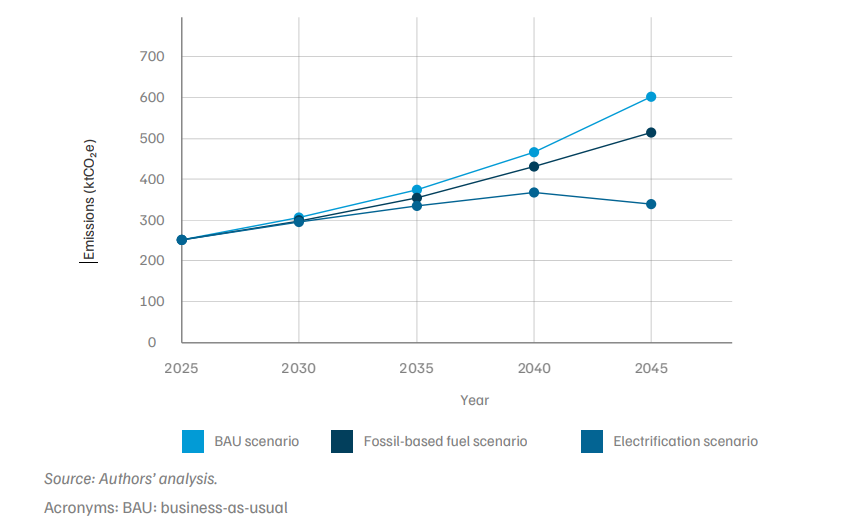
Freight transport in Erode emitted 252 kilotonnes of carbon dioxide equivalent (ktCO2e) in 2025, with HDTs accounting for the largest share (51 per cent), followed by LCVs (36 per cent) and MDTs (13 per cent). Without policy intervention, freight emissions are projected to increase nearly two-and-a-half times to 601 ktCO2e by 2045, highlighting the need for accelerated adoption of low-carbon technologies.
Based on the 2025–26 survey:
Figure ES1. LCVs exhibit the highest near-term electrification feasibility, with 58% of vehicles’ daily driving distance well within the range of current EV model offerings
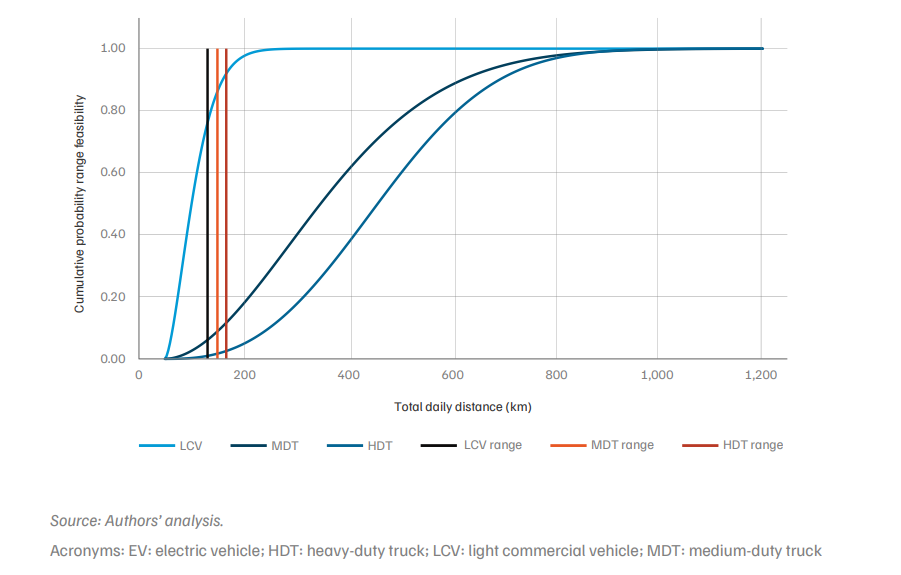
Figure ES2. By 2045, the fossil-based fuel and electrification scenarios achieve emission reductions of 14% and 44%, respectively, relative to the BAU scenario
State Industries Promotion Corporation of Tamil Nadu (SIPCOT) Perundurai, SIPCOT Ingur, Small Industries Development Corporation (SIDCO) Erode, SIDCO Uthukuli, Pallavada Textile Park, Bhavani, Chithode, and the Erode–Perundurai and Erode–Bhavani corridors emerge as priority locations for the phased deployment of freight EV charging infrastructure, supporting both urban inter-/intra-city logistics and regional or corridor freight movement.
Figure ES3. Origin–destination (OD) clusters for freight trips overlaid with major industrial estates and freight hubs in Erode district
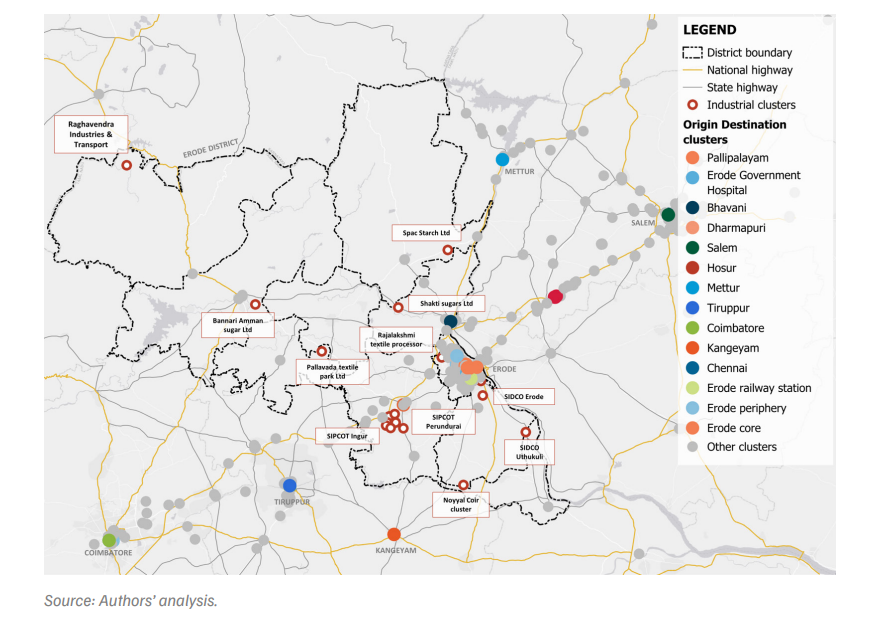
Based on the findings, the phased freight decarbonisation roadmap (2025–45) recommends technology adoption based on vehicle operating characteristics, infrastructure adequacy, and institutional capacity. It prioritises LCV electrification in the near term, leveraging the high operational compatibility of LCVs with current EV technologies and their use in urban freight operations. As charging infrastructure and vehicle technologies mature, the transition expands to MDTs through regional logistics hubs and industrial corridors, followed by HDTs supported by high-capacity charging infrastructure along strategic freight corridors and at truck terminals.
The roadmap combines fleet transition, charging infrastructure deployment, freight planning, financing, regulatory measures, and institutional coordination to ensure that investments align with technology maturity and freight demand. The key recommendations and their implementation timelines are summarised in Table ES1.
Table ES1. Phased freight decarbonisation roadmap (2025–45)
| S. no. | Recommendations | Near-term (2025–30) |
Medium-term (2030–35) |
Long-term (2035–45) |
|---|---|---|---|---|
| A. | Regulatory levers | |||
| 1. | Increase the core-area boundary for entry- and exit-time-based restrictions for diesel trucks during peak hours; exempt EVs from entry/exit restrictions | |||
| 2. | Restrict entry/exit of diesel-based LCVs during peak traffic hours in the city; exempt EVs from entry/exit restrictions | |||
| 3. | Introduce congestion pricing measures and progressively incorporate environmental performance standards into freight access management | |||
| B. | Urban planning and land-use integration | |||
| 1. | Prepare a comprehensive city logistics plan (CLP) for Erode city in coordination with nearby districts | |||
| 2. | Procure only EVs for municipal fleets | |||
| 3. | Relocate warehouses/godowns from the core city and railway yard to SIPCOT industrial estates; proposed truck depot at Perundurai Road and textile parks | |||
| 4. | Plan for load consolidation for agricultural and textile commodity flows at periphery terminals (Perundurai, Kongampalayam/Chithode) to improve freight movement efficiency and avoid empty trips | |||
| 5. | Establish dedicated loading/unloading bays at Erode Central Market and Gani Market and impose a penalty on vehicles parked illegally on roads | |||
| 6. | Reserve land at existing and proposed private/public truck depots/terminals and industrial clusters for EV charging infrastructure in the master plan (MP) and comprehensive mobility plan (CMP) | |||
| 7. | Prioritise areas near SIPCOT Perundurai, SIPCOT Ingur, Pallavada Textile Park, NH544, NH948, and NH381A for setting up group captive solar energy models | |||
| S. no. | Recommendations | Near-term (2025–30) |
Medium-term (2030–35) |
Long-term (2035–45) |
|---|---|---|---|---|
| C. | Behavioural interventions | |||
| 1. | Promote and explore opportunities for small-scale proof-of-concept pilot electric LCVs/medium- and heavy-duty trucks (MHDTs) with fleet operators/third-party logistics owners and subsequently scale up | |||
| D. | Financing mechanisms | |||
| 1. | For LCVs, channelise financing through fleet operators and leasing companies, using aggregated procurement, concessional credit, and battery-financing models to reduce upfront costs | |||
| 2. | For MHDTs, de-risk early-stage adoption through limited credit guarantees, original equipment manufacturer (OEM) warranties, and secured route-level charging, enabling lenders to scale financing as operating performance is demonstrated | |||
| 3. | Prioritise financing based on the dominant commodities transported in Erode, such as agricultural produce, textiles, and fast-moving consumer goods (FMCG) | |||
| 4. | Embed electrification within industrial estate lease policies to accelerate fleet electrification | |||
| E. | Data-driven decision-making and monitoring | |||
| 1. | Develop formal data-sharing agreements between regional transport offices (RTOs), Tamil Nadu Power Distribution Corporation Limited (TNPDCL), SIPCOT/SIDCO to better understand truck movement patterns and stakeholder expectations, such as those of forwarders, shippers and LSPs. | |||
| F. | State and central government support | |||
| 1. | Mobilise state-level financial support through domestic and international institutions such as the Tamil Nadu Green Climate Fund (TNGCF), Urban Challenge Fund, and the World Bank | |||
| 2. | Ensure TNPDCL plans for freight electricity demand of 1011 MWh/day by 2045 | |||
Source: Authors’ analysis
More than 80 per cent of LCV, MDT and HDT trips cross municipal boundaries, so a city-only boundary would understate where freight vehicles operate and emit. Major industrial clusters, such as the SIPCOT estates, lie outside the municipal limits, and most public datasets are organised at the district or RTO level.
LCVs, which mainly serve urban and last-mile freight. For LCV operators, the main constraints are awareness, battery concerns and upfront cost; for MDT and HDT operators, they are charging infrastructure, vehicle range, electricity costs and financing.
A phased 2025–45 sequence: LCVs first, then MDTs via regional hubs and industrial corridors, then HDTs supported by high-capacity charging on strategic corridors and at truck terminals. Measures include a city logistics plan, EV-only municipal fleet procurement, reserving land for charging in the master plan and comprehensive mobility plan, targeted financing, data-sharing among RTOs, TNPDCL and SIPCOT/SIDCO, and state support.
The report finds it supportive but partial. Gaps include limited state support for electric MDTs and HDTs, no freight-specific charging targets at industrial nodes, no grid framework for high-load depot charging, and no state freight financing linked to scrappage.
Microbuses have Mega Demand in Indian Cities
E-Bus Route and Service Planning in Emerging Public Transport Cities
Are Microbuses Suitable as Public Transport Vehicles?
Greenhouse Gas Accounting for On-road Transport Emissions