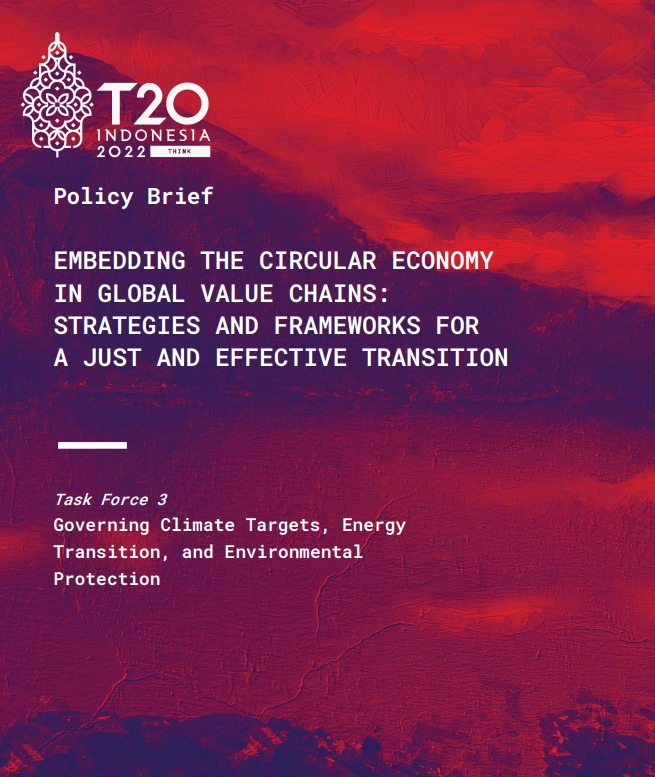
Policy Brief
Embedding the circular economy in global value chains
Kirana Agustina, Venkatachalam Anbumozhi, Romadhani Ardi, Nicolas Buchoud, Milindo Chakrabarti, Alexander Charalambous, Alex Godoy-Faúndez, Yasuhiko Hotta, Martin Kochhan, Konstantinos Karampourniotis, Rainer Lanz, Vesna Lavtižar, Hemant Mallya, Nam Hoang
September 2022 | International Cooperation
Overview
Global production networks are confronting a severe sustainability mismatch as linear growth outpaces the planet’s planetary boundaries. Driven by expanding populations and economic output, global resource consumption is projected to double by 2060, yet less than nine per cent of extracted materials are currently cycled back into production. This systemic linear bias acts as a major driver of environmental degradation, accounting for roughly 70 per cent of global greenhouse gas emissions through material processing and handling alone. This policy brief examines how the G20 can bridge this gap, arguing that curbing raw material extraction and hitting climate targets requires deep integration of circular economy principles directly into global value chains.
What is often overlooked in traditional green growth strategies is that international supply chains remain predominantly governed by localized monetary costs and comparative advantages rather than end-to-end resource efficiency. Consequently, structural fragments have emerged between the Global North and the Global South—manifested in a distinct chemical safety divide, inadequate product end-of-use infrastructure in developing countries, and disparate, Western-centric ESG methodologies that penalise emerging markets. To achieve an equitable transition, global circular frameworks must look beyond isolated domestic solutions and establish synchronized cross-border standards that account for the unique geographical and developmental priorities of the Global South.
Against this backdrop, the authors outline an eight-point policy architecture designed to migrate global trade from linear consumption to closed-loop resilience. The proposed framework hinges on establishing harmonized circular design metrics, aligning international trade and investment policies through the WTO, and blending public-private capital to de-risk long-term circular financing. Ultimately, the brief urges G20 leaders to advance beyond voluntary individual behavioral changes. Instead, they must actively anchor a just transition by codifying globally uniform ESG scoring, setting up robust Extended Producer Responsibility (EPR) standards, and creating a unified platform for cross-border policy learning.
Key Highlights
- Transitioning global value chains to circular models is critical for climate mitigation, as material handling and resource use account for roughly 70 percent of all global greenhouse gas emissions.
- The paper highlights a critical stagnation in resource efficiency, noting that less than 9 percent of raw materials extracted globally are ever cycled back into production.
- G20 members should incentivize the upstream circular design of products to prioritize material longevity, ease of repairability, and recyclability right from the manufacturing stage.
- The World Trade Organization should actively modernize international trade and investment policies to support the cross-border movement of circular goods, waste scraps, and secondary raw materials.
- Financial institutions need to dramatically scale up circular finance and harmonize taxonomies, as capital allocation for circular value chains remains critically low compared to traditional linear models.
- The transition requires implementing a robust "just transition" framework to protect vulnerable workers and ensure that the economic benefits of circular business models do not accumulate solely in the Global North at the expense of the Global South.
- Developing nations must be supported in adopting digital tracking tools, such as digital material passports and eco-labeling databases, to properly measure and valorize their contributions to global circularity.
- Best practice guidelines and specialized knowledge-sharing platforms must be established to reduce the digital divide and aid small and medium enterprises that lack massive research budgets.
Circular economy finance can be de-risked and expanded by making it an 'opt-out' rather than an 'opt-in' through policies, standard-setting, and fiscal interventions that nudge banking institutions towards sustainable investment decisions.