Policy Brief
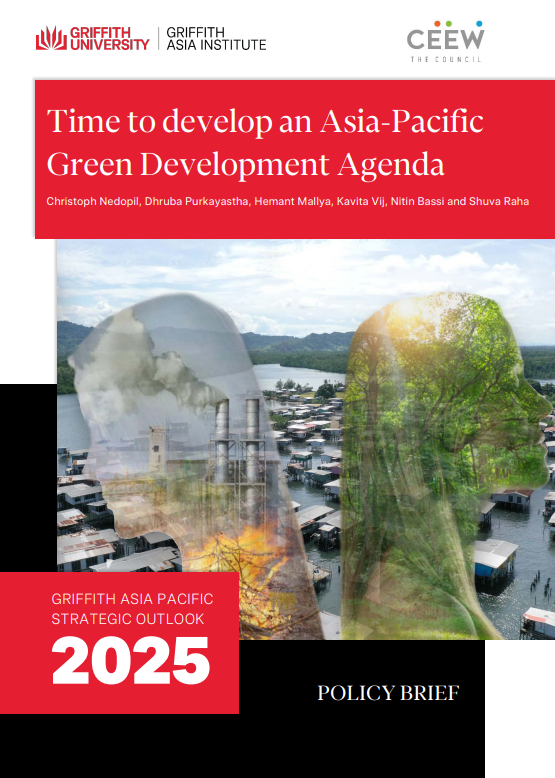
Time to develop an Asia-Pacific Green Development Agenda
Shuva Raha
January 2026 | International Cooperation
Suggested citation: Nedopil C, Purkayastha D, Mallya H, Vij K, Bassi N and Raha S, “Time to develop an Asia-Pacific Green Development Agenda”, Griffith Asia Pacific Strategic Outlook 2025, Griffith Asia Institute, Queensland, Australia, DOI: 10.25904/1912/578
Overview
The Asia-Pacific region stands at a critical juncture as it bears the brunt of a global climate breakdown, with record temperatures and escalating natural disasters threatening both lives and livelihoods. Despite the region housing 50 per cent of the world's most climate-vulnerable nations, the path to a green transition remains fraught with complexity due to its diverse economic landscape, ranging from industrial giants like China and India to remote Small Island Developing States. Recent geopolitical shifts, including the reversal of environmental policies by major global partners and the stagnation of traditional multilateral climate finance, have created a leadership vacuum. This underscores an urgent need for a bespoke Asia-Pacific Green Development Agenda that prioritises regional independence, tailored subnational approaches, and indigenous solutions to safeguard the planet while fostering economic resilience.
Moving forward, the region must capitalise on its position as a global leader in green technology and renewable energy to turn climate risks into sustainable growth opportunities. Accelerating industrial decarbonisation, securing critical mineral supply chains, and formalising robust carbon trading markets are essential steps to unlocking trillions in economic value and creating millions of green jobs. By fostering technological alliances and strengthening regional financial cooperation, Asia-Pacific economies can move beyond a reliance on external aid and establish a self-determined roadmap for a just transition. This agenda is not merely an environmental necessity but a strategic economic imperative to ensure long-term competitiveness and stability in an increasingly volatile global landscape.
Key Highlights
- The Asia-Pacific region bears the severe brunt of global climate breakdown, with half of the world's most vulnerable countries located in this area. Significant baseline risks are clear, such as in India, where nearly 93% of days in 2024 were hit by extreme weather events like intense heatwaves, devastating cyclones, and widespread floods.
- The region faces a complex green transition dilemma as countries continue to approve and construct new fossil fuel infrastructure. For example, China approved 66.7 GW of new coal-fired power plants in 2024, despite simultaneously installing a staggering 400 GW of new wind and solar capacity since 2023.
- To effectively address both climate mitigation and biodiversity preservation, the region requires a massive financial scaling up. Investment needs are estimated at USD 7.4 trillion for climate action and USD 1 trillion for biodiversity, though unlocking these nature-positive opportunities could generate USD 4.3 trillion in annual economic value and add 232 million jobs.
- Great power competition and shifting political climates present persistent challenges to regional clean energy progress. Volatile external dynamics, notably inconsistent policy positions and aid reversals from traditional global partners like the United States and the European Union, threaten to disrupt steady funding, technology access, and supply chains.
- Experts urge Asia-Pacific economies to fortify their climate independence through collaborative, sub-national frameworks rather than relying entirely on slow-moving global treaties. Crucial recommendations include forming cross-border technology alliances, building harmonized carbon markets under Article 6 of the Paris Agreement, and expanding nature-based solutions like wetland and watershed restoration.
The EU’s introduction of unilateral green trade measures such as the Carbon Border Adjustment Mechanism (CBAM) or Deforestation Regulation... are already impacting emerging economies in Asia. Leaders in Asia-Pacific must prepare for a future where access to Western markets is increasingly conditioned on meeting stringent environmental standards.