Paper
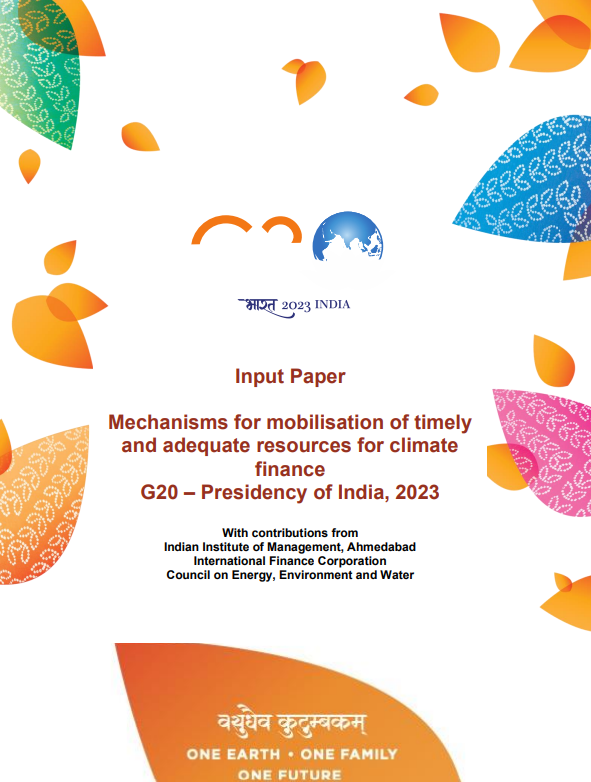
Mechanisms for mobilisation of timely and adequate resources for climate finance G20
Presidency of India, 2023
Indian Institute of Management, Ahmedabad, International Finance Corporation, Council on Energy, Environment and Water (CEEW)
July 2023 | International Cooperation
Overview
As the global community seeks to meet net-zero targets, there is an urgent need to scale climate finance to between USD 4 trillion and USD 6 trillion annually, yet current flows remain inadequate in both volume and type. While the public sector and multilateral development banks (MDBs) play a vital role in direct funding, their most critical function is to act as a catalyst for private capital by deploying strategic public funds to de-risk and unbundle complex green infrastructure projects. By adopting a diverse spectrum of innovative financial instruments—such as multi-tiered structured funds, first-loss capital, and outcome-based sustainability-linked bonds—policymakers can address investor concerns regarding technology risks and long project timelines. Ultimately, establishing a fair and inclusive energy transition requires a shift towards sector-specific financing and enhanced international cooperation to create self-determined, data-driven roadmaps that ensure clean energy remains economically accessible for developing nations.
Key Highlights
- Reaching global net-zero targets requires an estimated USD 4 trillion to USD 6 trillion per year, yet current global climate finance flows remain inadequate in both scale and type.
- Public funds must be used strategically to crowd in private investment by de-risking and unbundling complex green infrastructure projects.
- To address investor concerns over adoption risks and long time horizons, the paper advocates for tools such as multi-tiered structured funds, first-loss capital, and outcome-based sustainability-linked bonds.
- Developing countries often lack the capacity to de-risk investments at scale due to increasing debt vulnerabilities and developmental challenges, necessitating an enhanced role for Multilateral Development Banks (MDBs).
- A Global Clean Investment Risk Mitigation Mechanism is proposed to pool risks across projects and geographies, lowering the risk profile for clean infrastructure initiatives.
- Finance mechanisms and instruments should be tailored to the distinct needs of specific sectors, such as renewable energy and climate-smart agriculture, to attract more private capital.
- MDBs should expand guarantee instruments, channel philanthropic and pension fund capital, and provide technical assistance to build a robust project pipeline
For effective climate action, developed countries (where the majority of global capital is located) and developing countries (where the majority of the growth in demand for energy and materials will occur) must act in concert.