Home
Council on Energy, Environment and Water Integrated | International | Independent

ISSUE BRIEF
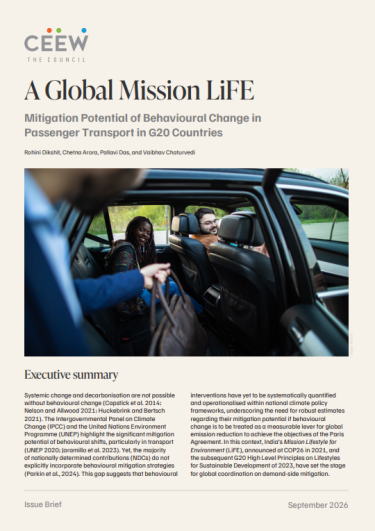
A Global Mission LiFE
Mitigation Potential of Behavioural Change in Passenger Transport in G20 Countries
03 September, 2026 | Low-carbon Economy
Rohini Dikshit, Chetna Arora, Pallavi Das, and Vaibhav Chaturvedi

Suggested Citation: Dikshit, Rohini, Chetna Arora, Pallavi Das, and Vaibhav Chaturvedi. 2026. A Global Mission LiFE: Mitigation Potential of Behavioural Change in Passenger Transport in G20 Countries. New Delhi: Council on Energy, Environment, and Water.
Overview

Behavioural and demand-side change is increasingly recognised in research as a mitigation lever, particularly in passenger transport. Yet, due to the absence of uniform measurement and quantification, it remains largely absent from formal climate policy and from the Nationally Determined Contributions (NDCs) of major economies, even as the IPCC and UNEP underscore its potential. As the G20's emerging economies grow wealthier and more mobile, how their citizens choose to travel will shape a significant share of future emissions.

This study uses the Global Change Analysis Model (GCAM) to quantify the emissions-mitigation potential of three behavioural levers in G20 passenger transport by 2050: hybrid work, shared mobility (carpooling), and higher bus ridership. It groups countries into developing economies and developed economies plus China to reflect the uneven distribution of transport emissions within the G20, and estimates both the carbon savings and the wider co-benefits, including oil savings and freed-up carbon budget.

Key Findings

  • Combined, the three levers could avoid 408–537 MtCO₂ a year from G20 passenger transport in 2050, comparable to South Africa's total annual emissions. Carpooling alone can save around 410 MtCO₂, hybrid work up to 322 MtCO₂, and higher bus ridership up to 53 MtCO₂.
  • The mitigation potential is concentrated in high-emitting economies. Roughly 80–88% of the combined savings sit with developed countries and China, whose per-capita savings potential runs up to four times that of developing economies, reframing behaviour change from a question of individual choice to one of where emissions-intensive lifestyles actually are.
  • Behaviour change delivers benefits with global repercussions. Sustained across the G20, these shifts could free up to 5.7–8 GtCO₂ of carbon space by 2050, amounting to around 5–6% of the world's remaining 1.5°C budget — space that developing economies will need as they grow,
  • The benefits extend to energy security. Between 2025 and 2050, these behavioural shifts could save the G20 around 2715 metric million tonnes of oil, worth $2.3 trillion at April 2026 prices, offering a buffer against the supply and price shocks that periodically strain oil-importing economies.
  • Realising this potential requires deliberate policy. The study recommends institutionalising shared mobility through infrastructure and incentives, sequencing measures to fit each economy's stage of growth, and establishing shared methods through a coordinated G20 effort to measure and verify behavioural emissions savings so they can enter NDCs and national inventories.

HAVE A QUERY?

author image
Programme Associate
"Behaviour change becomes climate policy only when it is supported by enabling systems. Governments, cities, employers, and mobility platforms must make low-carbon choices easier, safer, and measurable. This means embedding hybrid work into organisational practices, formalising carpooling through trusted platforms and workplace incentives, improving bus services and last-mile access, and sequencing policies according to each country's transport realities"

Executive summary

Systemic change and decarbonisation are not possible without behavioural change (Capstick et al. 2014; Nelson and Allwood 2021; Huckebrink and Bertsch 2021). The Intergovernmental Panel on Climate Change (IPCC) and the United Nations Environment Programme (UNEP) highlight the significant mitigation potential of behavioural shifts, particularly in transport (UNEP 2020; Jaramillo et al. 2023). Yet, the majority of nationally determined contributions (NDCs) do not explicitly incorporate behavioural mitigation strategies (Parkin et al., 2024). This gap suggests that behavioural interventions have yet to be systematically quantified and operationalised within national climate policy frameworks, underscoring the need for robust estimates regarding their mitigation potential if behavioural change is to be treated as a measurable lever for global emission reduction to achieve the objectives of the Paris Agreement. In this context, India’s Mission Lifestyle for Environment (LiFE), announced at COP26 in 2021, and the subsequent G20 High Level Principles on Lifestyles for Sustainable Development of 2023, have set the stage for global coordination on demand-side mitigation.

This study estimates the potential for lowering emissions in G20 countries by altering passenger transport behaviour, grouping countries into developing countries and developed countries + China to account for the uneven distribution of emissions within the G20 (UNEP 2025). G20 members account for 84 per cent of the global GDP, 60 per cent of the world’s population (World Bank 2026), and, as of 2024, 78 per cent of the global CO2 emissions (Crippa et al. 2025). Developed nations and China, just 34 per cent of the world’s population, were responsible for over 60 per cent of global road transport emissions that year (Crippa et al. 2025). Motor vehicle ownership follows a similar pattern: 860 per 1,000 people in the USA, 704 in France, 223 in China, and 33 in India (OICA 2024), reflecting how economic levels, infrastructure, and lifestyle shape mobility demand across nations.

This study uses the Global Change Analysis Model (GCAM) V8.2 to model three behavioural interventions in passenger transport: (1) hybrid work, (2) shared mobility, and (3) increased bus ridership, chosen for being system-wide, scalable, easy to quantify, and consistently highlighted in global assessments due to their measurable impacts across diverse national contexts. The scenarios model these levers separately and in combination, recognising that multiple behavioural measures are likely to be pursued concurrently in practice.

Key findings

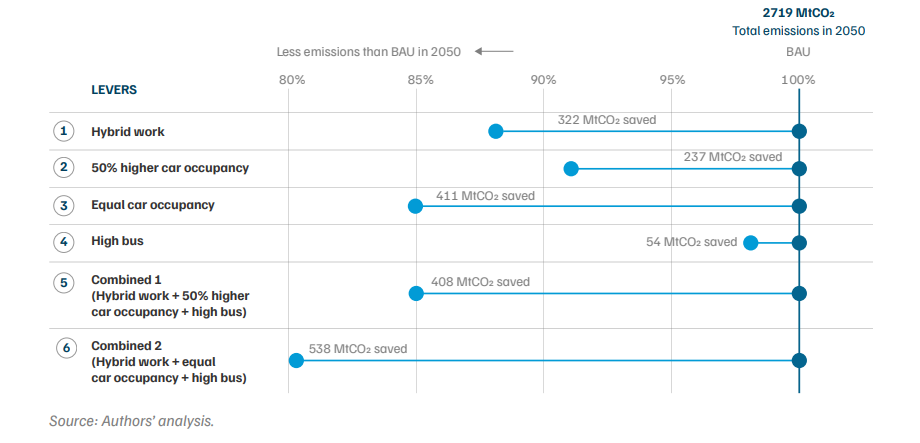
  • Hybrid work can reduce up to 322 million metric tonnes of carbon dioxide (MtCO2) annual emissions in 2050 from passenger transport in G20 countries. This is a 12 per cent reduction against the businessas-usual (BAU), with 65 per cent of it from developed countries plus China, led by China, the USA, and EU-15. In per capita terms, developed countries plus China can save 37 - 150 kgCO2 annually through hybrid work, compared to 32 - 53 kgCO2 in developing economies, reflecting differences in baseline travel demand and reliance on private mobility. While returnto-office mandates have resurged and remote work remains impossible for many primary-sector roles, hybrid work has nonetheless become a substantially more accepted model worldwide (ACCA 2026; CIPD 2025; Gallup 2026; Bloom 2026). Further, in times of oil shocks, remote work mandates have emerged as a popular measure across countries to reduce oil consumption (Gabbatiss 2026).
  • Carpooling can lead to 237 - 411 MtCO2 of emission savings in 2050 across G20 countries, as car usage and emissions are inversely correlated with occupancy. This is heavily skewed towards developed countries plus China (90-92 per cent of savings), which have lower baseline occupancy and higher car ownership — a pattern that holds in both equal car occupancy and 50 per cent higher occupancy.
  • High bus preference yields up to 54 MtCO2 emission savings across G20 countries, demonstrating that even a modest modal shift towards buses produces only measurable emission reductions. While our analysis models a relatively modest shift towards public transport use, CEEW mobility studies have found that real-world policies that combine large modal shifts with a high share of electric vehicles could induce significantly larger emission reductions (Soman et al. 2020). Thus, scaling ridership and decarbonising fleets are most powerful in combination.
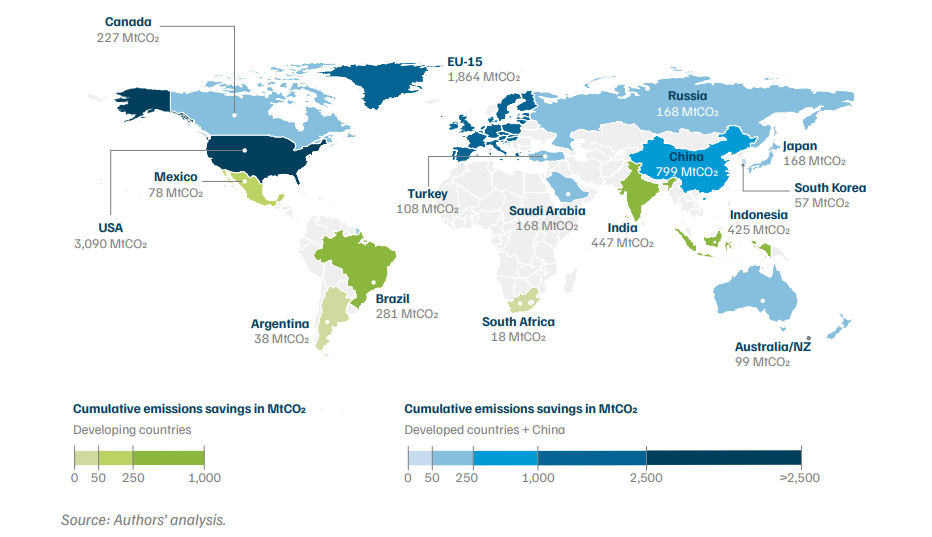
  • The three behavioural levers together can lead to emission savings of 408 - 538 MtCO2 in 2050 from G20 countries— roughly near South Africa's total 2024 emissions (Crippa et al. 2025). About 80-88 per cent of these savings come from developed countries plus China, with the USA and EU-15 contributing 61- 63 per cent; per capita savings potential in developed countries is 2 to 4.2 times higher than in developing countries. Additionally, between 2025 and 2050, behaviour change in G20 member countries can save around 2715 million metric tonnes (MMT) of oil, approximately 59 per cent of the global oil demand in 2024 (IEA 2025b) — worth roughly $2.3 trillion at the average April 2026 oil price (EIA 2026), offering a buffer against oil-supply shocks from geopolitical conflict.
  • From 2025-2050, behaviour change in passenger transport can free up 5.7-8 GtCO2 of carbon budget, a 5 - 6 per cent of the remaining carbon budget for a 1.5°C world. As the majority of savings lie with developed countries plus China, behavioural change there can free up carbon space for emerging economies and hard-to-abate sectors, reinforcing the uneven distribution of responsibility and opportunity within the G20.

Figure ES1. Combined behavioural shifts can reduce G20 passenger transport emissions by 20% in 2050
strenthing-air-emission

Figure ES2. Behavioural change in transport can lead to ~8 GtCO2 of emissions savings in G20 countries between 2025 & 2050 with hybrid work, equal car occupancy, and high bus
strenthing-air-emission

Conclusion and recommendations

Our findings suggest that behavioural interventions can substantially enhance the effectiveness of technological decarbonisation strategies. Whereas measures such as electrification and fuel switching reduce the emissions intensity of transport systems, demand-side interventions reduce the demand for energy-intensive mobility itself. Further, reduction in travel demand can reduce power sector emissions even in a predominantly electric grid. Pursued together, these approaches can accelerate decarbonisation while reducing pressures on energy systems and infrastructure. The results also underscore an equity dimension: countries with the most emissionsintensive mobility patterns, primarily developed countries and China, possess the largest potential for behavioural mitigation, thereby creating opportunities to ease mitigation pressures on emerging economies and hardto-abate sectors. This potential can be unlocked using three key recommendations.

  • As carpooling exhibited the highest emissions reduction potential in our analysis, we recommend that governments and employers institutionalise and formalise carpooling, particularly in developed countries, through highoccupancy vehicle (HOV) lanes (Teodorović and Janić 2017), ride-matching platforms with safety guarantees, preferential parking, congestion charge exemptions, and workplace incentives for shared commuting. National governments can support digital innovation for country-wide ride-matching platforms and public awareness campaigns, while municipal authorities enforce measures such as HOVs and congestion charges. Carpooling has historically seen limited success in developed nations, such as the UK and Australia, due to a combination of structural and behavioural factors, including rising car ownership with increasing incomes (Ferguson 1997), abundant free parking, low fuel prices, concerns around safety and convenience (Hellen 2025), limited ride-matching platforms (Jacka 2026), and the value commuters place on flexibility (Alonso-Gonzalez et al. 2021).
    However, these past challenges should not be interpreted as evidence that carpooling cannot work, but as lessons for improving its institutional design and implementation. As vehicle ownership saturates and cities adopt measures such as congestion pricing and paid parking, shared mobility options may become easier to mainstream, provided they are backed by enabling infrastructure and coordinated action.
  • G20 countries should place the measurement and accounting of the impact of behavioural change on emissions on their climate policy agenda, as a first step to defining international assessment methodologies. The absence of common methodologies for quantifying and verifying their impacts limits their incorporation into NDCs and greenhouse gas inventories. A coordinated effort through the G20 to establish shared assessment approaches could improve comparability, credibility, and policy visibility of demand-side mitigation, helping translate a growing evidence base into formal climate policy instruments.
  • Sequencing of policies to induce behaviour change must account for institutional feasibility and public acceptability across countries. Congestion charges will be more appropriate starting from the short term in developed countries, where car demand has already peaked. Developing countries can prioritise public transport in the short term and bring stringent car regulations in the long term, once viable alternatives are established. Electrification and bus-fleet expansion, however, should proceed in all G20 countries from the short term onwards.
FAQs

Frequently Asked Questions

  • What is behavioural or demand-side mitigation, and why does it matter for transport?

    Behavioural mitigation refers to reducing emissions by changing how people travel — working remotely, sharing vehicles, or shifting to public transport — rather than only by changing vehicle technology. It matters because technology alone may not be enough: as economies grow and travel demand rises, how efficiently people move becomes a significant lever for cutting emissions, particularly in passenger transport, which the IPCC and UNEP both highlight for its demand-side potential.

  • Why does this study focus on hybrid work, carpooling, and bus ridership?

    These three levers were chosen because they are system-wide, scalable, and already part of real-world policy debate, making them practical rather than hypothetical. The study models each individually and in combination, since in practice countries are likely to pursue several at once.

  • How does behavioural change complement technological measures like electric vehicles?

    The two work together rather than in competition. Electrification and cleaner fuels reduce the emissions intensity of each kilometre travelled, while behavioural change reduces the demand for energy-intensive travel, which can lower emissions even in a largely electric fleet and ease pressure on power grids and infrastructure.

  • Why is the mitigation potential greater in developed countries and China than in developing economies?

    Developed economies are where mobility is most emissions-intensive, with higher car ownership, lower vehicle occupancy, and greater travel demand. This means the countries with the most carbon-intensive travel patterns hold the largest opportunity to change them and action there can free up carbon space for developing economies that are still growing.

  • Why isn't behavioural change already reflected in national climate policy?

    Largely because it is difficult to measure. There is no widely agreed method to quantify and verify the emissions avoided through behavioural shifts, so they remain largely absent from Nationally Determined Contributions and greenhouse-gas inventories, despite growing evidence of their potential.
  •  

HAVE A QUERY?

author image
Programme Associate

Sign up for the latest on our pioneering research

Explore Related Publications