Council on Energy, Environment and Water Integrated | International | Independent

Suggested Citation: Vaid, Shubhi, Ritika Sen, and Seshadri Raghavan. 2026. Greenhouse Gas Accounting for On-road Transport Emissions: A Global Protocol for Community-scale Compliant Inventory for Erode. New Delhi: Council on Energy, Environment and Water.
India's transport sector contributes about 14 per cent of national greenhouse gas (GHG) emissions, and on-road transport accounts for roughly 90 per cent of that. Tier-2 and tier-3 cities, where population, vehicle ownership, and freight demand are rising fastest, remain largely absent from this evidence base. Constrained by data availability, technical capacity, and finance, these cities cannot establish an emissions baseline, prioritise mitigation measures, or track progress against state and national commitments.
This study develops a Global Protocol for Community-Scale Greenhouse Gas Emission Inventories (GPC)-compliant accounting framework for on-road transport emissions in Erode Municipal Corporation (EMC), Tamil Nadu, and translates it into an Excel-based GHG calculator and a website version for EMC. The framework adopts a bottom-up, modified production-based method (Activity–Share–Intensity–Emission Factor) at the GPC BASIC+ reporting level, covering Scope 1 tailpipe emissions, Scope 2 emissions from grid electricity used by electric vehicles, and selected Scope 3 emissions such as transboundary trips and transmission and distribution losses. The calculator supports annual inventory updates and scenario modelling to 2045, and is designed to be transferable to other tier-2 and tier-3 Indian cities working with comparable data and institutional capacity.
The study recommends integration of the calculator into comprehensive mobility plans and master plans; targeting high-emission-intensity diesel freight and buses through scrappage-linked incentives and green freight access zones; accelerating electrification across high-volume and public fleet segments; strengthening in-use emissions compliance at city cordon points and through permit-linked Pollution Under Control enforcement; and institutionalising data-sharing arrangements with RTOs, oil marketing companies, and fleet operators.
In India, transport sector contribute ~14 per cent of national greenhouse gas (GHG) emissions (MoEFCC 2024). Although India's annual per capita emissions remain below the global average (2.4 tonnes of CO2 equivalent [tCO2e] per capita compared with 6.3 tCO2e per capita globally) (Shinde et al. 2023), tier-2 and tier-3 cities are experiencing growth in population, vehicle ownership, and economic activity, leading to an increase in transport emissions (Ramachandra et al. 2015). Strengthening city-level GHG accounting is therefore essential to enable India to achieve the goals outlined in the nationally determined contributions (NDCs) (GoI 2022). Without such granular data, designing targeted mitigation strategies and tracking progress remains challenging.
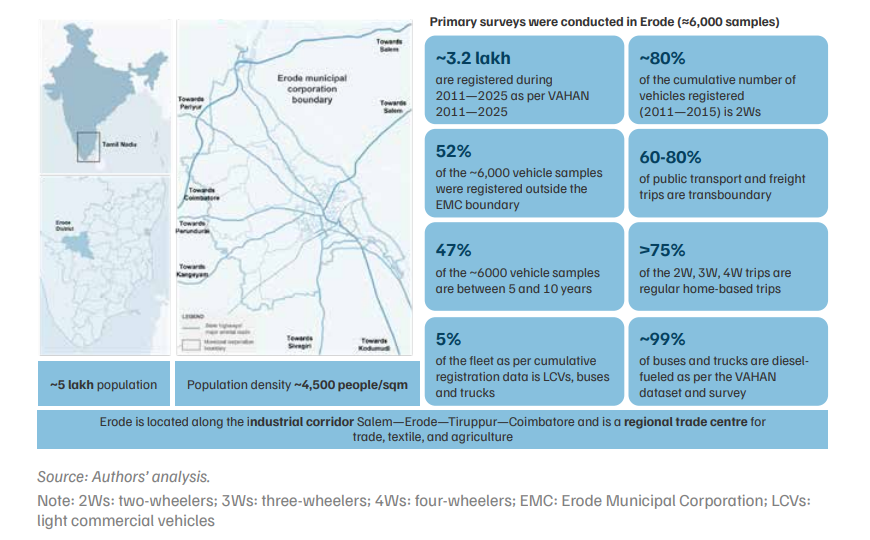
This study develops a Global Protocol for Community-Scale (GPC)-compliant Greenhouse Gas Emission Inventories (GHG) accounting framework for on-road transport emissions in Erode Municipal Corporation (EMC), Tamil Nadu. Although Tamil Nadu has adopted progressive climate action plans across sectors, including road transport, cities continue to face systemic gaps in data, infrastructure, and institutional capacity limiting the integration of emissions data into transport planning. Undertaken under the India–UK Partnering for Accelerated Climate Transitions (UK PACT) programme, Erode is one of the cities selected under the partnership, as it is one of the major regional trade centres for textiles and agriculture. The study aims to establish a transferable methodological model tailored to the data realities and institutional capacities of tier-2 and tier-3 Indian cities. The framework is designed to be scalable and transparent, enabling consistent reporting and policy alignment across comparable urban contexts. It accommodates varying levels of data availability, governance capacity, and transport system characteristics.
Figure ES1. Erode Municipal Corporation is a rapidly growing tier-2 city with increasing mobility demand
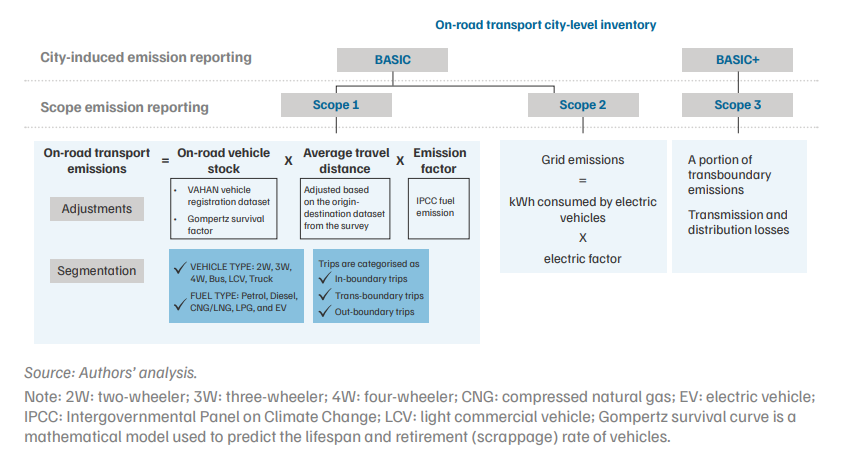
The study adopts a GPC-compliant, city-scale emissions-accounting framework at the BASIC+ reporting level, using a bottom-up, modified production-based methodology (Activity–Share– Intensity–Emission Factor). The analytical framework quantifies Scope 1 (tailpipe emissions), Scope 2 (emissions associated with grid electricity consumption associated with electric vehicles [EVs]), and selected Scope 3 emissions, such as trans-boundary trips and transmission and distribution (T&D) losses linked to electricity use.
Figure ES2. Framework for GPC-compliant on-road emissions inventory
To operationalise the framework, we developed an Excel-based GHG calculator for EMC. The tool is designed to support periodic inventory updates, features transparent documentation of assumptions, and enables scenario modelling within consistent methodological boundaries. It can simulate business-as-usual (BAU) scenarios and multiple alternative scenarios (activity-driven and energy-efficiency-driven) for the period 2030–45.
Figure ES3. Without intervention, on-road transport emissions could nearly double by 2045, reaching ~ 1.42 MtCO2 e under high growth conditions, compared to the BAU scenario
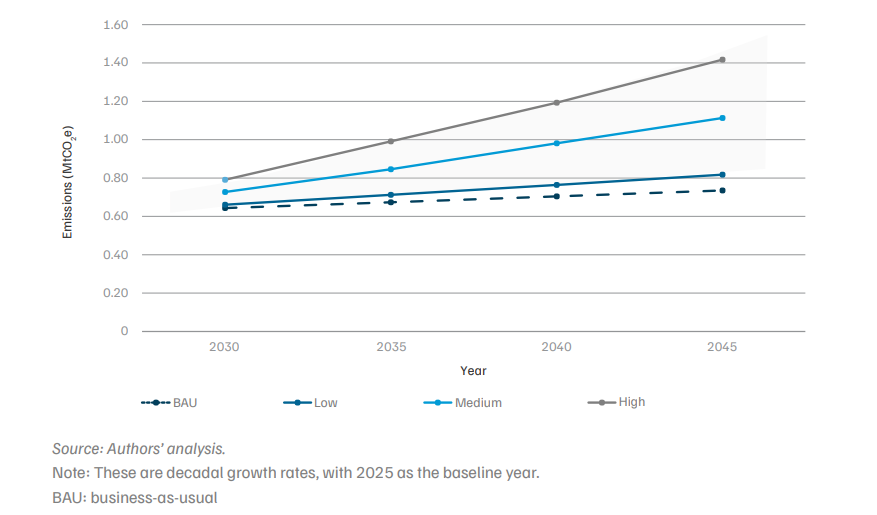
| Rate of development | Vehicle registration growth rate (%) | Increase in VKT (%) |
|---|---|---|
| Low | 10 | 5 |
| Medium | 30 | 7 |
| High | 50 | 9 |
*Development means an increase in vehicle registration and an increase in average VKT.
Source: Authors' analysis.
Note: VKT: vehicle kilometres travelled
Figure ES4. Growth in vehicle kilometres travelled leads to a greater increase in fuel demand and carbon dioxide (CO2 ) emissions than growth in vehicle registration
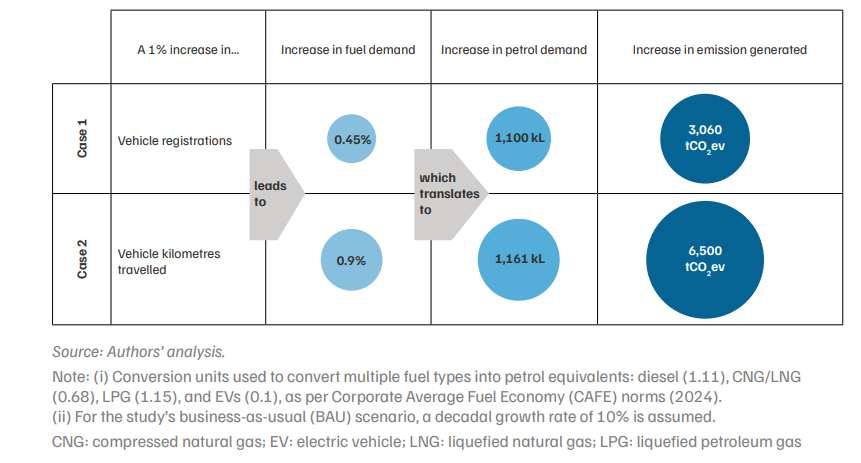
Figure ES5. In the full transition scenario, emission reductions are driven primarily by trucks, while transitions to CNG in 3Ws and LCV show negligible impact
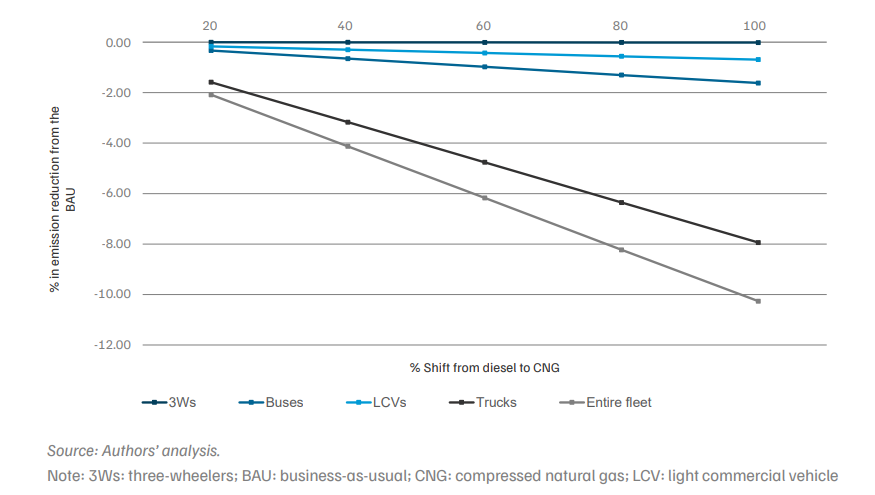
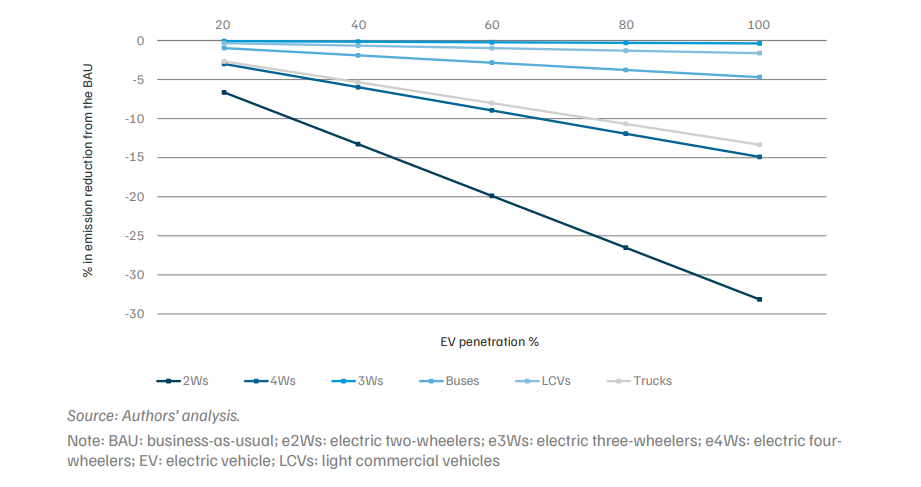
Figure ES6. e2Ws and e4Ws deliver the highest aggregate emission reductions due to the overall higher fleet share
Concerned stakeholders: EMC, Directorate of Town and Country Planning (DTCP), Department of Transport (Government of Tamil Nadu)
Concerned stakeholders: state transport department, regional transport offices (RTOs), Tamil Nadu State Transport Corporation (TNSTC), EMC, district collectors
Concerned stakeholders: TNSTC, Tamil Nadu Generation and Distribution Corporation Limited (TANGEDCO), state transport department
Concerned stakeholders: traffic police, state transport department
Concerned stakeholders: EMC, TANGEDCO, TNSTC, state transport department
Note: Short term: 1–2 years; medium-term: 3–5 years; long term: >5 years
The Global Protocol for Community-Scale Greenhouse Gas Emission Inventories (GPC) is the global standard for city-scale emissions reporting, recognised at COP21 in Paris. It requires cities to report emissions across defined scopes—direct emissions within the boundary, emissions from imported energy, and selected out-of-boundary emissions- so inventories are consistent, transparent, and comparable across cities. Frameworks such as the IPCC guidelines, the IEA and EDGAR datasets classify transport emissions at the national or regional level and cannot capture intra-city travel patterns or local vehicle profiles. This study reports at the GPC BASIC+ level.
Two datasets. The VAHAN registration database provides vehicle category, type, registration year and fuel type — about 3.2 lakh vehicles registered within the EMC boundary (RTOs TN33 and TN86) between 2011 and 2025. Because VAHAN does not record vehicle use, the study also ran a Fuel Station User Survey of about 6,000 vehicles across Erode in September 2025, capturing vehicle age, mileage, trip origins and destinations, trip type, and distance. A minimum of 300 samples were collected for each vehicle category, with the overall distribution matched to observed VAHAN registration shares.
Yes. The framework was built around the data realities and institutional capacities typical of Indian tier-2 and tier-3 cities, and accommodates varying levels of data availability, governance capacity and transport system characteristics. It is designed to be scalable and transparent so that reporting stays consistent and policy-comparable across similar urban contexts.
The Excel-based calculator is built for institutional use rather than one-off analysis. It documents its assumptions transparently, supports annual inventory updates, and models business-as-usual and alternative scenarios for 2030, 2035, 2040 and 2045. The study recommends notifying EMC as custodian of the annual inventory, integrating the calculator into comprehensive mobility plans and master plans so that any proposal affecting VKT or modal share can be tested for its emissions impact, and drawing on the Integrated Command and Control Centre built under the Smart Cities Mission as a data hub.
How Can Early Million-Plus Cities Address Parking Challenges?
Scaling Battery Swapping for India’s EV Ambitions
How States can Build Capacity for Urban Mobility Officials:
Can Indian Highways Support Zero-Emission Trucking?