Council on Energy, Environment and Water Integrated | International | Independent

Suggested Citation: CEEW, IBSA, and CII. 2026. Scaling Battery Swapping for India’s EV Ambitions: Market Challenges and Policy Opportunities. New Delhi: Council on Energy, Environment and Water.
CEEW: Anannya Jha, Chris Teresa Varghese, Nilanshu Ghosh, Saoni Sanyal, Sourav Dhar, Himani Jain
IBSA: Sutirtha Ghosh, Manvi Sherawat, Dilip Chenoy
CII: Eti Drolia, Mohit Sharma
India's electric vehicle (EV) transition has gathered significant momentum over the past decade. However, high upfront vehicle costs, range anxiety, long charging durations, and inadequate charging infrastructure continue to constrain large-scale EV adoption, particularly for commercial fleets and high-utilisation vehicles. Battery swapping, where a depleted battery is exchanged for a fully charged one within one to two minutes, offers a viable alternative by reducing vehicle downtime, lowering upfront costs through Battery-as-a-Service (BaaS), and improving vehicle utilisation.
This report examines the current status of battery swapping in India, reviews international experiences, analyses market trends, and assesses the potential of battery swapping across vehicle segments through 2047. It identifies the key regulatory, technical, and operational barriers in the battery-swapping ecosystem and estimates the economic, environmental, and employment benefits under different scenarios.
Drawing on extensive stakeholder consultations led by the Ministry of Heavy Industries (MHI), with participation from government agencies, battery swapping operators, vehicle manufacturers, financial institutions, researchers, and civil society organisations, the report presents a comprehensive policy roadmap to foster a robust, technology-agnostic, and efficient battery swapping ecosystem in India.
Transitioning to electric mobility is crucial for India to achieve its net-zero emissions target by 2070. Consequently, the adoption of electric vehicles (EVs) in India has gained significant momentum in recent years, spurred by the National Electric Mobility Mission Plan (NEMMP) and the Faster Adoption and Manufacturing of (Hybrid &) Electric Vehicles (FAME) scheme. However, challenges such as high upfront costs, range anxiety, lack of a charging network, long charging times, and limited parking spaces for charging restrict the widespread adoption of EVs. These challenges are particularly pronounced in the commercial vehicle segment, obstructing the electrification of freight and public transport fleets.
As India works to electrify its transportation sector, battery swapping technology can play a transformative role in boosting EV adoption, particularly for commercial fleets. Battery swapping involves exchanging a depleted EV battery for a fully charged one at a dedicated swapping station, eliminating the need for traditional plug-in charging.
This study presents an overview of the battery swapping ecosystem and highlights the key challenges faced by stakeholders across the value chain. To better understand stakeholder perspectives, three consultations were organised under the chairmanship of the AS, Ministry of Heavy Industries, bringing together over 150 stakeholders from across the ecosystem to share their inputs and insights. Based on these discussions, the report provides policy recommendations for various ministries to enable the integration and large-scale adoption of battery swapping.
Table ES1 The benefits of battery swapping systems far outweigh those of fixed for key stakeholders
| Key Stakeholders | Parameters | Fixed charging | Battery swapping |
|---|---|---|---|
| Users | Downtime | Slow charging: min 4–5 hours Fast charging: ~1 hour |
Near-zero downtime, as swaps take just a few minutes. Further, it removes range anxiety for customers. |
| Upfront cost | 1.5–2 times of internal combustion engine (ICE) counterparts | When we omit the battery cost, which makes up 40–50 per cent of the total upfront cost, EVs are at par or cheaper than their ICE counterparts. | |
| BSO | Technology obsolescence/ performance | Customers have concerns about battery performance and technology obsolescence | Battery swapping operators (BSOs) update the battery technology, thereby removing concerns over battery replacement and technology. It offers a quick and efficient energy replenishment solution. |
| Land requirement | Parking vehicles while charging requires a larger area | Swapping requires 90 per cent less space than fixed fast-charging systems to cater to the same amount of vehicles. | |
| Discoms | Load on the grid | Fast charging can strain the electricity grid | Controlled charging alleviates the strain on the grid and has better potential to integrate Decentralised Renewable Energy (DRE) and Business-to-X (B2X). |
| Banks / NBFCs | Financing for EVs | It is difficult to get long-term financing due to concerns over the residual value of the EV after end-of-life and technology obsolescence | Reduced upfront costs and the transfer of risks associated with battery technology from the customer make it a lucrative option for financial institutions to fund at par with ICE vehicles. |
Source: Authors’ analysis
Numerous assessments seek to estimate and project the value and size of the global battery swapping market. However, these estimates vary across reports. The value of the global battery swapping market in 2024 ranged between ~USD 1.6 billion (Future Market Insights 2024) and 4.22 billion (Research Nester 2025). It is anticipated to grow at a compound annual growth rate (CAGR) between 21.2 and 47 per cent. The market is projected to reach a value of ~USD 5 billion in a conservative scenario and up to USD 40 billion in an ambitious scenario by 2030 (Research Nester 2024). China currently leads the battery swapping market, accounting for 35 per cent of the total market share. Meanwhile, India is expected to emerge as a global leader by 2030. Table ES2 provides an overview of the various countries and the associated measures adopted by their respective industries and governments to facilitate the growth of the battery swapping market.
Table ES2 Overview of global battery swapping policies
Source: Authors’ analysis
Globally, fiscal and non-fiscal incentives have encouraged the uptake of battery swapping across segments. Owing to the nascent and evolving nature of battery swapping, most countries’ policies emphasise the safety and reliability of batteries and swapping stations.
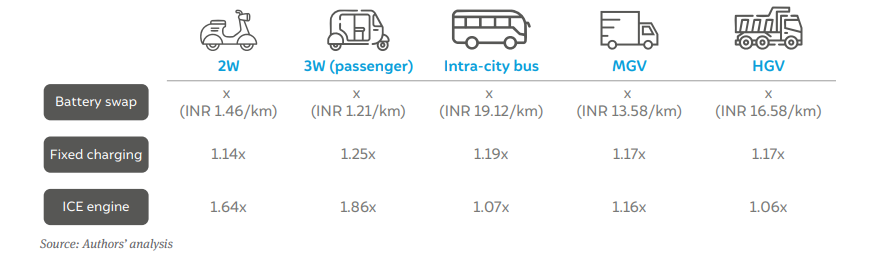
Battery swapping has gained significant traction in India since 2015. Its ability to lower the total cost of ownership (TCO) (Figure ES1) makes EVs more lucrative in the long run. Furthermore, it reduces the upfront cost of vehicles by decoupling battery ownership from the vehicle itself, thus increasing its affordability.
Figure ES1 TCO comparison across battery swapping, fixed charging, and ICE vehicles (without considering the subsidy)
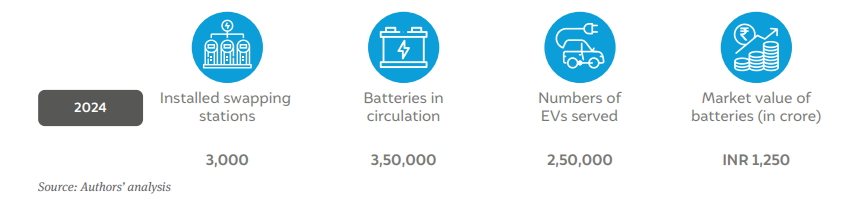
More than 20 battery swapping companies are operational in India, providing solutions across various vehicle segments. Combined, they have invested approximately USD 500 million in the sector and are planning to expand in the near future. They have also established strategic partnerships with oil marketing companies to utilise the existing fuel stations in India to create a dense network of swapping stations. Figure ES2 provides an overview of the status of battery swapping in India as of 2024.
Figure ES2 2024 scenario of battery swapping operations in India
In addition to attracting investments to catalyse the adoption of EVs, battery swapping has the potential to create jobs and provide environmental benefits (Table ES3). For instance, CEEW’s analysis indicates that with the active implementation of battery swapping, EV penetration in new sales could reach 70–80 per cent by 2047. Under a conservative scenario, the market is expected to reach 9 million swap vehicle registrations across all vehicle segments in the next two decades. Ambitious growth driven by adequate policy measures and industry development could lead to 23 million registered swap vehicles.
Table ES3 Battery swapping can create 3.6–14 million jobs by 2047
Source: Authors’ analysis
However, to achieve these estimates, it is imperative to address the various battery swapping challenges different stakeholders face. In June 2024, the Ministry of Heavy Industries conducted extensive consultations with industry and stakeholders, involving over 50 companies and more than 20 public offices and civil society organisations. These consultations revealed several obstacles within the battery swapping ecosystem (Figure ES3), including limitations in the homologation certificate process, exclusion from large government tenders for vehicles and real estate for installing infrastructure, and inconsistent regulations across states. These challenges impede the impact and adoption of battery swapping solutions. A detailed battery swapping roadmap can guide industry development and bolster the growth of battery swapping, increasing the EV growth trajectory in tandem.
Globally, industry initiatives supported by policy measures help establish the foundation for the widespread adoption and growth of the battery swapping market. Strategic public– private partnerships and infrastructure investments will be crucial for fleet operators in scaling the deployment of battery swapping stations. Schemes can offer the financial support and subsidies initially needed to accelerate the rollout of battery swapping stations.
Key stakeholders, including central and state government departments, BSOs, vehicle OEMs, financiers, and power distribution companies (discoms), must collaborate to overcome the challenges in the battery swapping ecosystem. The proposed vision and roadmap for effective implementation can help achieve the estimated benefits (Table ES4).
In 2024, the MHI task force, which includes CEEW, IBSA, and CII, identified key challenges and policy recommendations for battery swapping in India. Several of the task force’s recommendations have already been reflected in recent policy developments:
Overall, there is a growing alignment between the task force’s recommendations and the emerging policy actions in this area.
Table ES4 Key recommendations to address challenges and strengthen the battery swapping ecosystem
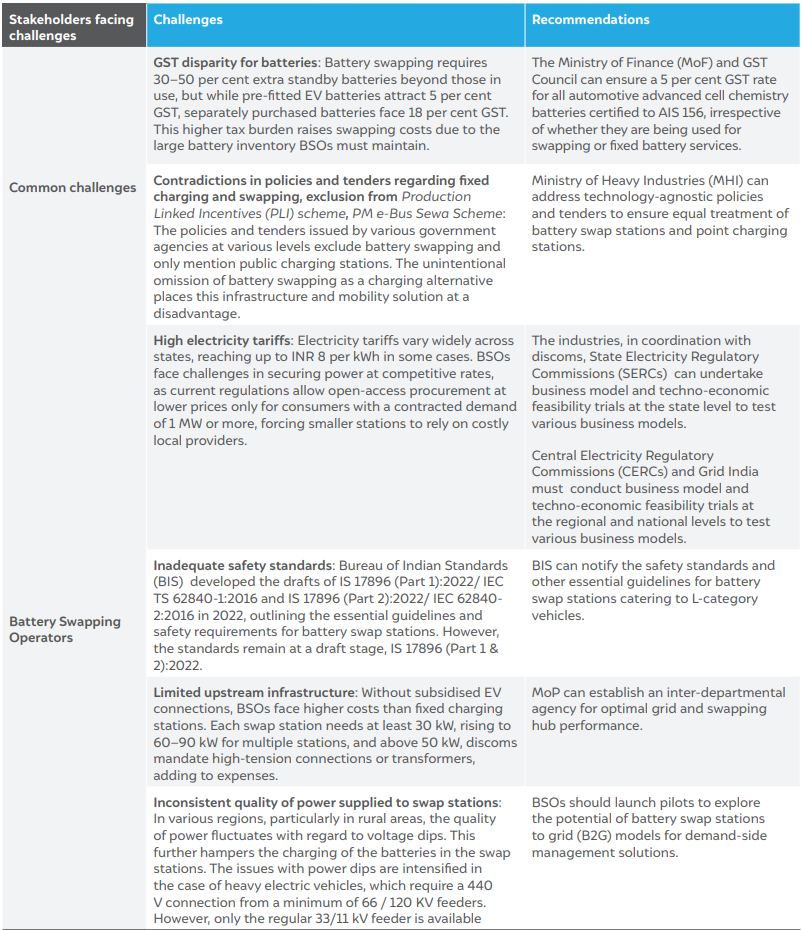
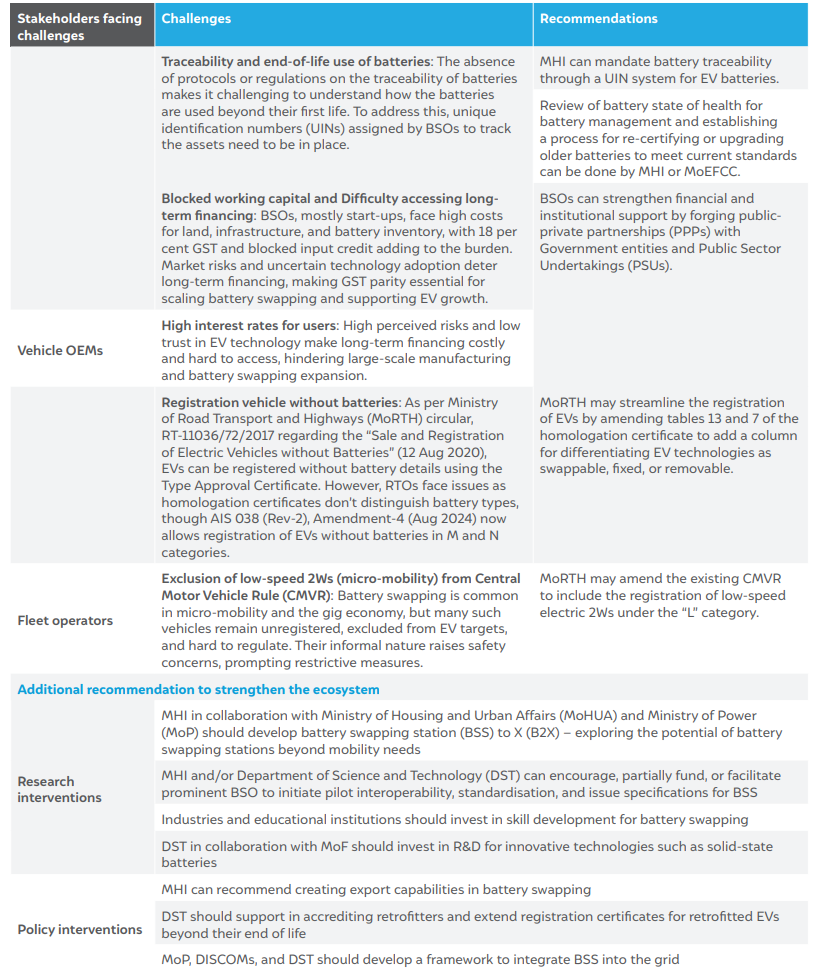
Focusing on battery traceability, responsible circularity practices, and interoperability can enhance long-term impact. Furthermore, larger battery stations can aid in demand-side management, grid stability, and the provision of ancillary services. By addressing these components, the government can create a robust EV ecosystem that promotes innovation, strengthens infrastructure, and supports the widespread adoption of EVs in India.
India’s electric vehicle transition began in 2013 with the NEMMP and the subsequent FAME policies. These initiatives laid the foundation for the rapid expansion of India’s EV market, which is projected to grow at a CAGR of 49 per cent from 2022 to 2030 (NITI Aayog 2023). Thanks to various government initiatives, EV penetration in total vehicle registrations has notably increased to around 7 per cent in 2024, compared to just 1 per cent in 2021 (MoRTH 2024).
India’s EV transition is primarily driven by the two-wheeler (e2W) and three-wheeler (e3W) segments. As of 2024, a total of 4.4 million EVs have been registered in India, with e2Ws and e3Ws representing approximately 50 per cent and 43 per cent of total registrations, respectively (MoRTH 2024). These segments serve a significant portion of the population and play a crucial role in urban and peri-urban transport, first and last-mile connectivity, business-to-business (B2B), and business-to-consumer (B2C) logistics. There is substantial year-on-year growth in EV sales. However, the overall share of EV registrations is minimal compared to ICE vehicles.
Despite the lower TCO, especially in smaller segments such as two-wheelers (2W) and threewheelers (3W), the adoption rate of EVs across these segments has yet to gain momentum. The low uptake can be linked to various barriers, including high upfront costs, the lack of long-term financing options, battery obsolescence, range anxiety due to the insufficient charging network, long charging times, and the unavailability of spaces for parking and charging EVs. According to India Battery Swapping Association (IBSA) estimates, there are currently approximately 17,000 charging stations and around 3,000 battery swapping stations in India (Saraswat and Mall 2024).
Traditional charging is ideal for personal use, allowing users to charge their vehicles overnight at home or during work hours. However, for commercial operations and highutilisation vehicles, such as those used for logistics, delivery services, and ride-sharing, prolonged charging times, land requirements, and the current shortage of fast-charging stations pose challenges. The fragmented nature of the market further complicates the electrification of commercial vehicles ranging from 3 to 55 tonnes. More than 90 per cent of fleet operators own fewer than five vehicles, making access to long-term financing for EVs a significant concern.
Battery swapping systems provide a promising solution for these challenges. Removing the battery from the vehicle reduces the upfront cost by ~40 per cent (Jain et al. 2022). Additionally, with a battery swapping system, the battery can be swapped in about three minutes, compared to the five to six hours needed for traditional charging (Jain et al. 2022). This faster swapping option benefits commercial fleet operators by decreasing vehicle downtime and increasing vehicle utilisation, as depleted batteries are swapped out instead of waiting to be charged. Lighter swappable batteries can also enable the carriage of additional cargo.
What is ‘battery swapping’ and ‘battery as a service’?
Battery swapping treats an EV and its battery as separate entities. Users can exchange their discharged battery for a fully charged one at a swap station in under three minutes. The fundamental principle involves separate ownership of the battery, providing it as an ondemand service (Jain et al. 2022) – known as battery as a service (BaaS) – which users can access through a subscription or lease. This separate ownership reduces vehicle costs and addresses concerns related to replacement costs and battery performance. The on-demand service is provided in just a few minutes, significantly reducing the vehicle’s charging time. Therefore, battery swapping could effectively tackle the significant challenges faced by fittedbattery EVs.
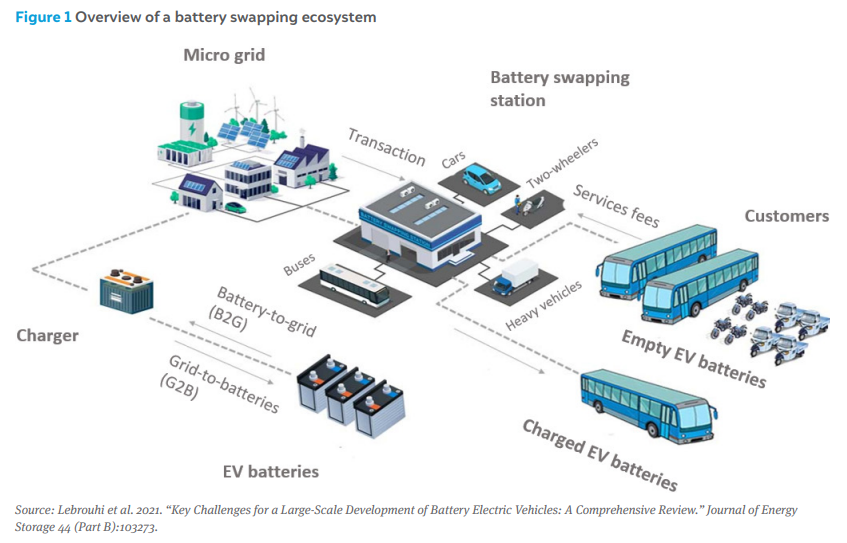
Types of battery swapping systems
IEC 62840–2:2016 outlines the safety requirements for the swappable battery systems (SBS) used in electric vehicles. This system is designed to connect to the supply network, with power supply levels reaching up to 1000 V AC or 1,500 V DC, in accordance with IEC 60038. Additionally, this standard is applicable to battery swap systems powered by on-site storage systems, such as buffer batteries (International Electrotechnical Commission 2016a). Various battery swapping methods exist, defined by the battery’s location within the vehicle and the position of the robotic arm.
Top swapping: This is the most common type of battery change, also known as vertical battery swapping. The entire battery is lifted from the vehicle and replaced with a fully charged battery. The swapping is done manually in 2Ws (Hussain et al. 2024). Robotic arms are used to perform the replacement in electric buses (e-buses) and trucks (e-trucks), where the batteries are positioned at the top or behind the driver’s cabin (Ahmad et al. 2020).
Sideways swapping: In this type of swapping, the empty battery is pulled horizontally from under the vehicle and replaced with a fully charged one. This method is common in 3Ws, small four-wheelers (4Ws), e-buses, delivery vans, and e-trucks (Hussain et al. 2024). Since the battery is changed from the side, the space and infrastructure needed for a vertical battery changing station, which is more costly to install, are unnecessary.
Rear swapping: This battery swapping method involves removing the vehicle‘s rear seats, where the battery is fixed, to replace it. This approach is common in cars with large trunks as well as in trucks and buses (Lakshmi 2024).
Bottom swapping: This technique is used in vehicles with bottom-mounted batteries. The swapping station places the vehicle on a raised platform, and the batteries are replaced from below using an automated arm and various peripheral equipment, often situated beneath (Lakshmi 2024).
Manual swapping of the top, rear, and side batteries is primarily practised for smaller vehicle segments.
Types of battery swapping deployment models
Decentralised model: The decentralised deployment model is the most common. It consists of roadside battery swapping cabinets with individual recharging compartments, each containing one battery. These cabinets can significantly expedite the recharging process. When a user inserts a depleted battery into one compartment, another provides a fully charged battery (if available) while the depleted battery is recharged for future use. Due to their ease of installation, these cabinets serve as a convenient solution for private electric bike (e-bike) owners, shared e-bike operators, and delivery riders.
Hub and spoke model: Widely explored in the literature, this model features centralised hubs where batteries are charged and maintained. From there, they are transported to demand centres where swapping occurs at distribution outlets/battery swapping stations. These stations are strategically placed in urban areas, providing easy access for e2Ws and e3Ws. Additionally, this model is utilised for emergency response services, where batteries are delivered to users’ locations and swapped accordingly.
Battery swapping business models
Various business models with different ownership and operations structures have emerged to reduce the capital expenditures (CAPEX) and operating expenses (OPEX) associated with establishing and maintaining battery swap systems. These models are classified into asset-heavy and asset-light models based on land ownership, charger usage, operation and maintenance (O&M), and battery management. They are further divided into four subcategories: (a) franchising, (b) dealer-owned and dealer-operated (DODO), (c) dealer-owned and company-operated (DOCO), and (d) company-owned and company-operated (COCO). Table 1 provides further details on these models (Jain et al. 2022).
| Models | BSO ownership | Details | |||||
|---|---|---|---|---|---|---|---|
| Land | Swap station | O&M | Battery | Financing by NBFCs* and banks | |||
| Asset-light models | Franchising | ✕ | ✓ | ✕ | ✓ | ✕ | Franchising involves third-party ownership of the swap station, including the land, chargers, and O&M. This model incurs the lowest CAPEX and OPEX for a BSO. |
| DODO | ✕ | ✓ | ✕ | ✓ | ✓ | The BSO owns the equipment; the dealer or the land-owning agency provides land and O&M support. This model incurs CAPEX on the charger and batteries for the BSO. |
|
| Asset-heavy models | DOCO | ✕ | ✓ | ✓ | ✓ | ✓ | The BSO owns the station and batteries in DOCO stations and takes care of its O&M. This model incurs both CAPEX and OPEX for the BSO, except the cost of real estate. |
| COCO | ✓ | ✓ | ✓ | ✓ | ✓ | The BSO fully owns and operates the station. This model incurs the highest CAPEX and OPEX for the BSO. Such models are ideal for flagship stations. |
|
Source: Invest India and NRI Consulting & Solutions. 2022. “Battery Swapping: India’s Opportunity for Global Dominance.” https://india.nri.com/media/fhebwrii/battery-swapping_india-s-opportunit....
How does battery swapping differ from conventional fixed battery charging?
Traditional charging is well-suited for personal use since users can charge their vehicles overnight at home or during work hours. However, prolonged charging times, land requirements for parking space, and a scarcity of fast-charging stations deter commercial operations and the higher utilisation of e-vehicles in logistics, delivery services, and ridesharing. Battery swapping systems offer a promising solution for these challenges. They present a viable alternative for commercial fleets, public transport systems, and high-usage personal vehicles, providing flexibility and efficiency (Tripathi et al. 2023). A significant advantage of battery swapping compared to fixed batteries is the reduced charging time and lower upfront cost of the vehicle as is discussed in Table 2.However, the benefits of battery swapping extend beyond these aspects.
Land requirements
From the infrastructure perspective, the land footprint associated with battery swapping is 0.94–3.92 sq. ft per vehicle for e2Ws and e3Ws, which is approximately 80–95 per cent less than that of point charging (~20.75 sq. ft per vehicle) (Ola Mobility Institute and CEEW [forthcoming]). According to IBSA, the area needed for battery swapping is one-fifth of what is required for fixed charging. For instance, battery swapping requires one acre of land for every 100 buses, whereas fixed charging requires five acres to charge the same number of buses. The reduced land footprint results from battery swapping’s ability to serve about three to four times as many vehicles per day compared to point charging (Ola Mobility Institute and CEEW [forthcoming]); IBSA estimates battery swapping can accommodate eight to ten times more vehicles in a day compared to point charging. Additionally, a 25 sq. m. swapping station can service 20–30 swaps in one hour, whereas a fast charging station can charge only 3–6 vehicles per hour (Prasad, Uchida, and Feng 2023).
A battery swap station can cater simultaneously to the recharging needs of multiple battery electric vehicles (BEVs), utilising a minimal geographic area for the battery swap kiosk. Therefore, it is ideal for locations with dense vehicular traffic and limited land availability.
Impact on battery quality
There are two types of battery charging: slow charging and fast charging. Slow charging is considered better for maintaining battery quality but requires four to five hours for a full charge (Jain et al. 2022). In contrast, fast charging can fully recharge the battery in just one hour. However, during and after fast charging, battery packs experience significantly higher temperatures and slower thermal equilibration (Tanim et al. 2018), which accelerates capacity decline (Gao et al., 2022). Battery swapping addresses both of these concerns. The quick swap time ensures minimal vehicle downtime and swapping centres provide a controlled environment for charging and thermal management of batteries. Battery swapping extends battery life and improves safety, preventing battery strain during fast charging. Furthermore, since the swapping occurs in a controlled environment at the designated station, monitoring the health and safety of batteries becomes easier. Unlike home charging, common charging areas can invest in a single health monitoring station for all the batteries that come in for charging. This results in proper battery monitoring during charging, preserving their health and safety and making these systems more socially acceptable.
Sustainability and scalability
Scaling existing charging systems and widely adopting fast charging stations raises concerns about the strain they may place on the local grid. Consequently, this increased demand could necessitate significant infrastructure upgrades, potentially delaying the rapid expansion of the charging network. In contrast, battery swapping presents a more sustainable and timely solution, serving as an important source of grid flexibility (Warrior 2022). According to IBSA estimates, peak power requirements are 50 per cent lower with swappable batteries than with fixed batteries. Additionally, battery swapping stations could function as grid-scale energy storage, alleviating stress on the power grid. Therefore, battery swapping stations can meet the needs of an increasing number of future EVs while efficiently utilising resources to align with the goals of sustainable urban planning, making it a scalable model.
| Parameters | Fixed charging | Battery swapping |
|---|---|---|
| Up-time | Slow charging: 4–5 hours Fast charging: ~1 hour |
Near-zero downtime, as battery swaps take under three minutes and reduce range anxiety for customers |
| Upfront cost | 1.5–2 times that of ICE counterparts | Removing the battery, the cost of which makes up 40–50 per cent of the total upfront cost, makes it at par or cheaper than ICE counterparts |
| Technology obsolescence/ performance |
Customers have concerns about battery performance and technology obsolescence | There is no fear of battery replacement and technology as BSOs will update the battery technology |
| Load on grid | Fast charging can cause additional strain for the electricity grid | Controlled charging alleviates strain on the grid and also offers better potential to integrate DRE and B2X |
| Financing for EVs | It is difficult to secure long-term financing as there are concerns about the residual value of the EV at end-of-life and technology obsolescence | The reduced upfront cost and the removal of risks associated with the battery technology for the customer make it lucrative for financial institutions to fund them at par with the ICE vehicles |
| Land requirement | Parking vehicles while charging requires larger real estate | Swapping requires 90 per cent less space than fixed fast charging to cater to the same number of vehicles |
Source: Authors’ analysis
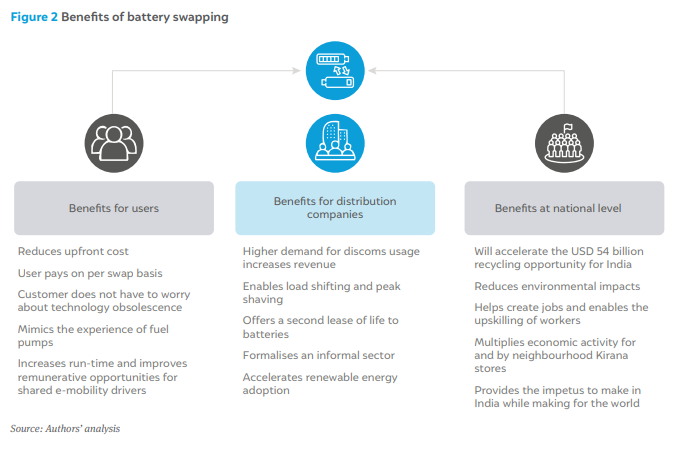
Benefits of battery swapping for users, discoms, and countries
Section 1.2 highlighted some advantages of battery swapping over fixed-battery charging. However, battery swapping offers widespread and varied benefits for different groups.
Benefits for users
Reduces upfront costs: The high upfront costs associated with EVs have remained a significant barrier to their rapid adoption. By separating the battery and vehicle costs through battery swapping, upfront costs decrease by approximately 30–50 per cent, making them competitive with ICE vehicles (Ola Mobility Institute and CEEW [forthcoming]). For instance, the price of an e2W sold without the battery (in the absence of subsidies) is INR 60,000–70,000, which equals that of an ICE vehicle, thereby addressing affordability concerns.
Reduces operational and maintenance costs, as users pay on a per-swap basis: The high cost of batteries remains a significant concern for users. With battery swapping, users pay either for each swap or a subscription fee for BaaS rather than incurring the hefty cost of purchasing a battery. This alleviates customers’ worries regarding battery replacement and maintenance.
Removes customers’ concerns about technology obsolescence. Lowering the upfront cost of the vehicle and separating ownership of the battery from the vehicle alleviates concerns about technology obsolescence. Customers can access newer battery technologies more readily without replacing their entire vehicle. As battery technologies evolve, the responsibility to provide the latest, more efficient batteries will fall on the battery service provider, not the customer. Thus, customers benefit from technological advancements without the anxiety of replacement costs.
Lowers downtime: With battery swapping, customers can exchange a drained battery for a fully charged one in just two to three minutes. In contrast to point charging, which takes over four to five hours, the speed and convenience of the swapping process are comparable to refuelling a vehicle. Consequently, battery swapping offers customers a simple recharging solution that minimises downtime and eliminates the need to charge vehicles at home or work.
Increases run-time and enhances earning potential for shared e-mobility drivers: The reduced time needed to swap batteries ensures that the vehicle’s uptime and productive hours remain unaffected. This enables commercial users of these vehicles to increase their earnings. For instance, vehicles using advanced batteries through swapping are able to operate 25 per cent longer than those powered by conventional charging (Ola Mobility Institute and CEEW [forthcoming]). Consequently, various last-mile delivery companies choose fleets primarily consisting of battery swap vehicles such as Zypp Electric. Additionally, other delivery companies, including Rapido and Delhivery, have incorporated battery swap vehicles into their EV fleet.
Benefits for discoms
Enables load shifting and peak shaving: As EV penetration increases, the growing energy demand must not burden the grid. Battery swapping allows batteries to be charged during non-peak hours, which can then be swapped and used during peak demand periods, thereby reducing the strain on the grid. Additionally, battery swapping stations can serve as battery energy storage systems to support the grid during times of high energy demand, postponing the need for ‘peaking‘ plants or upgrades to transmission and distribution systems.
Formalises an informal sector: Establishing an organised and dense network of swapping stations that charge EV batteries through legitimate connections can help eliminate power theft. Since 2010, there has been a surge in the penetration of e-rickshaws in Delhi and other cities in Uttar Pradesh, Bihar, and West Bengal, among others (Shandilya, Saini, and Ghorpade 2019). However, limited development in charging infrastructure facilities has resulted in illegal electricity syphoning, causing losses to discoms. Establishing battery swapping centres encourages formalisation and upgrading of the power consumed by erickshaws, which currently dominate India’s EV market.
Accelerates the adoption of renewable energy: Batteries serve as energy storage systems that effectively promote renewable energy. They store excess energy produced from renewable sources, which can later be used to reduce evening peaks. This supports grid stability, maximises the use of renewable energy, and facilitates a more sustainable energy system.
Benefits at the national level
Helps accelerate India’s USD 54 billion recycling opportunity: India’s lithium-ion battery market is projected to grow from 2.9 GWh in 2018 to approximately 132 GWh by 2030 (CAGR of 35.5 per cent). This tremendous volume of batteries will result in an increase in the number of ‘spent’ batteries within the ecosystem, which, if not disposed properly, can lead to health and environmental consequences. Hence, the increasing battery waste must be managed effectively and recycled. As the batteries currently in use in EVs are expected to reach the end of their lifespans, India’s battery recycling market is presented with a significant opportunity – by 2030, the recycling market is anticipated to be approximately 128 GWh, representing USD 54 billion (Bhattacharjee 2023; Lohum 2023).
Reduces environmental impacts: In battery swapping systems, ownership and responsibility for the management, maintenance, and care of batteries lie with the operators who own and lease them. Therefore, they oversee the recycling and safe disposal of batteries, allowing for better management of end-of-life batteries than individual owners can provide. This approach can streamline second-life use and recycling processes, helping to reduce the negative environmental impact associated with improper disposal.
Creates jobs and enables upskilling of workers: According to a 2019 World Economic Forum report, by 2030, the battery value chain will sustain ten million additional safe and fair jobs worldwide. More than 50 per cent of these will be in emerging economies (and contribute both direct and indirect employment to the economy (World Economic Forum 2019). Because the skills needed to transition from working at a petrol station to swapping batteries are straightforward to acquire, these newly created jobs can provide opportunities to upskilled workers, thereby reducing negative impacts on the current employment rate.
Increases economic activity for and by neighbourhood kirana stores: Battery swapping can integrate local kirana stores (grocery stores) into its value chain, generating indirect employment benefits. Because swapping stations have smaller, portable battery storage racks that require less space, they can be widely distributed across small kirana stores in densely populated cities. The government can offer minor incentives such as tax benefits and GST waivers to shop owners for establishing swapping stations, which will not only create new livelihood opportunities for them but also facilitate the creation of a network of battery swapping stations.
Provides an impetus for indigenisation: India has set a target of achieving 60 per cent indigenisation by 2025 to promote local manufacturing and reduce import dependence (Sharma 2019) . One strategy to accomplish this is by imposing tariffs on lithium-ion cell imports and offering incentives for local manufacturing, such as a 100 per cent tax deduction on capital expenditure in the first year of operations and output-linked cash subsidies (Ghosh and Bhaskar 2020). These measures will enhance the self-sufficiency of battery manufacturing in India. However, the import tariffs must remain unchanged until PLI are instituted to develop a competitive domestic manufacturing system. When coupled with battery swapping systems that can rapidly create economies of scale, indigenously manufactured batteries can reach a break-even point more quickly. Therefore, the demand generated by battery swapping accelerates indigenisation.
Enhances India’s global role in EV adoption: By tackling various issues that contribute to the limited adoption of EVs, battery swapping can play a crucial role in accelerating EV uptake in India. With proper policy and regulatory support, there is also significant potential to implement battery swapping stations globally, which will bolster India’s leadership in battery swapping.
Challenges of battery swapping
While battery swapping as a technology offers multiple benefits, specific challenges are associated with it. These are discussed in this section.
Cost implications
• The high deployment cost of battery swapping stations for medium and heavy electric vehicles: Deploying a battery swapping station for 4Ws and medium and heavyduty vehicles (MHDVs) entails a significant initial investment, primarily due to the costs associated with maintaining a battery inventory and specialised infrastructure such as mechanised arms (Pulse Energy 2024). Studies indicate that approximately half of the setup cost for a swapping station is attributable to the battery inventory, while the other half covers equipment, cables, and transformers (Cui, Xie, and Niu 2023).
• The high maintenance costs of swapping stations: The charging equipment in battery swapping stations requires regular maintenance to prevent corrosion and other damage, increasing the overall maintenance cost of a swapping facility (Prasad, Uchida, and Feng 2023).
Environmental impacts
• Upfront emission concerns when manufacturing battery packs: The battery production process consumes a large amount of energy and emits significant levels of carbon dioxide. The circulation of approximately 1.5–2 times more batteries in a battery swapping system compared to a fixed charging system increases upfront emissions.
Infrastructure and logistics
• Managing battery inventory: Battery inventory management, planning, and operations pose challenges, particularly in ensuring that sufficiently charged batteries are available at swapping stations with varying flow levels. Due to the high cost of batteries, many battery swapping stations maintain a limited stock of charged batteries, resulting in users picking up partially charged batteries for use (Wang, Hou, and Guo 2024).
• Lack of clarity regarding the roles and responsibilities of battery swapping stakeholders in the event of accidents: In the battery swapping model, frequent plugging and unplugging of batteries can lead to thermal runaway, which may result in fire incidents. In such situations, determining liability becomes complex, as the responsibility could fall on the car manufacturer, the battery manufacturer, or the battery swapping service provider (Danilovic and Liu 2021).
• Complexity due to the lack of uniformity in swappable batteries: Batteries from different car manufacturers and models have different chemistries, power and energy densities, form factors, and drivetrains that require specific energy and power ratios. These variations lead to compatibility issues, limiting the interoperability of batteries among vehicles from different OEMs, which consequently restricts the potential for widespread adoption of battery swapping. Interoperability and standardisation of battery packs may be required as potential solutions to alleviate this challenge. However, the nascent nature of battery swapping, and the limited development of interoperability standards globally, make this a potential that could be explored in the future.
Interoperability can be understood at various levels of aggregation, emphasising the integration and compatibility of components, systems, and networks (Chen et al. 2022).
Component level: This level focuses on the interoperability of individual parts, such as battery cells, connectors, and management systems, ensuring they can interface correctly and function together within a system.
System level: This level considers the interaction between the battery pack, the vehicle, and the swapping station. It ensures that the battery can be safely integrated and operated in different vehicles and charged or swapped at various stations. Modular and scalable battery systems are prime examples.
Network level: This broader perspective encompasses the entire network of swapping stations and service providers. It ensures that users can access a cohesive network of services, enabling them to use any station within a specific network or across different networks without compatibility issues.
However, there has been limited global discussion on interoperability and standardisation. Industry-led consortia have been formed, which have either chosen intra-network interoperability or are working on developing common standards. Pilots have yet to demonstrate inter-network interoperability to gauge the potential of battery swapping and interoperability.
Evolution of battery swapping
The concept of battery swapping and BaaS is not new. It was initially adopted in the fourwheeler segment by companies such as Hartford Electric and GeVeCo from 1910 to 1924, along with Milburn Light electric cars in Chicago in 1917. Better Place reintroduced battery swapping for four-wheelers in 2008. Tesla followed suit in 2013 by launching a fast swapping system that enabled Tesla cars to swap batteries in just 90 seconds. These companies aimed to address range anxiety but struggled to inspire confidence among early adopters.
By the late 2000s, battery swapping faced setbacks in several geographies, including China, Europe, and the US, due to unsustainable early business models and economics. The key roadblocks related to the bulky nature of the battery used in high-mileage vehicles, as well as engineering challenges related to new types of mountings, fasteners, seals, and connectors. Furthermore, safe and durable battery and vehicle designs were necessary to facilitate rapid battery replacement. However, with changing times, advancements in battery technologies made swapping feasible, and by the early 2020s, battery swapping began to gain popularity.
Current status of battery swapping in India
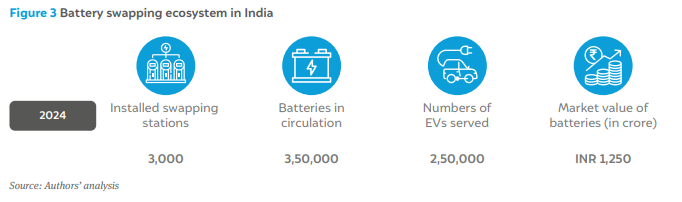
India has seen early success with battery swapping for both 2Ws and 3Ws. According to IBSA, over 3,000 battery swap stations are currently installed across India for e-2Ws and e-3Ws, facilitating approximately 7 million e-km daily for hundreds of businesses as shown in Figure 3. The value of battery packs in the Indian battery swapping industry currently stands at USD 500 million, and according to IBSA estimates, this is projected to reach USD 26 billion by 2030. The Ministry of Road Transport and Highways (MoRTH) permitted the sale of vehicles without batteries in 2020, and NITI Aayog developed a draft policy on battery swapping in April 2022. The future holds enormous potential for a rapidly growing battery swapping market, and India is well-positioned to emerge as a global supplier of swappable vehicles across all segments.
The MHI has established a strong foundation for boosting EV market penetration through the FAME, Advanced Cell Chemistry (ACC), and PLI programmes. Aiming for 30 per cent vehicle electrification by 2030, the government is investigating innovative solutions to address the current challenges in EV charging infrastructure.
Battery swapping is increasingly being explored as a scalable solution across diverse transport applications, with several countries and industry stakeholders investing in technology development, pilot projects, and supporting infrastructure.
Global market size of battery swapping
Battery swapping gained traction globally in the early 2010s, starting with the 2W segment in Taiwan. It then expanded to China, Indonesia, the Philippines, and other countries in the Association of Southeast Asian Nations (ASEAN). Following this, China, the US, and Japan began exploring initiatives for swapping batteries in cars and HEVs such as buses and trucks. As of 2023, China is the world’s largest market for electric cars, buses, and trucks and has seen a continuous rise in the sales of battery swap trucks. In 2022, battery swap trucks accounted for 49.5 per cent of the electric trucks sold in China. Similarly, in Taiwan, the sales of e2Ws has increased 40 times since the launch of Gogoro networks, which grew from 30 stations in 2015 to 2,633 today. The battery swapping ecosystem has expanded significantly in the last decade and is rapidly increasing across various segments and use cases.
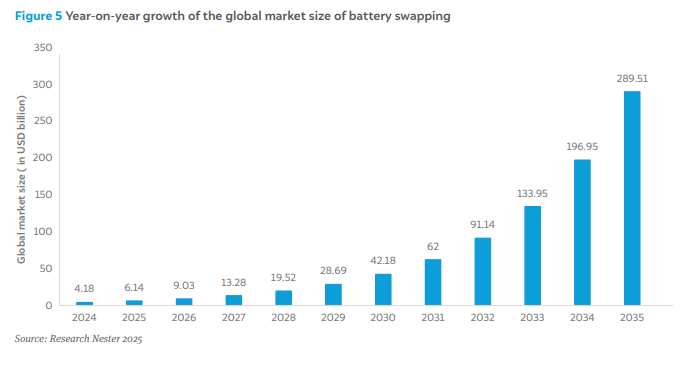
Many reports have sought to estimate and project the value and size of the global battery swapping market. However, these estimates vary across reports. Based on the calculations presented, the value of the global battery swapping market for 2024 ranges between approximately USD 1.6 billion (Future Market Insights 2024) and USD 4.22 billion (Research Nester 2024). It is expected to grow at a CAGR of between 21.2 to 47 per cent. It is projected to reach approximately USD 5 billion in a conservative scenario and up to USD 40 billion in an ambitious scenario by 2030 (Research Nester 2024). India is anticipated to be a global leader by 2030.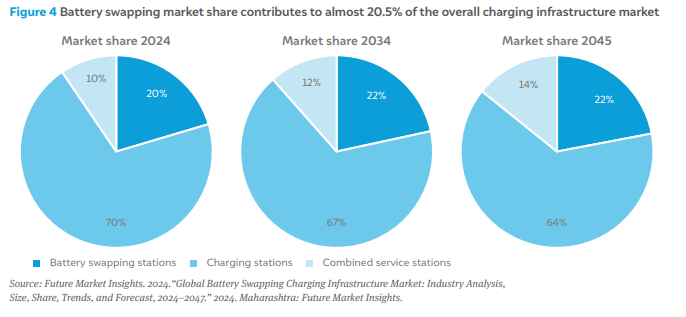
Top countries in battery swapping
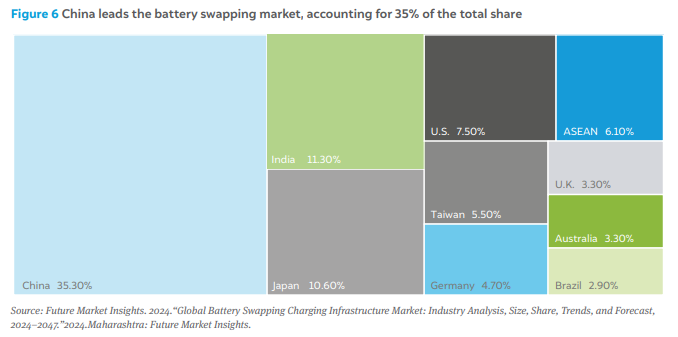
China leads the battery swapping market, holding a global market share of 35 per cent. India follows closely with a market share of 11.3 per cent, while Japan accounts for 10.6 per cent of the total global market value (Future Market Insights 2024). Additionally, China dominates the HEV segment, capturing approximately 90 per cent of the global market share.
Battery swapping market by vehicle type and applications
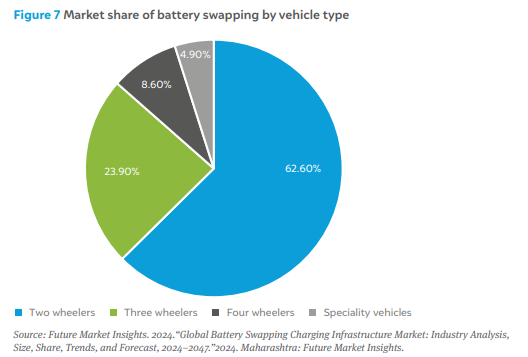
As of 2023, 2Ws dominate the global battery swapping market, representing approximately 62 per cent of the market share. 3Ws follow closely, accounting for nearly 25 per cent of the total share. HEVs and 4Ws account for the remaining 9 per cent and 4 per cent, respectively. Figure 7 illustrates the market share of each vehicle type.
Currently, approximately 44 per cent of market demand originates from vehicles used for personal purposes, while around 35 per cent comes from vehicles used for commercial purposes. However, this situation is changing rapidly. The demand for battery swapping in commercial vehicles has surged in recent years. By 2034, the share of personal use vehicles and commercial use vehicles using battery swapping is expected to be nearly equal, at 40 per cent each. By 2047, it is anticipated that almost half of the market demand will be generated exclusively by the commercial sector.
An overview of battery swapping in different countries
China: Scaling battery swapping through policy, innovation and pilots
Market: China has emerged as a global leader in battery swapping, particularly in the 2W, 3W, and heavy-duty truck (HDT) segments, accounting for nearly 50 per cent of the market share (Future Market Insights, 2024). Companies such as Hello, Tycorun, and China Tower dominate this sector. In the 4W segment, automakers such as NIO and Geely, along with battery swap developers such as Aulton and Sinopec, are advancing the technology. NIO operates over 2,500 battery swap stations across 64 cities, offering BaaS with flexible upgrades and national policy incentives. Despite the high costs – NIO’s stations are five times more expensive than gas stations – profitability is expected as the user base scales significantly. In 2023, NIO entered into a share subscription agreement with CYVN Holdings and received an investment of USD 2.2 billion. Contemporary Amperex Technology Co., Limited (CATL) plans to implement 10,000 battery swap stations by 2030, with 3,000 operational by 2027. Aulton, focusing on the B2B market, aims to establish 5,000 stations in 100 cities by 2025, supporting over nine vehicle models from major OEMs. Similarly, Beijing Automotive Industry Corporation (BAIC) targets 4W taxis with 280 swap stations as of 2022.
Battery swapping has gained traction in HDTs due to modular designs and operational feasibility. In 2022, 36,000 electric trucks were sold in China, of which 49.5 per cent were swap-capable. This number is projected to rise to 160,000 by 2025, fuelled by short-haul applications in ports, mines, and urban logistics.
Notable initiatives include Tangshan’s deployment of over 6,000 swap-capable trucks and partnerships such as Foton Daimler‘s collaboration with Aulton to enhance HDT solutions (Gasgoo 2023). Aulton secured RMB 3.5 billion in investment from its founders, NIO Capital and BAIC BJEV. Infrastructure advancements, such as CATL‘s highway swap stations, support adoption, particularly for fixed-route commercial trucks. China‘s focus on battery swapping, bolstered by government subsidies and pilot programmes since 2016, positions the country as a global leader in this technology, with rapid growth expected across all segments as infrastructure and standards evolve. Annexure 4 provides additional details.
Policy support: Since 2019, the Chinese government has implemented policies to promote battery swapping adoption, including the 2019 Plan for Renewing and Upgrading key Consumer Products. which encourages EVs with flexible charging and swapping options.
In 2020, the New Energy Vehicle Industry Development Plan (2021–2035) prioritised approximately EUR 1.15 trillion for New Energy Vehicle (NEV) charging and swapping infrastructure under the New Infrstructure Construction Campaign. The National standard for Battery Swap Safety Requirement (GB/T 40032-2021), effective November 2021, established safety protocols for swappable EVs. That same year, a pilot programme launched in 11 cities, focusing on public transport, logistics, and ports, projected to save 700,000 tonnes of fuel and over 2 million tonnes of CO2 annually.
Fiscal incentives, including construction and operational subsidies in cities such as Dalian and Shanghai, as well as subsidies for battery swapping NEVs priced above CNY 300,000, have made these vehicles more affordable by separating battery costs. These measures reinforce China’s leadership in battery swapping technology, providing both environmental and economic benefits.
Taiwan: Leading battery swapping in the e2W segment
Market: Taiwan’s battery swapping ecosystem thrives due to industry-led efforts supported by favourable government policies. Gogoro, a leader in the sector, operates over 13,500 battery swapping stations, powering 90 per cent of Taiwan’s electric scooters by 2022 and assisting 600,000 riders with 1.3 million smart batteries. In collaboration with Uber Eats, Gogoro aims to double EV deliveries to 40 per cent of trips by 2025. Recent investments include USD 50 million from Gold Sino Assets, USD 5 million from Castrol, and USD 1.5 billion for expansion in India and China with Foxconn.
KYMCO, another key player, operates 400–500 iONEX swapping stations and announced a USD 142 million investment in electric scooters and battery swapping in 2023. These industry initiatives, supported by government electrification subsidies, drive a sustainable mobility future. Annexure 4 provides more details.
Policy support: The Taiwanese government promotes EV adoption through subsidies, which include a central subsidy of USD 233 per EV and city-level subsidies ranging from USD 40–500, available until 2026. Under the Electric Scooter Industry Environmental Value-Added Subsidy Program, the government has allocated USD 0.2 billion (2023–26) for projects such as installing battery swapping and charging infrastructure. Additionally, capital subsidies cover up to 50 per cent or USD 10,000 per swapping station. To transition 100 per cent of 2Ws to electric by 2040, companies such as Gogoro are increasing investments in EV technology and expanding their battery swapping networks.
Indonesia: Public-private partnerships to scale battery swapping
Market: Local companies such as Astra Honda, PT Starvo Global Energi, and Swap Energi, alongside global players such as Shell, Pertamina, and Gogoro, are driving Indonesia’s battery swapping ecosystem. As of November 2022, the country had 961 battery swap stations and plans to expand to 52,125 stations by 2030 to support electric motorcycles, according to the Energy Ministry and Badan Pengkajian dan Penerapan Teknologi (BPPT).
Established in 2019, Swap Energi operates over 1,300 swapping centres across major Indonesian islands. It partners with Smoot, Minerva Electrons, and retailers such as Shell and Alfamart. Additionally, it collaborates with Perusahaan Listrik Negara (PLN) to develop an integrated EV ecosystem. Swap Energi has received USD 7.2 million in investments to support its business expansion, totalling USD 22 million in funding from Qiming Venture Partners, Ondine Capital, and GGV Capital.
Gojek, TBS Energi Utama, Pertamina, and Gogoro formed a joint venture in 2022 to advance EV infrastructure. Gogoro fosters innovation in battery technology, while Pertamina installs swap stations at gas stations. By mid-2024, their Electrum venture supported over 2,000 2W EV riders, completing 1 million swaps at 250 stations in Jakarta. In 2022, Gogoro also partnered with Hon Hai (Foxconn), Indonesia Battery Corporation (IBC), and Indika Energy to create a comprehensive EV ecosystem, focusing on battery manufacturing, recycling, and research and development. Additionally, Gogoro and Gojek launched a pilot in Jakarta featuring 250 Gogoro Smartscooters and four GoStation swap stations, aiming to scale to 5,000 scooters. Annexure 4 offers more details.
Policy support: Indonesia’s government prioritises battery swapping for 2Ws due to its substantial market size (Uchida et al. 2023). Fiscal and non-fiscal incentives, including the removal of import duties and luxury goods tax on EVs in December 2023, are designed to promote electrification. Additionally, tax incentives for provincial governments bolster the growth of the EV market.
Under Presidential Regulation No. 55 (2019), state-owned enterprises such as Pertamina and PLN play a crucial role in establishing an integrated EV ecosystem. Pertamina concentrates on battery packing, infrastructure, and BaaS, while PLN develops swapping and charging stations across the nation. Safety standards for removable and swappable batteries, detailed in SNI 8927:2020 and SNI 8928:2020, support government initiatives, promoting infrastructure development and EV adoption (Bitgaram 2024).
Japan: Industry collaborations to advance battery swapping
Market: Japan is advancing in battery swapping technology, capturing 10.6 per cent of the global market in 2024, aiming for 100 percent EV adoption by 2035 and carbon neutrality by 2050. Key developments include the establishment of Gachaco Inc. in 2022, a joint venture between Honda, Yamaha, Suzuki, Kawasaki, and ENEOS Holdings. Gachaco aims to standardise and produce swappable batteries for 2Ws and to deploy infrastructure nationwide, starting with Honda’s Mobile Power Pack e: and Power Pack Exchanger e: in Tokyo and Osaka.
Before Gachaco, ENEOS teamed up with Ample in 2021 to launch modular swapping stations in Kyoto, aiming to tackle charging downtime and limited infrastructure. In the same year, Ample secured USD 30 million in its series C-1 round with support from ENEOS and Blackstone (ENEOS 2021). Honda is spearheading efforts to overcome EV adoption hurdles by offering effective battery swaps for electric motorcycles through the Honda Power Pack Exchanger e:, which debuted in 2022. In 2024, Honda attracted an investment of USD 65 billion. Furthermore, Fomm launched a service to convert gasoline vehicles to EVs with swap-capable batteries, beginning with Suzuki’s Every microvan, commonly used for delivery services. This initiative, backed by the Japanese government, further enhances the EV ecosystem. More details can be found in Annexure 4.
Policy support: Under its Zero Emission Tokyo vision, the Tokyo Metropolitan Government aims to make all new motorcycles sold in Tokyo non-gasoline powered by 2035. Key initiatives include launching an EV bike battery-sharing service in October 2022 and partnering with the Tokyo Motorcycle Cooperative to promote EV bike adoption and infrastructure development. In 2023, the Japanese government eased storage rules for lithium-ion battery warehouses to boost domestic production. It introduced its Guidelines for Promoting the Development of EV Charging Infrastructure, targeting 300,000 charging ports by 2030. However, specific plans for battery swapping stations remain pending.
Japan offers substantial subsidies for new EV purchases to encourage EV adoption, including USD 5,200 for BEVs, USD 3,600 for Plug-In Hybrid Electric Vehicles (PHEVs), and USD 18,500 for Fuel Cell Electric Vehicles (FCEVs). Vehicles equipped with advanced features, such as vehicleto-home chargers, qualify for higher subsidies, reaching up to USD 6,800 for BEVs and USD 20,500 for FCEVs. These initiatives and Fomm’s new service that converts gasoline vehicles to swappable EVs are crucial for attaining Japan’s clean energy and transportation objectives.
USA: Modular batteries for compact stations and faster swaps
Market: In the United States, investments in battery swapping stations are projected to grow from USD 21.5 million in 2024 to USD 892 million by 2047, while investments in charging stations are expected to surge from USD 75.51 million to USD 2.647 billion. Key players such as Ample and Swobee are leading the battery swapping market. Founded in 2014, Ample specialises in modular, universal battery swapping stations that require no modifications to electric vehicles. Its ‘Lego-like’ modular batteries convert 1,000-lb units into smaller, shoebox-sized modules, enabling 5-minute swaps. These compact stations occupy the space of two parking spots and are prefabricated for quick deployment in gas stations or parking lots. Supported by USD 275 million from investors such as Blackstone and Shell Ventures, Ample has partnered with Mitsubishi Fuso and Stellantis to integrate its technology into e-trucks and Fiat 500e EVs, respectively. In California, its stations assist Uber drivers in saving time and boosting earnings. Additionally, Ample focuses on interoperability, striving to standardise swappable batteries across OEMs without necessitating vehicle modifications. In 2024, Ample secured an investment of USD 280 million, which included a grant from the California Energy Commission, following a USD 160 million funding round led by Moore Strategic Ventures in 2021.
Swobee is addressing last-mile delivery needs by building modular battery kiosks in New York city for 2Ws used by delivery workers. These kiosks offer a convenient, cost-effective, and fire-safe alternative to home charging. Ample’s universal design, combined with Swobee’s tailored solutions, positions them as key players in advancing sustainable EV infrastructure and mobility. More details can be found in Annexure 4.
Policy support: The US Federal Highway Administration’s National Electric Vehicle Infrastructure Standards and Requirements (February 28, 2023) does not include battery swapping. Some commenters have urged the inclusion of battery swapping and wireless charging. However, the administration believes that the technology is premature for regulation but assures that the final rules will not hinder future adoption as the industry matures. As of July 2024, no official updates have been provided.
Germany: Creating a nationwide battery swapping ecosystem
Market: Germany is rapidly expanding its battery swapping infrastructure, holding 4.7 per cent of the global market in 2024, with a slight decline projected to 4.3 per cent by 2035. Key players include Nio, e. GO Mobile, Swobbee, BaaS.energy, and Yamaha Motors are driving innovation and adoption in the sector. Nio operates 11 Power Swap Stations (PSS) in Germany and plans to establish 50 more. These stations are located in cities such as Zusmarshausen, Hilden, and Dorsten, focusing on creating a nationwide network. A cooperation agreement with Shell will pave the way for an investment of USD 10 million in 2023 for the long-term vision.
Swobbee offers modular battery swapping solutions for light electric vehicles, with more than 20 stations installed as of 2022, supporting last-mile delivery and logistics. In 2023, Swobbee raised an additional EUR 2 million in an extended Series A funding round, bringing its total funding to EUR 7.9 million.
BaaS.energy provides standardised battery swapping solutions to alleviate range anxiety and minimise downtime, bolstered by successful pilot projects and collaborations in urban areas.
e.GO Mobile has launched its first battery swap stations in Aachen and Zülpich, with plans to expand to Düsseldorf and Hamburg. Yamaha Motors is set to debut Enyring in 2025, offering subscription-based swappable batteries for compact urban vehicles, including e-bikes. The company aims to expand throughout Germany and the Netherlands.
While Germany invests heavily in charging infrastructure, government subsidies for battery swapping are still lacking, highlighting a gap in policy support for this growing segment. More details can be found in Annexure 4.
Policy support: Germany aims to reduce transport-sector greenhouse gas emissions by 48 per cent by 2030, compared to 1990 levels, necessitating the electrification of road transport and an increased use of renewable energy. The Charging Infrastructure Masterplan II (2023) highlights the potential of emerging technologies, such as swappable batteries, inductive charging, and overhead line systems, as complementary to conventional charging infrastructure. However, the current German Charging Infrastructure Regulations (2019), developed by the Ministry of Foreign Affairs of the Netherlands and other partners, does not yet address regulations for battery swapping, reflecting its limited integration into existing policies.
Global standards for battery swapping stations
Given the nascent market for battery swapping, the emphasis has been placed on ensuring the safety and reliability of battery swapping stations. The availability of spare batteries and proximity to petrol pumps (where these stations are primarily located) make it imperative to maintain robust safety standards. Additionally, focus has also been placed on ensuring proper end-of-life recycling and disposal of batteries
While global conversations about interoperability and standardisation have occurred, these initiatives have mainly been led by industry pilots involving a few players. Most countries prioritise safety standards over the interoperability aspects of the battery swapping ecosystem. This section highlights key interventions undertaken in various countries.
| Standard | Description | Remarks |
|---|---|---|
| TR 25–4:2022, Singapore (Singapore Standards Council 2022) |
The standard sets out the requirements for battery swap systems, whose protection relies on double or reinforced insulation intended to be used for electric motorcycles. | The government of Singapore decided not to pursue interoperability and prioritised safety standards. |
| GB/T 40032–2021, China (Standardization Administration of the People's Republic of China 2021) |
The standard applies to M-category vehicles and specifies safety requirements, test methods, and inspection rules for battery swappable electric vehicles. For instance, models with snap-on batteries need to be able to support at least 5,000 battery swaps, while models with bolt-on batteries need to be able to support at least 1,500 battery swaps. | The Chinese government has also prioritised the safety aspect of battery swapping stations over interoperability and notified the first standard applicable for the M1 category of vehicles. |
| SNI 8928:2020, Indonesia (Badan Standardisasi Nasional 2020) |
This standard specifies dimensions, voltages, capacities, connector types, and standard communication types of removable and swappable battery packs. This standard applies to lithium-ion batteries installed in category L electric motor vehicles. | Allows multiple fixed dimensions. Allows two different connector configurations with no specificity on its form factor and shape. The annexure includes three example drawings of connectors providing significant flexibility to the manufacturer. It allows three communication protocols and no in-depth detailing is required on the message payload structure, etc., giving the service provider additional flexibility. |
| IEC 61851–3, International Electrotechnical Commission (International Electrotechnical Commission 2023) |
The standard includes requirements for conductive charging <120-volt direct current, battery swap systems, and communications between the electric vehicle and the charger and between the battery and the charger inside the swap/recharge station. | No requirement for inter-network interoperability |
| IEC 62840–1, International Electrotechnical Commission (International Electrotechnical Commission 2016) |
Electric vehicle battery swap station-general and guideline | No requirement for inter-network interoperability |
Source: Authors’ compilation
Alternatives beyond the battery pack standardisation
The discussions on interoperability and standardisation stem from specific perceptions within the battery swapping ecosystem. This section reviews common concerns raised by various stakeholders and aims to explore alternatives that might not require standardising battery packs.
• Lock-in of vehicle OEMs with a particular BSO: Currently, vehicle OEMs can operate with multiple BSOs. For example, Omega Seiki Mobility collaborates with SUN Mobility in the 3W segment. If a specific OEM or customer chooses to switch their BSO, the vehicle’s battery dock can be replaced at a minimal cost (INR 8,000–13000). At present, the BSO also absorbs the cost of the dock replacement to facilitate the transition for the customer/OEM.
• Limited swap options available for consumers: Different BSOs can be co-located at a single site, offering multiple swap options for consumers. Initial reports indicate that petrol pump owners have raised safety concerns about the consideration of urban petrol pumps as primary locations for installing these multi-BSO swap stations. Therefore, it is essential to ensure that the necessary safety standards are in place for the swap stations, in addition to meeting the existing Petroleum and Explosives Safety Organisation (PESO) approvals, before exploring the potential for co-location.
• Swap stations in urban areas will require more land to accommodate multiple swap operators. It is perceived that setting up swap stations for various operators will increase the land requirements. However, one swap station can serve multiple vehicles simultaneously, unlike fixed charging stations. For instance, according to IBSA, a single swap station can cater to approximately 200 2Ws daily, while a fixed-point charger can only support 5–7 vehicles each day. This means that conventional charging of 200 2Ws would require 35–40 fixed-point charging stations. In contrast, the land footprint required for battery swapping is considerably less than that of fixed-point charging.
India’s battery swapping ecosystem is evolving rapidly through a combination of national Ev policies, state -level initiatives and growing private sector participation. With increasing focus on reducing charging time, improving affordability, and supporting high-utilization vehicle segments, battery swapping is emerging as a key enabler of India’s electric mobility transition, particularly in the 2W, 3W, and commercial fleet sectors.
National policy framework
India’s new EV registrations surged from 174,000 in FY2020 to almost 1.6 million in FY2024 across vehicle segments, taking the cumulative number to 4.4 million. This growth can be attributed to policy support from the central and state governments that helped scale the manufacturing of EVs and reduce the TCO. Including battery swapping in existing EV policies can instil confidence in consumers and further accelerate the growth of EVs. Table 4 presents an overview of existing national EV policy frameworks, government circulars related to electric vehicles, and efforts they can take to support the battery swapping ecosystem further.
| Ministry | Policy/Standard/Circular | Overview | Challenges |
|---|---|---|---|
| Policies/initiatives published before the stakeholder convening (after May 2024) | |||
| Ministry of Heavy Industries | PM Electric Drive Revolution in Innovative Vehicle Enhancement (PM E-DRIVE) scheme | The scheme has an outlay of INR 10,900 crore over two years. It has provided grants worth INR 3,679 crore to incentivise 24.79 lakh e2Ws, 3.16 lakh e3Ws, and 14,028 e-buses. The scheme also proposes installing 22,100 fast chargers for e4Ws, 1800 fast chargers for e-buses, and 48,400 for e2W/3Ws. The outlay for EV (Public Charging Stations) PCS will be INR 2,000 crore. |
|
| Ministry of Heavy Industries | Operational Guidelines For Deployment of EV Public Charging Stations (under the PM E-DRIVE Scheme), 2025 | BSS that comply with the MoP Guidelines for Installation and Operation of Battery Swapping and Battery Charging Stations, 2025 will be eligible for financial support to set up upstream infrastructure and EV Supply Equipment (EVSE) costs in certain cases. The subsidy will be a percentage of either the benchmark costs published by BEE, MoP or the actual costs, whichever is lower. | |
| Ministry of Power | Guidelines for Installation and Operation of Battery Swapping and Battery Charging Stations, 2025 | These guidelines are applicable to swappable battery providers, and owners and operators of battery charging stations and battery swapping stations located anywhere. The main objective is to promote swapping of batteries as an alternative method of powering EV, promote BaaS and to develop a battery swapping ecosystem. |
|
| Ministry of Road Transport and Highways of India | Amendment 4 (08/2024) to AIS-038(Rev.2): 2020 Specific Requirements for Electric Power Train of Vehicles | This amendment updates standards for the registration of M and N category vehicles by stating safety requirements for electric power trains to M and N category vehicles. | |
| Policies/initiatives published before the stakeholder convening (before May 2024) | |||
| NITI Aayog | Draft Battery Swapping Policy, 2022 | It aims to catalyse large-scale adoption of EVs by promoting battery swapping technology and BaaS. Its objectives include decoupling battery costs from the upfront costs of EVs, creating alternatives to charging facilities and mitigating risks in the battery swapping ecosystem by leveraging policy and regulatory levers, among others. |
Yet to be notified |
| BIS, Ministry of Consumer Affairs Food and Public Distribution | IS 17896 (Part 1):2022/ IEC TS 62840-1:2016 and IS 17896 (Part 2):2022/ IEC 62840-2:2016 (Annexure 11) | It lays down the essential guidelines and safety requirements for battery swap stations. It indicates ratings, mass, and requirements for power transfer between the battery swap system and the swappable battery system. It is notified for swap stations catering to M and N category vehicles. |
No major challenges were highlighted by stakeholders during the convening |
| Ministry of Road Transport and Highways of India | Sale and registration of electric vehicles without batteries, circular RT-11036/72/2017 | It aims to enhance India's EV ecosystem by easing the registration and sale of battery-swappable 2Ws and 3Ws. It permits the sale and registration of vehicles without batteries based on the type of approval certificate issued by the test agency. in the homologation certificate issued by the testing agencies. |
The current circular does not include LCVs, buses, and trucks. Registering swap-capable vehicles at RTOs is a challenge due to limitations |
| Ministry of Power | Charging Infrastructure Guidelines, 2018 | It lays the foundation for safe, reliable, and accessible charging infrastructure in India. It aims to offer affordable tariffs for charging station operators and EV owners, create jobs and income opportunities, support charging infrastructure development, and promote energy security and emission reductions. | Battery swapping is excluded from the Electric Vehicles Charging Infrastructure (EVCI) guidelines published in 2024. |
| Ministry of Housing and Urban Affairs | PM e-Bus Sewa Scheme | The PM e-Bus Sewa Scheme aims to augment bus operations by deploying 10,000 electric buses in cities without bus service. | Tender specifications requiring the minimum range of e-bus on a single charge are: - 200 km (at 80% SoC) for a 12 m bus - 180 km (at 80% SoC) for a 9 m bus - 160 km (at 80% SoC) for a 7 m bus. This suits fixed point charging |
| Ministry of Heavy Industries | PLI Scheme for Automobile and Auto Component Industries, 2021 (PLI-Auto Scheme) | It aims to enhance India's advanced automotive manufacturing, build a robust supply chain, and create economies of scale. | Battery swapping is excluded from the scheme. Thus, battery swap providers cannot take advantage of the benefits extended to fixed or point charging operators. |
| GST Council, the Ministry of Finance | GST on advanced batteries (lithium-ion batteries), 2019 | In India, EVs sold with fixed batteries are taxed at 5 per cent, while lithium ion batteries sold separately are taxed at 18 per cent. Industry bodies requested the GST Council to reduce the GST on Li-ion batteries to 5 per cent, but the Council rejected the proposal. |
When charged at home, a fixed battery vehicle attracts no GST, whereas GST on services for swapping is 18 per cent - this higher GST blocks BSOs' working capital. |
Source: Authors’ compilation
Standards in India for battery swap stations
The IBSA has led the discussions on the standards for electric vehicle battery swapping over the past few years. Vehicle manufacturers have been following the MoRTH’s CMVR for the type of approval process for swappable battery EVs. The process involves comprehensive testing, evaluation, and certification of EVs to verify compliance with regulatory requirements. Further, the BIS published draft standards for standardisation and interoperability (Table 5).
| Draft standard(s) | Scope | Example specifications |
|---|---|---|
| IS 17896 (Part 2): Safety Requirements for Battery Swap Systems | Specifies the safety requirements for handling, storing, and transporting swappable batteries. It includes guidelines for protection against electric shock, thermal management, and fault protection. | Standards for thermal management systems to prevent overheating. Adequate protection against electric shocks, including measures for both normal and fault conditions. |
| Integration with IEC 62840-1 (International Electrotechnical Commission 2016a) and IEC 62840-2 (International Electrotechnical Commission 2016b) | General guidelines and safety requirements, including battery management and swapping operations specifications. | Battery management and safety guidelines can help align India's standards with global practices, facilitating international collaboration and market expansion. |
Source: Authors’ compilation
Issues related to interoperability and standardisation
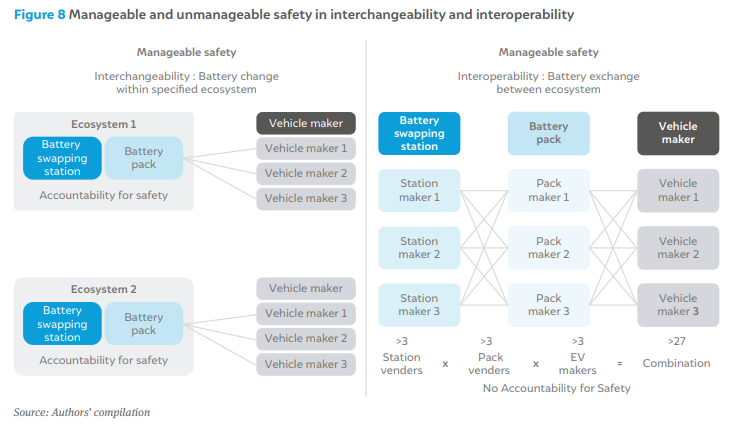
• Safety: Interoperability introduces combinations that may be challenging to manage and raises safety concerns. For instance, with the exact battery pack dimensions, form factors, and communication protocols, a combination of three battery providers, three swap operators, and three OEMs necessitates testing 27 configurations to ensure customer safety, which, according to IBSA, is impractical. In contrast, interchangeability (the exchange of batteries between vehicles within an ecosystem) is tested, safe, and transparent, ensuring traceability and accountability for the safety and performance of the entire swapping ecosystem.
• Legal framework: Defining mechanisms to assign liability in the event of accidents is necessary before pursuing interoperability. For example, if a battery from one company enters a swap station operated by another company and causes a fire incident, there is currently no clarity on who will be liable for that incident. Both battery and station companies might assert that their respective products are faultless.
• End-of-life recycling: In a closed-loop system under the “extended producer responsibility”, the respective BSOs and manufacturers have a greater role in properly disposing of batteries at the end of their life cycle. However, in an open system, where batteries move between systems, the accountability for recycling becomes unclear.
• Investments at risk: Over 30 companies have entered India’s battery swap space, investing millions of dollars to develop the necessary technology. IBSA believes that if any standards, apart from safety standards, are modified at this stage, the entire investment made so far could become obsolete.
• Innovation: Pushing towards a single standard may hinder innovation, as one size does not fit all. For example, there are scooters with power levels ranging from 800W to 8000W. Implementing a single battery size that meets all requirements for range, performance, power, and so on would limit OEMs’ and customers’ options, potentially discouraging customers from adopting EVs. Additionally, adopting a single standard would also restrict opportunities to export EVs globally, as different markets have various sets of requirements.
• Diversify battery swap options for customers: Standardising the dimensions of battery packs may lead to commoditisation, with the market focusing more on reducing swap costs to capture market share rather than on providing high-quality products. An open market enables BSOs to introduce newer products, offering customers a wide selection of options. For instance, companies are actively developing new battery packs, including solid-state batteries, which offer higher energy density and more charge cycles than lithium-ion batteries. These batteries are often smaller, more compact, easier to handle, and have a longer operational lifespan.
Regarding interoperability and standardisation, the IBSA maintains that:
• The appropriate battery sizes and connector interfaces should be allowed to evolve within the individual ecosystem over time-based on market acceptance. This flexibility will foster product innovation and ensure safe designs. Safety should take precedence over interoperability.
• IPR and royalty restrictions hamper innovation, thus creating unfavourable business conditions for promoting EVs.
The Department of Consumer Affairs, BIS, MoRTH, NITI Aayog, DST Society of Indian Automobile Manufacturers, IBSA, and industry stakeholders under the chairmanship of then Union Minister Mr Piyush Goyal met on 3 January 2023 to finalise the issue of interoperability (Minutes of the meeting attached in Annexure 10). They decided that the safety standards for batteries and swap stations should be prioritised, and all other requirements should be in abeyance. Point 14 in the minutes states:
After detailed deliberations, it was decided that Light Electric Vehicle (LEV) battery swapping interoperability standards may not be brought out at this stage since the technology is still evolving and the majority of manufacturers/swap operators are not in favour of the interoperable standards and the proposed dimensions for EV battery swapping. Further, the following was decided:
• BIS to prepare horizontal standards and battery specific quality control orders (QCOs) for all batteries.
• BIS may formulate stringent standards on the performance and safety of batteries and remove size from the Draft standard of battery swapping.
• A meeting of the Technical Committee, who have formulated the standards on batteries may be conducted at the earliest.
At the meeting held on 27 February 2024 by the Ministry of Consumer Affairs with various industrial stakeholders, the following was agreed upon (minutes of the meeting attached in Annexure 10):
QCO on battery swapping station standards delineating the policy on swapping stations be developed by the Government of India (GoI) in consultation with all the stakeholders, including Industry Associations. MHI may be requested to take this forward.
State policy framework
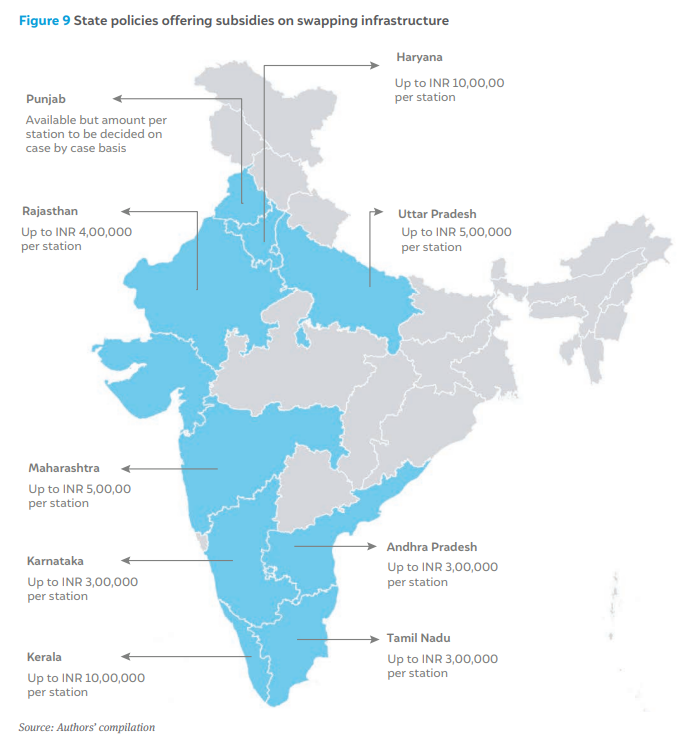
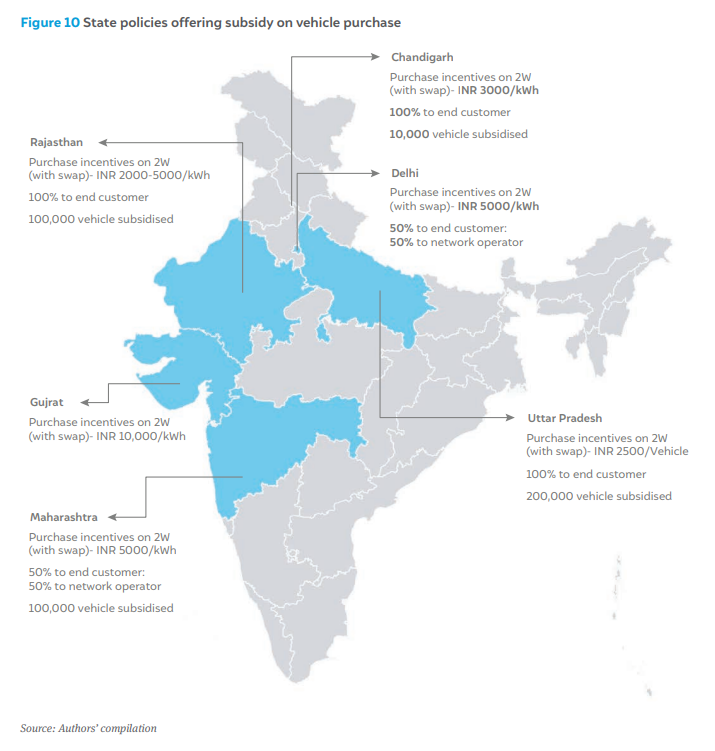
State policies developed in conjunction with national EV policies are critical for the rapid adoption of EVs. Since 2013, 28 state EV policies have been notified. Among these, nine include provisions to expedite the development of battery swapping (Figure 9). Additionally, some states offer subsidies on vehicle purchases (Figure 10).
Indian market
Battery swapping emerged in India in the early 2010s as a pragmatic complement to point charging and has attracted significant investment since 2015. This was followed by a series of developments and achievements that laid the groundwork for expanding battery swapping. In 2017, Ola, in collaboration with government and business partners, deployed a fleet of electric rickshaws featuring swappable batteries in Nagpur, Maharashtra. It was found that e-rickshaw drivers using swappable batteries could operate their vehicles for 25 per cent longer ranges than those with fixed Li-ion batteries. This pilot demonstrated battery swapping as a reliable charging method, particularly for small vehicles (2W, 3W).
In 2018, the Centre for Battery Engineering and Electric Vehicles at the Indian Institue of Technology Madras (IIT-M) Research Park built on the success of the 2017 Nagpur pilot and developed a prototype for a swappable battery.
Following this, explorations and investments in EVs with swappable batteries by Indian startups, large manufacturers, and global automakers intensified. As of 2024, India’s battery swap market size is approximately USD 500 million, with nearly 20 players in the market, as shown in Table 6 (Future Market Insights 2024). Annexure 5 provides the segment-wise distribution of battery swapping market players)
| 1. Amara Raja Power Systems | 8. Exter Energy | 15. Okaya Power Group |
| 2. BAAZ | 9. Energy Cafe - Indraprastha Gas Limited (IGL) | 16. Power Global |
| 3. Battery Pool | 10. Gogoro | 17. RACEnergy |
| 4. Battery Smart | 11. Honda Power Pack Energy India Pvt Ltd | 18. SAR group (Mooving, Lectrix, LivGuard) |
| 5. Bounce | 12. Jio BP | 19. SUN Mobility |
| 6. Charge-up | 13. Lithion Power | 20. Volt up |
| 7. Charge + Zone | 14. Mooving | 21. Yulu/Yuma |
Source: Authors’ compilation
These players consistently enhance their market presence through mergers, acquisitions, and collaborations. For instance,
• In late 2020, VoltUp announced a partnership with Hindustan Petroleum Corporation Limited (HPCL) to establish 50 battery swapping centres across India by June 2021. In early 2023, it partnered with Bharat Petroleum Corporation Ltd (BPCL), aiming to set up 650 swapping stations with over 7,800 charging docks across 50 cities over the next three years.
• SUN Mobility has partnered with companies including Amazon, the Delhi Metro Rail Corporation (DMRC), Bengaluru Metro Rail Corporation Limited (BMRCL), Indian Railways, Tata Power, Delhi Transco Ltd (DTL), Bosch, Uber, Vitol, and others to expand its network. In 2024, SUN Mobility formed a 50–50 joint venture with Indian Oil Corporation Limited (IOCL) to establish battery swapping stations at IOCL fuel pumps nationwide. As of July 2024, SUN Mobility has over 650 stations and has operated more than 550,000 km.
• In August 2021, Battery Smart partnered with GoMechanics to establish swap stations in their 100+ garages throughout India. In early 2022, they collaborated with Zypp Electric to integrate 2,000 Zypp electric 2Ws into its network. In early 2024, Battery Smart worked with Zepto to electrify last-mile deliveries. As of July 2024, Battery Smart operates around 1,140 swapping stations across more than 30 cities in India (Business Standard 2024). The company offers swapping services to over 50,000 vehicles using more than 150,000 Li-ion batteries.
• In early 2022, RACEenergy partnered with HPCL to launch its first battery swapping station in Hyderabad. Later, in 2023, it collaborated with Lohum to extend the life of swappable battery modules, seamlessly transitioning into practical second-life applications (Bhardwaj 2023).
• Mooving is growing rapidly and is currently among India’s top three battery swapping companies. It has 400 base stations across three cities, with over 10,000 batteries in circulation. In 2024, Mooving announced a partnership with HPCL to install automated swapping stations at more than 22,000 HPCL retail outlets nationwide (Pall 2024).
Investment and funding support driven by the market facilitated the expansion of these market players. Table 7 summarises this.
| Company Name | Investment received |
|---|---|
| Battery Smart | In 2022, they raised USD 25 million in a series A funding round, and in 2023, they successfully raised USD 33 million in a pre-series B funding round. Battery Smart has raised another USD 65 million in its recently concluded Series B funding round. |
| SUN Mobility | In 2024, SUN Mobility entered into a 50–50 joint venture with IOCL along with a USD 278 million investment from IOCL |
| RACEnergy | In August 2021, RACEnergy raised USD 1.3 million in a seed+round |
Source: Authors’ compilation
Segment-wise overview of battery swapping in India
2W segment
In the long term, the market for swap-capable e2Ws is expected to grow due to factors such as technological advancements in lithium-ion batteries, increased research and development spending by major players, and a rise in global e2W sales (Mordor Intelligence n.d.).
Significant progress in the battery swapping market for e2Ws commenced in 2021. Companies such as VoltUp, Gogoro, SUN Mobility, Honda Power Pack Energy India, SAR Group, and Yuma are operational in India. OEMs providing swap-capable e2Ws include Ampere, Shema, Omega Seiki Mobility, Honda, Bounce Infinity, Atul Auto, Piaggio, Swarna, Gogoro (their vehicle), and Lectrix.
As India boosts the appeal of electric mobility by lowering ownership costs and addressing concerns about EV charging times, the battery swap market is poised for growth. Research shows that gasoline-powered 2Ws are the most expensive to own and operate in India over the long term, regardless of usage levels.
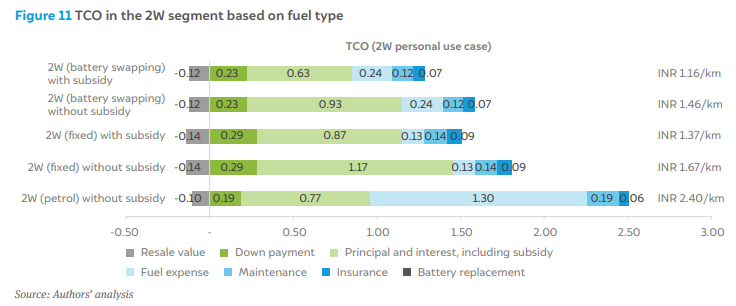
Literature indicates that in India, swap-capable e2Ws are primarily used for commercial applications where vehicle utilisation is high. To assess their suitability across various use cases, we calculated and compared the total cost of ownership (TCO) for ICE 2Ws, e2Ws with fixed batteries, and e2Ws with swappable batteries. The results demonstrate that even at lower daily usage–such as 30 km per day, typical for personal use–the TCO per kilometre for swap-capable e2Ws is lower than that of conventional ICE 2Ws and e2Ws with fixed batteries. Specifically, the TCO per kilometre for swap-capable e2Ws can be as low as INR 1.46 without subsidies.
Battery swapping, therefore, is a promising solution for 2Ws across all use cases from both operational and economic perspectives. This includes personal use and commercial operations by B2B enterprises, such as urban freight, e-commerce deliveries, and shared mobility. For instance, in 2023, Zypp Electric operated over 16,000 e-scooters and e-bikes in various Indian cities. Their primary clients include companies such as Zomato and Swiggy, which require a daily range of 100–120 km per vehicle, making battery swapping a cost-effective and efficient solution. Likewise, Delhivery, a Gurugram-based logistics and infrastructure provider, has been testing EVs for last-mile deliveries and is actively exploring battery swapping due to its potential to enhance e2W runtime.
Annexure 6 has further details on the TCO analysis.
3W segment
India’s transition to electric mobility focuses on electrifying the populous and polluting small vehicle segments. Consequently, e3Ws hold the second largest share in India’s battery swapping market, accounting for 24.5 per cent.
The expansion of battery swapping in this segment is due to several leading BSOs, including Battery Smart, SUN Mobility, RACEnergy, and international players, such as Honda, who add an international flavour to the Indian battery swap market. SUN Mobility, a prominent player in India’s battery swapping sector, has partnerships with brands such as Piaggio and Omega Seiki, providing a compact and portable battery swapping solution that requires minimal power and space to scale operations. Likewise, Battery Smart, another key player in the Indian market, mainly focuses on low-speed e-rickshaws and the ‘L3‘ EV category, collaborating with local businesses to establish swap stations. Honda Power Pack Energy has also teamed up with Omega Seiki and Atul Auto to offer a Honda Battery Swapping Solution (Honda e:Swap) for the 3W segment. Finally, RACEnergy provides a distinctive form of battery swapping that retrofits existing ICE 3Ws to EVs that are compatible with its swapping network.
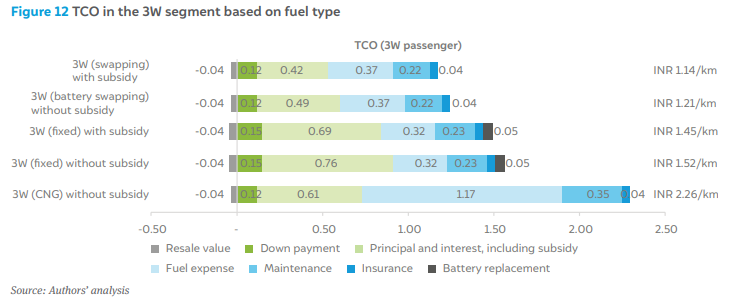
The TCO of e3Ws with swappable batteries is lower than that of their ICE counterparts, at INR 1.21 per km without subsidy (details on assumptions of TCO are in Annexure 6). In addition to their lower cost, swappable e3Ws allow for quick and convenient battery replacement, which increases the range of the vehicle and reduces downtime, making them an attractive option for shared mobility, last-mile delivery, and other commercial applications (Prasad, Uchida, and Feng 2023). Due to these benefits, several B2B logistics players are willing to switch to EVs (Prasad, Uchida, and Feng 2023).
Even in the 3W passenger segment, where the reliance on public charging is high, battery swapping is currently more cost-effective than point charging.
Studies have shown that access to residential charging presents challenges for many passenger e3W (L5M) drivers (Vahan Sewa n.d.). Additionally, dedicated parking spaces require improvement, leading drivers to park their vehicles on roads or in other public areas (Roychowdhury, Mohanty, and Shrivastava 2021). Furthermore, drivers with access to residential parking may lack the necessary electricity connections, electric equipment, and uninterrupted power supply to facilitate residential charging. These factors heighten the dependence of passenger e3Ws on public charging, which is more expensive, as noted above. Public charging is also less convenient, as BEV users lose the ease of charging their vehicles without leaving home.
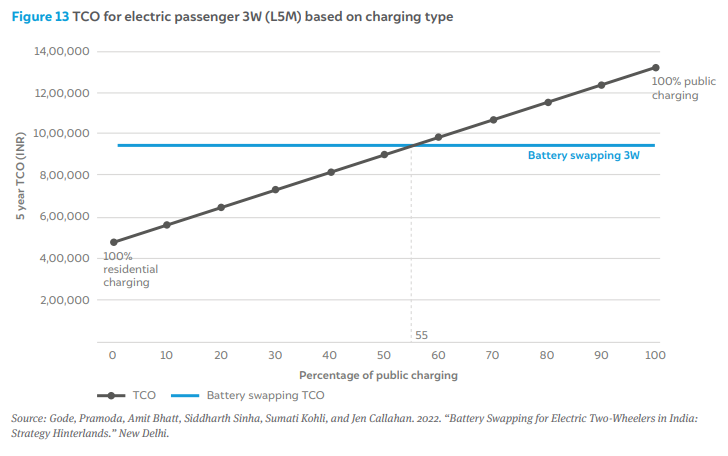
Figure 13 compares the 5-year TCO of passenger e3Ws using battery swapping with those using a combination of point charging and residential charging. The x-axis indicates the share of public charging in the total charging requirements of the e3Ws, while residential charging accounts for the remainder. The y-axis plots the 5-year TCO. Point charging is the most economical method when the majority of charging occurs through residential means. However, battery swapping becomes more economically viable for a passenger e3W when the dependence on public charging surpasses 55 per cent of total charging needs, as public charging incurs higher costs than residential charging. Additionally, there is an opportunity cost related to point charging (both residential and public), meaning a loss of earnings for the e3W driver due to the time spent at public charging stations to recharge the vehicle. Both of these costs increase the TCO when there is a significant reliance on public charging.
Consequently, battery swapping can increase the appeal of passenger e3Ws, particularly in situations where access to residential charging is restricted and reliance on public charging is high.
Bus segment
India has emerged as a leader for e-buses in South Asia, aiming to deploy 50,000 e-buses by 2030 (Shakti Sustainable Energy Foundation 2023) World Resources Institute (WRI. However, the high upfront cost of BEV buses is a significant challenge in their uptake. For BEV buses, the purchase cost is two to four times higher than that of conventional buses. Approximately 40 per cent of the cost of BEV buses is attributed to batteries (Kumar, Mulukutla, and Doshi 2024). Implementing battery swapping for BEVs in these segments can significantly reduce the initial cost of e-buses, thereby enhancing their cost competitiveness with conventional vehicles.
Battery swapping also provides the benefit of a shorter recharge time compared to point charging. Point charging buses take several hours when using a slow charger and about 40 minutes with a DC fast charger. In contrast, battery swapping requires only about three to six minutes. Therefore, battery swapping can significantly decrease charging downtime and enable BEVs to operate for extended periods.
Ashok Leyland spearheaded the initial efforts to launch a battery swap-capable e-bus in 2019 in collaboration with SUN Mobility. India’s first battery swap bus, the Circuit-S, was specifically designed for Indian conditions. That same year, the Ahmedabad Municipal Corporation issued a tender for 18 of these buses from Ashok Leyland under the gross cost model, wherein Ashok Leyland owned, operated, and maintained the buses while the municipal corporation compensated the company with a per-kilometre rate (EAI 2018). Eighteen e-buses were deployed as a pilot project and travelled over 650,000 kilometres in one year, achieving over 25,000 battery swaps. Additionally, SUN Mobility showcased its battery swapping solution for buses this year, unveiling the first 10.5-meter battery swappable buses for intercity and mofussil (i.e., regional, suburban) routes.
By separating the battery cost from the bus, for the first time, the upfront price of the buses is reduced to match that of a traditional diesel bus. The bus is uniquely designed for Indian mass transport, as the battery’s compact and lightweight form factor allows for more passenger space and standing room. Additionally, the swappable technology is compatible across various bus platforms. As per CEEW and IBSA estimates, when a subsidy is available, the TCO for battery swapping in buses is more appealing than fixed charging and diesel options. Figure 14 presents the TCO comparison of different fuel types in the bus segment.
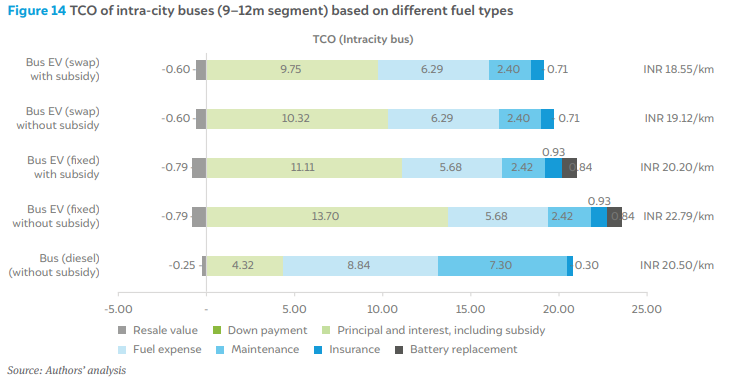
Truck segment
Similar to the bus segment, the high upfront cost of BEV trucks, which ranges from 2.5 to 3.5 times higher than conventional trucks (Kaur and Narla 2023), hinders their adoption. Since batteries account for about 40 per cent of the cost, implementing battery swapping for BEVs in these segments can significantly lower their upfront cost as the BEV would be sold without the battery. This improves their cost competitiveness compared to conventional vehicles. Additionally, as seen with BEV buses, battery swapping provides the benefit of a shorter recharging time, typically about three to six minutes. This greatly decreases charging downtime, enabling BEV trucks to operate longer, potentially increasing profits and minimising the opportunity cost of charging. Therefore, battery swapping in trucks could be a viable solution to stimulate growth in the electric truck market (Dalroad 2024).
Companies such as IPLTech Electric are exploring battery swapping for trucks. In September 2025, Montra Electric eM&HCV, belonging to the same parent company as IPLTech Electric launched the Rhino 5538 EV 4x2 TT, a 55-ton electric truck, at its manufacturing facility in Manesar, Haryana. The truck offers a range of 198 km on a single charge and battery swapping technology allows battery changes in under six minutes (Shiraguppi 2025). Currently, these systems are primarily used for short-haul applications at ports, mining sites, and in urban logistics.
Since 2020, China has promoted battery swapping technology, establishing itself as the world’s largest market for electric trucks (Cui, Xie, and Niu 2023). In 2022, China sold 36,000 electric trucks, accounting for 91 per cent of the global total. Drawing parallels from the growth of swap-capable trucks in China, India also has the potential to electrify the challenging heavy commercial vehicle segment through battery swapping.
According to CEEW, the TCO of truck battery swapping is more appealing than that of fixed charging and diesel segments. Figure 15 illustrates the TCO for battery swapping compared to fixed charging and diesel alternatives.
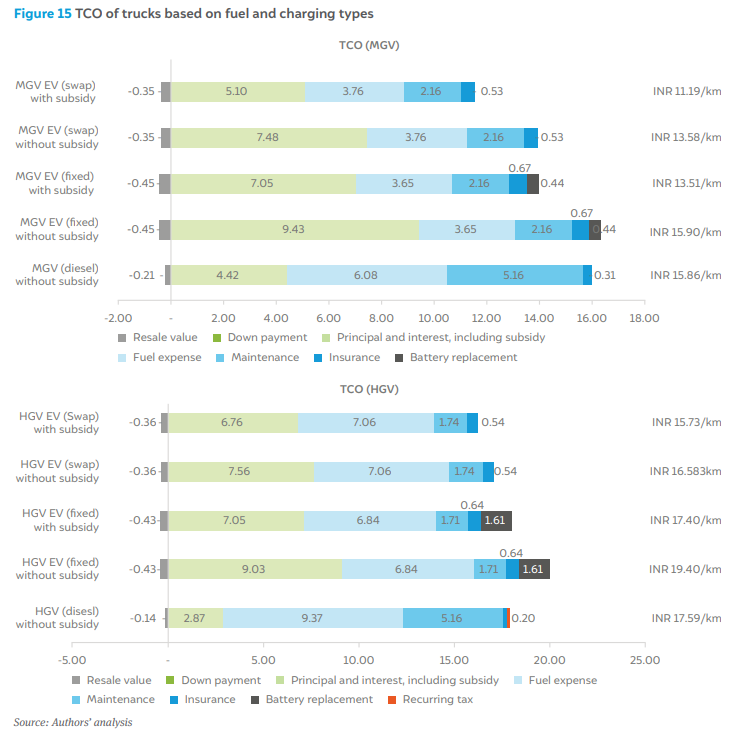
The Chinese province of Hainan offered a subsidy of 15 per cent of the total construction cost of battery swapping stations from January 2021 to December 2022 (Cui, Xie, and Niu 2023). The Qingdao City in China has also promoted battery-swappable electric buses by adopting the “vehicle-electricity separation” model, in which the Qingdao Municipal Government purchases electric buses without batteries and delivers them to the bus operator (United Nations 2023). The Qingdao Electric Power Company buys batteries from manufacturers and leases them to bus operators, while the State Grid Corporation of China mainly funds the construction of battery swap stations. In 2022, 49.5 per cent of the electric trucks sold in China were battery-swappable (Cui, Xie, and Niu 2023).
Hence, battery swapping could address critical challenges in adopting electric buses and trucks. The government should support pilot programmes to investigate the potential of battery swapping for these two vehicle segments in India.
The global battery swapping market is projected to reach USD 77 billion by 2047 (as discussed in Chapter 2). In an ambitious scenario, India has the potential to become a global leader by attaining a market size of USD 32.6 billion, which would represent a 42 per cent share. This growth will strengthen India’s position as a leading manufacturing hub and help establish the country as a major export centre for battery swapping vehicles.
This section outlines the potential growth of the EV market and the share of swap vehicles by 2047. We projected the impact on emissions from EVs replacing ICE vehicles, potential market investment, and jobs created through the development of the battery swapping ecosystem in two different scenarios – conservative and ambitious. The ultimate objective was to recommend the necessary interventions from different stakeholders in the ecosystem to realise the benefits of these projections.
Approach and methodology
Different Indian agencies have developed various energy models, including the CEEW– GCAM model, the Activity Analysis Model by IRADe, the India Emissions Model by ICCT, and MARKAL–TERI. However, most of these models are not open source, and very limited information is available regarding the sector-specific results and assumptions.
Therefore, we used the CEEW vehicle stock model to estimate the EV registration figures until 2047 (Soman et al. 2020). We analysed historical vehicle registration trends, GDP growth, and a survival curve function to calculate the on-road vehicle stock. We reviewed segmentwise vehicle registration data from 2000 to 2022 to project the vehicle stock through 2047. By employing a survival curve function, we assessed the vehicle age of the fleet and the vehicles retiring from operation due to age. Based on the on-road stock, we estimated the total vehicle registration numbers.
Out of the total year-on-year vehicle registrations, we considered the share of EV registrations based on the two scenarios from NITI Aayog and IIT Bombay’s India Energy Security Scenarios 2047 (IESS 2047). We selected IESS 2047 because it includes various policies concerning alternative energy resources, such as green hydrogen, energy storage, renewable purchase obligations, PM-KUSUM, offshore wind strategy, electric vehicle policy, and energy efficiency. While estimating the demand and supply of energy in the country, the tool also aids in calculating emissions, costs, and land and water requirements until 2047. The baseline was standardised in 2020 and calibrated through 2022, enhancing the model’s robustness by integrating the latest policies and technological advancements.
We calculated the percentage of swap-capable vehicles in new EV sales based on data from industry partners. Table 8 presents the percentage of EVs and swap vehicles across various vehicle segments.
| Indicators | Year | 2W (%) |
3W-P (%) |
3W-G (%) |
4W (%) |
Taxi (%) |
Bus (%) |
LGV (%) |
M&HGV (%) |
|---|---|---|---|---|---|---|---|---|---|
| Conservative scenario | |||||||||
| Share of EVs in new sales | 2030 | 30 | 30 | 36 | 13 | 16 | 16 | 20 | 1 |
| 2047 | 80 | 80 | 80 | 40 | 40 | 40 | 40 | 4 | |
| Share of swap vehicles in new EV sales | 2030 | 30 | 50 | 55 | 0 | 0 | 40 | 15 | 40 |
| 2047 | 30 | 50 | 55 | 0 | 0 | 70 | 15 | 40 | |
| Ambitious scenario | |||||||||
| Share of EVs in new sales | 2030 | 70 | 90 | 90 | 17 | 22 | 50 | 55 | 22 |
| 2047 | 100 | 100 | 100 | 50 | 60 | 100 | 100 | 80 | |
| Share of swap vehicles in new EV sales | 2030 | 60 | 80 | 80 | 5 | 10 | 70 | 55 | 70 |
| 2047 | 60 | 80 | 80 | 5 | 10 | 70 | 55 | 70 | |
Source: Authors’ compilation from India Energy Security Scenarios, 2047 and industry inputs
Overview of the ambitious and conservative scenarios
This section provides an overview of the ambitious and conservative scenarios. We developed these two scenarios to understand the implications of battery swapping in the overall EV market. The scenarios, which project the number of EVs, are based on estimates from IESS 2047, developed by NITI Aayog and IIT Bombay.
• The conservative scenario is based on the ambition level 3 of the transport sector in IESS 2047, where the electrification of both private and mass transit vehicles reaches 40 per cent. In the 2W and 3W segments, this figure will reach 80 per cent by 2047.
• The estimated swap percentages in new EV sales are based on industry inputs for conservative and ambitious scenarios.
• The ambitious scenario, based on the level 4 ambition from IESS 2047 and industry estimates, envisions a higher adoption of EVs due to battery swapping. The greater penetration of EVs is primarily driven by the increasing prominence of battery swapping. It employs the rationale of separating the vehicle from the battery costs, which account for nearly 40 per cent of the vehicle cost, thus making TCO more attractive. This will be particularly true for the heavy electric vehicle segments, including trucks and buses.
Assumptions concerning the calculations of emissions abated, jobs created, and the market value of components
The increased number of EVs on the road, reducing the tailpipe emissions of the corresponding ICE vehicles, has been projected for 2047 using the combustion emission factors highlighted in Table 9 and the annual utilisation of the vehicles noted in Table 10.
| Emission factors | ||
|---|---|---|
| Petrol | 2.2719 | kg CO2/l |
| Diesel | 2.6444 | kg CO2/l |
| CNG | 2.6920 | kg CO2/kg |
Source: India GHG Program. 2015. “India Specic Road Transport Emission Factors.” Mumbai: India GHG Program.
| Year | Annual utilisation | ||||||
|---|---|---|---|---|---|---|---|
| 2Ws | Cars | Taxis | 3Ws | Buses | LGVs | M&HGVs | |
| 2047 | 6,300 | 11,560 | 70,000 | 27,900 | 62,000 | 30,000 | 65,816 |
Source: Soman, Abhinav, Harsimran Kaur, Himani Jain, and Karthik Ganesan. 2020. “India’s Electric Vehicle Transition: Can Electric Mobility Support India’s Sustainable Economic Recovery Post COVID-19?” New Delhi: Council on Energy, Environment and Water.
The jobs related to manufacturing, repair and maintenance, operations, and servicing are estimated using the job coefficients discussed with IBSA and listed in Table 11.
| Job coefficients | LEVs | HEVs | |
|---|---|---|---|
| Batteries | Manufacturing (batteries per person) | 66.7 | 66.7 |
| Repair and maintenance (batteries per person) | 80.0 | 80.0 | |
| Swap stations | Manufacturing (stations per person) | 4.0 | 2.7 |
| Operators (stations per person) | 1.5 | 1.5 | |
| Service (batteries per person) | 160.0 | 266.7 |
Source: Authors’ analysis
The market value of the various components in the battery swapping ecosystem, primarily the swap stations and the batteries, is estimated based on the costs provided by the different BSOs. Table 12 presents an overview of the costs related to the swap station.
| Vehicle segment | Cost of swap stations without batteries (lakh INR) |
|---|---|
| 2W | 1.5–15 |
| 3W - P | 1.5–15 |
| 4W | 50–150 |
| Taxis | 50–150 |
| Buses | 60–150 |
| 3W-G | 8 |
| LGVs | 50 |
| M&HGVs | 70–150 |
Source: Authors’ analysis
To estimate the cost of the batteries, we calculated the inventory of spare batteries and the corresponding swap stations based on inputs from the relevant BSOs. The cost projection for lithium-ion batteries is derived from Bloomberg NEF’s forecast (Bloomberg NEF 2023). The cost decline is assumed to level off at USD 80 per kWh.
Forecasting EV and battery swap market for 2047: Conservative scenario
In a conservative scenario, EV penetration in new sales will be most significant for the 2W and the 3W, primarily driven by the lower TCO, the availability of various vehicle models in the market, and convenient charging options. The bus segment will also gain traction mainly due to various government schemes, such as the PM e-Bus Sewa Scheme, and new business models like the ‘gross cost contract’, which mitigates the higher upfront costs of electric buses. Four-wheelers, particularly for commercial purposes, will start gaining traction due to mandate policies such as the Delhi Motor Vehicle Aggregator Policy, which establishes targets for fleet operators to adopt a certain percentage of EVs in their fleets.
In the freight segments, the 3W goods vehicles and the LGV category will be the first to electrify due to lower TCO and the introduction of more EV models from various manufacturers. Electrification in medium and heavy goods vehicles will remain limited, primarily because of higher TCO and the few models available in the market.
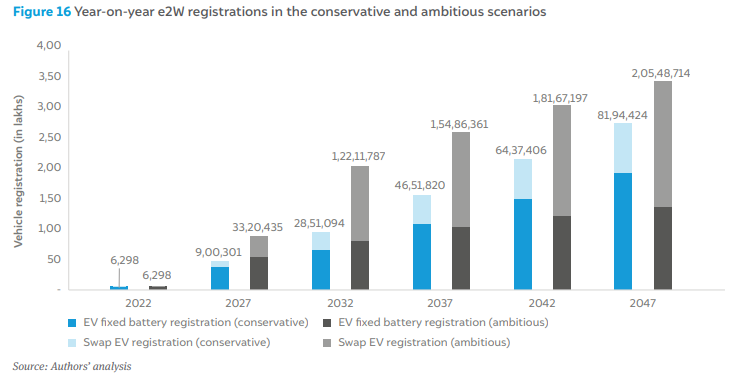
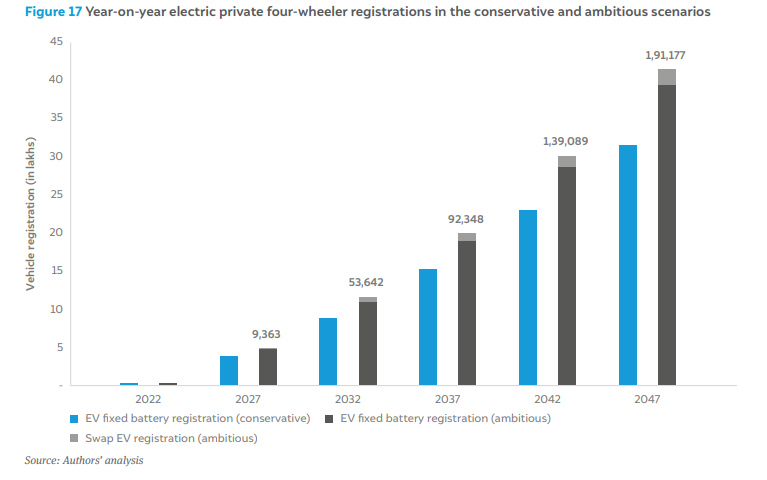
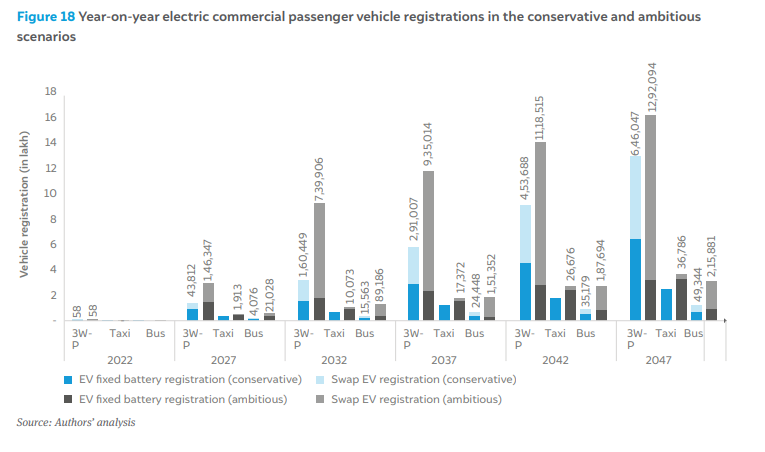
Swappable battery vehicles will expand in the smaller vehicle segments, specifically the 2W and 3W categories. Due to faster refuelling, swap vehicles are expected to offer greater profitability in commercial segments than fixed-charging counterparts, leading to increased operational kilometres. Additionally, heavy electric vehicles, including buses and mediumand heavy-duty trucks, will also experience significant adoption of swap vehicles, primarily driven by various BSOs entering this market.
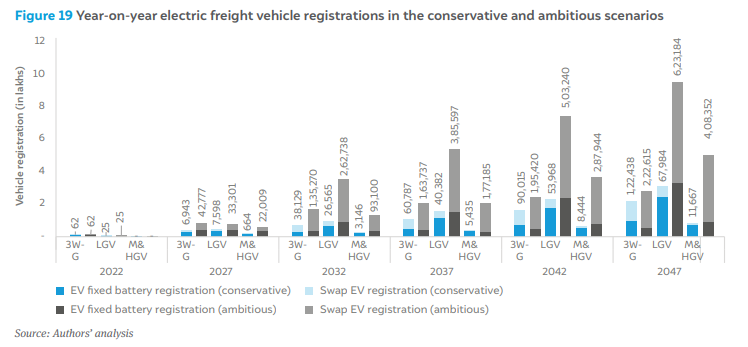
The potential impact of the battery swapping market in a conservative scenario highlights that the growth in this market will offer numerous benefits to the economy, particularly in terms of employment generated through manufacturing and repairing batteries. Moreover, jobs will be created in manufacturing battery swap stations, as well as in operations and services. This is expected to result in a combined workforce of approximately 3.6 million jobs created cumulatively by 2047. Furthermore, the batteries in circulation and the swap stations deployed by 2047 can collectively generate a market value of USD 40 billion. The EVs added on the road by 2047 will lead to cumulative savings of around 275 million tonnes of CO2 emissions.
Forecasting EV and battery swapping market for 2047: Ambitious scenario
In an ambitious scenario, EV penetration is expected to increase significantly compared to the conservative scenario. A set of policies, EV mandates, and manufacturing programmes will create the economies of scale necessary to support this ambitious growth trajectory. Swap vehicles in both the passenger and freight sectors are projected to grow 2.5 times more in ambitious scenarios than in conservative scenarios.
The widespread availability of battery swapping technologies across vehicle segments will be crucial in lowering the capital costs of EVs, thereby catalysing the EV market share. The increase in the penetration of swap vehicles will diminish the TCOs of electric vehicles. Consequently, a more extensive network of swapping stations will alleviate users’ range anxiety. Under ambitious scenarios, the advantages of reduced upfront costs and quicker refuelling through swapping will be most significant in the commercial vehicle segments, particularly in medium and heavy goods vehicles.
The potential impact of the battery swapping market in the ambitious scenario is significant. The ambitious growth of the swapping industry will lead to the creation of 14 million jobs cumulatively by 2047, and the combined market value of swap stations and batteries could reach USD 110 billion. The jobs and market opportunities created in this ambitious scenario are approximately three to four times higher than those in the conservative scenario. As a result, the EVs added on the road by 2047 will yield cumulative savings of about 700 million tonnes of CO2 emissions, which is roughly three times more than in the conservative scenario.
A comprehensive mapping exercise was carried out to identify the stakeholders involved in the battery swapping industry. Subsequently, three sets of consultations took place in June 2024. This section discusses the various challenges and obstacles highlighted by stakeholders.
Challenges highlighted by the vehicle original equipment manufacturers
Challenges in the existing regulations
• Registering vehicles without batteries: According to the MoRTH circular RT11036/72/2017 regarding the “Sale and Registration of Electric Vehicles without Batteries” dated 12 August 2020, vehicles without batteries can be registered based on the Type Approval Certificate issued by an accredited testing agency, without the need to specify the make, type, or any other details of the battery. However, challenges arise when attempting to register these vehicles at RTOs without batteries, primarily due to the limitations in the homologation certificate issued by testing agencies that fail to distinguish between fixed, removable, and swappable technologies in EVs.
• Registering EVs without batteries in the M and N categories: The MoRTH circular (RT-11036/72/2017) currently covers only the “L” category of vehicles, which includes 2Ws and 3Ws. However, given the rise of electric vehicles in the 4W segment, the registration of vehicles without batteries should also be extended to light commercial vehicles, buses, and trucks. However, post the consultations, ARAI notification, AIS 038 (Rev-2), Amendment-4 issued in August 2024, makes provisions for the registration of EVs without batteries in the M and N categories and this no longer remains a challenge.
• Lack of subsidies and incentives for swap vehicles: Demand-side incentives under previous schemes, such as the FAME I & II and the Electric Mobility Promotion Scheme (EMPS), as well as current initiatives like the PM e-Bus Sewa Scheme, favour fixed-battery vehicles due to their incentive structure (subsidies based on battery size). Additionally, certain clauses in the PM e-Bus Sewa Scheme tender that specify minimum ranges of 200, 180, and 160 km on a single charge hinder the ability to benefit from battery swapping.
• High interest rates for users: Financing options for EVs and related systems come with very high rates due to a lack of trust in the new technology and the high perceived risks by financial institutions. Accessing long-term financing for EVs, including battery swapping models, is difficult. As a result, establishing large-scale manufacturing facilities has become a challenge for OEMs.
• Onboard chargers for EVs: Currently, vehicle OEMs are required to include the onboard charger with their vehicles. However, since the swap vehicle does not need a charger, as it is swapped in a public place rather than at home, this requirement hampers swap vehicle OEMs from obtaining homologation for their vehicles without the chargers.
Challenges highlighted by the battery swapping operators
Challenges in the existing regulations
• Pending notification of the battery swapping policy: NITI Aayog drafted a battery swapping policy and published it for comments in 2022. Industry players provided their comments on the draft Battery Swapping Policy for NITI Aayog’s consideration (attached in Annexure 1). Notifying the Battery Swapping Policy will provide a roadmap for various stakeholders in the ecosystem to facilitate the deployment of battery swapping stations. Consultations with stakeholders from the battery swapping ecosystem highlighted myriad challenges, including the inverted GST structure, incentive parity, recognition in national and sub-national policies, the vehicle registration process, etc. The draft policy covers essential aspects such as the second life of batteries, recycling, data sharing and communication, safety standards, potential subsidy schemes, and tariffs for electricity which supports the growth of battery swapping. In January 2025, however, the MoP issued guidelines for the Installation and Operation of Battery Swapping and Charging Stations which provides the necessary structure for stakeholders in the battery swapping ecosystem to operate.
• Lack of a clear definition of battery swapping stations: The distinction between a battery charging station and a BSS is arbitrary and confusing. All battery swapping stations currently deployed charge batteries, yet industry players refer to them as BSS. However, this contradicts the terminology introduced by the MoP and can lead to misinterpretation by on-ground agencies such as urban local bodies, discoms, and land authorities. It must be noted that this challenge has been addressed by the MoP guidelines issued in 2025 which provide clear definitions for battery swapping stations and its associated technology.
• Inadequate safety standards for battery swap stations: Certain guidelines and safety standards for battery swap systems are essential as the government promotes BaaS and battery swapping to enhance consumer convenience and increase the adoption of EVs at scale. BIS developed the drafts of IS 17896 (Part 1):2022/ IEC TS 62840-1:2016 and IS 17896 (Part 2):2022/ IEC 62840-2:2016 in 2022, outlining the essential guidelines and safety requirements for battery swap stations. However, the standards remain at a draft stage and have yet to be notified. The notification of these standards is imperative to ensure the safety of battery swapping stations and provide essential guidelines to plan the infrastructure.
• Contradictions in policies and tenders regarding fixed charging and battery swapping: The policies and tenders issued by various government agencies at both national and sub-national levels exclude battery swapping and only mention public charging stations. Therefore, the government should ensure technology-agnostic policies and tender documents to create a level playing field for both swappable and fixed electric vehicles. The current version of the Charging Infrastructure Guidelines issued by the Ministry of Power also heavily favours point charging in its description of requirements, procedures, tariffs, provisions, standards, and more. The unintentional omission of battery swapping as a charging alternative places this infrastructure and mobility solution at a disadvantage.
• Exclusion from the PLI scheme: Currently, critical EV components, including battery packs, battery management systems, and charging or swapping infrastructure, are excluded from the PLI scheme. Including these components in the PLI scheme will help reduce the overall costs of EVs and facilitate wide-scale adoption.
• Exclusion from the PM E-DRIVE Scheme: Initially, battery swap vehicles were not eligible for demand incentives. Furthermore, the budget for EV PCS did not include battery swapping stations. Extending the scheme’s incentives to cover battery swap vehicles and stations will facilitate widespread adoption. Recognising this, in September 2025, the Ministry of Heavy Industries issued the operational guidelines for the deployment of EV PCS under the PM E-DRIVE scheme under which BSS will be eligible for financial support to set up upstream infrastructure and EVSE costs in certain cases (Table 4).
• Exclusion from the PM e-Bus Sewa Scheme: Battery swap buses face challenges in accessing the opportunities provided by the PM e-Bus Sewa Scheme due to the technical specifications of the tender. The specifications stipulate that the minimum range of the e-bus on a single charge must be (i) 200 km (at 80 per cent SoC) for a 12 m bus, (ii) 180 km (at 80 per cent SoC) for a 9 m bus, and (iii) 160 km (at 80 per cent SoC) for a 7 m bus. These requirements hinder the adoption of battery swapping technology.
Challenges related to the financing of swapping stations and batteries
• GST parity for batteries: Battery swapping is a capital-intensive business. In addition to the batteries in circulation with each subscriber, BSOs need to maintain additional batteries charging on standby–between 30 per cent and 50 per cent more batteries than those in circulation. Furthermore, while a 5 per cent GST applies to batteries pre-fitted to an EV, the rate increases to 18 per cent if the batteries are purchased separately. This higher taxation significantly impacts the BSO, which must keep a substantial inventory of spare batteries in addition to those in circulation at any given time. Achieving GST parity will create a level playing field and support the EV growth targets set by the government.
• Blocked working capital: Currently, to provide battery swapping services, the operator purchases batteries with an 18 per cent GST, while recovery is anticipated over a period of 5 to 7 years, depending on the battery’s lifespan. As the battery swapping sector in the country is still developing, BSOs are significantly investing in establishing battery swapping infrastructure to meet the growing demand. However, considerable capital is being tied up due to the government’s GST input credit. Given that the majority of the swapping operators are start-ups in the early growth stage, GST parity will provide a level playing field and help achieve the EV growth targets envisioned by the Government.
• Difficulty accessing long-term financing: Battery swapping is a capital-intensive venture because operators must account for land rents, battery inventory for swap stations, upstream infrastructure, and more. However, due to the risks associated with this nascent market and the uncertainty regarding the future proliferation of battery swapping technology, financiers are reluctant to provide long-term loans.
• High electricity tariffs: Electricity tariffs vary across different states, with costs reaching as high as INR 8 per kWh in some instances. These elevated costs render battery swapping operations unviable. Furthermore, BSOs struggle to obtain electricity at an attractive price for their swap stations. India’s power sector regulations stipulate that only consumers with a contracted 1 MW or higher demand can purchase electricity through open access. However, as part of their EV policies, Andhra Pradesh, Delhi, and Madhya Pradesh have lifted this restriction, permitting the purchase of electricity of over 100 kW. Open access allows customers to procure electricity at lower prices from various competitive electricity providers rather than being confined to the local provider. The government should consider replicating the 100 kW contracted demand across states.
Challenges regarding infrastructure
• Limited upstream infrastructure: In the absence of subsidised EV connections, there are economic challenges as they compete with fixed vehicles that enjoy these advantages. The minimum requirement is 30 kW per swap station. If multiple swapping stations exist, the power requirements could increase to 60 kW and 90 kW. When electricity demand exceeds 50 kW, most discoms require the BSOs to obtain a high-tension connection or set up a transformer to accommodate the swap stations.
• Poor quality of power supplied to swap stations: In various regions, particularly in rural areas, the quality of power fluctuates with regard to voltage dips. This further hampers the charging of the batteries in the swap stations. The issues with power dips are intensified in the case of heavy electric vehicles, which require a 440 V connection from a minimum of 66 / 120 KV feeders. However, only the regular 33/11 kV feeder is available.
• Delay in PESO approvals: The current Petroleum and Explosives Safety Organisation (PESO) approval process is not suited for an EV-ready future, where numerous applications will be submitted for swap stations and point charging station deployment at petrol pumps. While the current approval timeline is 21 days, the typical approval process takes 30 to 45 days per station, which hampers the large-scale deployment of battery swapping stations. Therefore, capacity, standard operating procedures, and processes need to be enhanced for a quicker turnaround.
• Land approvals: Accessing real estate required for setting up infrastructure for battery swapping presents a challenge. Existing stations often lack the necessary space (approximately 500 sq. ft.) to accommodate transformers alongside swapping facilities, which are essential for providing the required power.
Challenges regarding the operations of swap stations
• Traceability and end-of-life use of batteries: The absence of protocols or regulations on traceability and end-of-life use of batteries makes it challenging to to understand how the batteries are used beyond their first life. To address this, UINs assigned by BSOs to track the assets need to be in place.
Challenges highlighted by fleet operators
• Higher GST on swapping: Battery swapping players provide BaaS to their consumers, meaning the battery is leased to the customer, who pays a subscription fee. If batteries incur 5 per cent GST, the energy operator experiences 13 per cent lower blocked working capital, resulting in a reduced cost of capital that can be passed on to the customer. Battery swapping mainly exists in the B2B sector, particularly in last-mile connectivity and delivery. A preferential GST on battery packs will directly enhance the livelihoods of gig workers using battery swap vehicles.
Example: Considering a battery cost of INR 40,000, the additional GST for 2 BP is (40000*2*13 per cent) = INR 10,400. The extra annual capital cost on this GST would be INR 1,040 (assuming a 10 per cent interest rate).
• Exclusion of low-speed 2Ws (micro-mobility) from CMVR: Battery swapping is widespread in the micro-mobility segments and is often used extensively in the gig economy. Despite a significant number on the road, these vehicles are often not included in the EV targets. The lack of registration poses challenges for various state and city authorities in regulating them. Their informal nature frequently results in safety concerns, leading to restrictive measures.
Challenges highlighted by financiers
• Information asymmetry: Investors require clear insights into the technology, support for project pipelines, and advisory assistance. The nascent nature of the sector has led to limited information availability. This scarcity of information and the perceived risks associated with rapidly evolving technology hinder investors from funding innovative companies (Palai and Vashi 2024).
• Complex asset valuation: Valuing assets in the EV sector is complicated, mainly due to uncertainty about the lifespan of their components. This challenge prevails in the battery swapping sector as well. As a result, financiers face difficulties in determining asset values and incur high capital costs to mitigate risks. Moreover, the lack of clarity on the salvage value of components and the limited secondary markets further intensify this challenge (Pmanifold 2019).
Proposed vision: By 2037, overall battery swapping services will see significant improvements, and by 2047, the entire battery swapping service network will be both convenient and efficient. Enterprises will develop EV products that offer a combination of charging and swapping options along with flexible battery configurations. Battery swapping will be promoted, the construction of swapping infrastructure will be expedited, and the modular traction battery standard system will be established and enhanced.
Market size and growth: Over the next two decades, the number of vehicles potentially needing battery swapping is expected to reach 9 million in a conservative scenario and could increase by 2.6 times in an ambitious scenario to 23 million.
Estimated impact: In an ambitious scenario, the catalysed battery swapping market could grow to USD 110 billion by 2047, creating 14 million jobs and helping achieve greater EV penetration across vehicle segments. It may also reduce a potential 700 MT of CO2 emissions.
National battery swapping programme as a solution: To nudge suitable swappable battery vehicle models and innovative and competitive financing and swapping operators in the market, battery swapping promotion programmes offering critical R&D, incentives and collaborations are planned. The programme will develop suitable policies, standards, and guidelines to catalyse the market. A diverse pool of pilot projects could be supported in the interim years. This, along with robust policy and regulatory frameworks, can facilitate more than 3 million battery swapping stations, supporting 22 million vehicles on the road.
Short-term interventions (2030)
• Ensure GST parity in batteries: MoF and GST Council can ensure a 5 per cent GST rate for all automotive advanced cell chemistry batteries certified to AIS 156 irrespective of whether they are being used for swapping or fixed battery services. For details, see Annexure 9.
• Address technology-agnostic policies and tenders: MHI can ensure equal treatment of battery swap stations alongside point charging stations in all tenders and state and national EV policies. As both BSOs and charge-point operators have emphasised similar difficulties faced in setting up swapping and charging stations respectively, Incentives for developing charging infrastructure could be made technology-neutral, so that they apply to all charging solutions, including battery swapping and point charging. For instance, tender clauses that specify minimum ranges prevent leveraging the benefits of battery swapping. As charging infrastructure technology evolves, establishing a level playing field for all charging solutions is essential for fair competition. Ultimately, the market will determine the most effective charging solution for specific BEV use cases and applications.
• Issue safety standards for battery swap stations: BIS can notify the safety standards and other essential guidelines for battery swap stations catering to L-category vehicles. Defining clear safety standards and accountability mechanisms ensures that repurposed batteries do not pose safety hazards. Enforcing accountability guarantees that all stakeholders, including manufacturers, users, and recyclers, comply with the necessary safety and environmental standards. Regulatory bodies must establish standards for testing and certifying second-life batteries. This includes defining protocols for safety checks, performance testing, and implementing certification processes. Furthermore, clear guidelines must specify who is responsible for these checks and what actions should be taken if a battery fails to meet the standards. This ensures that each stage of the battery lifecycle is managed responsibly. Annexure 8 includes a proposal regarding the safety standards of the battery swapping station.
• Streamline the registration of EVs without batteries: MoRTH may amend tables 13 and 7 of the homologation certificate to add a column for differentiating EV technologies as swappable, fixed, or removable. Additionally, the existing CMVR can be amended to include the registration of low-speed electric 2Ws under the “L” category. Allowing the registration of various vehicle types without batteries can promote the adoption of battery swapping technologies and lower the upfront cost of EVs. This flexibility will benefit consumers and foster the growth of a robust battery swapping infrastructure. Furthermore, reselling vehicles without batteries is simpler, as batteries can deteriorate faster than other components. In the case of a vehicle without a battery, there is no need to assess the battery’s health at the time of resale. Changes to existing vehicle registration forms and processes are necessary. Separate categories and forms can be introduced for vehicles designed to utilise battery swapping systems. Relevant vehicle registration legislation needs to be amended to accommodate batteryless vehicle registrations, ensuring that the process remains straightforward and accessible for all vehicle segments.
• Accredit retrofitters and extend registration certificates for retrofitted EVs beyond their end of life: Standards need to be established to guarantee the safety, reliability, and environmental sustainability of the retrofitting process. Regulatory frameworks, supported by DST, can ensure compliance with stringent criteria, build trust among stakeholders, and promote technological advancements in EV infrastructure. Accreditation ensures that retrofitters possess the necessary skills and knowledge to safely and effectively convert vehicles to electric power. This guarantees high-quality conversions while maintaining safety standards, thereby boosting consumer confidence in retrofitted vehicles. Retrofitment will play a crucial role in battery swapping across all vehicle segments in India. Thus, the timely implementation of the required regulatory mechanisms will facilitate the adoption of retrofitted vehicles, further amplifying overall EV adoption.
Diesel trucks that over 10 years old are not allowed to operate in tier 1 cities, leading to their sale in tier 2 or tier 3 cities, where they continue to run for an additional 10 years (as per the Indian scrap policy), following which they often receive a 5-year extension, resulting in no reduction in net carbon emissions. Retrofitment can serve as a solution to this challenge. The cost of these repowered or retrofitted EV trucks will be 70 per cent of the price of a new EV truck.
A certification process needs to be developed, outlining eligibility criteria, testing procedures, and standards for workshop management. This entails defining who can apply for accreditation, how they will be evaluated, and the standards they must achieve. The process should also address the responsibilities of retrofitters and OEMs to ensure comprehensive oversight and quality control. Additionally, for retrofitted vehicles, it is reccomended that:
- MoRTH extend the vehicle lifespan of EVs post-retrofitting beyond the conventional 10–15-year limit.
- MoRTH and the relevant testing agencies ensure that the homologation of retrofitted vehicles complies with AIS 123 Parts 1, 2, and 3.
- Retrofitted vehicles be integrated into Vahan, and MoRTH must ensure that the retrofitted EVs receive a green number plate after registration.
The regional transport office may also extend the registration certificates of retrofitted EVs upon verifying the certificates provided by the testing agencies.
• Strengthening Financial and Institutional Support for BSOs: Sustained growth of BSOs requires access to affordable, long-term financing options for BSOs, fleet operators, and end-consumers, facilitated through low-interest credit solutions. In parallel, BSOs can enhance the efficiency and reach of swapping networks by forging public–private partnerships with government entities and PSUs, thereby leveraging existing institutional infrastructure for scalable deployment.
• Mandate battery traceability: The MHI can mandate end-to-end tracking of batteries by requiring manufacturers to assign a UIN at the manufacturing stage, enabling lifecycle tracking, monitoring, and safe repurposing, recycling, or disposal. Ensuring comprehensive traceability is critical for maintaining safety, performance, and environmental compliance, including tracking battery condition, usage patterns, and end-of-life handling.
The MoEFCC can promote IoT-based battery monitoring, along with advanced telematics and asset tracking systems, to capture data on battery health, location, and history and support recall processes.
For battery traceability, MoRTH has issued draft guidelines for implementing the Battery Pack Aadhaar System, mandating a unique 21-character Battery Pack Aadhaar Number (BPAN) for each EV battery pack, acting as a digital passport from raw material to recycling and disposal.
• Provide clarity on safety standards and accountability: Enforce battery safety standards to ensure the safe use and disposal of batteries. BIS can offer clarity on regulations that manufacturers must follow to minimise risks such as overheating, leaks, or explosions, thereby protecting consumers and the environment. This can help ensure accountability and further advance standards with innovations and evolving technology.
• Establish a phased manufacturing plan: MHI can strengthen automotive advanced cell chemistries through targeted research funding, collaborative industry partnerships, and regulatory support. This entails inclusion in investing in R&D initiatives to improve vehicle performance, range, and sustainability, thereby ensuring a competitive advantage in the battery market.
• Review of battery state of health for battery management: According to the current Battery Waste Management Rules, 2022, dead batteries are defined by their years in operation. However, battery health, assessed by the state of health (SoH), is a more scientific and reliable method that evaluates battery condition based on actual utilisation. For instance, a battery may be in service for a longer period, but its effective utilisation could be less. Consequently, the need for refurbishment or recycling might arise later than the specified duration. The effective utilisation of the battery and its remaining health is accurately measured using the battery management system, represented as SoH. A battery with a SoH of less than 70 per cent may require a second life. Integrating older batteries into the current system ensures that resources are not wasted and that all batteries comply with updated safety standards. Additionally, it helps manage the environmental impact of batteries and promotes the efficient use of available resources. We recommend establishing a process for re-certifying or upgrading older batteries to meet current standards. This may involve testing and, if necessary, refurbishing batteries before reintroducing them into the swap network. This ensures that even older batteries can be safely and effectively utilised within the updated system, reducing waste and maximising resource use.
Medium-term (2037) and long-term (2047) plans
• Pilots to explore the potential of B2G models: BSOs should launch pilot projects with discoms to assess the technical and economic feasibility of using BSS for demand-side management solutions.
• Pilot interoperability, standardisation and issue specifications for BSS: The industry is already pursuing intra-network interoperability. Inter-network interoperability can be explored in the long term through consultations with BSOs, and vehicle & battery OEMs based on field deployment experiences. MHI and/or DST can encourage, partially fund, or facilitate prominent BSOs to initiate pilot programmes focusing on battery interoperability and standardisation. This involves developing technical protocols and interfaces that enable different battery systems to communicate and operate cohesively. Such initiatives include creating standardised connectors, communication protocols, and data exchange formats to ensure compatibility across various manufacturers and applications. Also, draft specifications developed in partnership with BIS can help work towards the interchangeability of batteries among vehicles from various manufacturers and enhance safety standards nationwide.
- DST, GOI has partnered with InfinityX Innovations Pvt. ltd. to pilot automated EV battery swapping stations.
- The solution features modular, thermally stable batteries compatible across multiple vehicle platforms, supporting interoperability and scalable deployment.
• Develop export capabilities: MHI can recommend creating export capacities in battery swapping. This entails implementing communication protocols and interfaces to ensure compatibility with global electric vehicle networks. By concentrating on scalability and efficiency, the industry can build a robust export market for battery swapping technology.
• Invest in R&D for innovative technologies such as solid-state batteries: DST, in collaboration with MoF, can take the lead in R&D for technologies such as solid-state batteries by offering grants, tax incentives, and fostering public-private partnerships that will evolve in the coming years.
• Invest in skill development for battery swapping: The industry and educational institutions can provide specialised training programmes that address battery management systems, safety protocols, and the integration of swapping stations with electric vehicle networks. Upskilling mechanics and other workers in the EV ecosystem is vital to maintain safety and efficiency standards. Skilled workers play a crucial role in ensuring the proper installation, maintenance, and repair of EVs and their components, including batteries. Training programmes and certifications must be designed in collaboration with industry stakeholders to ensure workers know about the latest technologies and standards. These programmes should encompass various aspects of EV technology, including battery manufacturing, swapping stations, and related components. This will help develop a well-trained workforce capable of supporting the growing EV market.
• Establish an inter-departmental agency for optimal grid and swapping hub performance: An agency for inter-departmental coordination may be formed, or a specific ministry can undertake the responsibility of coordinating policies and promoting data sharing among the energy, transportation, and technology departments, efficiently integrating battery swapping hubs with the national grid.
• Develop a framework to integrate BSS into the grid: MoP, discoms, and DST can coordinate to provide a clear regulatory framework for integrating BSS into the grid supported by key stakeholders including industry, CEA, BEE, SERCs, and FoR. They can develop and publish technical standards for the grid integration of battery swapping stations. Establish enforcement mechanisms and penalties for non-compliance. Additionally, they may set minimum requirements for swapping stations to engage in ancillary services, including energy storage capacity and power output levels. Key stakeholders: the MoP, discoms, and the DST. This is crucial for battery swapping stations to provide services to discoms on a large scale and to participate in the bulk market.
• Undertake business model and techno-economic feasibility trials at the state level: The industry, in coordination with discoms, SERCs must conduct pilot projects to test various business models, such as net metering, and assess the techno-economic feasibility of battery swapping for grid services.
• Conduct business model and techno-economic feasibility trials at the regional and national levels: CERC and Grid-India must establish clear rules and regulations for integrating aggregated battery swapping stations into the regional and national power grids. CERC must also create suitable market mechanisms for aggregated swapping stations to engage in the bulk supply market (e.g., for ancillary services) and specify technical requirements for grid connection. Lastly, Grid-India can collaborate with regional load dispatch centres to enable aggregators to participate in the bulk market.
• Develop BSS to X (B2X) – exploring the potential of battery swapping stations beyond mobility needs: MHI, in collaboration with MoRTH, MoP, and MoHUA, can integrate BSS-to-everything (B2X) capabilities to broaden their role. This involves establishing standards for bidirectional energy flow, enabling stations to support grid stability, peak load management, and renewable energy integration. While BSS are currently used primarily to cater to vehicle segments, this technology may extend beyond merely supporting grid infrastructure. Due to their capability to store energy in the spare batteries housed within them, BSS have the potential to supply energy back to the grid and act as grid support, serving various purposes.
• Ancillary services: These include frequency regulation, voltage support, and spinning reserves, which are essential for maintaining the stability and reliability of the power grid. Battery swapping stations can provide these services through bidirectional power transfer, utilising their ability to charge and discharge batteries as needed. The CERC has established regulations for ancillary services, including market mechanisms to support these activities. A 10 MW/10 MWh grid-connected battery energy storage system by AES India and Tata Power-DDL in Delhi demonstrates the potential of aggregated batteries to contribute to these services (TATA Power DDL 2019). In essence, aggregated battery swapping stations can function similarly to large-scale battery storage systems that offer grid support.
• Local (DT-level) peak shaving: Peak demand periods strain the distribution grid, resulting in higher costs for discoms and potential outages. In these situations, idle batteries at swapping stations can be discharged during peak hours to alleviate the load on distribution transformers or feeders. This practice also facilitates the integration of intermittent renewable energy sources like solar power by providing a buffer during periods of low solar generation or helping absorb surplus solar energy. For instance, in Taiwan, Gogoro’s battery swapping stations have been integrated into a virtual power plant to assist the power grid in managing peak demand and balancing intermittent supplies from renewable sources (Ridden 2023).
To implement peak shaving through the storage capacity of swapping stations, various business models can be adopted:
- Net metering: Battery swapping stations, including those equipped with solar panels, can store excess solar energy during the day and return it to the grid during peak hours, offsetting the station’s electricity costs. States such as Delhi, Maharashtra, and Karnataka have established net metering policies that battery swapping stations could potentially utilise.
- Feed-in tariffs under a power purchase agreement: Swapping stations commit to supplying a predetermined amount of energy at specified times to the discom, in exchange for a stable income at fixed rates set by feed-in tariff agreements for the energy provided.
- Merchant prosumer model: Swapping stations function as prosumers, capable of selling energy to other consumers in the distribution grid (refer to P2P below) and to the discom at prices that are either bilaterally agreed upon or market-discovered.
- Peer-to-peer (P2P) trading: Battery swapping stations can facilitate P2P energy trading by serving as energy hubs, enabling users to buy and sell stored energy directly. For instance, Karnataka’s draft regulations aim to establish a framework for P2P solar trading, including pricing and grid integration. Consumer interaction platforms are essential for ensuring transparent transactions (Singh 2024). Discoms’ involvement is crucial to guarantee compatibility with existing infrastructure and systems, such as its billing systems. A few pilot projects in India have demonstrated P2P applications involving renewable energy and storage. For example, Tata Power-DDL partnered with Power Ledger to implement a P2P solar energy trading project using blockchain technology. Although it does not directly involve battery storage, it illustrates the feasibility and potential of P2P, which can also encompass storage.
Conclusion
India stands at a pivotal juncture in its transition to sustainable mobility, and battery swapping can accelerate this shift. Battery swapping technology can improve the economic viability of EVs, make them more accessible, reduce downtime, while offering a range of other significant benefits. However, successfully establishing battery swapping technology at scale requires targeted policy actions, support for infrastructure development, and robust public-private collaboration.
In this report, we present an overview of battery swapping technology and its evolution in the global markets. We also undertook a detailed assessment of the battery swapping ecosystem in India, its current status, national and state EV policies that impact and influence the development of India’s battery swapping market, and the extent to which battery swapping can advance India’s electric transition. Additionally, we conducted extensive stakeholder consultations; we identified key challenges and policy support required to establish battery swapping technology at scale in India. Consequently, we developed a detailed roadmap to strengthen India’s battery swapping ecosystem. Recommendations span regulatory clarity, fiscal incentives, and safety standards. It also focuses on battery traceability, responsible circularity practices, grid integration, skill development, and interoperability pilots to enhance long-term impact. By addressing these components, the government can create a robust EV ecosystem that promotes innovation, strengthens infrastructure, and supports the widespread adoption of EVs in India.
Battery swapping addresses several barriers to EV adoption, including high upfront costs for vehicles, long charging times, range anxiety, and reduced fleet utilisation. These benefits are especially significant for commercial vehicles operating at high daily utilisation.
Battery swapping is particularly well suited for high-utilisation vehicle segments where minimising downtime is critical for operational efficiency. These include commercial two-wheelers, three-wheelers, buses, and heavy freight vehicles. However, in the current Indian market, battery swapping has achieved commercial scale primarily in the two-wheeler and three-wheeler segments, where batteries can be swapped manually within a few minutes. For larger vehicles such as cars, buses, and trucks, battery swapping typically requires automated or robotic systems to safely handle heavier battery packs. While pilot projects and technological developments are underway, these solutions are yet to be deployed at scale in India.
Battery swapping in India is constrained by policy and regulatory gaps, GST disparities, limited financing options, the absence of harmonised safety standards, interoperability and battery traceability challenges, and high electricity tariffs. Addressing these barriers through coordinated policy reforms and industry collaboration is essential to enable large-scale adoption.
With enabling policy support and coordinated industry action, battery swapping could become a key pillar of India's EV ecosystem by supporting up to 23 million swap-enabled vehicles, creating up to 14 million jobs, enabling a USD 110 billion swapping infrastructure market, and abating nearly 700 million tonnes of CO₂ emissions annually.

Greenhouse Gas Accounting for On-road Transport Emissions
How Can Early Million-Plus Cities Address Parking Challenges?
How States can Build Capacity for Urban Mobility Officials:
Can Indian Highways Support Zero-Emission Trucking?