Council on Energy, Environment and Water Integrated | International | Independent

Suggested Citation: Jain, Himani, Saoni Sanyal, and Krishna Khanna. Microbuses have Mega Demand in Indian Cities: Rethinking Public Transport for All 4,200 Cities. New Delhi: Council on Energy, Environment and Water (CEEW), 2026.
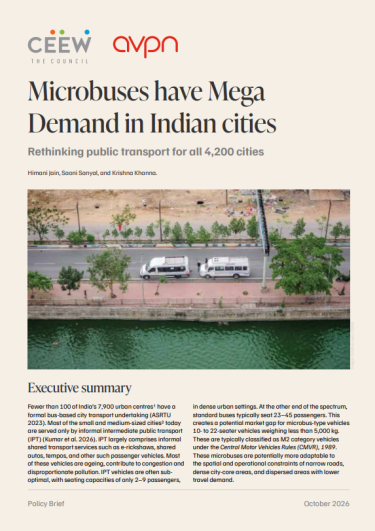
Fewer than 100 of India’s roughly 7,900 urban centres have a formal bus-based city transport undertaking (ASRTU 2023). Most small and medium-sized cities rely on informal intermediate public transport (IPT) such as e-rickshaws, shared autos and tempos (Kumar et al. 2026), which are often ageing, overloaded and polluting. IPT vehicles seat only 2–8 passengers, while standard buses seat 23–45 and need wider roads than many of these cities have. This leaves a market gap for microbuses: 10- to 22-seat vehicles weighing less than 5,000 kg, classified as M2-category vehicles under the Central Motor Vehicles Rules (CMVR), 1989. The PM-eBus Sewa scheme covers 169 cities (PIB 2023), leaving nearly 3,900 cities with populations below 3 lakh outside its scope by 2031.
Across the Global South, microbuses already carry a large share of urban trips: jeepneys in Manila, public light buses in Hong Kong, combi taxis in South Africa and peseros in Mexico City. In some cities, they account for 60–70 per cent of road-based motorised urban trips (Dumedah and Eshun 2020). This policy brief tests the hypothesis that microbuses can optimally serve the transit needs of India’s statutory cities. It uses a public-transit vehicle-capacity optimisation tool (PT V-Co tool), using Census 2011 data (OGD Platform India 2011) and CEEW mobility surveys (Soman, Kaur and Ganesan 2019). It estimates the optimal vehicle size and fleet at the route level, projects demand to 2031, and showcases 2–3 representative cities in each of five city-size categories, from small towns to megacities. It also draws on roundtables with government officials from 12 states, Original equipment manufacturers (OEMs), IPT operators, banks, non-banking financial companies (NBFCs) and development finance institutions to recommend how microbuses can be introduced at scale.
Figure 1. India will require an estimated 6.5 lakh stage-carriage microbuses for urban operations by 2031
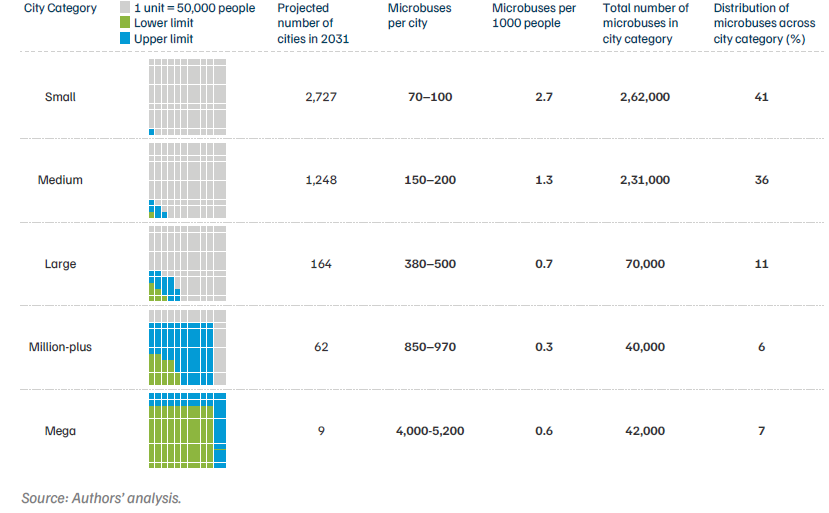
The assessment finds that microbuses in India are not held back by demand but by the absence of suitable vehicles, permits, and business models. India needs approximately 6.5 lakh stage-carriage microbuses by 2031 across about 4,200 cities, with 77 per cent of this demand concentrated in small and medium-sized cities. The key findings are summarised below:
Fewer than 100 of India’s 7,900 urban centres1 have a formal bus-based city transport undertaking (ASRTU 2023). Most of the small and medium-sized cities2 today are served only by informal intermediate public transport (IPT) (Kumar et al. 2026). IPT largely comprises informal shared transport services such as e-rickshaws, shared autos, tempos, and other such passenger vehicles. Most of these vehicles are ageing, contribute to congestion and disproportionate pollution. IPT vehicles are often suboptimal, with seating capacities of only 2–9 passengers, in dense urban settings. At the other end of the spectrum, standard buses typically seat 23–45 passengers. This creates a potential market gap for microbus-type vehicles 10- to 22-seater vehicles weighing less than 5,000 kg. These are typically classified as M2 category vehicles under the Central Motor Vehicles Rules (CMVR), 1989. These microbuses are potentially more adaptable to the spatial and operational constraints of narrow roads, dense city-core areas, and dispersed areas with lower travel demand.
Japan and South Korea have similar microbuses that operate as government-run services or demand-responsive stage-carriage services, connecting villages, elderly passengers, and tourists with large cities. Microbuses are widely used as flexible and affordable paratransit services, operated by informal private operators in cities across the Global South. In Latin America, 16-seater peseros and combi taxis operate as informal microbus services, while South Africa has dala-dala buses that typically accommodate up to 20 passengers. Hong Kong, Manila, and Jakarta have semi-formal microbus services with defined routes and fares, using jeepneys (old military jeeps use a public transport) and public light buses (PLBs) that seat 14–18 passengers. These microbuses sometimes account for as high as 60–70 per cent of the total modal share of road-based motorised transport in the city (Dumedah and Eshun 2020).
Learning from the Global South experience, our study aims to test the hypothesis that ‘microbuses can optimally serve the transit needs of top 4,000 small and mediumcities in India’. The policy brief informs city and state governments in planning their future public transit fleets. Our model supports rethinking urban bus transit for small and medium-sized cities, especially for narrow roads and routes with low, dispersed passenger demand.
Study develops a ‘public-transit vehicle-capacity optimisation tool’ (PT V-Co tool) to estimate the use case and market size for microbuses across Indian cities. The tool assesses various modal shift scenarios and planned city transport service levels. The model develops inputs for trip-length distribution, number of routes, and routelevel trip demand based on a 2020 CEEW survey of 61 cities (Soman, Kaur and Ganesan 2019) and Census 2011 travel data (OGD Platform India 2011). We also model 2–3 representative cities in each of the five city population categories – small (20,000 – 50,000) medium (50,000 – 3 lakh), large (3–10 lakh), million plus cities (10–40 lakh), and megacity (more than 40 lakh) – to corroborate the model inputs. Thus, the model computes the optimal vehicle capacity (in seats) at the route level, for varied trip lengths covering intra-city and peri-urban areas.
The required number of microbuses and their use cases are calculated using the V-Co tool for each of the five citysize categories. Microbus demand is projected for 2031 based on anticipated urbanisation and the growth in the number of cities.
India needs approximately 6.5 lakh microbuses by 2031 to serve top 4,000 cities, with about 3/4th demand concentrated in small and medium-sized cities. Our model and tool-based analysis highlighted the following key insights:
Figure ES1. India will require an estimated 6.5 lakh stage-carriage microbuses for urban operations by 2031
To introduce microbuses at scale, we recommend a three-step process based on our study and extensive stakeholder discussions:
Develop a small bus programme for public transit in small and medium-sized cities. A few original equipment manufacturers (OEMs) have developed electric microbus prototypes, presenting an opportunity for governments to aggregate demand and procure 8,000–10,000 microbuses for pilot deployment in 30–50 small cities. Through this approach, they can inform vehicle design, standardisation, and specifications and potentially open up the private market for these vehicles. A programmatic approach would also help address barriers in these nascent markets, including limited technical planning and implementation capacity at the local level, as well as the capital expenditure required to set up depots, terminals, bus stops, charging infrastructure, and rolling stock. Additionally, aggregated public procurements will give OEMs greater confidence to introduce more products in the microbus category.
Ease and rationalise regulations governing microbuses. Current permit regulations classify microbus-like vehicles as ‘maxi cabs’ or ‘minibuses’, limiting their use in public transport. Maxi cab permits limits seating capacity and restrict operations to tourism, while bus permits are comparatively costly. Defining microbuses under the Central Motor Vehicles Rules is therefore essential to enable their use as route-based, stage-carriage public transport. Pilot interventions, primarily driven by OEMs and research institutions, are critical to develop electric variants and fleet management practices. State governments must consider planning microbus initiatives to encourage sector formalisation.
Establish a robust institutional set-up to channel investment and finance for the scaled adoption of microbuses. Microbus adoption can be further scaled through two methods:
As India urbanises at a faster rate, grows economically, and decarbonises while addressing the challenge of air pollution, rethinking microbuses can provide reliable, clean public transport across its top 4,000 cities. Thus, the union government must conceptualise a National Small Bus Programme to aggregate demand across cities and catalyse the market. A national programme can help build local public assets, transit infrastructure, and technical capacity at scale, thereby improving citizens’ quality of life. To do this, civil society organisations (CSOs), OEMs, and academics must collaborate to map travel patterns in small and medium-sized cities across urban India, develop suitable transit solutions through pilots, and conduct market and business assessments to inform robust vehicle specifications. Our study is the first step in this direction.
About 40 per cent of India’s urban population lives in small (20,000–50,000) and medium-sized (50,000–3 lakh) cities (OGD Platform India 2011), yet most have no formal city bus service. Their road networks are narrow and organically developed; a typical small city has only 2–3 arterial roads wide enough (over 18 m right-of-way) for standard buses, and passenger demand is too low and dispersed to fill them. Informal IPT fills the gap, but it is often overcrowded and inaccessible to elderly passengers, children and persons with disabilities (Nichols et al. 2025). Travel is also getting costlier: in urban areas, the share of household expenses spent on transport rose from 6.52 per cent in 2011–12 to 8.59 per cent in 2022–23 (MoSPI 2024).
The study defines microbuses as M2-category vehicles with 10–22 passenger seats and a gross vehicle weight of up to 5,000 kg. IPT vehicles such as e-rickshaws and shared autos typically seat 2–8 passengers, while minibuses seat 18–27 including the driver, so the microbus range partly overlaps with minibuses. In India, these vehicles currently fall under two separate permit categories - maxi cabs and omnibuses- each with its own conditions on seating, use and specifications (MoRTH 1988). Neither is designed for route-based, stage-carriage public transport operations.
The PT V-Co tool estimates the optimal vehicle capacity for each route from route length, the road network available for public transport, number of routes, trip rates, trip-length distribution, target modal shift and planned service frequency. Inputs draw on Census 2011 data, CEEW mobility surveys, an IIT Delhi framework for selecting urban transport systems (Tiwari and Jain 2023) and UN projections of city numbers (UN DESA 2025). The headline estimate assumes public transport carries 80 per cent of motorised trips, in line with the desired high public transport modal share sought by the National Urban Transport Policy (MoUD 2006) and state/city policies.
Small cities account for about 2.62 lakh microbuses (41 per cent of total demand) and medium-sized cities for about 2.31 lakh (36 per cent). Large to mega cities would need about 40,000-70,000 microbuses. What changes with city size is the role of the vehicle, not the vehicle itself: in smaller cities microbuses would form the core public transport network, while in larger cities they would mainly serve short trips, especially in old city cores, urban villages and low-income areas with narrow roads and as metro feeder service. This estimate complements, rather than replaces, the requirement for standard buses on wider, high-demand corridors.
Yes, though mostly informal or small in scale. In Delhi, around 6,000 Gramin Sewa vehicles run as metro feeders and shared transport on more than 100 regulated routes, at fares of INR 5–15. Alwar, Rajasthan, formalised Tata Magic vehicles as public transport under the Alwar Vahini initiative by scrapping 720 old vehicles, launching a fleet of 58 vehicles and upgrading bus stops, lighting and CCTV. There are existing informal microbus services, for example using tempo in UP, Gujarat, magic-taxi in Madhya Pradesh cities, kadukas and bhoond in Punjab towns.
Are Microbuses Suitable as Public Transport Vehicles?
Greenhouse Gas Accounting for On-road Transport Emissions
How Can Early Million-Plus Cities Address Parking Challenges?