Council on Energy, Environment and Water Integrated | International | Independent

Suggested Citation: Maharashtra Institution for Transformation (MITRA), Government of Maharashtra, and Council on Energy, Environment and Water (CEEW). 2026. PARIVARTAN: Every Taluka, Climate Ready. Mumbai: Department of Environment and Climate Change, Government of Maharashtra.
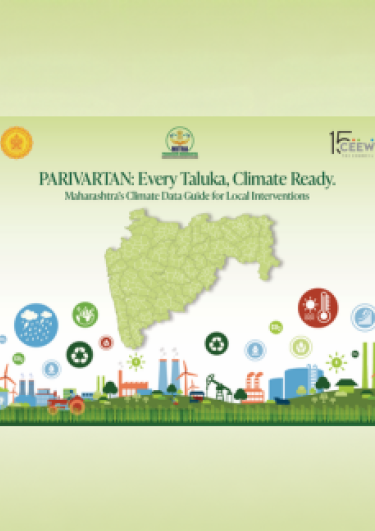
Maharashtra is one of the five states in the country most vulnerable to the impacts of climate change. Over 94 per cent of the districts in the state are vulnerable to climate change (Pankaja Munde 2025). The state’s diverse geography is being impacted by a rising frequency and intensity of extreme weather events such as extreme monsoon and rainfall, extreme summer heat, landslides, etc. Ahmadnagar, Parbhani, Nandurbar, Nanded, and Mumbai districts in Maharashtra are most vulnerable to the compounded impacts of extreme events (Mohanty and Wadhawan 2021).
According to the analysis done by the Council on Energy, Environment and Water (CEEW) in the Maharashtra State Action Plan on Climate Change: Pathways for 2030, 80 per cent of the districts are highly sensitive to extreme hydro-met events. Additionally, 25 per cent of districts in the state are exhibiting a swapping trend, where flood-prone areas are becoming drought-prone and vice versa. These findings highlight the significance of understanding sensitivity drivers for effective climate risk mitigation and adaptation strategies.
PARIVARTAN: Every Taluka, Climate Ready presents a taluka-level profile of extreme weather events for every district of Maharashtra, combining historical observations with future projections. The book also presents the localised hazard classification in terms of Land Surface Temperature and Flood Susceptibility to map the hyperlocal hotspots of susceptibility to the two events. The analysis from the hazard profile identifies impacts on each district’s key economic sectors, such as agriculture, industry, tourism, healthcare, and transportation. Based on the identified impact drivers, the study provides contextualised, tailored recommendations aligned with Viksit Maharashtra 2047 and the State Action Plan on Climate Change.
The framework was developed under the guidance of the Department of Environment and Climate Change, Government of Maharashtra, the Maharashtra State Climate Action Cell (MahaSCAC) and the Maharashtra Institution for Transformation (MITRA), with CEEW as knowledge partner
Maharashtra is among India’s most climate-vulnerable states, with over 94 per cent of its districts identified as vulnerable to climate change. The state’s diverse geography and economic landscape are increasingly exposed to extreme weather events, including intense rainfall, flooding, extreme heat and landslides. CEEW’s analysis also finds that 80 per cent of Maharashtra’s districts are highly vulnerable to extreme hydro-meteorological events, while nearly 25 per cent exhibit a ‘swapping’ trend, where areas historically prone to floods are increasingly experiencing drought-like conditions, and vice versa. These evolving and compound risks have significant implications for the state’s economic sectors, infrastructure and communities.
To address this gap, the Council on Energy, Environment and Water (CEEW) and the Maharashtra Institution for Transformation (MITRA) have developed PARIVARTAN: Every Taluka, Climate Ready, an actionable, taluka-level assessment developed to support administrators in data-driven decision-making and ensure resilient economic growth across Maharashtra.
PARIVARTAN provides a comprehensive climate hazard profile for every taluka across Maharashtra, bringing together historical observations, recent trends and future climate projections. It assesses the profile of extreme summer heat and extreme rainfall through indicators such as changes in the number of hot days, warm nights and heavy rainfall days, alongside hyperlocal indicators including land surface temperature and flood susceptibility. The assessment compares recent trends of the indicators (2011–2024) and projected trends (2030–2050) against the historical climatic baseline (1981–2010), enabling decision-makers to understand both emerging and future climate risks.
The climate hazard assessment is further translated into sector-specific implications for key drivers of Maharashtra’s economic growth, including agriculture, industry, tourism, healthcare and transport. By identifying the climatic drivers affecting each sector and location, PARIVARTAN provides context-specific adaptation strategies that can inform planning and investment decisions at the district and sub-district levels.
The assessment is aligned with the vision of Viksit Maharashtra 2047 and the Maharashtra State Action Plan on Climate Change, and seeks to bridge the gap between climate assessment and actionable decision-making. By making climate information available at the taluka level, PARIVARTAN aims to enable every taluka to anticipate the impacts of extreme weather events, strengthen sectoral resilience and pursue sustainable, climate-informed development.
PARIVARTAN: Every Taluka, Climate Ready presents a taluka-level profile of extreme weather events for every district of Maharashtra, combining historical observations with future projections. The book presents the impact of extreme summer heat using indicators such as changes in the number of hot days and warm nights in recent years (2011-2024) and future years (2030-2050) compared to the climatic baseline (1981-2010), heat index, and hyperlocal indicators such as land surface temperature.
State-level officials, district-level decision-makers, and taluka-level officers are the core users of PARIVARTAN, who can use the taluka-level profiles and tailored recommendations to embed resilience into planning, budgeting and programme design. Beyond this, various sectoral and line departments such as agriculture, tourism, infrastructure, healthcare, etc., can benefit from the book in planning the future development pathway for the respective talukas.
It assesses the profile of extreme summer heat and extreme rainfall through indicators such as changes in the number of hot days, warm nights and heavy rainfall days, alongside hyperlocal indicators including land surface temperature and flood susceptibility. The assessment compares recent trends of the indicators (2011–2024) and projected trends (2030–2050) against the historical climatic baseline (1981–2010), enabling decision-makers to understand both emerging and future climate risks.
No. It is explicitly designed as a living document. It will be periodically reviewed and updated to account for updated hazard and extreme weather event timelines, as well as emerging evidence, lessons from implementation and evolving international best practice. Governance arrangements for operationalising the framework will be determined in consultation with departments of the Government of Maharashtra, MITRA and technical partners.
Living with Heat in Bangladesh
Unlocking Finance for Nature-based Solutions (NbS) in Indian Cities