Council on Energy, Environment and Water Integrated | International | Independent

Suggested citation: Joy Rajbanshi, Johns Tiyndel and Vaibhav Chaturvedi. 2026. Making the Forest Roadmap Work: Forest Finance, Deforestation-Free Trade and Priorities for COP31. New Delhi: Council on Energy, Environment and Water.
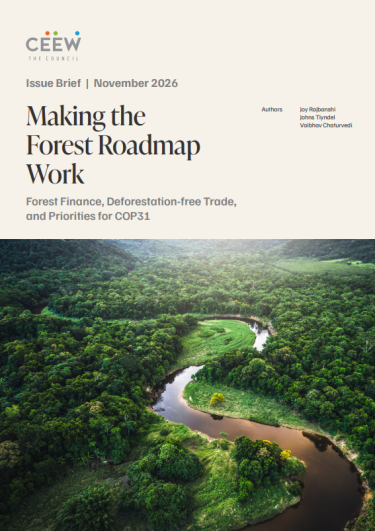
The first Global Stocktake (GST-1), concluded at COP28 in 2023, established a shared commitment to halt and reverse deforestation and forest degradation by 2030. Meeting this goal requires adequate finance, effective market incentives, and the institutions and systems needed to turn commitments into action. The COP30 Presidency’s Roadmap for Halting and Reversing Deforestation and Forest Degradation by 2030 (the Forest Roadmap), with further outcomes expected at COP31, provides an opportunity to strengthen implementation and accelerate progress towards this target.
The brief analyses 174 written submissions to the COP30 Presidency’s consultation, covering 13 policy propositions on forest finance, trade and cross-cutting issues. It examines how existing financial and trade measures can contribute to the Forest Roadmap’s goal of halting and reversing deforestation and forest degradation by 2030. In particular, it assesses two instruments: the Tropical Forest Forever Facility (TFFF), which proposes payments for maintaining standing forests, and the EU Deforestation Regulation (EUDR), which requires specified commodities entering the EU market to be deforestation-free and legally produced. The brief assesses the global implications of these instruments, examines their implications for India, and identifies eight policy priorities to inform global action and India’s engagement at COP31.
Deforestation and forest degradation threaten the environmental, climatic, and socioeconomic benefits that forests provide, including the livelihoods of people who depend on them. The first Global Stocktake (GST1) recognised the urgency of halting and reversing both trends by 2030 (UNFCCC 2023). Meeting this target requires not only commitments but also adequate finance, effective market incentives, and robust institutions and systems to translate commitments into action. The 30th Conference of the Parties (COP30) Presidency Roadmap for Halting and Reversing Deforestation and Forest Degradation by 2030 (the Forest Roadmap) provides an opportunity to align these efforts. It addresses four key questions:
Answering these questions can help identify practical approaches to financing, implementing, and sustaining forest conservation. This brief analyses the 174 written submissions to the COP30 Presidency’s consultation against 13 questions on finance, trade and cross-cutting issues, and uses one forest-finance instrument (the Tropical Forest Forever Facility, TFFF) and one demandside trade measure (the EU Deforestation Regulation, EUDR) as examples to identify what the Forest Roadmap can add to existing instruments and how India can contribute to its discussions.
Submissions to the Forest Roadmap consultation highlight the challenge of translating commitments into action. Our analysis identified 233 actionable asks across the 13 questions (Section 3.3). Three priorities emerged: direct access to finance for communities, including a funding floor (51 asks); operationalising the Forest Roadmap (40 asks); and extending duediligence requirements to the demand side (24 asks). These asks call for finance that reaches communities directly, a clear home, budget and reporting line for the Roadmap, and the retention and extension of demand-side due-diligence laws. Rather than proposing substantial changes to individual instruments, the submissions point to broader implementation challenges. Key questions concern institutional responsibility for implementing commitments, delivery of finance to those managing forests, distribution of the costs associated with new market requirements, and the support and systems countries and producers need to meet these requirements.
These findings highlight the need to consider both forest finance and demand-side trade measures together. Forest finance can strengthen incentives to conserve standing forests, while trade measures can influence the production and sale of commodities linked to deforestation. Pursued in isolation, each leaves gaps: additional finance may have limited impact if public subsidies and private investments continue to support activities that increase pressure on forests, while stricter market requirements may impose additional compliance costs on producers, particularly smallholders whose livelihoods depend on these commodities, where they lack the finance, infrastructure, and public systems needed to comply. The TFFF and the EUDR represent these two approaches, and both depend on reliable forest monitoring, land and tenure records, traceability, institutional capacity, and systems that support those managing forests. Neither instrument fully addresses all four questions raised by the Forest Roadmap, but examining them together reveals where stronger coordination between finance, markets, and implementation is needed.
The TFFF addresses one part of the forest-finance challenge. Forest countries (countries with large forest areas, particularly tropical forest countries) bear much of the cost of maintaining forests that deliver global benefits, yet receive limited international financial support. Of an estimated USD 84 billion in forestrelated finance in 2023, only USD 2.9 billion came from international public sources (UNEP 2025). Forestry mitigation accounted for approximately 0.12 per cent of tracked global climate finance in 2024, a narrower measure than UNEP’s estimate of all forest-related finance (CPI 2026a). Existing results-based approaches may provide insufficient incentives for countries that have already maintained substantial forest cover (Teo et al. 2024). The TFFF seeks to address this gap through payments linked to standing forest cover (TFFF Secretariat 2025), but its effectiveness will depend on payment stability, financial risk management, eligibility and degradation criteria, and whether benefits reach those managing forests.
On the demand side, the EUDR raises a related implementation challenge. Compliance depends largely on producer-country systems, including landtenure records, legality documentation, plot-level geolocation, traceability, and digital data systems. These requirements can impose significant fixed costs on smallholders, particularly in countries with limited land administration capacity (Verma et al. 2026). Differences in requirements across major consumer markets can further increase compliance costs and risk diverting deforestation-linked trade towards markets with weaker regulations (Boysen 2025; Sharma and Villoria 2026). Greater coordination among consumer markets could help mitigate these risks, and existing legality requirements for forest-based products in other major importing markets, including the United States and Japan, offer a starting point (USDA APHIS 2026; Forestry Agency n.d.). Forest certification can support producers in demonstrating legal and sustainable sourcing across markets, but it cannot substitute for operators’ own duediligence responsibilities (EU 2023).
The central policy challenge, therefore, is to connect financial and market incentives with the systems required for effective implementation. Neither forest finance nor demand-side trade measures can realise their full potential without adequate institutions, infrastructure, and financial systems. By integrating forest finance, trade measures, forest monitoring, land administration, and community access into a coordinated implementation framework, the Forest Roadmap can help bridge this gap.
Our analysis of the consultation, the TFFF and the EUDR identifies eight priorities for COP31. They respond to the Roadmap’s four questions as follows: priority 1 addresses the main barrier, the absence of a delivery mechanism; priorities 2, 3, 7, and 8 set out measures that can accelerate action through finance and markets; priority 6 identifies practices that producer countries can replicate; and priorities 4, 5, and 7 address differences in forest conditions, national circumstances, and the rights of Indigenous Peoples and local communities.
India did not submit written inputs to the consultation, but the assessment of the TFFF and the EUDR shows why implementation rules must account for differences in forest conditions, supply chains and national circumstances (Section 7).
TFFF: About 23.4 million hectares (Mha) of India’s moist forest could qualify, as recent loss from forest fires, estimated from Global Forest Watch data, falls below the 0.5 per cent entry cap (Section 7.1). The size of the potential payment depends on how fires are counted. At full capitalisation, the gross inflow would be about USD 94 million a year; counting every burn scar as degradation would eliminate the payment, whereas weighting fires by severity would retain up to USD 40 million a year. India could seek to extend eligibility to its 12.2 Mha of tropical dry forest, which is currently excluded.
EUDR: India is classified as low risk (European Commission 2025a), but most of its green-coffee and natural-rubber imports in 2024 came from standard-risk countries (UN Comtrade 2026), so these raw materials still require full due-diligence information. Small holdings also account for most of India’s coffee holdings (Coffee Board 2023), which makes plot-level traceability and legality evidence harder to assemble.
Options for COP31: India could propose fire-severity weighting before the TFFF operations manual is approved and seek a separately funded window for dry forests. Under the EUDR, it could seek recognition of Coffee Board and Rubber Board registries as supporting evidence of plot location and legality, and targeted EU co-financing for smallholder compliance costs. Its forest-fire monitoring, producer registries and certification scheme also offer lessons for other countries.
Source: Authors’ analysis.
The Forest Roadmap is an initiative launched by the COP30 Presidency to halt and reverse deforestation and forest degradation by 2030. It received support from more than 90 Parties at COP30 but was not incorporated into the formal negotiated outcome. The COP30 Presidency has therefore continued advancing the initiative under its own mandate, with further outcomes expected at COP31. The Roadmap matters because it seeks to provide a common framework for coordinating and accelerating the implementation of existing global forest commitments, which currently lack a unified approach.
Most existing results-based forest finance mechanisms reward countries for reducing deforestation or emissions against an established baseline. This can limit incentives for countries that have already maintained low deforestation rates and are conserving large areas of standing forest. The Tropical Forests Forever Facility (TFFF) proposes a different approach: providing recurring payments of approximately USD 4 per hectare of eligible standing tropical forest annually at full capitalisation. Rather than relying solely on measured reductions in deforestation, it aims to create a financial incentive for countries to conserve existing forests and prevent future degradation and loss.
The brief examines the TFFF and EUDR as two complementary approaches to tackling deforestation. The TFFF incentivises forest conservation through finance, while the EUDR promotes deforestation-free and legal production through market requirements. Together, they illustrate how finance and trade measures can complement each other, while highlighting gaps in eligibility, implementation capacity and producer support that the Forest Roadmap can address.
The brief highlights the TFFF’s proposed minimum 20 per cent allocation of payments to Indigenous Peoples and local communities. It recommends strengthening transparency and accountability by tracking funds from national to local levels, involving community organisations in monitoring allocations, and ensuring that international finance reaches communities directly and provides additional support beyond existing domestic spending.
The brief recommends that COP31 establish a clear implementation framework with defined responsibilities, milestones and reporting. It should strengthen TFFF payment safeguards, review forest eligibility criteria, ensure transparent community finance, support producer countries with EUDR compliance, promote coordination across markets, and align public and private financial flows with forest conservation goals. The focus should be on improving existing mechanisms rather than creating new ones.
The brief identifies opportunities for India to shape the Forest Roadmap discussions at COP31. Under the TFFF, India could advocate for fire-severity-based assessments, inclusion of dry forests and more predictable conservation payments. Under the EUDR, it could seek recognition of Coffee Board and Rubber Board registries as supporting evidence for traceability and legality, along with targeted EU financial support for smallholder compliance. India can also showcase its forest-monitoring capabilities and producer-registration systems as examples for other countries.
How South Asia’s Energy Transition Can Respond to Global Disruptions

Time to develop an Asia-Pacific Green Development Agenda