Home
Council on Energy, Environment and Water Integrated | International | Independent
PAPER
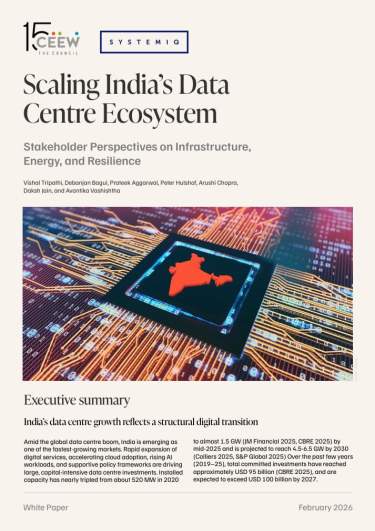
Scaling India’s Data Centre Ecosystem
Stakeholder Perspectives on Infrastructure, Energy, and Resilience
17 February, 2026 | Power Markets
Vishal Tripathi, Debanjan Bagui, Prateek Aggarwal, Peter Hulshof, Arushi Chopra, Daksh Jain, and Avantika Vashishtha

Suggested Citation: Tripathi, Vishal, Debanjan Bagui, Prateek Aggarwal, Peter Hulshof, Arushi Chopra, Daksh Jain, and Avantika Vashishtha. 2026. Scaling India’s Data Centre Ecosystem: Stakeholder perspectives on Infrastructure, Energy, and Resilience. Council on Energy, Environment and Water and SYSTEMIQ.
Overview

India's digital economy is entering a new phase. Digitalisation is no longer peripheral to growth; it is now embedded in how productivity, competitiveness, and service delivery are being reimagined across sectors. Artificial intelligence (AI) is being embedded across search, payments, logistics, healthcare, education, and public service delivery, marking the next phase of this transition and reshaping how digital systems operate across the economy. What often goes unnoticed is that this digital layer is powered by a very physical backbone, i.e. data centres that operate around the clock.

Installed data centre capacity has nearly tripled since 2020, reaching ~1.5 GW, and is projected to reach around 6.5 GW by 2030. Total committed investments between 2019 and 2025 reached approximately USD 95 billion, underscoring the scale and capital intensity of the sector.

This rapid expansion carries substantial implications for land, energy, and water. In 2025, data centres account for ~0.5 per cent of national electricity consumption and approximately ~150 billion litres of annual water use, both expected to more than double by 2030. Decisions taken today on siting, power sourcing, and cooling technologies will shape India’s long-term environmental and infrastructure footprint.

Against this backdrop, this white paper examines how prepared India’s data centre ecosystem is to absorb this scale of growth, and whether current market practices, policies, and regulatory frameworks align with long-term resilience. We do so through a review of global and Indian literature and semi-structured consultations with key stakeholders across the data centre ecosystem, including data centre operators, cloud service providers, renewable energy (RE) developers, policymakers, and domain experts.

Key insights

  • Hyperscaler and colocation facilities are expected to dominate India’s data centre market over the next decade.
  • Cloud expansion, AI/ML workloads, and data localisation mandates are the primary drivers of demand for data centres.
  • Stakeholders increasingly factor climate risk assessments, including heat stress, flooding, and seismic risk, into data centre siting decisions.
  • India does not yet have a national data centre policy; instead, states have taken the lead, with 15 states notifying dedicated data centre policies or leveraging IT and industrial frameworks to attract investment.
  • Only 5 out of 15 state policies explicitly embed sustainability-related provisions for data centre development.
  • Renewable energy developers indicate that up to ~80 per cent renewable supply is feasible through geographically diversified solar–wind portfolios combined with battery storage.

HAVE A QUERY?

“AI-driven data centre growth is inevitable, but India has the opportunity to plan it right from the start. By embedding sustainability in siting decisions—on land, water and energy—we can avoid global pitfalls and build resilient digital infrastructure that serves both economic and societal needs.”

Executive summary

India’s data centre growth reflects a structural digital transition

Amid the global data centre boom, India is emerging as one of the fastest-growing markets. Rapid expansion of digital services, accelerating cloud adoption, rising AI workloads, and supportive policy frameworks are driving large, capital-intensive data centre investments. Installed capacity has nearly tripled from about 520 MW in 2020 to almost 1.5 GW (JM Financial 2025, CBRE 2025) by mid-2025 and is projected to reach 4.5-6.5 GW by 2030 (Colliers 2025, S&P Global 2025) Over the past few years (2019–25), total committed investments have reached approximately USD 95 billion (CBRE 2025), and are expected to exceed USD 100 billion by 2027.

Land, water, and energy footprint of India’s data centres

As India seizes this unprecedented opportunity, it must also strike a fine balance between growth and sustainability. Decisions being taken now on siting, power sourcing, and cooling technologies will lock in land, energy, and water impacts for decades. In 2024, data centres accounted for around 0.5 per cent (Cornell 2025) of national electricity consumption and approximately 150 billion litres (Mordor Intelligence 2025) of water use, both figures projected to more than double by 2030. As of January 2026, India hosts ~271 data centres1 (Data centre map n.d.), occupying ~23 million square metres (CBRE 2025) of land. With nearly a quarter of the total data centres, Mumbai leads the market, followed by Chennai, Hyderabad, and Bengaluru.

A hybrid approach to assess the data centre ecosystem

This white paper examines how prepared India’s data centre ecosystem is to absorb this scale of growth, and whether current market practices, policies, and regulatory frameworks align with long-term resilience. We do so through a review of global and Indian literature and semi-structured consultations with 24 key stakeholders across the data centre ecosystem, including data centre operators, cloud service providers, renewable energy (RE) developers, policymakers, and domain experts.

States have led data centre policy development

India does not yet have a binding national policy framework for data centre development, and state governments have taken the lead in shaping the sector’s growth. This trajectory mirrors other sunrise sectors, such as green hydrogen (Pal, et al. 2025), where early state-level incentive and promotion policies preceded the articulation of a national mission. At the central level, support for data centres has been provided through targeted enabling measures, including the grant of infrastructure status (The Hindu 2025) and the 2026 Budget announcement of a long-term tax holiday (PIB 2026) extending to 2047. In parallel, 15 states have already notified dedicated data centre policies or used IT/ industrial policies to attract data centre investment.

Figure ES1. Each stakeholder plays a distinct role in the data centre ecosystem

Data centre operators

Manage and maintain physical data centre infrastructure


Cloud service providers

Utilise data centre facilities to run their IT infrastructure and deliver services


Renewable energy developers

Provide sustainable energy solutions for data centres


Policymakers

Shape frameworks, reforms, and governance for the data centre ecosystem


Domain experts

Offer analytical insights on policy, sustainability, and market evolution


Source: Authors’ analysis

Key stakeholder insights from the study

The table presents key stakeholder insights across the market, infrastructure, energy, and policy dimensions that are collectively and rapidly shaping the evolution of India’s data centre sector.

Table ES1. Sustaining data centre growth will require better alignment of infrastructure, energy, and policy

S. No. Theme Insight
1 Market growth outlook Hyperscaler and colocation facilities are expected to dominate India's data centre market over the next decade.
2 Drivers of data centre expansion Growth in demand for cloud services, expansion of AI/ML2 workloads, and data localisation requirements are the primary drivers of data centre growth.
3 Siting considerations Stakeholders increasingly factor climate risk assessments, including heat stress, flooding, and seismic risk, into data centre siting decisions.
4 Power backup requirements Diesel generator (DG) sets remain an indispensable asset for meeting uptime and reliability requirements.
5 Primary water source for cooling Small-scale data centre operators (<5 MW) primarily rely on municipal water supply for cooling.
6 Water risk perception Most stakeholders currently perceive water availability risks to be low to medium.
7 Renewable energy feasibility Renewable energy developers indicate that up to ~80 per cent renewable supply is feasible through geographically diversified solar–wind portfolios combined with battery storage.
8 Renewable energy adoption incentives Power-sector incentives are the most influential policy lever across states, with the majority of stakeholders identifying them as critical for accelerating renewable energy adoption by data centres.
9 Sustainability provisions in state policies Only 5 out of 15 state policies explicitly embed sustainability-related provisions for data centre development.
10 Policy implementation challenges Despite single-window clearance provisions, stakeholders report delays in practice, particularly in land acquisition, building approvals, grid connectivity, and fire safety clearances, slowing deployment timelines.
11 Role of state policies State policies are a major driver of data centre investments and capacity build-out in India.
12 Land–water–energy nexus planning Stakeholders strongly endorse the need for an integrated land–water–energy nexus framework to guide siting and improve long-term resilience of data centres.
13 National–state policy alignment The majority of stakeholders support the coexistence of a national green data centre framework alongside state policies.

Source: Authors’ compilation

Enabling resource-efficient data centre growth

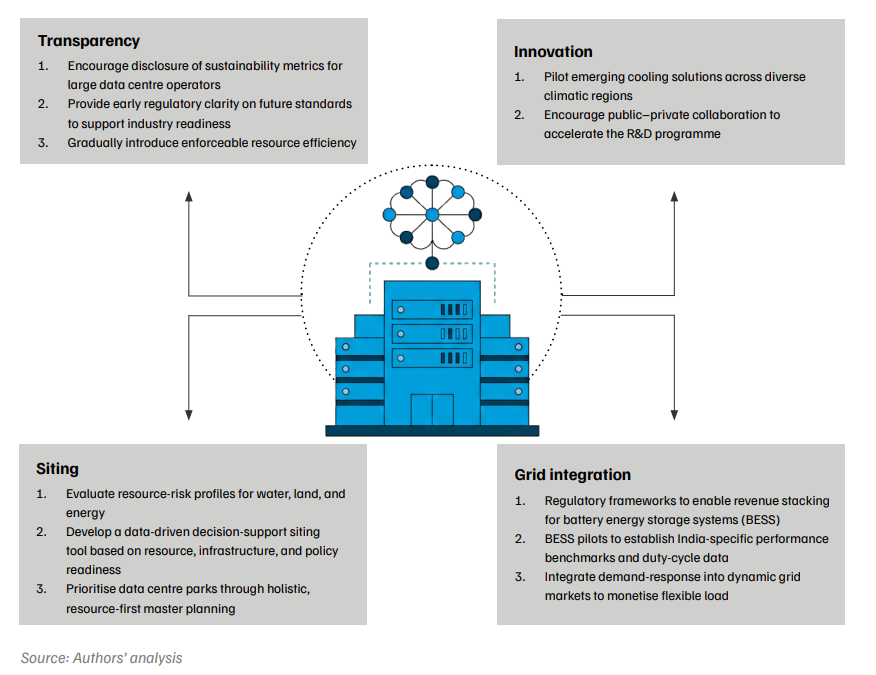
Stakeholder consultations suggest that India’s data centre sector is at an inflexion point. While growth prospects are strong, the scale, pace, and siting of expansion must align with system readiness across power, water, and land. This is particularly relevant in the context of India’s emerging “frugal AI”3 (Economic Survey 2026) pathway, which prioritises application-led, resource-efficient deployment over compute-intensive frontier models. Such an approach places greater emphasis on efficient, shared, and flexible compute infrastructure, underscoring the need for phased growth and early coordination across enabling systems. The way forward, therefore, lies in coordinated action across transparency, innovation, siting, and grid integration, as outlined in Figure ES2.

Figure ES2. Four levers to align data centre growth with sustainability and resilience
Why are data centres emerging as a strategic sustainability challenge for India?

In an era where data is considered the new oil and a strategic global currency, data centres act as refineries powering the digital economy. The rise of artificial intelligence (AI) is intensifying the global race to build advanced data and computing infrastructure. As nations scale up digital capacity, integrating sustainability into infrastructure development is becoming essential to ensure long-term responsible growth.

The global AI race is accelerating demand for compute-intensive infrastructure

  • Global data boom in the AI-driven digital economy: Global data generation is expanding at an unprecedented pace, with worldwide data volumes projected to reach ~400 zettabytes (ZB)4 by 2028, nearly 2.7 times that of 2024 (IDC Research 2025). This acceleration reflects the rapid digitisation of economies worldwide, driven by rising internet penetration, increased per capita data consumption, the adoption of AI and the growing reliance on digital platforms and services. Among these factors, AI is the primary driver of this massive growth, given its reliance on data-intensive models and continuous learning. In 2025, globally, one out of every six people used generative AI tools to learn, work, or solve problems (Microsoft 2025).
  • The US–China AI race is shaping the scale and direction of data centre expansion: Data centres have existed for decades. However, the exponential growth in AI workload has fundamentally transformed data centre intensity. The United States (US) and China lead advanced AI development, accelerating the global race and shaping its pace, scale, and infrastructure.

India is positioning itself as an emerging data centre and AI hub

  • India’s growing digital footprint and connectivity expansion: India, with a population of ~1.5 billion (bn), is positioned to play a pivotal role in shaping the global digital evolution, and has been experiencing rapid digitalisation across sectors under the Digital India initiative (UNPF 2025, Digital India 2015). The number of internet subscribers has increased by ~30 per cent over the last 5 years ~0.8 bn in 2020 to ~1.02 bn in 20255 (TRAI 2020, TRAI 2025). The average mobile data consumption in the country reached ~25 GB per user per month in 2024, significantly above the global average of ~19 GB, and is projected to nearly double by 2030 (Ericsson 2024).
  • National AI ambitions further reinforcing demand for data centres: India has further strengthened its digital and technological ambitions through the launch of the IndiaAI Mission (PIB 2025), aimed at fostering the development, deployment, and responsible adoption of AI technologies across sectors. India’s approach to AI adoption is intended to be economically grounded and socially responsive (Economic Survey 2026).
  • The digital economy is becoming a central pillar of national income growth: The digital economy6 is expected to contribute 20 per cent of national income by 2030, compared to ~12 per cent in FY 23 (MeitY 2025).

Rapid growth intensifies energy, water, and land demands, making sustainability essential

  • Electricity demand from data centres is projected to nearly double this decade: Data centres accounted for ~1.5 per cent (IEA 2025) of global electricity consumption in 2024. The demand is projected to nearly double, reaching ~945 TWh by 2030 (equivalent to Japan’s FY24 electricity consumption).
  • Water and land use intensify pressure on local communities: Beyond being energy-intensive, data centres also consume large volumes of water and strain land (Gorey 2025), exerting significant pressure on local communities. The global data centre industry currently consumes around 560 bn litres of water annually, equivalent to the domestic water demand of a metropolitan city with roughly 8 million residents (IEA 2025).
  • Integrating sustainability and resilience in data centre expansion: Countries, including the US and China, and regions in Europe, have already experienced significant data centre deployment; however, some of these facilities are grappling with water scarcity, energy constraints, and other operational challenges (CERRE 2025). While India’s data centre industry is still nascent, it is poised for a rapid scale-up in the coming years. Given India’s already critical resource constraints (Mehra 2025, World Bank 2025), and its large population, sustainability and resilience must be integrated from the outset to support long-term growth while minimising environmental and social impacts.

Our approach

  • Understanding the data centre landscape: This study assesses the current state of the sector by examining market dynamics, the policy and regulatory environment, energy procurement strategies, and industry practices. While doing so, it identifies opportunities to embed resilience and sustainable practices as a core design and operational principle, and highlights priority research areas that must be addressed as the sector scales.
  • Combining literature with India-specific stakeholder insights: This study adopts a hybrid framework that integrates a review of the existing literature with primary insights from stakeholder consultations (one-on-one interviews and survey responses). A total of 24 engagements were conducted with key stakeholders across the data centre ecosystem, including data centre operators, cloud service providers, renewable energy (RE) developers, policymakers, and domain experts.

What is driving the rapid growth of data centres in India?

The domestic data centre ecosystem is undergoing a significant transformation, driven by strong demand, expanding geographic footprints, and accelerating investment flows. The evolving market landscape is being shaped by both domestic and global players, reflecting the sector’s growing strategic importance.

Factors accelerating domestic data centre infrastructure

  • The structural drivers of India’s data surge: As discussed in the earlier section, India has witnessed rapid digital adoption across sectors, especially in the post-pandemic phase. The proliferation of hybrid work models, digital education (EdTech), e-commerce, digital payment gateways, digital consumer services, OTT adoption, and the rollout of 5G services have collectively fuelled a surge in data generation (Figure 1) (Digital India 2015). The growing adoption of cloud services, advancements in quantum computing, and the utilisation of AI across sectors such as information technology (IT), banking, financial services, and insurance (BFSI), healthcare, media, retail, sales and marketing further accelerate the expansion of India’s digital footprint. More than 80 per cent (PIB 2025) of organisations in India are actively using AI solutions. India’s AI market is expected to reach USD 17-22 bn by 2027, double from USD7-9 bn in 2023 (BCG, Nasscom 2024).
  • India’s expanding digital footprint is outpacing storage capacity: India generates nearly one-fifth of global data, but holds only ~1.2 per cent of global data centre capacity (Savills 2025, Cargoson 2025). As India’s digital footprint expands, the volume of data continues to grow at an unprecedented pace. Ensuring data security and advancing data sovereignty are equally critical, as domestic infrastructure must safeguard sensitive information and support India’s strategic digital autonomy. This mismatch between data generation and storage capacity underscores the urgent need for robust, resilient data centre infrastructure to efficiently store, process, and manage information at scale.

Figure 1. Core enablers of India’s digital transition
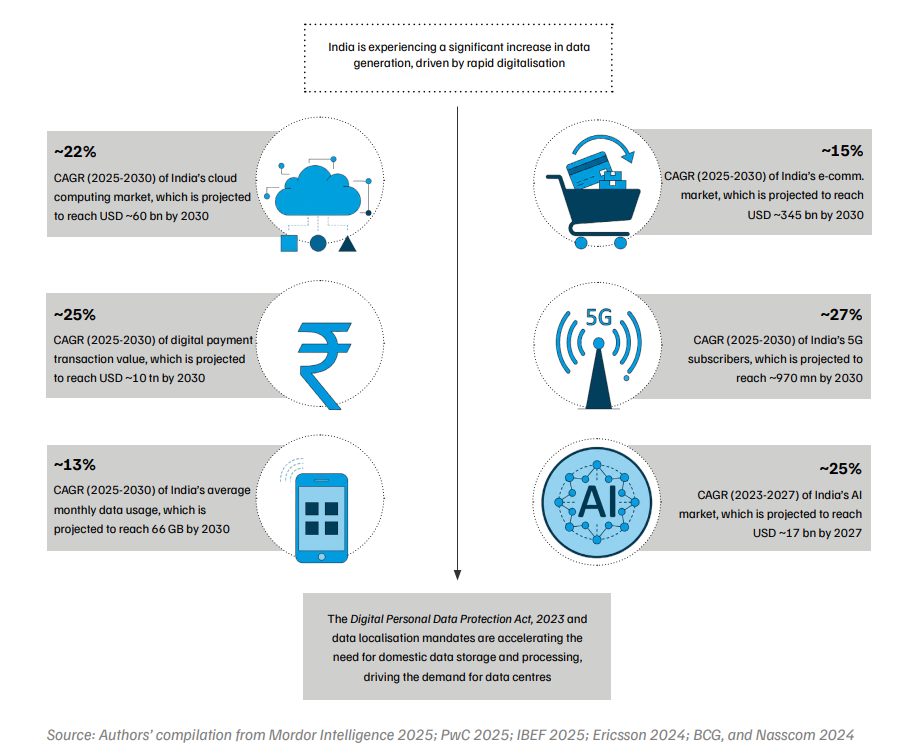
  • Data security and compliance as catalysts for domestic data centre infrastructure: Responding to the need, India introduced the Digital Personal Data Protection (DPDP) Act (MeitY 2023) in 2023⁹ to strengthen the governance framework for data security and responsible data use, while signalling the need for resilient domestic infrastructure to support compliance. Sector-specific regulations further reinforce this shift. The Reserve Bank of India’s (RBI) data-localisation mandate (RBI 2023) requires all payment-related data to be stored within the country; the Securities and Exchange Board of India (SEBI) Cloud Services Framework (SEBI 2023) directs regulated entities to host their data and logs on servers located in India; and the draft National E-Commerce Policy (PwC 2019) proposes that all data generated by Indian consumers, including IoT (internet of things) and platform data, be stored domestically.

The evolving geopolitical landscape and heightened national security priorities are expected to prompt more sectors to implement data-localisation (CSIS 2021) mandates10 . Together, these measures reflect India’s broader push toward data sovereignty, thereby accelerating nationwide demand for data centre infrastructure.

Regional footprint and capacity expansion

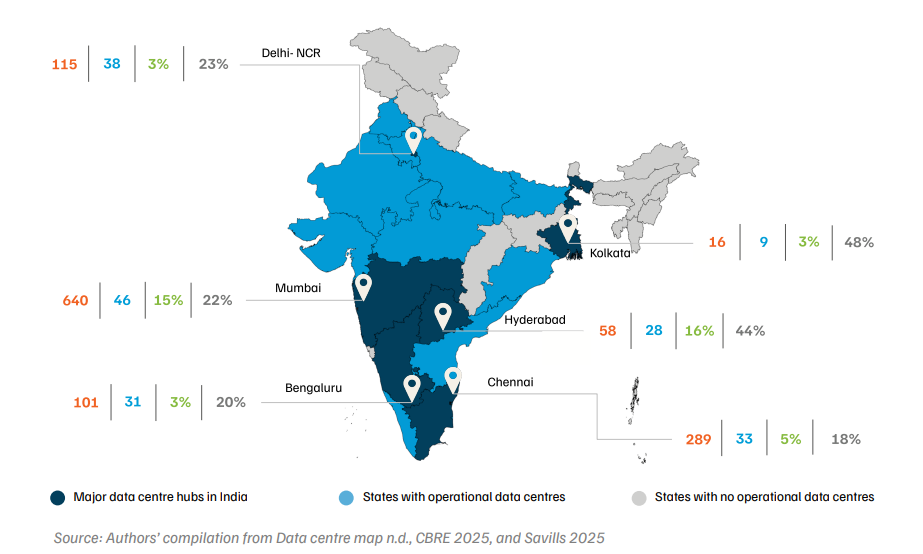
  • IT capacity has grown threefold over the last five years: Domestic data centres have witnessed significant capacity growth, from 520 MW in 2020 to ~1.5 GW as of 2025 (JM Financial 2025, CBRE 2025), and this is projected to reach up to ~4.5-6.5 GW by 2030 (Colliers 2025, S&P Global 2025). In comparison, total global data centre capacity is expected to reach ~200 GW by 2030 (JLL 2025). As of January 2026, India has ~271 data centres11 (Data centre map n.d). Mumbai leads the country’s data centre market (~25 per cent of the total data centres), followed by Chennai, Hyderabad, and Bengaluru.
  • Hyperscalers dominate the data centre market: A quarter of data centre capacity is dedicated to hyperscalers, ~10 per cent serves enterprise users, with the remaining capacity comprising mixed-use facilities (Savills 2025). Most hyperscaler data centres in India, located in the coastal regions of Mumbai and Chennai, are proximal to landing stations, leverage seawater cooling, and have undersea cable connectivity12. The top five players STT, NTT, Sify, CtrlS, and Nxtra hold ~66 per cent of India’s total operational data centre capacity (JM Financial 2025). While Edge data centres13 are expected to grow rapidly due to 5G, IoT, and lowlatency applications, our stakeholder consultations indicate that colocation and hyperscaler facilities will remain the primary growth drivers in India.

Investment trends and distribution across states

  • Committed investments have increased significantly in recent years: India has witnessed significant investments from global operators, real estate developers, and private equity funds eager to tap into the country’s thriving market. Between 2019 and 2025, the commitment investment reached approximately USD ~95 billion14 from both global and domestic investors, with USD 30 bn committed in 2025 alone (Figure 2) (CBRE 2025). Major players include Adani, Amazon Web Services (AWS) and ST Telemedia Global Data Centres (STT GDC). Overall, investments in the sector are set to exceed USD 100 billion by 2027 (CBRE 2024).
  • Investments are geographically concentrated in select states: Cumulative investment commitments have been heavily concentrated in Maharashtra, Tamil Nadu, Telangana, Delhi-NCR, and West Bengal, reflecting their growing prominence as datacentre hubs. This concentration can be attributed to connectivity and resource availability, explored further in the subsequent section.
  • Global tech giants recognise India as a major data centre hub: Most recently, Google announced a USD 15 bn (E.B. Nidhi Sharma 2025) investment to establish an AI data centre in Andhra Pradesh. At the same time, Meta has partnered with Sify to develop a 500-MW (Nidhi Sharma 2025) data centre, with an estimated investment of USD1.5 billion in the state. Likewise, Tata Consultancy Services (TCS) has unveiled plans to invest USD ~6.5 bn (The Economic Times 2025) over the next 5–7 years to develop a 1-GW data centre network.

In comparison, the global data-centre market is witnessing similarly strong momentum. More than USD ~60 bn (CNBC 2025) has reportedly flowed into the sector in 2025 alone, underscoring sustained investor confidence worldwide. Looking ahead, cumulative global investments in data-centre infrastructure are expected to reach up to USD 3 trillion (JLL 2025) during the 2026– 2030 period, driven by hyperscale expansion, cloud adoption, and AI-led demand. Insights from stakeholder consultations also indicate that investment is expected to increase significantly over the next few years, globally and in India.

Figure 2. More than ~65% of data centres are located in six regions
Why does site selection determine the resilience of data centres?

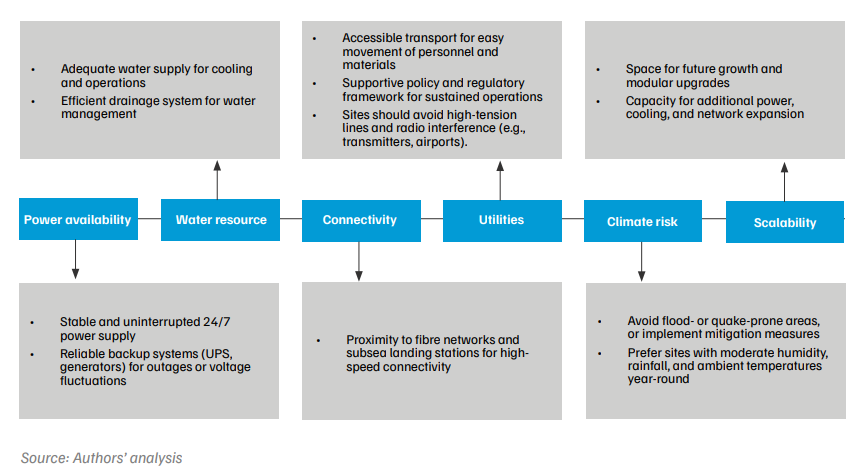
Power and water availability, along with the climate risk profile, are the primary parameters considered when selecting a site for a data centre. Beyond these factors, several additional operational and logistical parameters must also be considered (Figure 3). Given that data centres are designed for long operational lifecycles, it is essential to carefully evaluate all these parameters to ensure operational reliability, cost efficiency, and longterm performance.

Figure 3: Critical factors that define data centre site selection
Access to reliable power is the primary siting criterion

  • Continuous, uninterrupted power is fundamental to data centre operations: Operating a data centre requires a stable, uninterrupted 24/7 power supply. Servers, storage systems, cooling units, and other network equipment must operate simultaneously to maintain data operation. Server and cooling infrastructure collectively account for nearly 70 per cent of the total electricity consumption in data centres, though this proportion varies widely by facility type (IEA 2025). Even a momentary power loss can cause servers to shut down abruptly, leading to data corruption, disrupting any real-time operation that relies on the particular data centre, and causing a widespread service outage.
  • Power disruptions directly translate into contractual and financial risk: Typically, uptime requirements16 are contractually defined between the data centre operator and the end user (tenant), with any power disruption or service outage constituting a breach of service-level agreements (SLAs) and resulting in financial penalties for the operator. A 2024 global survey on data centres indicates that 54 per cent of data centres reported annual outage costs exceeding USD0.1 million, with ~20 per cent of operators reporting costs exceeding USD1 million (Uptime 2024). Outage costs extend beyond immediate losses to contracts, customer retention, and insurance.

Water availability influences data centre planning

  • Cooling needs make water availability a critical siting consideration: As servers process vast volumes of data, they generate substantial heat, requiring effective cooling systems to prevent overheating, equipment failure, or permanent damage (Annexure). Data centres relying on waterbased heat-rejection systems17 , such as cooling towers, have high overall water consumption (Mytton 2021). The volume of water required depends on the data centre’s size, IT load, local climate, and cooling technology used.
  • Water unavailability may cause operational challenges: Given that water is an increasingly constrained resource, careful assessment of water availability and sustainability is essential in data centre planning. Locating data centres in already water-stressed areas can place significant pressure on local communities (CERES 2025, Triona McGrath 2024, World Economic Forum 2024) and may affect the long-term operational viability of the facilities. Yet, global trends show a growing imbalance, with around 43 per cent (S&P Global 2025) of global data centres operating in areas of high water stress in the current decade.
  • Rising rack densities further intensifying water use: Driven by AI and high-performance computing workloads, average rack power densities have increased from approximately 1–3 kW (Eisenband 2023) in the early 2000s to around 8 kW (Uptime 2024) per rack today. Rising rack densities increase cooling intensity, and in facilities that are reliant on evaporative cooling, it can intensify water use unless offset by liquid or closed-loop cooling technologies. A typical 100-MW hyperscaler data centre can consume ~2 million litres of water per day for on-site cooling (IEA 2025).

Climate risks increasingly affect operational resilience

  • Climate risk profile must be prioritised in data centre planning: The climate risk profile, including exposure to flooding, seismic activity, soil movement, tropical cyclones, wind, and coastal inundation, of potential sites needs to be factored in. If these profiles are not assessed during installation, and mechanisms to mitigate these challenges are not established, data centres can suffer significant damage (Shine Jacob 2023) and financial losses. Studies suggest that globally, ~6 per cent (XDI 2025) of installed data centres are located in zones highly exposed to climate-related hazards, while 16 per cent are in moderate-risk zones.
  • India’s climate vulnerability amplifies siting risks: As many as 72 per cent (Wadhawan 2023) of Indian districts are exposed to extreme flood events, while 57 per cent (Shravan Prabhu 2025) face high to very high risk from extreme heat. Exposure to extreme heat can significantly increase cooling costs, while flooding poses direct risks to physical infrastructure. This underscores the need for a detailed assessment before setting up a data centre. While India’s data centre industry is still in its nascent stage, such assessments of environmental, climate, and infrastructure risks should be prioritised to ensure sustainable, resilient, and long-term operations as the sector scales. This perspective is reinforced by our stakeholder consultations, which indicate that operators are increasingly factoring climate risk profiles into data centre planning and operational decisions.

In addition to the aforementioned parameters, land availability, the policy and regulatory landscape, and permitting and approval processes frequently determine project viability and development timelines. Connectivity-related factors such as access to optical fibre networks, proximity to subsea cable landing stations, and latency requirements are also critical to ensuring high-speed, low-latency operations. The relative importance of these parameters, however, varies significantly depending on the intended function of the facility, whether hyperscale, colocation, or edge (refer to the Annexure).

How are Indian stakeholders navigating growth and sustainability trade-offs in practice?

Data centre sustainability rests on six levers spanning power systems, cooling, IT equipment, construction, and materials. While all influence outcomes, stakeholder evidence shows that electricity and cooling-related water use dominate delivery risk and long-term lock-in. This chapter, therefore, focuses on how Indian stakeholders navigate these two trade-offs in practice.

Power procurement strategies reflect cost, reliability, and regulatory risk

  • Electricity costs and reliability dominate all other operational considerations: Energy expenses make up the bulk of data centre operational costs, typically 60–70 per cent (DCD 2025). Our consultations reaffirmed that electricity costs and reliability outweigh land costs, fiscal incentives, or labour availability in determining data centre viability. Stakeholders consistently ranked power economics and grid stability far above other factors.
  • Tight uptime and latency guarantees drive conservative power system design: As discussed earlier, uptime requirements are embedded in SLAs between data centre operators and tenants, with outages triggering contractual penalties. A senior data centre design professional emphasised that even microsecond-scale power disturbances can trigger material contractual penalties due to strict uptime and latency guarantees in hyperscale and colocation contracts. This risk profile explains deep conservatism in power system design, redundancy provisioning, and energy procurement choices, with operators prioritising supply certainty and contractual compliance over aggressive cost optimisation. These risks were consistently reiterated during stakeholder consultations, with participants emphasising that incorporating uninterruptible power supply (UPS) systems and diesel gensets (DGs) is an inherent design requirement to avoid downtime and ensure compliance with SLAs.
  • Diesel remains unavoidable, but storage-backed systems are reducing dependence: Stakeholders noted that long-duration intermittency (such as monsoon-driven solar shortfalls or extended wind lulls) continues to necessitate grid backup or diesel support. In response, operators are increasingly deploying storage-backed architectures to reduce diesel use for peak management and shortduration backup, while also piloting lower-emission alternatives. Some international operators, like Princeton Digital Group in Indonesia, have shifted to hydrogenated vegetable oil (HVO) (PDG 2025) for backup generation to reduce lifecycle emissions, while others, such as NorthC in the Netherlands, are piloting hydrogen fuel cells (NorthC 2025) as cleaner alternatives to diesel.
  • Uncertain revenue streams constrain large-scale storage deployment: Consultations across operators, developers, and domain experts converge on the view that energy storage systems (both short-duration and long-duration), and in particular battery energy storage systems (BESS), will become central to data centre power architecture over the next 3–5 years, enabling firm renewable supply, peak shaving, grid balancing, and reduced diesel dependence. However, developers highlighted that underdeveloped market mechanisms, including the lack of clearly priced ancillary services and limited revenue-stacking opportunities, remain a persistent barrier to scaling storage deployment and firm RE procurement.
  • Dual sourcing from discoms and non-discom routes creates system-level tensions: Data centres typically secure full-capacity grid connections from discoms for reliability while meeting part of their demand through non-discom renewable routes (open access, captive, or group captive). This can lead discoms to contract capacity based on peak demand even when the actual grid offtake is partially offset by captive supply. Over time, this structure may result in under-utilised or stranded capacity, creating financial stress for discoms or socialisation of fixed costs among other consumers. Such outcomes may create pressure on discoms to restrict or discourage non-discom renewable procurement to protect revenue recovery, a challenge likely to intensify as data centre capacity expands.
  • Achieving 24/7 operations on 100 per cent renewables remains technically challenging: Data centres operate continuously with near-zero tolerance for downtime, while solar and wind generation are inherently variable. Interviews with RE developers indicate that up to ~80 per cent renewable supply is feasible using geographically diversified solar–wind portfolios combined with battery storage. Notably, some operators have voluntarily committed to hourly carbon-free energy matching (PDG. 2025) to align themselves with the anticipated GHG Protocol revisions (Huckins 2025). This shows that proactive operators are already treating more granular emissions accounting as a strategic priority and that voluntary action can accelerate industry-led efforts to enhance long-term resilience.

Overall, stakeholder insights suggest that although data centre operators are pursuing more diversified and cleaner electricity sourcing strategies, these efforts remain bound by physical grid constraints. They highlighted evacuation and capacity limitations in major data centre clusters. However, such grid congestion challenges are not unique to data centres, but mirror those encountered by other large electricity consumers seeking to increase RE procurement.

Cooling technology choices reflect water–power trade-off

  • The choice of cooling technology is one of the most significant levers for energy efficiency: Traditional cooling methods, such as air-cooled chillers, generally consume little to no water, but come at the cost of higher energy consumption and a larger carbon footprint. In contrast, water-based cooling systems can be more energy-efficient but depend on reliable water availability, highlighting the trade-offs (Google 2023) between energy use, water consumption, and operational sustainability. High ambient temperatures and humidity in tropical regions can reduce the efficiency of air-cooling systems compared to those in mild climates, necessitating the adoption of alternative or enhanced cooling solutions. According to data centre operators, the selection of cooling technologies is influenced by locational factors, customer requirements, cost optimisation, and operational efficiency.
  • Advanced cooling technologies offer pathways to reduce water use but face adoption barriers: Alternatives such as direct-to-chip cooling, dielectric plate cooling, and immersion cooling can significantly reduce water and power usage. However, their adoption has been slow due to several barriers, including high costs, supply chain difficulties (Uptime 2025), limited vendor choice, maintenance challenges (Uptime 2024), technical complexity, and business planning constraints.
  • Stakeholders differ on how serious future water risk will be: India accounts for 18 per cent of the world’s population but only 4 per cent of its water resources (World Bank 2025). The concern is further intensified by the clustering of data centres in cities like Mumbai, Hyderabad, Chennai, and Bengaluru, where competing urban water demands are already high. However, our consultations indicate divergent views on future water risks, ranging from low to medium. Additionally, consultations also highlighted that smaller data centres (1-5 MW) rely heavily on municipal water supplies.

How do India’s data centre policies compare with emerging global regulatory approaches?

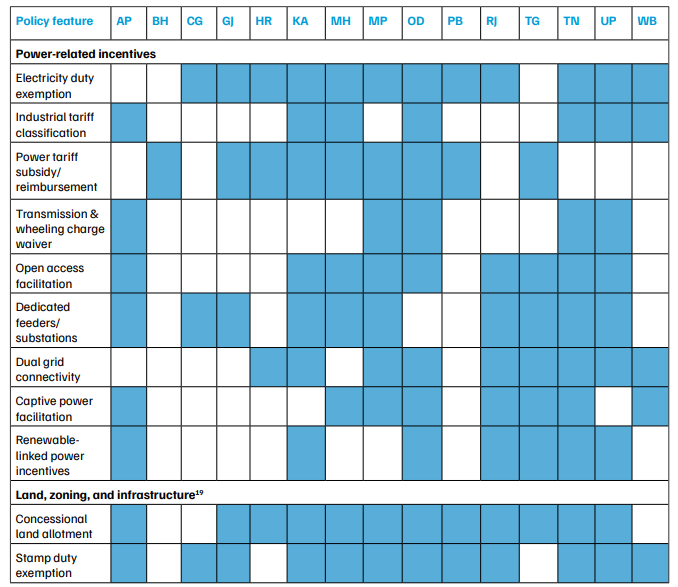
India does not yet have a national policy framework specifically governing data centre development. A Draft National Data Centre Policy (MeitY 2020) circulated by the Ministry of Electronics and Information Technology (MeitY) in 2020 was not notified; instead, central support has been provided through enabling measures such as according infrastructure status (The Hindu 2025) to data centres above 5 MW in 2022 and the announcement of a long-term tax holiday (PIB 2026) for data centre and cloud investments (extending up to 2047) in the Union Budget 2026. In the absence of a binding national framework and with national guidance largely limited to an early compilation of energy-efficiency best practices, (BEE 2010), state governments have taken the lead. Currently, 15 states support data centres through dedicated policies or through IT/ITeS and industrial policies (see Figure 4).

Table 1. Comprehensive comparative matrix of the policy levers across states


Source: Authors’ compilation from 15 states’ policies

State-level policies in India prioritise investment attraction over performance outcomes

  • Incentives have become the primary basis of state competition: Stamp duty exemptions, electricity duty waivers, capital subsidies, and expedited approvals have effectively become standard policy tools, with states competing primarily on the scale, duration, and bundling of incentives.
  • Power-related incentives dominate state policy design: States such as Uttar Pradesh, Rajasthan, Odisha, Gujarat, Haryana, and Tamil Nadu place central emphasis on power concessions, including tariff rebates, electricity duty waivers, transmission and wheeling charge exemptions, and facilitation of captive and open-access procurement. Consultations indicate these measures are critical for lowering delivered electricity costs, the single most important determinant of data centre viability.
  • Data centre park models reflect hyperscaler preferences for speed and certainty: Gujarat, Rajasthan, Uttar Pradesh, Haryana, and Andhra Pradesh have adopted park-based development models that offer plug-and-play infrastructure, pre-zoned land, floor-area ratio (FAR) relaxations, bundled approvals, and common utilities. This aligns with hyperscaler priorities for scale-ready, timebound deployments.
  • A subset of states is embedding explicit sustainability objectives: Rajasthan, Odisha, Karnataka, Tamil Nadu, and Andhra Pradesh have begun integrating sustainability into policy design. Notably, Rajasthan’s 2025 policy constitutes India’s most comprehensive sustainability-oriented data centre framework, integrating measures such as mandatory wastewater recycling, zero liquid discharge (ZLD), rainwater harvesting, groundwater recharge, advanced water management systems, green building standards, and targeted subsidies for green solutions. This integrated approach positions Rajasthan as a reference model for climatealigned data centre expansion in water-stressed geographies.
  • States are innovating on sustainability tools: Andhra Pradesh promotes seawater cooling for coastal data centres, leveraging natural geography to reduce cooling-related electricity demand. Karnataka and Tamil Nadu emphasise green building certification and energy-efficient infrastructure, while Odisha explicitly links data centre development to carbon footprint reduction.
  • Three systemic gaps persist across most state policies: Across most states, data centre policies exhibit three recurring gaps—(i) a water governance deficit, with limited provisions on cooling water management and reuse; (ii) an absence of performance standards such as power usage effectiveness (PUE), water usage effectiveness (WUE), or carbon benchmarks; and (iii) weak climate resilience framing, despite growing exposure to floods, cyclones, heatwaves, and seismic risks. In practice, some states are already implicitly accounting for water constraints in siting decisions. For instance, Maharashtra has prioritised coastal and peri-urban clusters, such as Navi Mumbai’s Rabale hub, while slowing development in waterstressed inland areas, such as Nagpur. Yet these considerations are not codified through enforceable water-efficiency norms or policy requirements.

As hyperscale capacity expands, future policy leadership will depend less on fiscal generosity and more on systemic integration of energy, water, land, and climate resilience. Rajasthan, Odisha, Karnataka, Tamil Nadu, and Andhra Pradesh offer early templates for such nextgeneration policy frameworks.

Global policy approaches increasingly link incentives to performance

  • Regulation is shifting from permitting to managing system-wide impacts: Globally, governments are increasingly tightening regulatory oversight of data centres as sustainability ambitions rise and electricity systems come under growing stress. Policy focus is shifting beyond site-level permitting towards managing cumulative system impacts through a combination of mandatory reporting, efficiency standards, renewable integration requirements, and grid-connection conditions.
  • The European Union leads on performancebased regulation: The revised EU Energy Efficiency Directive (2023) (EUDCA 2025) mandates energy and water reporting for data centres above 500 kW, and requires waste heat recovery for facilities above 1 MW. The directive also signals expectations for greater renewable energy uptake and continuous efficiency improvements. These obligations are complemented by voluntary initiatives such as the European Code of Conduct for Energy Efficiency in Data Centres, (EU 2025) and emerging provisions under the EU AI Act, which increasingly link digital infrastructure development with energy-system performance. Several EU countries are going further. Germany’s Energy Efficiency Act (EnEfG) (EnEfG 2023) imposes binding requirements on efficiency, renewable sourcing, waste-heat utilisation, and energy management systems. At the same time, Ireland has introduced stringent grid-connection rules for large energy users, requiring on-site generation and storage to limit system stress. In parallel with the Energy Efficiency Directive, the EU is also developing a harmonised data centre rating scheme, (EU 2026) expected to be introduced from 2026 onward.
  • Asian economies are linking approvals to sustainability metrics: China’s Green Data Centre Standards (Shid 2025) sets caps on water-to-energy ratios for cooling. Singapore’s Green Data Centre Roadmap (IMDA 2024) and Green Mark for Data Centres (BCA 2024) establish rigorous standards for energy performance, monitoring, and reporting. Malaysia is similarly advancing with the introduction of national guidelines (Skrine 2025) on power, water, and carbon efficiency, which are increasingly linked to project approvals and associated incentives.
  • The United States follows a fragmented, stateled approach: In contrast, regulation in the US remains fragmented, with limited federal mandates and greater reliance on state policies, utility interconnection rules, and local permitting processes. While federal efforts emphasise voluntary efficiency programmes, several states are introducing harder constraints. Virginia (Virginia Legislative 2024) links tax exemptions to meeting efficiency and clean power criteria, while Texas (Texas Legislature 2025) is tightening connection rules for huge loads, including curtailment obligations during grid emergencies, reflecting rising concerns about grid reliability. Arizona’s Tucson city (Mendoza 2025) mandates conservation plans for large water users and imposes penalties for exceeding thresholds.

Compared to these jurisdictions, India’s regulatory approach remains largely incentive-driven and nonprescriptive, relying on state-level industrial policies, general environmental compliance, and renewable procurement mechanisms. This highlights a growing gap between India’s investment-led data centre expansion and global shifts towards performance-based sustainability regulation.

Stakeholders highlight implementation gaps despite supportive policy intent

  • Single window in policy, delays in practice: Industry stakeholders consistently flagged slow, fragmented approvals as a material driver of project delays (particularly grid connectivity approvals, building plan sanctions, and fire NOCs). This suggests that, despite many state policies offering a single-window mechanism, the delays persist in practice. Our consultations further suggest that, after power, land acquisition is the most significant hurdle at present, while the perceived water-availability risk remains low. However, this likely reflects the sector’s early stage and may understate future constraints as deployments scale up. This reinforces the need for proactive planning now.
  • Regulatory friction in clean energy procurement is raising project risk and costs: Consultations indicate that institutional and regulatory barriers now outweigh technological constraints. Key institutional barriers include protracted approval processes, which often delay renewable sourcing decisions or lead to project deferrals, despite the presence of deemed-approval provisions. Data centre operators and renewable energy developers independently highlighted high cross-subsidy surcharge (CSS) and additional surcharge (AS), inconsistent banking rules, sudden withdrawal of waivers/provisions, and state-wise policy heterogeneity as the principal regulatory impediments. Collectively, these factors elevate project risk premiums, undermine long-term contracting, and increase financing costs.
  • Integrated land–energy–water planning is seen as essential for sustainable siting: Domain experts strongly endorsed the development of integrated national spatial planning frameworks to guide data centre location decisions, rather than fragmented industrial zoning approaches. Sustainable data centre expansion, they argued, requires co-optimisation of grid readiness, cooling water availability, land suitability, and climate resilience. Urban-edge projects like Actis’s green data centre in Taipei (SYSTEMIQ 2025) showcase how integrated land, water, and energy planning can enable sustainability even in dense, constrained environments. In our consultations with data centre operators as well, a strong consensus emerged that India requires dedicated green data centre policy frameworks, rather than relying solely on generic industrial promotion policies.

How can India position itself as a sustainable data centre hub?

Rapid digitisation and data localisation requirements have positioned data centres as critical national infrastructure. While there is a broad consensus on India’s long-term demand potential, consultations reveal divergent views on the pace, scale, and conditions required for sustainable growth. This signals the need for a more coordinated and evidence-based approach to sector development. Table 2 outlines indicative pathways for each focus area, reflecting how targeted actions across these domains can reinforce one another and guide the sector’s transition towards more resilient, efficient growth.

Table 2. Structuring the pathways to sustainable data centre growth

Focus area Critical questions Potential pathways Long-term sectoral benefits
Transparency How can transparency and evidence become the foundation for sustainable data centre growth?
  • Encourage sector-specific environmental disclosures for large data centre operators, regardless of BRSR status
  • Provide early regulatory clarity on future standards and milestones to support industry readiness
  • Gradually introduce enforceable benchmarks for PUE, WUE, renewable energy sourcing, and cooling efficiency
  • Improved accountability and regulatory certainty
  • Enable better planning and informed investment decisions across the sector
Innovation How can innovation be aligned with long-term sustainability outcomes?
  • Test emerging cooling solutions across diverse climatic regions
  • Encourage public–private collaboration to accelerate the research, development, and deployment of sustainable solutions
  • Lower water intensity, improved energy efficiency, greater operational resilience
  • Development of indigenous technology capabilities
Siting How can siting decisions move from project-level approvals to system-level planning?
  • Evaluate water, land, and energy availability alongside sustainability risks
  • Analyse locations across land, energy, water, environment, infrastructure, and policy dimensions to develop a decision-support siting tool
  • Develop data centres in planned parks with integrated resource planning
  • Efficient use of land, water, and energy resources
  • Reduced local environmental stress
  • Coordinated infrastructure development
Grid integration How can data centres be integrated into power systems as flexible infrastructure rather than passive loads?
  • Develop regulatory structures for value stacking of BESS
  • Execute on-site BESS pilots to generate India-specific operational data and performance benchmarks
  • Enable demand-response participation in dynamic grid-service markets
  • Value stacking for BESS beyond captive data centre use
  • Pilots generating evidence and bankable use cases
  • Leveraging data centre load for demand response

Source: Authors’ analysis

FAQs

Frequently Asked Questions

  • What are the key drivers behind the rapid expansion of India’s data centres?

    The Digital India initiative, the rapid growth of quick commerce and e-commerce, internet and 5G penetration, the expansion of public digital infrastructure, digital payments, and increasing AI adoption have significantly accelerated data generation. In addition, regulatory developments, such as the Digital Personal Data Protection Act and data localisation mandates from regulators like SEBI and RBI, are further strengthening the case for expanding domestic data centre capacity.

  • What is the growth trajectory of AI adoption globally and in India?

    AI adoption is increasing at an unprecedented pace, both globally and in India. Approximately 1 in 6 people worldwide use gen-AI for learning or work-related purposes. More than 80% of organisations globally, and a similarly high proportion in India, are actively using AI in some capacity.

  • What is India’s regional footprint and capacity expansion outlook?

    India’s installed data centre capacity stands at approximately 1.5 GW as of 2025 and is projected to grow to 4.5–6.5 GW by 2030. In comparison, global data centre capacity is expected to reach around 200 GW by 2030. Mumbai leads India’s data centre market, accounting for roughly 25% of total facilities, followed by Chennai, Hyderabad, and Bengaluru.

  • Does India have a national policy for data centres?

    While India does not currently have a binding national-level policy specifically for data centres, state governments have taken the lead in driving sector growth. 15 states have introduced dedicated data centre policies or leveraged existing IT and industrial frameworks to attract investment and facilitate data centre development.
  •  

HAVE A QUERY?

Sign up for the latest on our pioneering research

Explore Related Publications