Council on Energy, Environment and Water Integrated | International | Independent

Suggested Citation: Singh, Rashi, Vikrant Kumar Singh, Nitesh Kumar, and Kartikeya Yadav. 2026. Powering Uttar Pradesh: The Vidyut Sakhi Model for Women’s Empowerment and Discom Revenue Recovery. New Delhi: Council on Energy, Environment and Water (CEEW)
Reliable and affordable electricity is not just about wires, meters, and infrastructure. It also depends on whether people trust the system, understand their bills, and have easy ways to pay on time. In rural Uttar Pradesh, this has often been a challenge. Many consumers have limited access to convenient payment options, payments are irregular, and trust in billing systems remains low.
The Vidyut Sakhi programme, launched in 2020 by the Uttar Pradesh State Rural Livelihood Mission (UPSRLM) and the Uttar Pradesh Power Corporation Limited (UPPCL), responds to this last-mile challenge by placing rural women at the centre of electricity service delivery. Women from self-help groups are trained and equipped as digitally enabled doorstep bill collection agents. In doing so, the programme creates a performance-linked income opportunity for women while helping discoms improve revenue recovery and build stronger consumer relationships.
This policy brief studies the Vidyut Sakhi programme as a women-led, service-based livelihood model. Drawing on programme data, field research, and a statewide training intervention, it shows how technology, training, and trust can turn a persistent last-mile challenge into an opportunity for both livelihood creation and public service reform.
The findings show that Vidyut Sakhis are no longer just an additional bill collection channel. They have become a trusted link between rural consumers and discoms. Their experience offers important lessons for policymakers looking to design scalable, women-led service delivery models across sectors.
Discom finances remain a critical determinant of reliable and affordable power supply. In Uttar Pradesh (UP), distribution utilities have historically faced high AT&C losses and uneven revenue recovery, particularly in rural areas (PFC, Performance of State Power Utilities 2022–23., 2024) (UPERC, 2025). While billing coverage and digital payment options have expanded in recent years, irregular payment behaviour, limited payment access, and low consumer trust continue to challenge UP discom’s regular revenue realisation (Agrawal, 2020) (Balani, 2021).
It was in this context that the Vidyut Sakhi (electricity allies) programme was launched in 2020. By FY25, it had been expanded statewide, onboarding more than 30,000 women from self-help groups (SHGs), with half of them actively working as digitally enabled, doorstep bill collection agents across all 75 districts. Each sakhi earns a commission for every bill collected, creating a performance-linked income stream, while discoms benefit from deeper rural reach and a more predictable cash flow.
By embedding SHG members into last-mile electricity bill collection, the programme has strengthened revenue recovery for distribution companies (discoms) while creating dignified performance-linked livelihood opportunities for rural women.
This issue brief examines the Vidyut Sakhi programme as a case study in women-led, commission-based service delivery, with a particular focus on how well-curated training programmes can enable scale, productivity, and institutional trust. Drawing on programme data, field research, and a statewide mass training intervention, it offers practical lessons for policymakers designing livelihood and service-delivery programmes for women.
Even as the programme achieved scale, productivity varied widely until a statewide mass training was undertaken between December 2024 and mid-January 2025. Covering around 14,500 newly onboarded Vidyut Sakhis, the 45-day training was designed to address operational uncertainty, strengthen digital skills, and standardise service delivery.
Post-training assessments show a 23 percentage-point increase in average knowledge scores, alongside a sharp reduction in variation across districts. Crucially, improvements were driven by the training itself, not by district conditions, batch size, or earnings potential— demonstrating the power of standardised, practiceoriented capacity building.
Training also translated into outcomes. Activations2 surged immediately after training, followed by a sustained rise in collections. Collections grew faster than the number of active sakhis, indicating higher productivity per agent, not scale alone. Within eight months, from January 2025, the number of lakhpati didis more than doubled.
As performance improved, Vidyut Sakhis shifted from a supplementary channel to a core operational asset for the UPPCL. During the 2025 one-time settlement drive, around 15,000 sakhis were deployed as the primary lastmile recovery force, supported by rapid fintech upgrades and joint field coordination, contributing roughly 13 per cent to the endeavour’s total collections.
At the community level, Vidyut Sakhis have reached over 23 lakh rural consumers, with nearly 17 per cent emerging as frequent payers. This shift from sporadic to regular payments reflects growing trust, convenience, and familiarity—outcomes that conventional enforcement or digital-only approaches have struggled to achieve.
At full activation, with all registered sakhis reaching lakhpati-level incomes, the programme can potentially handle over INR 300 billion (30,000 crore) in annual collections. In practice, with varying productivity across districts, a more realistic medium-term aspiration is 4-5 times the current collections, or around INR 60–70 billion (6,000–7,000 crore) annually. Achieving this will require the sakhis to treat their role as a primary occupation, supported by strong institutional backing, reliable digital systems, and sustained consumer trust.
The Vidyut Sakhi experience shows that women-led service delivery models can act as reform accelerators, not welfare add-ons—provided they are designed correctly. Four lessons stand out:
This study demonstrates how technology, training, and trust can convert the last-mile challenges into opportunities. Moreover, this model need not be limited to electricity. We hope this study offers insights and a scalable blueprint for other public service delivery systems where trust, access, and service quality determine outcomes—and where women can play a central role in delivering them.
India has made significant progress in expanding access to public services over the past decade. Electricity connections are near-universal, digital payment platforms are widespread, and frontline delivery systems have been strengthened across sectors. Yet, despite these gains, a persistent challenge remains: gaps in last-mile service delivery—especially in rural areas (PFC, 2020) (PFC, 2024) (Agrawal, 2020) (Ganesan, Bharadwaj, Balani, & CEEW, 2019).
The rural last-mile gap: Access exists, reliability does not
In rural India, service delivery failures rarely stem from the absence of systems. Instead, they arise from irregularity, low trust, and high transaction costs. The gaps in timely revenue recovery in Uttar Pradesh’s power sector is an example. Despite improvements in billing efficiency and the expansion of digital payments, rural revenue recovery remains uneven (Annexure 1). High reported collection efficiency often masks sporadic billing and lump-sum payments, rather than regular monthly compliance. This pattern is not unique to electricity. It reflects a broader last-mile challenge: systems designed for scale may struggle to deliver reliability without trusted, human interfaces.
Emergence of performance-linked delivery models
Across sectors, there is a growing interest in delivery models that move beyond welfare and volunteerism towards performance-linked, accountable service provision. National livelihood frameworks such as the National Rural Livelihood Mission (NRLM) increasingly emphasise service-based, outcome-oriented roles for women, particularly in financial services, energy access, and digital inclusion (MoRD, 2011) (MoRD, 2023).
Digital systems alone cannot ensure compliance; trusted, local intermediaries remain critical for consistent rural service delivery.
Across sectors, three design principles are gaining prominence:
• Performance-linked service delivery models that align incentives with measurable outcomes rather than inputs or participation (World Bank, 2018) (MoRD, 2011)
• Women-led delivery platforms that combine trust, institutional reach, and livelihood creation, building on SHG federations as frontline service institutions (MoRD, 2023).
• Training as infrastructure, where capacity building is treated as a core system input for service reliability, not a one-time project activity (NRLM, 2022).
These approaches move beyond traditional beneficiary or volunteer models. Instead, they position local actors as partners in service delivery, embedded within formal systems, financially accountable, and governed through performance metrics rather than presence alone. Evidence from rural service delivery in sectors such as electricity, banking, and digital payments suggests that such models are particularly effective in low-trust environments where system reliability depends on sustained human interfaces.
Vidyut Sakhi initiative: A response to the last-mile challenge
The Vidyut Sakhi programme in Uttar Pradesh emerges from this evolving landscape. Launched in 2020, the programme was conceived to address gaps in the collection of electricity bill payments in rural areas. It does so by embedding women from self-help groups as commission-based, digitally enabled last-mile service providers within the power distribution system. Rather than relying solely on digital apps, payment counters or enforcement, the model introduces a trusted human interface—one that is locally rooted, financially incentivised, and institutionally integrated.
Why this case matters now
As India scales up smart metering, digitised public services, and outcome-based funding across sectors, the question of who delivers these in the last mile— and how—is becoming increasingly important. The Vidyut Sakhi experience offers timely insights into how governments can:
• Embed women-led delivery models within core public services;
• Use training and incentives to convert participation into productivity; and
• Leverage institutional convergence for livelihood generation and improved public service delivery.
This issue brief examines the Vidyut Sakhi programme through this wider lens. It situates the model within the broader challenge of rural last-mile service delivery, analyses how training enabled it to work at scale, and draws lessons for policymakers seeking innovative, scalable, and outcome-oriented delivery models across sectors.
In 2020, the Uttar Pradesh State Rural Livelihood Mission (UPSRLM) and the Uttar Pradesh Power Corporation Limited (UPPCL) jointly launched the Vidyut Sakhi programme, with a two-fold objective:
• Increase revenue of the discoms from rural Uttar Pradesh;
• Generate livelihood opportunities for SHG women in rural areas.
Today, over 30,000 SHG women are registered as Vidyut Sakhis in Uttar Pradesh, with half of them actively operating as door-to-door electricity bill collection agents for domestic consumers. They remain affiliated with their respective SHGs, but operate within a formal, digitally mediated revenue recovery framework.
Programme design and institutional architecture
At inception, rural areas in Uttar Pradesh were organised into 15,521 clusters across 75 districts, with each cluster comprising three to four villages. The original programme design envisaged one Sakhi per cluster, resulting in the onboarding of 15,521 registered women in FY 2021. In FY 2023–24, the programme was strategically expanded to improve consumer coverage, service accessibility, and collection efficiency. Under the revised structure, two Sakhis were deployed per cluster, effectively doubling the programme’s scale.
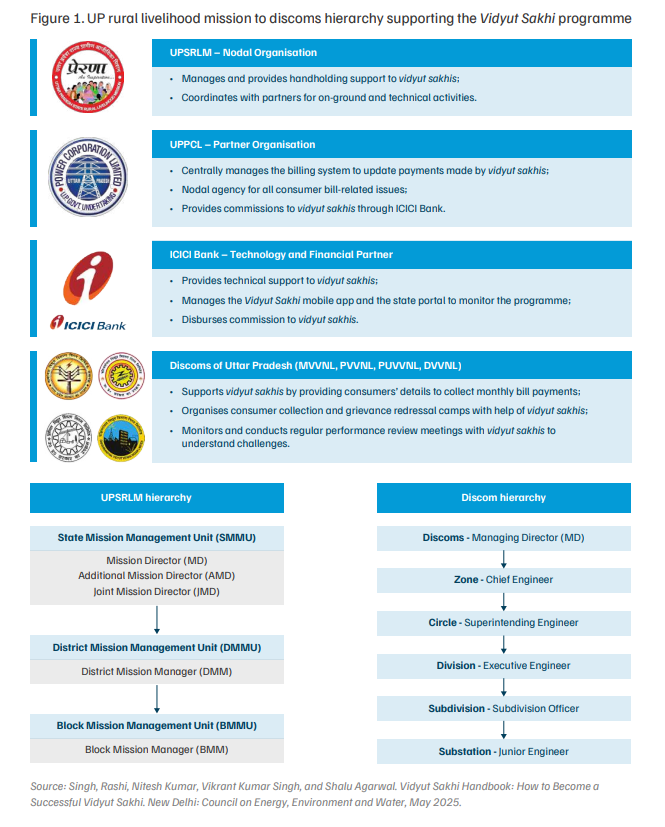
The Vidyut Sakhi programme is implemented through a clearly defined multi-tier institutional architecture that links livelihood institutions with utility systems. The UPSRLM acts as the nodal agency, providing overall programme management and handholding through its state, district, and block mission management units (SMMU, DMMU, and BMMU), while the UPPCL and the four discoms oversee billing systems, consumer interfaces, and revenue integration. ICICI Bank serves as the technology and financial partner, managing the digital payment platform and commission disbursements. This structure ensures vertical coordination from state to village level, and enables seamless operational alignment between community institutions and formal utility systems (CEEW, 2024).
| Area | Bill amount (INR) | Rate (as of 2025) | |
|---|---|---|---|
| Full payment | Part payment* | ||
| Rural | 0 - 2,000 | INR 20 per transaction | 1% of the collected amount |
| > 2,000 (Up to 1,99,999) | 1% of the collected amount | 1% of the collected amount | |
| Urban | 0 - 3,000 | INR 12 per transaction | 0.4% of the collected amount |
| > 3,000 (Up to 1,99,999) | 0.4% of the collected amount | 0.4% of the collected amount | |
* Part payment is when the consumer pays only a portion of the total outstanding bill, with the remaining balance carried forward.
Source: Vidyut Sakhi programme guidelines as outlined in government order.
Note: The commission structure is higher for rural and small-value bills to align the NRLM's mandate of rural economic empowerment with the discoms' need to improve recovery in low-collection segments.
Commission structure
Vidyut Sakhis earn income through a transparent commission structure tied directly to bill collections. Commission slabs vary by consumer category and bill amount, as detailed in Table 1. This design ensures that earnings increase with effort and efficiency, enabling income growth through service delivery rather than fixed wages or subsidies.
Operationally, the programme is enabled through a fintech platform provided by ICICI Bank. Each Vidyut Sakhi is registered on the Vidyut Sakhi mobile application, and activates her virtual wallet through an initial recharge of INR 10,000, which serves as working capital for transactions.
The sakhis collect electricity payments in cash from consumers during door-to-door visits. The amount collected by a sakhi is deposited into her personal bank account, after which she recharges her virtual wallet through UPI or other digital payment modes. All payments to the discom are executed through this wallet, ensuring full traceability and real-time transaction records.
A critical institutional reform within the programme has been the transition from a delayed, multi-layered commission system—earlier routed through multiple institutional levels—to a direct digital settlement mechanism. Today, commissions are credited to sakhi wallets in near real time, typically by the day after collection.
This shift has had important system-level effects: it has improved cash-flow certainty, strengthened trust in the platform, reduced dependence on intermediaries, and significantly enhanced sakhi motivation and participation. In practice, this digital financial architecture has been as important as physical deployment in sustaining scale and performance.
What makes the programme work at scale?
The Vidyut Sakhi programme’s ability to operate at scale rests on a carefully aligned combination of low entry barriers, financial incentives, and digitally enabled accountability, backed by a standardised training module.
Low entry barriers and financial incentives
In November 2024, the UPSRLM lowered the participation barriers by reducing the wallet activation requirement from INR 30,000 to INR 10,000. This significantly expanded access and enabled faster activation, particularly for women with limited savings or credit history, as shown in Figure 6 later.
Earnings are fully performance-linked. In FY 2025- 26, over 550 Vidyut Sakhis were earning more than INR 100,000 (1 lakh) annually, demonstrating that the model supports income growth through service delivery rather than subsidies.
The programme also benefited from explicit policy prioritisation in commission design. While commission rates for other fintech-enabled bill collection channels used by the UPPCL, such as common service centres (CSCs), were rationalised downwards to 0.5 per cent, the commission rate for Vidyut Sakhis was maintained at INR 20 per bill or 1 per cent of the bill amount (whichever is higher) for full payment in rural areas. This differentiation reflected sustained coordination between the UPSRLM and the UPPCL, supported by programme evidence, to protect income viability for communitybased agents.
Digital systems for transparency and accountability
The programme operates through a tripartite fintech architecture involving the UPPCL, the UPSRLM, and ICICI Bank. Each sakhi uses a mobile application and virtual wallet for all transactions, enabling real-time settlement and automated commission credit. This replaced an earlier delayed payment system routed through multiple institutional levels.
The shift to near real-time digital commission payments proved decisive. It improved cash-flow certainty, strengthened trust in the system, and directly enhanced sakhi motivation and participation. All transactions are traceable, reducing leakages and allowing discoms to monitor collections at cluster, district, and state levels.
Training as the critical performance multiplier
While the programme achieved rapid geographic scale, early years revealed wide variation in activation and productivity across districts. Structured training emerged as the key intervention that converted registration into performance.
Between December 2024 and January 2025, over 14,500 Vidyut Sakhis were trained through a centrally standardised residential programme. The training produced a 23 percentage-point increase in average knowledge scores and sharply reduced inter-district variability (see Section 4 for details). Statistical analysis confirms that improvements were driven by training itself rather than district characteristics, earning potential, or batch size.
Programme outcomes so far
The Vidyut Sakhi programme has delivered substantial financial, institutional, and livelihood outcomes since its statewide expansion.
Scale and coverage
Originally designed to assign one sakhi per cluster, the programme expanded in FY24 to two sakhis per cluster, resulting in over 30,000 registered women across all 75 districts. Approximately half are now active collectors.
Revenue recovery
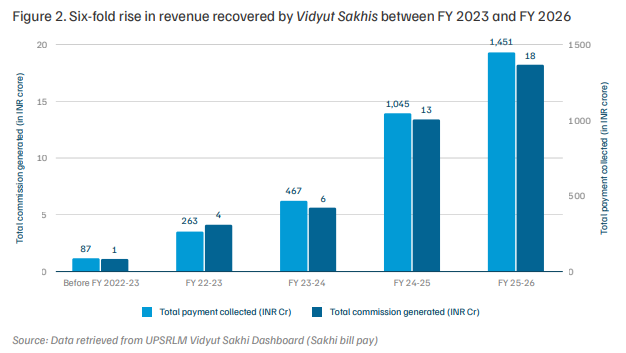
Electricity bill collections through Vidyut Sakhis grew sixfold between FY 2023 and FY 2026, rising from around INR 2 billion (200 crore) to approximately INR 14.5 billion (1,451crore) annually (see Figure 2). The programme’s contribution to total rural domestic revenue for UP discoms was approximately 15 per cent in FY 2024–25 and around 12 per cent in FY 2025–26.
Low entry barriers, performancelinked incentives, real-time payments, and structured training together drive participation and productivity.
Livelihood outcomes
Commission earnings increased proportionally with collections. Over 550 women now earn more than INR 100,000 (1 lakh) annually, aligning the programme with the national Lakhpati Didi vision. These incomes are recurring, performance-linked, and independent of welfare transfers. On average, an active Vidyut Sakhi earned ~INR 2,000–3,000 per month in FY 2024–25, translating to around INR 22,000–INR 36,000 annually. However, earnings are unevenly distributed, with a small but growing share of high performers driving a rising upper tail (Figure 3).
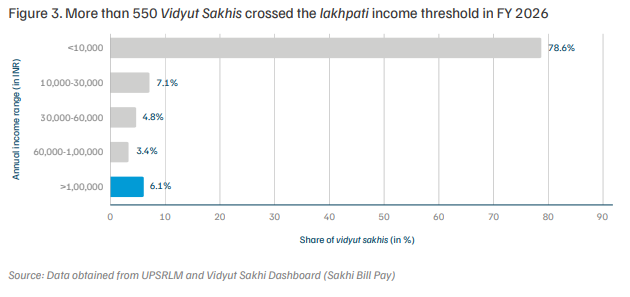
With around 30,500 registered Vidyut Sakhis across Uttar Pradesh, the programme has the potential to evolve into one of the largest performance-linked livelihood platforms for rural women in the state. Currently, more than 15,200 sakhis are active, which means they have completed the initial wallet recharge and are able to undertake collections. If all the registered sakhis were to become active and earn INR 100,000 (1 lakh) annually, the programme's livelihood impact and revenue contribution will expand substantially.
At a commission rate of 1 per cent (see Table 1), a sakhi earning INR 100,000 (1 lakh) annually will need to collect roughly INR 10 million (1 crore) in electricity bills each year. At full potential, this implies total annual collections of around INR 305 billion (30,500 crore) across the state. This is equivalent to roughly 35–40 per cent of UPPCL's approved tariff revenue for FY 2025–26 (INR 86,183 crore), highlighting the programme's potential as both a major revenue channel for discoms and a large-scale livelihood platform for rural women (UPERC, 2025).
However, achieving such income levels will require the sakhis to treat the role as their primary occupation, and undertake 6 - 7 hours of daily fieldwork involving travel across multiple villages within their assigned clusters, rather than the largely part-time engagement seen today. Realistically, all 30,000 Vidyut Sakhis, working at varying levels of productivity linked to their diverse contexts, can easily mobilise 4-5 times the current revenue collection. This will amount to collections of INR 60–70 billion (6,000–7,000 crore) per annum, comprising 60–70 per cent of total discom revenues from rural areas. The programme can pursue this as an aspiration.
Unlocking this aspiration will require strong institutional backing from the UPSRLM and discoms, along with reliable digital systems, communication channels, and consumer trust to sustain regular payments at scale.
Although the Vidyut Sakhi programme achieved early geographic scale, productivity and activation remained uneven. Our research team supporting the Vidyut Sakhi programme identified training as a critical lever for transforming the registered women into confident and more productive service agents. The training strategy involved a four-step process: diagnostic analysis, content redesign, piloting and standardisation, and mass delivery.
Diagnosing the capability gap
We conducted a telephonic survey with over 4,000 inactive Vidyut Sakhis in 2022. It revealed four systemic bottlenecks:
• 85 per cent of the sakhis reported consumer trust deficit due to lack of formal identity markers.
• 40 per cent of the sakhis cited delayed commissions as a major demotivator
• Only 27 per cent of the sakhis contacted discom officials when facing issues; most depended entirely on block mission managers (BMMs), creating an indirect communication channel that slowed issue resolution.
• While 91 per cent of the sakhis had received basic app training, practical troubleshooting skills were weak.
These findings indicated that low productivity was not a function of motivation alone, but of uncertain institutional interfaces, limited digital confidence, and unclear escalation pathways.
Designing a handbook for Vidyut Sakhis
In response, we co-developed a comprehensive training module along with a Vidyut Sakhi Handbook as the core learning instrument. It consolidated operational procedures, app workflows, commission rules, and most importantly, field communication scripts. The training content prioritised real-world scenarios—how to explain bills, resolve disputes, handle partial payments, and reassure hesitant consumers. This differentiated the training content from previous efforts, which mainly focused on procedural familiarity.
The handbook was deliberately given a conversational format, reflecting the typical questions and concerns raised by sakhis during field operations. This communication-first design philosophy positioned the sakhi not just as a transaction agent, but as a trusted intermediary between consumers and discoms. The draft handbook was piloted during early training rounds, refined based on trainer and participant feedback, and finalised before being scaled up across all training centres.
Piloting, iterating, and standardising
The training module was piloted in Varanasi and Unnao with around 250 sakhis. These pilots tested:
• One-day vs two-day formats
• Role-play vs video instruction
• Module sequencing
• Trainer facilitation capacity
Insights from the pilots informed iterative redesign, resulting in a curriculum that was field-tested, timeefficient, and repeatable across districts. This process significantly reduced variation in delivery during statewide rollout.
Delivering mass training
To train over 20,000 newly onboarded women, a threephase centralised model was adopted:
• Phase 1: Training of trainers (75 DMMs and 75 nodal BMMs)
• Phase 2: Online training of the remaining 800+ BMMs
• Phase 3: Residential mass training of newly registered Vidyut Sakhis
Institutional roles in training delivery
The mass training programme was delivered through a joint institutional model involving the UPSRLM, the State Institute of Rural Development (SIRD), and CEEW. The UPSRLM led overall coordination and mobilisation, including participant selection, logistics, and on-ground facilitation through district and block teams. SIRD served as the core training partner, providing master trainers, training infrastructure, and standardised pedagogy aligned with state capacity-building protocols. CEEW supported curriculum design, training content, and evaluation, including the development of training handbooks, instructional videos, and learning assessments.
The programme covered 50 training centres over 45 days. Approximately 70 per cent of all the newly onboarded Vidyut Sakhis completed the full residential training. The remaining 30 per cent were unable to participate primarily due to personal and logistical constraints, including caregiving responsibilities, healthrelated issues, and limited ability to travel to distant training centres.
The training sessions comprised a mix of standardised handbooks, structured presentations, peer learning, and short instructional videos developed specifically for the programme. These videos, ranging from 5–10 minutes each, covered key operational tasks such as bill reading, app navigation, and consumer interaction, and were screened repeatedly during sessions and later shared digitally with the sakhis for continued reference.
Field insights from a multi-district study conducted by a CEEW team in October 2024 highlight the structural and gender-linked constraints that shape participation in the Vidyut Sakhi programme. The study involved shadowing high-performing sakhis, interviews with block and district mission staff, and focus group discussions across districts with varying performance levels.
Women's participation was closely tied to mobility constraints and household responsibilities. Several sakhis reported difficulty travelling long distances or working fixed hours due to caregiving roles and social norms. Fieldwork also exposed them to safety risks, especially while carrying large amounts of cash, with some instances of theft reported. Limited access to sanitation facilities and exposure to harsh weather conditions were also cited as factors affecting health and work continuity.
The study found that sakhi performance was strongly linked to three pillars of support: family, livelihood mission staff, and discom officials. Where any of these were weak, women faced greater operational and social challenges. Conversely, women who earned regular commissions reported greater influence in household financial decisions and improved social standing.
Despite rising incomes, some sakhis faced transaction costs from handling large cash volumes and lacked access to appropriate banking products, such as current or overdraft accounts. There was also demand for stronger grievance redressal systems and clearer escalation pathways to resolve field-level issues.
The field study showed that many women's participation was shaped by caregiving duties, mobility constraints, safety concerns, and the difficulty of travelling long distances for training. For several sakhis, attending a centralised residential programme in Lucknow was not feasible. Based on these insights, the training model was decentralised across SIRD's regional and district centres, reducing travel time and making participation more practical.
The study also highlighted financial barriers in wallet activation, as women often had to use their own savings to start work—many a time without being able to borrow from male family members. The activation requirement was therefore reduced from INR 30,000 to INR 10,000, lowering entry barriers while retaining the discipline of a prepaid digital system.
Training outcomes were evaluated using Aakalan, a structured pre- and post-training assessment tool administered across 50 training centres to over 14,000 Vidyut Sakhis. The tool was designed to measure changes in operational knowledge and practical readiness of participants before and after the twoday residential training programme. Each participant completed the same multiple-choice questionnaire on Day 1 (pre-training) and again at the end of Day 2 (post-training), enabling a direct comparison of learning outcomes. Responses were matched using unique phone numbers or sakhi IDs to ensure accurate before-and-after analysis. The assessment focused on five core training domains:
1. Understanding of the Vidyut Sakhi programme and stakeholders,
2. Knowledge of commission structures,
3. Mobile application and printer handling,
4. Electricity bill reading, and
5. Consumer interaction skills.
Results were analysed using percentage scores and domain-wise comparisons to identify areas of strongest improvement and remaining gaps.
Clear learning outcomes
The average scores of sakhis increased from 56 per cent (pre-training) to 79 per cent (post-training), a 23 percentage-point gain. Score variability dropped from 17 per cent to 9 per cent, indicating convergence across districts. Participants with the lowest baseline scores recorded the largest improvements.
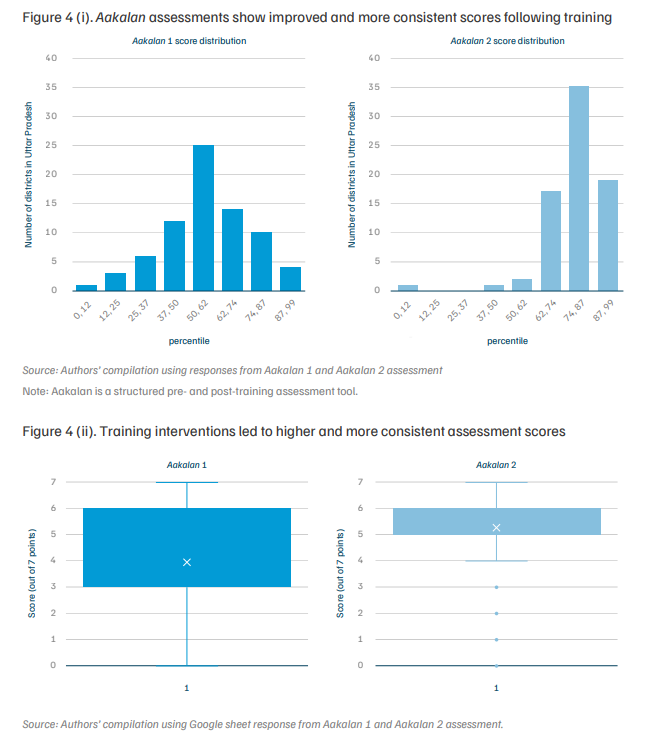
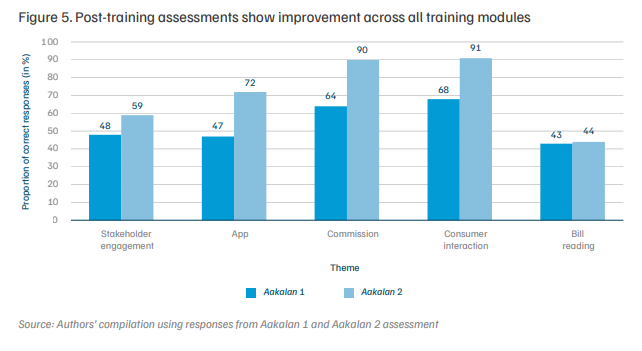
The 23 percentage-point improvement reflects the training’s ability to bridge knowledge gaps effectively, especially in domains like stakeholder roles, digital app usage, commission structures, and consumer interaction.
However, one area that lagged in performance improvement was bill reading, indicating the need for strengthened focus or alternative teaching methods for this specific module (Figure 5).
Regression analysis shows that the training itself explained over 67 per cent of knowledge gains, while district conditions, batch size, or earning potential had negligible influence. This confirms the causal role of standardised capacity building.
4.2 Higher productivity levels
Post-training, sakhi activations surged sharply, peaking in January 2025 (see Figure 6). However, the more significant shift was in performance. Total electricity bill collections rose steeply and remained elevated over subsequent months, with the growth in collections consistently outpacing the increase in the number of active sakhis. This indicates that improvements were driven by higher productivity per sakhi rather than scale alone.
Reflecting this shift, the average number of bills collected per active sakhi more than doubled, increasing from around 14 in FY23 to about 31 in FY26, underscoring improved field efficiency and consumer engagement.
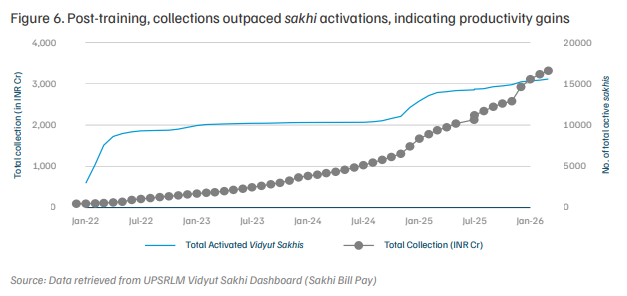
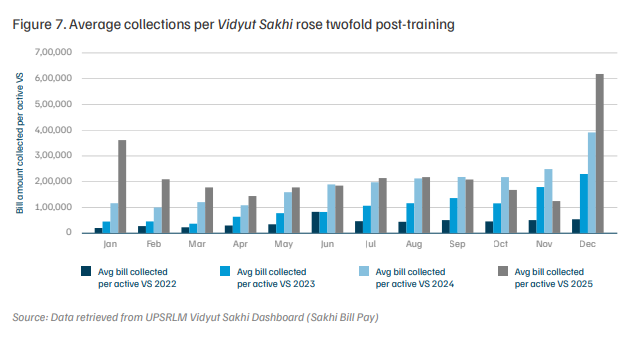
Average collections per Vidyut Sakhi doubled within months of the training (see Figure 7), and the corresponding commission earnings increased accordingly. These trends suggest that the training translated into greater operational efficiency, stronger consumer engagement, and more regular collection behaviour at the field level. Over time, these productivity gains supported the emergence of a growing cohort of lakhpati didis. The number of sakhis earning over INR 1 lakh annually rose from 189 before the training to 432 within eight months, reinforcing the programme’s character as a performance-linked livelihood model rather than a participation-based intervention.
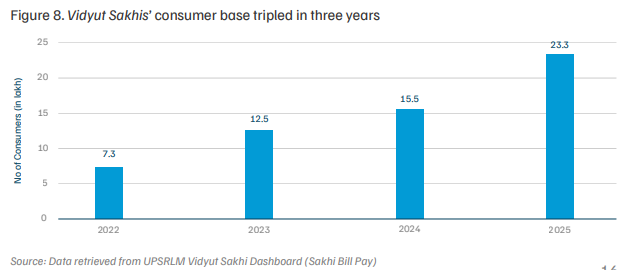
Simultaneously, the Vidyut Sakhi programme has significantly improved consumer access to and engagement with formal electricity payment systems. In 2025, Vidyut Sakhis reached over 23 lakh unique rural consumers across Uttar Pradesh (see Figure 8). Of these, more than 4 lakh consumers (around 17 per cent) emerged as frequent payers, making electricity bill payments through Vidyut Sakhis in four or more months during the year, indicating growing trust and repeat use of the platform.
Enhanced institutional trust
From an institutional perspective, the post-training surge in activations and collections reflected stronger alignment between the UPSRLM state office, district staff, discoms, and banking partners. For the UPPCL, the resulting improvement in cash flow and field-level responsiveness reinforced confidence in communitybased service delivery as a viable complement to infrastructure and smart metering reforms.
The trained Vidyut Sakhis were increasingly engaged in UPPCL-led recovery initiatives, most notably during the 2025 one-time settlement (OTS) drive. This signalled a gradual shift in their role from peripheral support to a more central position in field-level revenue recovery.
The UPPCL launched the statewide OTS scheme in December 2025 to recover long-pending dues from consumers, including those who had never made any payment. The outstanding arrears were estimated at ~INR 280 billion (28,000 crore). Vidyut Sakhis were formally deployed as the primary last-mile collection Beyond programme-level metrics, the Vidyut Sakhi initiative has generated tangible changes in women’s economic agency and social positioning within rural communities. Improved operational skills, predictable income flows, and sustained engagement with both consumers and public institutions also strengthened the sakhis’ confidence, visibility, and autonomy in public spaces. Through three case stories, drawn from in-depth interviews (IDI), we illustrate how the Vidyut Sakhi programme has enabled rural women to transition from low-income, informal work to stable, performance-linked livelihoods. These journeys highlight gains in income security, skills, confidence, and social recognition at the household and community levels. workforce for the OTS drive, leveraging a network of ~15,000 women across all districts as the largest fieldlevel collection force available to the utility, especially in rural areas where the percentage of target consumers was higher. During the three-month drive, Vidyut Sakhis collected over INR 656 crore in revenue, earning more than INR 6 crore in total commissions.
To support this scale-up, the UPPCL, in coordination with the UPSRLM and its fintech partner, rapidly upgraded the Vidyut Sakhi application to integrate end-to-end OTS functionalities, including identification and registration of consumers with long-unpaid dues, settlement workflows, and real-time transaction reporting. The OTS implementation was executed through jointly coordinated field drives led by the senior management of the UPPCL and the UPSRLM, signalling a clear shift in institutional strategy. The Vidyut Sakhis moved from being a supplementary channel to a core operational asset for revenue recovery, contributing around 13 per cent of the collection under the OTS drive, and reinforcing discom confidence.
Beyond programme-level metrics, the Vidyut Sakhi initiative has generated tangible changes in women’s economic agency and social positioning within rural communities. Improved operational skills, predictable income flows, and sustained engagement with both consumers and public institutions also strengthened the sakhis’ confidence, visibility, and autonomy in public spaces.
Through three case stories, drawn from in-depth interviews (IDI), we illustrate how the Vidyut Sakhi programme has enabled rural women to transition from low-income, informal work to stable, performance-linked livelihoods. These journeys highlight gains in income security, skills, confidence, and social recognition at the household and community levels.
Anita Verma—a trained B.Ed. graduate—had withdrawn from paid work after the COVID-19 pandemic due to increased household responsibilities and caregiving needs. With limited mobility and no independent income, she remained a full-time homemaker until early 2025.
Anita learned about the Vidyut Sakhi programme through her SHG, and was drawn by the flexibility of the role. Training equipped her with practical skills in bill explanation, digital payments, and consumer interaction, building her confidence to operate independently in her village.
Activated as a Vidyut Sakhi in January 2025, Anita earned INR 163,244 (1.63 lakh) in commissions within a year, becoming a lakhpati didi by January 2026. This income strengthened her financial autonomy, enabled regular savings, and improved her household's economic security.
Her social standing has also shifted. Villagers now rely on her for electricity-related support, and new sakhis seek her guidance. At the community level, her work has improved payment discipline, with most households in her ward now paying electricity bills regularly through her doorstep service.
In Anita's own words...
"Buying two LIC policies for my child. Once, my child's school fees were due and there was no money at home. But my commission got credited the same day. That's when I realised I can actively secure my child's future."
"People now depend on me for guidance. My phone keeps ringing for bill-related help, even from new Vidyut Sakhis."
"Earlier, people did not understand the consequences of not paying bills. Now, almost every household in my ward pays regularly."
Before joining the Vidyut Sakhi programme, Mohini devoted most of her time to caring for her household and supporting her family. Like many women in her village, her responsibilities centred around domestic work, and she had limited opportunities to take up paid employment or participate in activities outside the home. Her earnings, when they came, were occasional, through small seasonal work or family support, and she had little exposure to financial or digital systems.
In 2022, Mohini learned about the Vidyut Sakhi programme when a UPSRLM team visited her village. With encouragement from her family, she decided to enrol. Through the programme's structured training in December 2024, she acquired new skills in digital payments, customer interaction, and problem-solving, and became comfortable using smartphones, payment apps, and basic printing for bill collection.
Today, Mohini earns a stable monthly income as a Vidyut Sakhi. Her earnings have allowed her to purchase her own plot of land and a two-wheeler, giving her greater financial confidence and mobility. She has also grown in confidence, moving from being hesitant to speak to now actively leading discussions in SHG meetings and interacting with consumers and officials.
Her work has had positive effects in her community as well. Local households find it easier to pay their electricity bills through her, and many prefer the clarity and support she provides, contributing to more regular and timely payments. Mohini now travels across nearby villages as part of her work, balancing her household responsibilities with a meaningful public-facing role.
In Mohini's own words...
"Buying my own plot and scooter with my earnings. It proved to me that I can rebuild my life independently."
"Before, I wasn't allowed to travel freely. Now I move independently across villages and speak without hesitation with community members and in my SHG meetings."
"More households pay on time now because they have someone reliable nearby to support them. Many users say they prefer coming to me because I explain clearly and without hesitation."
"Don't hesitate. This programme gives you skills, confidence, and a steady income—things every woman deserves."
Gayatri Devi's livelihood options before becoming Vidyut Sakhi were defined by constraint. As an anganwadi worker and a woman with a physical disability, she earned about INR 2,000–2,800 per month, barely enough to support her household. Limited mobility, few income options, and social hesitations around her disability kept her financially dependent and professionally invisible.
In 2022, Gayatri was introduced to the Vidyut Sakhi programme through the district SRLM office (DMM). Despite initial hesitation, she enrolled after encouragement from her SHG and family. She credits the ensuing training with transforming her ability to engage with technology and customers. She learned to use smartphones, from accessing the Vidyut Sakhi app and YouTube tutorials, to digital payments, and even basic printing for receipts.
Today, Gayatri earns INR 30,000–40,000 per month as a Vidyut Sakhi, more than ten times her earlier income. She manages household finances, contributes to major family decisions such as her son's marriage, and has helped build her family's home.
Her social standing has also shifted. She rarely stepped outside before, but now travels freely with the help of her son, interacts with officials and consumers, and is trusted by villagers for financial transactions. Electricity bill payment regularity in her village has improved because residents now have a reliable, local woman they trust.
In Gayatri Devi's own words...
"Contributing financially for my son's wedding and helping build our house."
"I feel more confident in meetings; people listen to me now. People trust women with financial transactions because of my work."
"Electricity bill payments in my village have become more regular because people find it easier to pay through me."
"Initial acceptance and outreach were tough, and accessibility issues due to my disability still exist."
Strengthening the next phase
The Vidyut Sakhi programme demonstrates that women-led, community-based service delivery can significantly improve rural revenue recovery while generating dignified, performance-linked livelihoods. Its rapid scale-up across all Uttar Pradesh districts and its growing contribution to discom revenues reflect a strong institutional foundation.
To unlock the full potential of the programme, where sakhis can help mobilise 60-70 per cent of the discoms’ rural revenues, three sets of improvements are proposed:
First, the UPSRLM should strengthen field-level workforce management and communication. District teams currently have limited flexibility to manage the sakhi workforce, and communication between the state and districts officials, and the sakhis remains fragmented. Establishing direct digital communication channels, periodic refresher trainings, and simple district-level performance dashboards will improve responsiveness, reduce attrition, and enable more active workforce management.
Second, discoms should deepen service integration and strengthen grievance redressal. While the sakhis play a frontline role in collections, institutional support for bill corrections and consumer complaints remains uneven. Time-bound grievance protocols, formal integration of sakhis into complaint systems, and functional digital identities will strengthen their credibility and improve consumer trust.
Third, the UPSRLM and the UPPCL should strengthen incentives, data systems, and long-term programme architecture. Clear district-wise targets, better analytics on inactive sakhis and low-compliance consumer segments, and closer alignment with reforms such as smart metering and digital payments will help institutionalise the programme as a core component of the state’s revenue and livelihood strategy.
Overall, the Vidyut Sakhi model is already delivering strong outcomes, and has the potential to evolve into a permanent, system-level reform tool. To sustain this momentum, several operational risks will need to be managed as the programme is scaled up.
• Uneven income distribution: A small but growing group of high earners drives the upper end of earnings, highlighting the need for a viable income floor across districts.
• Evolving role with digitalisation: As smart meters and digital payments expand, the sakhis’ roles may need to shift towards consumer education, digital facilitation, and grievance support.
• Operational constraints in the field: Mobility barriers, safety risks on account of cash handling, and limited access to appropriate financial products continue to affect participation.
• Need for sustained institutional support: Stronger grievance systems, safer transaction mechanisms, and financial literacy for sakhis will be essential to maintain livelihoods and preserve the sakhis’ role as a trusted last-mile interface.
Recognising and planning for these risks will be essential to sustain the programme’s livelihood outcomes while preserving its role as a trusted last-mile interface in an increasingly digital electricity system.
Sustaining scale requires stronger grievance systems, safer transactions, and continuous institutional support for frontline workers.
What policymakers can learn from the Vidyut Sakhi model
The Vidyut Sakhi experience offers a set of transferable lessons for policymakers seeking to strengthen lastmile service delivery while simultaneously advancing women-led livelihoods. The programme demonstrates that community-based delivery models can improve institutional performance when they are embedded within core systems, governed through data, and supported by credible income pathways.
Institutionalise community-based last-mile delivery: In sectors such as electricity, where citizen behaviour directly shapes system outcomes, human interfaces remain essential even in highly digitised environments. Embedding community agents within formal operational structures enables states to improve trust, access, and compliance in ways that purely technological or enforcement-based approaches often cannot.
Leverage livelihood missions as reform partners: Livelihood missions and SHG federations can function as strategic partners for public utilities. Their existing institutional networks offer scale, local legitimacy, and accountability mechanisms that state agencies alone struggle to replicate. Rather than positioning livelihood institutions as beneficiaries, governments can leverage them as co-producers of public services.
Design for income certainty and cash-flow predictability: Stable commission structures and near real-time digital payments are critical for sustaining participation, reducing attrition, and incentivising effort. Where earnings are predictable and transparent, community agents are more likely to invest time, build consumer relationships, and internalise service standards.
Use data to move from input tracking to outcome governance: Simple diagnostic tools, periodic assessments, and performance dashboards enable managers to identify bottlenecks, target support, and adapt programme design in real time. This shift from input compliance to outcome management is essential for scaling up service quality.
Treat women-led service models as reform accelerators: When women are positioned as accountable service providers—supported by training, digital tools, and institutional legitimacy—they can strengthen state capacity while expanding economic participation.
Uttar Pradesh’s Vidyut Sakhi programme demonstrates how embedding women-led service delivery within core public systems can help strengthen institutional performance while expanding economic participation and livelihood creation. We hope that lessons from this programme will inspire more sectors and public programmes to leverage technology, training and trustbuilding as measures for enhanced last-mile service delivery.
Livelihood missions can act as implementation partners, not beneficiaries, in delivering public services at scale.
The Vidyut Sakhi programme is a women-led electricity bill collection initiative in Uttar Pradesh. It was launched in 2020 by the Uttar Pradesh State Rural Livelihood Mission (UPSRLM) and the Uttar Pradesh Power Corporation Limited (UPPCL). Under the programme, women from self-help groups are trained and onboarded as doorstep electricity bill collection agents. They use a digital application and virtual wallet to collect payments from rural consumers and earn a commission for each successful transaction.
Discoms depend on timely bill collection to maintain cash flows, procure power, invest in infrastructure, and provide a reliable electricity supply. In rural areas, revenue recovery is often hindered by irregular payments, limited access to payment methods, and low consumer trust. Vidyut Sakhis help address this by providing a trusted local interface for consumers. Their doorstep service makes bill payment more convenient and improves the regularity of collections.
The programme creates a performance-linked income opportunity for rural women. Vidyut Sakhis earn commissions based on the value and number of electricity bills they collect. Since commissions are linked to effort and performance, the model enables women to increase their income through regular service delivery. Over 550 Vidyut Sakhis now earn more than INR 100,000 annually, contributing to the Lakhpati Didi vision.
Training was a turning point for the programme. A statewide training intervention was conducted between December 2024 and January 2025, covering over 14,000 newly onboarded Vidyut Sakhis. The training focused on digital app usage, bill reading, commission rules, consumer interaction, and grievance escalation. Collections also rose faster than the number of active Sakhis, showing that training improved productivity.
The Vidyut Sakhi model shows that women-led service delivery can improve institutional performance when it is embedded within formal systems and supported by clear incentives, digital tools, training, and grievance redressal. Other states can adapt this model to improve public service delivery in sectors such as electricity, water, banking, digital services, local governance, and grievance support. The key lesson is that livelihood missions and SHG networks can act as implementation partners, not just beneficiary platforms.
How Should Indian States Choose New Power Generation Capacity?
How can India Create a Demand Flexibility Market?
Contracts for Difference for Flexible and Affordable Clean Power
Enabling Corporate India's Clean Energy Transition
Scaling Solar Power for Irrigation in India: