Other Publications
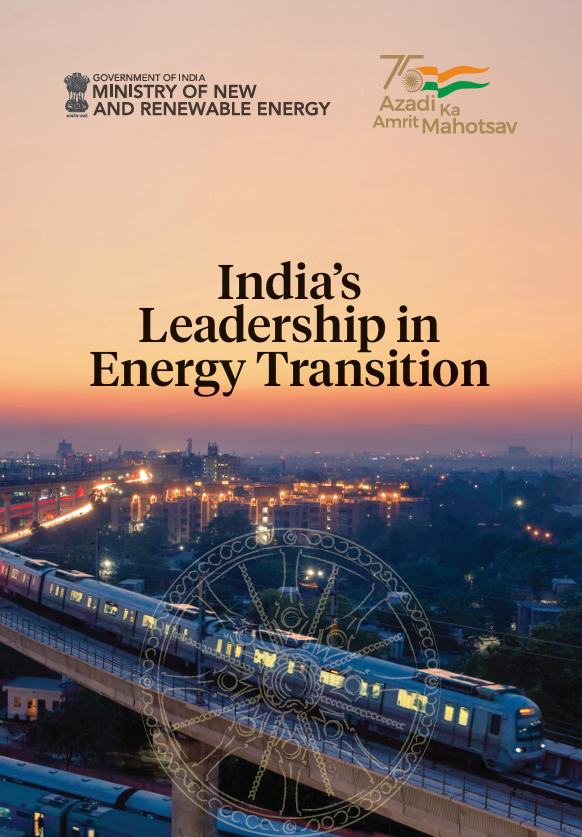
India’s Leadership in Energy Transition
Ministry of New and Renewable Energy (MNRE), Government of India; CEEW
July 2022 | International Cooperation
Authors: Ministry of New and Renewable Energy (MNRE), Government of India; CEEW
Overview
India has been designated a Global Champion for the Energy Transition as part of the United Nations High-Level Dialogue on Energy, reflecting its commitment to an inclusive global energy shift. Central to this leadership is India’s National Energy Compact, which outlines a target to install 450 GW of renewable energy capacity by 2030 and develop a National Green Hydrogen Mission to achieve an annual production of 1 MT. These efforts are complemented by the Pradhan Mantri Ujjwala Yojana, which has delivered clean cooking gas to millions, and a national goal to reduce the emissions intensity of the economy by 33–35 per cent by 2030. Representing nearly half of the total global value of commitments submitted to the UN, India’s compacts—supported by sub-national governments and private sector leaders—demonstrate a comprehensive strategy to decarbonise the energy, transport, and industrial sectors whilst ensuring energy security for its population.
Key Highlights
- India frames its economic trajectory around the concept of "recoupling," ensuring that macroeconomic growth is structurally tied to measurable improvements in social welfare and human development.
- True sustainable prosperity requires shifting the primary metric of national progress away from pure GDP growth toward holistic, community-centric human capital accumulation.
- The state leverages large-scale digital public infrastructure to smoothly deliver financial inclusion, healthcare, and social safety nets directly to marginalized populations, reducing institutional friction.
- Fostering inclusive development acts as a stabilizer for the macroeconomy, converting baseline social expenditures into long-term investments that expand domestic consumer markets and workforce productivity.
- The transition model focuses heavily on localized, grassroots empowerment, using public-private-civil partnerships to customize sustainability solutions to the specific socioeconomic realities of various regions.
- The strategy bridges the urban-rural divide by prioritizing decentralized green energy access, transforming rural areas into vibrant hubs for eco-friendly micro-entrepreneurship and job creation.
- Elevating women’s economic participation and formalizing informal labor sectors serve as primary foundational levers for unlocking India's demographic dividend.
- Globally, this paradigm provides an actionable blueprint for the "Majority World," demonstrating that developing nations can successfully engineer poverty alleviation alongside ambitious climate and resource-conservation mandates.
To transition hard-to-abate energy infrastructures, governments must develop and implement a National Hydrogen Energy Mission to scale up green hydrogen production and utilization across multiple sectors, targeting ~1 MT of annual capacity by 2030.