Council on Energy, Environment and Water Integrated | International | Independent

Suggested citation: Relan, Arushi, Disha Agarwal. 2026. How Should Indian States Choose New Power Generation Capacity? A Case Study of Rajasthan. New Delhi: Council on Energy, Environment and Water.
India's electricity demand crossed 270 GW in May 2026 and is growing fast — but it is also becoming more volatile, with peak demand rising faster than overall demand and concentrating in short windows. This makes procurement decisions harder and costlier: the average cost of electricity supply rose by 30 per cent between 2017 and 2024, leaving discoms with less room to invest in network upgrades.
This study examines how states can meet rising peaks and variability without adding to the cost burden on consumers, through a case study of Rajasthan — a renewable-energy-rich state where 3,200 MW of new coal capacity has been proposed to address shortages during non-solar hours. Using a 15-minute production cost simulation of the state's power system for 2030 (GridPath), the study compares three pathways: business-as-usual, new coal, and an equivalent renewable-plus-storage portfolio. It finds that both options can close the projected deficit at a comparable reliability level — but with substantially different outcomes for costs, grid operations, employment and emissions. The brief examines three key questions:
1. Is the existing and planned generation capacity adequate for Rajasthan to meet the expected electricity demand in 2030?
2. If not, what are the options that the state is considering? Is that the most cost-effective and suited to future system needs?
3. Do our power power procurement frameworks allow for least-cost system build-out?
There is a gap between planning and procurement across states. The study reveals:
India’s electricity demand crossed 270 GW in May 2026 (MERIT India, n.d.). It is expected to grow rapidly in the coming years, driven by economic growth, urbanisation, and frequent extreme temperatures. At the same time, demand is becoming more volatile and increasingly concentrated in short peak periods, complicating system planning and real-time operations. Consumption patterns across states illustrate this shift. Peak demand is growing faster than the overall demand (Bureau of Energy Efficiency 2024). For instance, in FY25, Delhi’s average demand was about 4,000 MW, while it saw a peak load of more than 8,500 MW for only 17 hours that year (MERIT India, n.d.). Distribution companies (discoms) face growing difficulty in meeting these peaks cost-effectively, particularly when reliant on long-term contracts with rigid take or pay obligations and limited flexibility (Aggarwal et al. 2022; Rambani 2025). Inflexible contracts, low liquidity in wholesale markets, and limited resource sharing between states lead to inefficient use of existing capacities and burden the discoms with costly power, especially for managing demand surges. This has increased average cost of electricity supply by 30 per cent between 2017 and 2024—while reducing the financial flexibility available for network upgrades and system modernisation (NITI Aayog, n.d.).
This study examines how states can meet the growing peaks and variability in electricity demand, without increasing the cost burden on consumers. In doing so, it analyses a case from renewable energy-rich state, Rajasthan where new coal capacity has been proposed as a solution to meet the power shortages during non solar hour (Rajasthan Urja Vikas and IT Services Limited 2025). New investments in Indian states must deliver four outcomes simultaneously: they must minimise the cost of supply to consumers, be fast to deploy to handle any uncertainty in projections, reduce overall imports, and maximise social and environmental benefits.
This study compares the outcomes of the proposed coal capacity and an alternate option available with the state. Using a detailed 15 minute production cost simulation for 2030, it assesses three scenarios: (i) a business-as-usual (BAU) pathway with all existing and planned capacities, (ii) a pathway that adds 3,200 MW of new coal capacity, and (iii) an alternative pathway that meets the same reliability requirement using a combination of renewable energy (RE), including solar, wind, and battery energy storage systems (BESS).
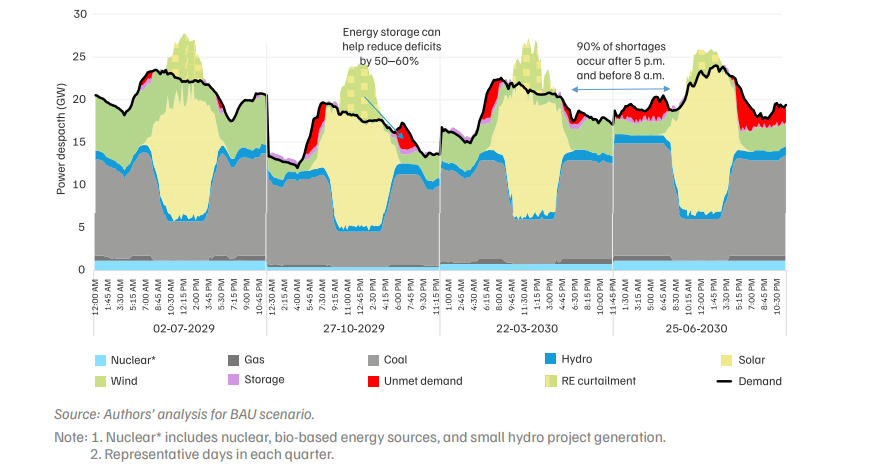
The analysis finds that if Rajasthan’s demand grows as projected, existing and planned capacities will be insufficient. In 2030, the state could fall short by 5.5 billion units (BUs)—3.4 per cent of the total demand. Nearly 90 per cent of these shortages will occur during non-solar hours.
The state can avoid the shortages through new coal or RE plus storage options and meet demand at a comparable reliability level, but with substantially different system outcomes in terms of overall costs, system operations and long term social and economic benefits for the people of Rajasthan.
The Rajasthan case holds relevance across states. Our findings show that Rajasthan can meet its rising electricity demand reliably without burdening consumers with costly power. However, a persistent gap remains between power system planning and procurement—a challenge not unique to Rajasthan.
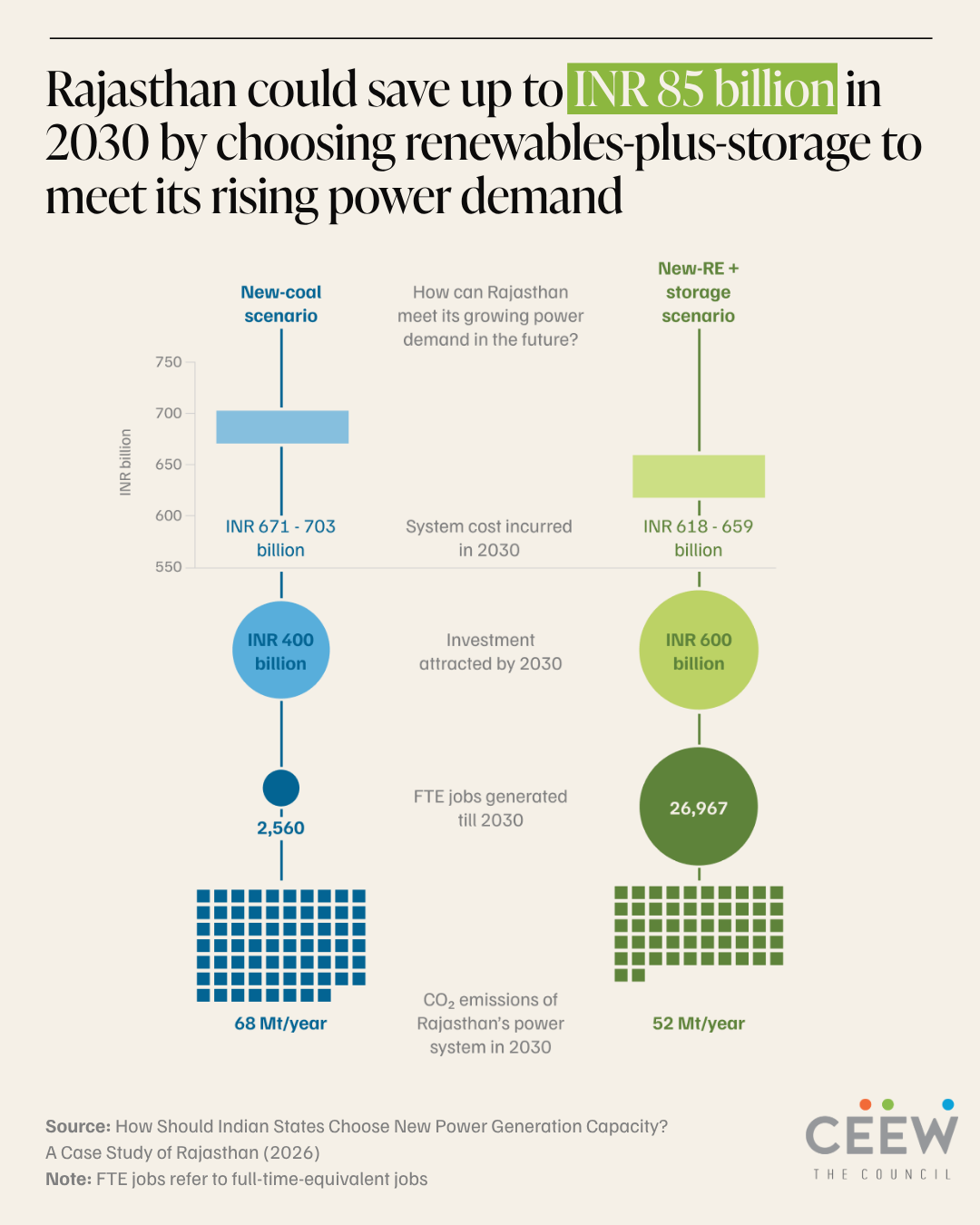
State discoms must institutionalise robust, scenario-based integrated resource planning (IRP). Our findings indicate that opting for an RE-and battery storage combination could help Rajasthan discoms save up to INR 85 billion in a year. This highlights the need for states to conduct continuous and rigorous IRP that tests technology options under varying demand, supply and cost scenarios. The state discoms can do so through a dedicated set-up with expertise in demand forecasting, system planning, and power system operations. The mandate must be to regularly assess multiple demand and supply scenarios, and jointly evaluate generation, transmission, storage, and flexible options. For instance, Gujarat Urja Vikas Nigam Limited (GUVNL) has established the Green Energy Transition Research Institution (GETRI), which provides in-house technical support for resource adequacy studies, system planning, and capacity building across the power sector. Regulators should standardise IRP methodologies, require periodic updates aligned with procurement cycles, and ensure planning assumptions and results are publicly available. The regulators must:
The Forum of Regulators should anchor procurement in technology-neutral, system defined requirements. Procurement frameworks must specify the service required such as firm energy, peak support, or ramping capability and allow all eligible technologies to compete using common reliability metrics (e.g., effective load carrying capability). This prevents technology lock in and enables least cost solutions to emerge through competition. The regulators must:
Rajasthan’s electricity demand is rising fast. Between FY22 and FY25, annual electricity requirement and peak demand have grown at compound annual growth rates (CAGRs) of 8 per cent and 7 per cent, respectively, with demand peaking to 19-GW levels (Central Electricity Authority, n.d.). In response, the state added approximately 2 GW of solar, 300 MW of wind, and 1.7 GW of coal to its procurement portfolio during the same period (Ajmer Vidyut Vitran Nigam Limited 2025). With these additions, Rajasthan met 17 per cent of its demand with solar and wind in FY25, 65 per cent with coal and remaining by nuclear, gas and hydro power (Rajasthan Urja Vikas and IT Services Limited, n.d.).
However, shortages persist, between FY23 and FY26, Rajasthan has consistently had the highest power shortages amongst all states, typically in the non-solar hours (Central Electricity Authority, n.d.). Despite the shortages, Rajasthan bought only 23 per cent of total renewable electricity generated within the state for self-consumption in FY25, with the remainder exported to utilities and industries in other states (Central Electricity Authority 2025a; Rajasthan Urja Vikas and IT Services Limited, n.d.).
The state has been slow in contracting new capacities, due to a combination of reasons, including poor planning, not enough focus on strengthening the state transmission infrastructure, and challenges with procuring new wind capacities, despite highest wind energy potential within the state (Rajasthan Rajya Vidyut Prasaran Nigam Limited 2025; National Institute of Wind Energy 2023). As a result, the state continues to rely heavily on existing capacities even as it experiences recurring shortages during peak demand periods.
The Central Electricity Authority (CEA) projects the state’s electricity demand in FY30 will be 1.5 times that in FY25 (Central Electricity Authority 2022). State plans to add 2.4 GW of coal-based capacity (Central Electricity Authority 2023b), along with 21 GW of RE to meet 2030 renewable consumption obligation (RCO) targets (Bureau of Energy Efficiency, n.d.). However, multiple studies (Agrawal et al. 2023; Idam Infrastructure Advisory Pvt Ltd 2023) indicate that the state will continue to face significant power shortages even if all planned capacities materialise. These findings underscore the need for adding new capacities fast, while keeping supply affordable for consumers.
In February 2025, Rajasthan discoms proposed contracting 3,200 MW of new coal capacity, beyond that already planned, as a possible solution to avoid the likely power shortages (Rajasthan Urja Vikas and IT Services Limited 2025). The study assesses if this is the right technology choice for Rajasthan to meet its expected demand in 2030, given the urgency, and reliability and cost concerns. We simulate the state’s power system for every 15-minute in 2030 using GridPath, to compare an alternate choice–RE and storage–and its implications on the system wide costs and grid operations.
Rajasthan’s electricity requirement and peak demand are expected to rise annually by 6.3 and 5 per cent, respectively, between 2022 and 2030. We use a business as usual (BAU) scenario (described in Box 1) based on Agrawal et al. 2023, as the reference case for our analysis.
Box 1: BAU scenario
Under the BAU scenario, all existing and planned generation and storage capacities are assumed to be operational by 2030. While the research (Agrawal et al. 2023) assumed the retirement of 1.9 GW of coal-based capacity, we retained these units in operation, reflecting CEA guidance on the continued use of existing assets (Press India Bureau 2023). With the existing and planned generation and storage contracts, we find that 5.5 billion units (BUs) of demand in 2030 will remain unserved. The state could thus face major shortages during non-solar hours.
Source: Authors’ analysis.
To address these shortages, we evaluated two procurement options, as illustrated in Figure 1.
Figure 1. Simulating Rajasthan’s grid with two procurement options
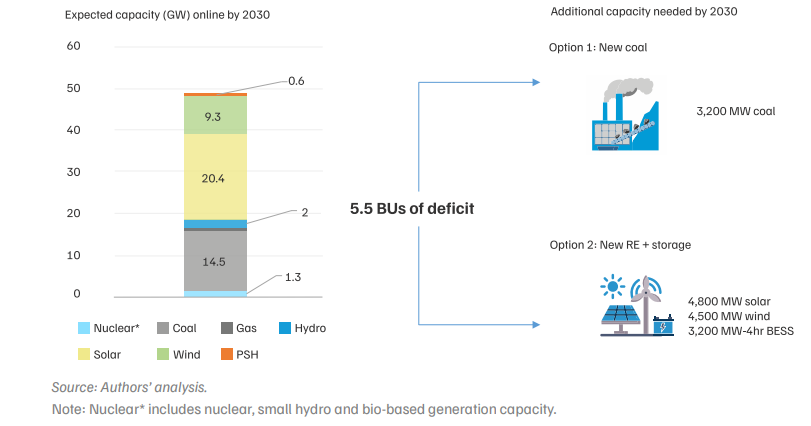
Table 1 summarises the techno-economic assumptions used for each technology.
Table 1. Capacity, capex, and constraints—comparing coal with renewable energy
| Option 1: new coal | Option 2: new RE+storage | |||
| Coal | Solar | Wind | BESS | |
| Capacity | 4 units x 800 MW | 4,800 MW | 4,500 MW | 3,200 MW (4- hour) |
| Cost assumptions | ||||
| Capex (INR million per MW) | 106.4–124.86 | 40–45 | 70–80 | USD 112– 130 per kWh7 |
| Weighted average cost of capital8 | 10.8% | |||
| Variable cost (INR per unit) | 4.05–5.059 | |||
| Landed cost (INR per unit) | VC: 4.05–5.05 FC: 1.76–2.0010 |
LCOE: 2.83 –3.20 |
LCOE: 4.47 –5.10 |
LCOS: 3.84 –4.50 |
| Operations | ||||
| Normative utilisation | 85% availability |
24% CUF | 28% CUF | 5,000 cycles |
| Operational constraints | Ramp rate: 1% per minute MTL: 55% Warm starts only |
- | - | 88% round trip efficiency, 90% depth of discharge |
Source: Authors’ analysis based on Central Electricity Authority data and stakeholder consultation.
Note: 1. CUF: capacity utilisation factor; VC: variable cost; FC: fixed cost; LCOE: levelised cost of energy; LCOS: levelised cost of storage; MTL: minimum technical load.
2. In addition to these costs, the cost of transmission as INR 10 million per MW is considered separately.
The state’s electricity demand is expected to grow at a CAGR of 7 per cent between FY25 and FY30. Our 15-minute production-cost simulations indicate that, under the BAU scenario, around 5.5 BUs of electricity demand, equivalent to 3.4 per cent of the total annual requirement, will remain unserved. Nearly 90 per cent of these shortages will occur during non-solar hours, between 5 p.m. and 8 a.m. (Figure 2).
Figure 2. Rajasthan will face consistent shortages with existing and planned capacities
This section discusses the implications of two proposed procurement strategies.
While the system faces 5.5 BUs of electricity deficit, it is also expected to curtail approximately 3.8 BUs of cheap RE generation in 2030, with solar accounting for about 86 per cent of total curtailment. Storage solutions can partially mitigate the temporal mismatch by shifting surplus renewable generation from the solar hours to non-solar deficit hours. Further analysis shows that unmet demand overlaps with wind-rich periods in Rajasthan, indicating an opportunity to reduce shortages. Sensitivity simulations combining wind capacity with battery energy storage reduce annual unmet demand by half relative to the BAU scenario, to 1.7 per cent of overall demand in 2030 (Annexure 1).
Figure 3. Both scenarios, new-coal and new-RE, meet the demand at the same reliability levels
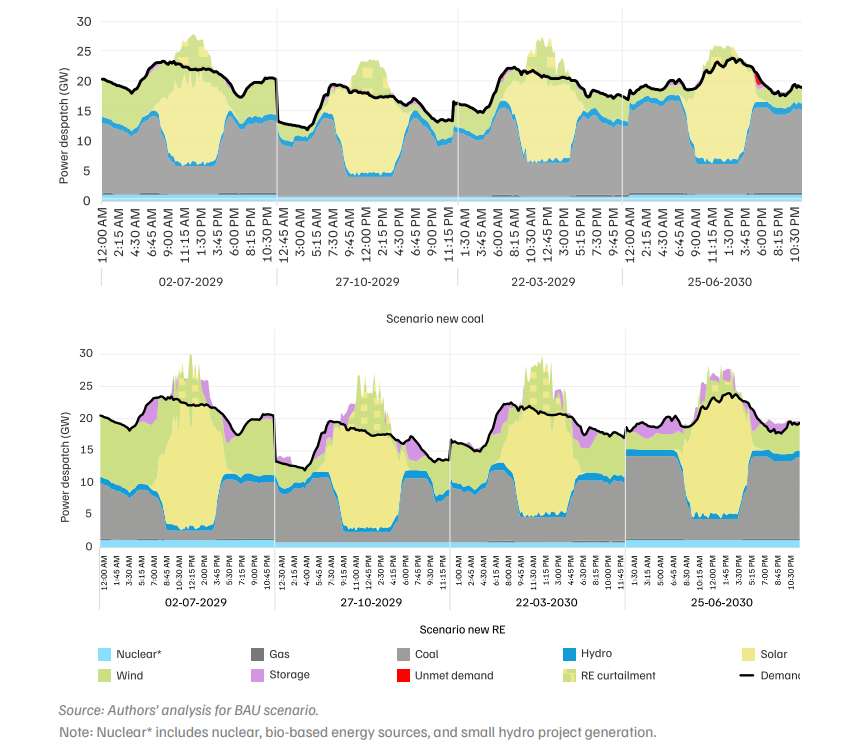
Figure 4. Rajasthan discoms can meet and exceed the RCO target by adding new RE
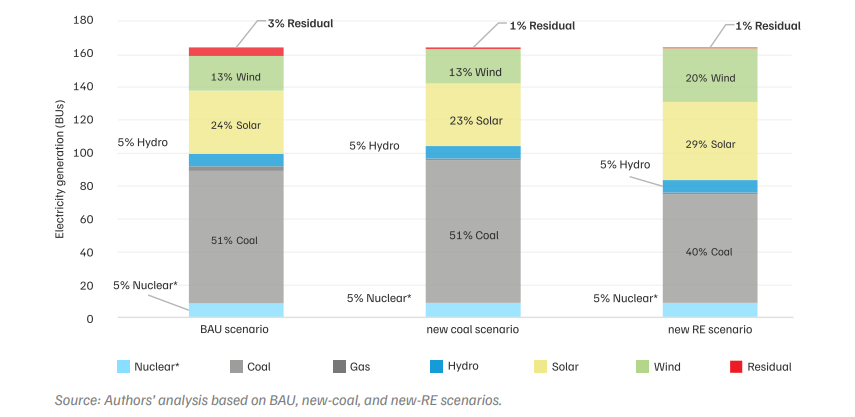
Figure 5. Despite coal availability, Rajasthan will face shortages
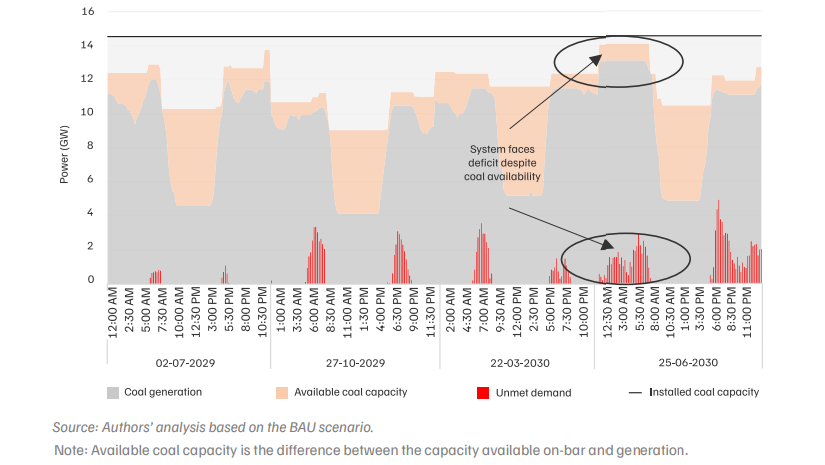
In the BAU scenario, Rajasthan’s coal fleet is expected to operate under significant operational stress, frequently cycling between minimum and peak output. The system will record over 3,000 warm starts across 37 coal units in 2030,13 averaging 86 starts per unit. Meeting the demand reliability will further increase the flexibility requirements, to account for the demand and generation variability. Under the new-RE scenario, the cycling stress on the coal fleet will be increased to about 94 per unit. BESS will be despatched optimally — based on the need — and not uniformly across all days. For instance, frequent charge–discharge cycles will be needed in peak winter months, January–February, to meet the steep ramping needs (see Annexure 2 for more details).
In contrast, the new-coal scenario will witness a 32 per cent higher stress (on an average of 124 starts per unit). The new units alone will experience more than 200 warm starts in a single year—levels that can materially shorten plant life and raise operating costs. Expanding storage capacity further will shift flexibility provision away from thermal units, easing operations across both existing and proposed coal plants in Rajasthan.
A renewable and storage-based procurement pathway can meet Rajasthan’s electricity demand at comparable reliability while lowering system costs. Across a range of technology cost assumptions for solar, wind, BESS, and coal, the RE-plus-storage option delivers net savings of INR 11.4–85 billion in 2030 relative to new coal capacity (Table 2). The RE-plus-storage option remains reliable and cost-effective even on peculiar days such as high-demand days, high-/low-RE-penetration, and high-flexibility days (Annexure 3).
Table 2. The RE-plus-storage option is cost-effective even with pessimistic assumptions
| Scenario | System cost (INR per kWh) |
| New coal | 4.16–4.36 |
| New RE | 3.84–4.09 |
Source: Authors’ analysis based on scenarios.
Note: 1. Considering real cost numbers as of 2025.
2. The system cost considers variable and operational costs for coal, gas, hydro, nuclear, bio-based energy, small hydro, along with the levelised cost of electricity for solar and wind, and levelised cost of BESS and PSH. It also includes start-up costs for coal and gas power plants, annualised fixed costs for new coal units, and additional transmission costs for new capacities. However, it does not include the existing fixed and transmission costs that are considered sunk costs for the system. 3. We varied the capex, variable cost, and levelised cost of storage assumptions for solar, wind, coal, and BESS, as illustrated in Table 1.
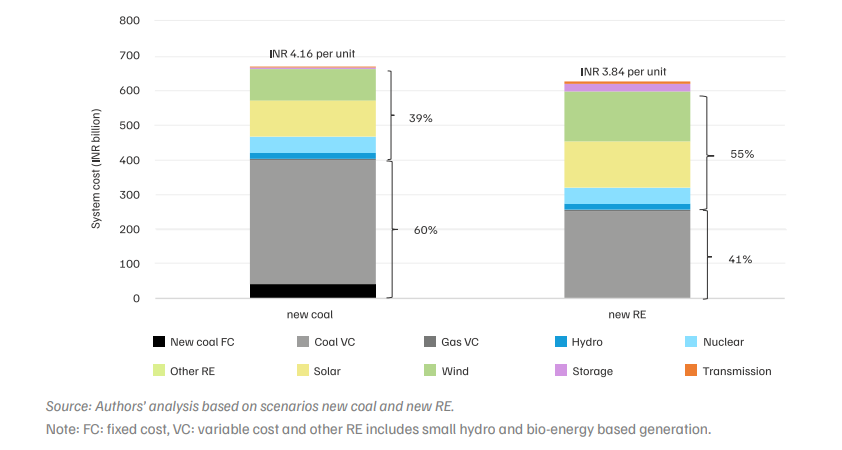
As non-fossil sources rise to around 60 per cent of total generation in the new-RE scenario (Figure 4), they account for roughly 55 per cent of total system costs. This reflects a shift in the power system’s cost structure: lower-cost renewable generation increasingly displaces higher-cost fossil-based generation (Figure 6). Even under optimistic cost assumptions, flexible resources— including BESS, pumped storage hydropower (PSH), and associated transmission—contribute only 1–4 per cent of total system costs, while enabling the integration of cheaper energy and reducing overall financial exposure for discoms.
Figure 6. Cheaper non-fossil generation displaces higher-cost fossil-based sources
In addition to these system-level savings, Rajasthan discoms can monetise surplus generation through power exchanges, earning up to INR 35 billion in 2030. Surplus energy is available across thermal, solar, wind, and other renewable sources (Table 3), with the highest volumes occurring between March and May during solar transition hours. This surplus not only improves discom revenues but also supports system balancing for other utilities. The surplus energy is sold at the exchange for every 15 minutes, when it is economically viable to sell. For instance, in the new-coal scenario, only 22 out of 26 BUs of surplus energy in 2030 traded at the exchange as the variable cost of surplus coal power is less than the anticipated exchange price, which will yield profits for the state discoms.
Table 3. Rajasthan discoms can earn up to INR 35 billion in 2030 from the sale of surplus power
| Source of surplus | Option 1: New 3,200 MW coal (INR billion) |
Option 2: New Solar + wind + storage (INR billion) |
| Solar + Wind | 12.9–13.3 | 17.6–18.3 |
| Coal | 5.9–6.8 | 4.6–4.8 |
| State hydro, small hydro, and bio-energy |
14.2–14.7 | 19–19.8 |
| Overall | 27.5–29.2 | 34–35.2 |
Source: Authors’ analysis based on simulation results and power exchange price between 1 July 2023 and 30 June 2025.
Note: Surplus power is sold at 15-minute intervals only when the market-clearing price exceeds the variable cost of generation. Average exchange prices over the past two years are discounted by INR 0.50 per unit to account for future market prices.
Beyond meeting the electricity demand reliably and affordably, power procurement choices shape the broader development outcomes for the state. We assess the employment, investment, and emissions implications of the two procurement pathways (Table 4).
The new-RE scenario is expected to generate substantially higher socio-economic benefits for Rajasthan. By 2030, it will create nearly 11 times as many full-time equivalent (FTE) jobs as the new-coal pathway. The RE-plus-storage pathway is also expected to attract higher investment, around INR 600 billion in clean energy technology.
At the same time, the transition will reduce the power system’s environmental footprint. Annual CO₂ emissions under the new-RE scenario will reduce to 52 million tonnes—around 24 per cent lower than the new-coal pathway and equivalent to 78 per cent of Rajasthan’s power sector emissions in FY24. These outcomes indicate that a renewables-led procurement strategy can support a reliable power supply while advancing employment, investment, and emissions-reduction objectives of the state.
Table 4. Renewable-plus-storage delivers stronger socio-economic outcomes for the people of Rajasthan
| Parameter | New-coal scenario | New-RE scenario |
| FTE jobs (till 2030) | 2,560 | 26,967 |
| Investment attracted (INR billion) |
400 | 600 |
| CO2 emissions of state’s power system (MT/year) |
68 | 52 (24% lower) |
Source: Authors’ analysis.
Note: 1. Considering the 0.8, 1.68, 1.15 and 4.29 full time equivalent (FTE) coefficient for new coal, new utility solar, wind and BESS as discussed in (Agarwal et al. 2025; Council on Energy, Environment and Water, n.d.).
2. Considering the emission factor as 0.727 tonnes/MWh (Central Electricity Authority, n.d.-a). 3. Considering transmission investment along with generation will result in INR 420 billion of investment in Rajasthan under new-coal scenario, and INR 650 billion under new-RE scenario.
India and its states, like many other emerging economies in the Global South, are caught in a trilemma—meeting rising electricity demand reliably, keeping tariffs affordable, and reducing exposure to fuel and supply risks. This challenge is most acute in fast-growing, renewable-rich states, where demand growth coincides with a changing generation portfolio. The Rajasthan case highlights that the state’s power shortage is not primarily driven by inadequate capacity, but the capacity available at the time of need. Despite a capacity addition of 3,200 MW, which is designed to generate over 20 BUs, as opposed to 5.5 BUs of deficit, the state will continue to face deficits during critical hours, suggesting gaps in planning. Adding new resources without a robust, system-level evaluation risks locking discoms into higher costs without resolving reliability concerns.
The Indian Electricity Grid Code mandates each discom, in consultation with the state and central transmission utility, to conduct integrated resource planning (IRP) — including (i) demand forecasting; (ii) generation; and (iii) transmission adequacy—to meet projected requirements (Central Electricity Regulatory Commission 2023). However, in practice, implementation remains inconsistent. For instance, 42 out of 62 Indian discoms use simple CAGR extrapolations to estimate future power needs. Only a few discoms conduct trend analysis or evaluate demand at a higher granularity (monthly) (Pandey and Shweta Kulkarni 2024). These methods often underestimate peak requirements while overstating baseload demand, skewing procurement decisions towards building an inflexible mix.
Planning gaps extend beyond demand forecasting. Although regulations mandate integrated generation -transmission planning, multiple states have recently procured large, long-term capacities without exploring realistic least-cost alternatives. For instance, Bihar and Assam procured 5,600 MW of new long-term capacity in 2025 (Bihar Electricity Regulatory Commission 2025; Assam Electricity Regulatory Commission 2025), with fixed costs ranging between INR 4.17–4.54 per unit. However, the underlying planning studies assumed a capital cost of INR 115 million per MW (INR 11.5 crore per MW), implying a fixed cost of less than INR 2.55 per unit for the same technology (Central Electricity Authority 2025e, 2025d). In contrast, the capex considered for RE is mostly reflected in the discovered tariffs. Further, these assumptions rely on commissioning the coal unit within a four-year timeline. Historically, coal plants in India have taken 7-9 years to commission (Agarwal et al. 2025). Delays significantly increase the project costs (Figure 7). For instance, the Bhusawal thermal power station unit six in Maharashtra saw a 40 per cent cost escalation following a nearly 3-year delay. A similar trend holds for other conventional technologies, where consumers bear the impact of the escalated fixed costs due to delayed commissioning.
Figure 7. Capex increases by 30% with 3-4-year delay, a common trend
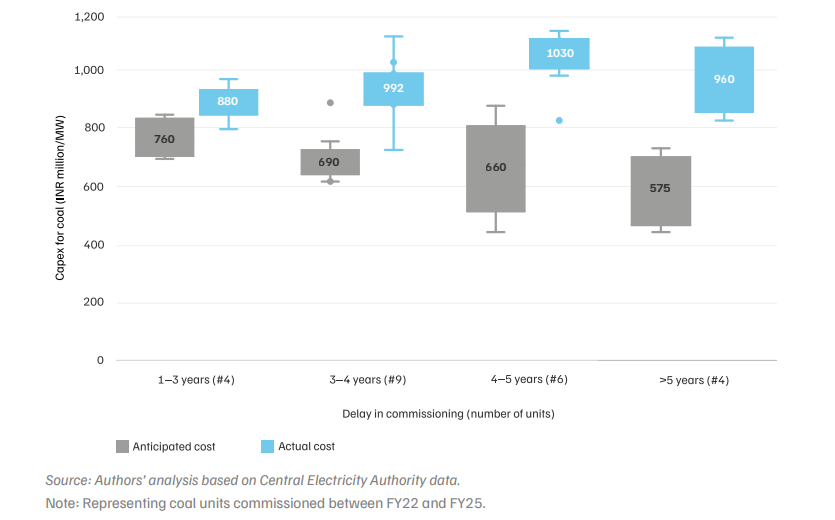
Locking into long-term take-or-pay contracts under these conditions exposes discoms to substantial financial risk particularly in a rapidly changing demand scenario. If plants operate below the normative 85 per cent utilisation level, the effective per-unit fixed costs increase further.
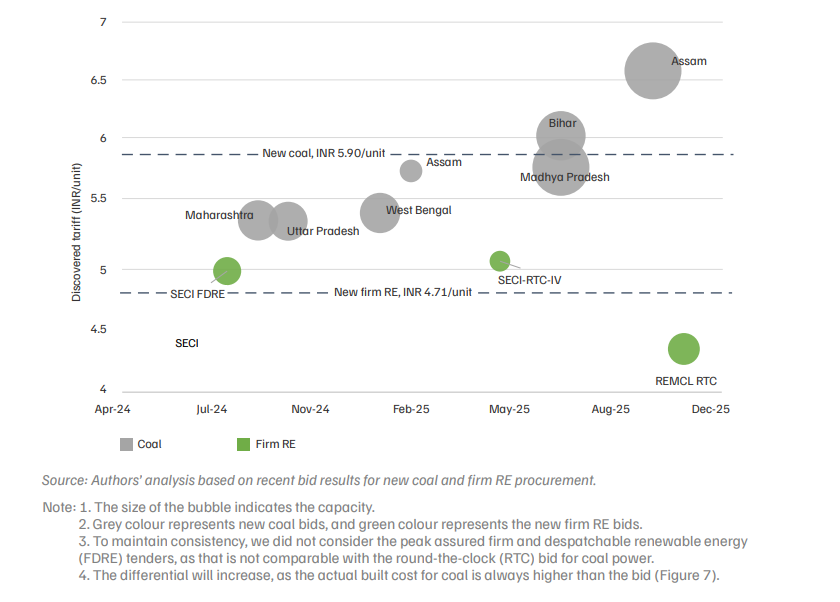
Globally, the cost of the BESS pack has declined by 82 per cent over the last decade (Ember 2025). With declining costs and technological development, RE combined with storage now delivers firm power at a lower cost. In 2024 and 2025, bids for firm RE were at least INR 1.2/ unit lower than those for recently procured coal capacity (Figure 8). Multiple system-level simulations reinforce this finding. Our analysis for Rajasthan shows that a REplus-storage pathway can meet demand at comparable reliability levels while reducing overall system costs by more than 50 paise per unit relative to new coal additions (section 3.2). Additionally, power from RE plants is inflation-proof for the consumers. Our consultations with developers and renewable energy implementation agencies (REIAs) indicate that utility-scale solar projects have been commissioned in 16 months, wind farms in 20-45 months—significantly faster than coal plants. While transmission build-out (typically 3-5 years) remains a constraint, recent amendments to the CERC’s General Network Access (GNA) regulations have enabled solar and non-solar hour-specific connectivity, promising better transmission utilisation and faster renewable integration.
Figure 8. New RE bids are at least INR 1.20 per unit cheaper than newly bid coal units
India spends heavily on energy imports. For instance, between FY19 and FY23, India spent approximately USD 82 billion on importing non-coking coal, majorly used for power generation (Ministry of Coal, n.d.). Concurrently, India also spent about USD 24 billion on importing RE and storage technologies.
However, the nature of this expenditure differs fundamentally. Coal imports represent recurring fuel payments tied to electricity generation. In contrast, RE and storage investments create domestic generation assets with negligible fuel risk over their operational life. India has also strengthened its domestic manufacturing capacity. The country has over 170 GW of module manufacturing capacity, more than 25 GW of cell manufacturing capacity, and surplus wind manufacturing capacity alongside rapidly expanding BESS manufacturing capabilities (Ministry of New and Renewable Energy 2026). Scaling renewable and storage deployment can therefore reduce reliance on imports in the long run, stabilise the power costs, and stimulate domestic industrial growth.
The examples above point to a structural gap between planning and actual procurement decisions across states. Often, procurement decisions are not driven by robust, transparent, system-level assessments that evaluate multiple demand-and-supply scenarios. States typically prefer choosing selective technologies, resulting in a sub-optimal solution for the consumers. The National Tariff Policy, 2016, emphasises competitive bidding to deliver consumer benefits through cost reduction and efficiency gains (Ministry of Power 2016). In practice, however, technology-specific competitive bidding determines the price of a selected capacity rather than whether that capacity is the most costeffective way to meet system needs. Strengthening the link between planning and procurement, therefore, requires procurement decisions to follow from systemlevel planning outcomes. When planning compares multiple scenarios and a wider set of technology options, procurement can focus on addressing the identified reliability gap, instead of defaulting to capacity-specific solutions.
While this case study focused on evaluating the procurement decision for the proposed 3,200 MW of new coal capacity in Rajasthan, similar studies must be conducted to set the state’s plans and meet the future demand. According to the regulations, these studies must include robust medium- and long-term demand forecasting to assess the least-cost planning, meeting system adequacy needs.
Procurement frameworks must internalise these strategic considerations. Choices made today will determine not only near-term system adequacy, but also long-term fiscal resilience and energy sovereignty.
To address the misalignment between planning and procurement, we propose three key interventions.
Evidence from Rajasthan and other states shows that simplified forecasting and siloed planning have led to procurement choices that increase fixed costs without addressing peak shortages or operational stress.
Competitive bidding determines the price of a chosen capacity, but not whether that capacity represents the least-cost solution for the system. Technology- neutral tenders enable discoms to respond to evolving system needs without locking into inflexible capacity choices.
While discoms are responsible for demand forecasting and proposing procurement plans, regulators must be able to independently test whether these proposals address the underlying system needs and consumer interests. Strengthening regulatory capacity is essential to avoid long-term procurement lock-ins that respond to demand projections without resolving system constraints.
Our analysis shows that Rajasthan will face shortages of nearly 6 billion units in 2030 with its existing and planned capacities, so the state does need to add new resources. But adding new coal capacity is not the only way to close this gap. We compared the proposed 3,200 MW of coal capacity against an equivalent renewable-plus-storage portfolio and found that both meet demand at a comparable reliability level — with very different implications for costs, grid operations and jobs.
Recently discovered firm clean energy bids are at least INR 1.20 per unit cheaper than recent coal bids. Even at the system level, our simulations show that Rajasthan discoms can save up to INR 8,500 crore in power procurement costs in a single year by choosing renewables with storage over new coal capacity. This holds even under conservative cost assumptions for solar, wind and batteries. Flexible resources such as batteries also meet most of the system's ramping and balancing needs, reducing the strain on existing coal plants.
Yes, when the portfolio is designed for it. Batteries store surplus solar generation during the day and release it in the evening and night hours, while wind generation in Rajasthan is strongest during exactly the hours when the state faces shortages. Our 15-minute simulations show that a portfolio of solar, wind and four-hour battery storage delivers the same reliability as the proposed coal capacity.
Technology-neutral procurement means inviting bids for the service the grid needs — firm energy, peak support or ramping capability — and allowing all technologies to compete to provide it, rather than deciding the technology first and then seeking the lowest price for it. Currently, tenders in India remain restricted to a single, pre-selected technology for which bidding guidelines already exist. Competition then happens only within that technology, which may not discover the least-cost option available in the market.
Our study points to a gap between how states plan and how they procure. Around 70 per cent of Indian discoms rely on simple CAGR-based demand forecasting, without assessing changing demand patterns or emerging critical hours. Planning assumptions also do not carry through to tenders — Bihar and Assam contracted 5,600 MW of coal in 2025 at fixed costs of INR 4.17–4.54 per unit, against planning assumptions of under INR 2.55 per unit for the same technology. States need scenario-based integrated resource planning, technology-neutral procurement frameworks, and regulators with the in-house capacity to test procurement proposals independently.
How can India Create a Demand Flexibility Market?
Contracts for Difference for Flexible and Affordable Clean Power
Enabling Corporate India's Clean Energy Transition
Scaling Solar Power for Irrigation in India: