Council on Energy, Environment and Water Integrated | International | Independent

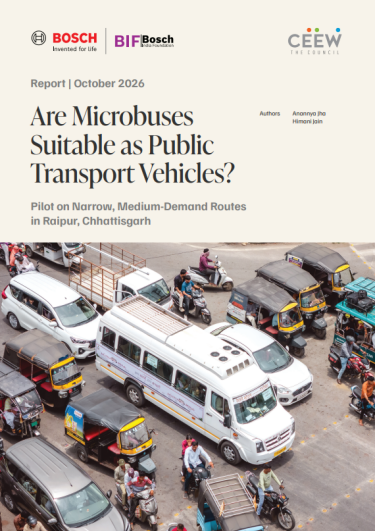
Suggested Citation: Jha, Anannya, and Himani Jain. 2026. Are Microbuses Suitable as Public Transport Vehicles? Pilot on Narrow, Medium-Demand Routes in Raipur, Chhattisgarh. New Delhi: Council on Energy, Environment and Water.
About 95 per cent of the estimated 4200 statutory cities by 2031 will be small and medium towns with populations between 20,000 and 300,000. Today, only around 120 cities nationwide have a formal public transport system. The PM-eBus Sewa scheme also does not cover these 4,000 small and medium cities. Most of these towns lack the passenger volume for a standard bus, and their narrow roads with mixed use cannot accommodate standard buses. CEEW's 2026 study estimates that urban India will need about 6.5 lakh stage-carriage microbuses by 2031, 77 per cent of them in these towns, acting as the missing public transport segment of 10-22 seats, between the auto and e-rickshaws and the bus.
To test whether a microbus can fill this gap as formal public transport, CEEW, along with the Government of Chhattisgarh and under the guidance of the Ministry of Housing and Urban Affairs (MoHUA), conducted a pilot in Raipur in June–July 2026. The pilot examined operational viability, vehicle suitability, and user acceptance and affordability. It shows that a microbus can run as formal, affordable, and well-accepted public transport on constrained corridors, but the microbus models available today are only partially suited to stage-carriage duty and need design modification. The report sets out recommendations for city, state and national governments.
Pilot at a glance
A. Is the microbus operationally viable in stage-carriage operations?
A microbus can run a scheduled stage-carriage service on medium-demand corridors.
B. Are microbuses suitable for narrow urban roads?
The size of the vehicle suits the service. However, interiors and design of vehicles require modifications.
C. Do users accept and afford the service?
Riders accepted the service, and it cut their commuting costs.
D. Potential estimated benefits - Modal shift initiated by the microbus pilot - delivered benefits of reduced congestion, air pollution, and GHG.
India will have about 4,200 cities by 2031. Of these, roughly 4,000 small and medium towns do not have any formal public transport system. The PM-eBus Sewa scheme only covers up to 169 cities (with populations of three lakh and above). Small and medium towns lack the passenger volume for a standard bus, and have narrow congested roads that have evolved organically over decades. We estimate urban India will need about 6.5 lakh stage-carriage microbuses by 2031, 77 per cent of them in these towns, acting as the missing mode between the auto-rickshaw and the full-size bus (Jain et al. 2026). Microbus1 pilot examines the three key propositions of operational viability, vehicle suitability and user acceptance: To test whether a microbus can fill the gap as formal public transport, the CEEW, with the support of Government of Chhattisgarh, under guidance from the Ministry of Housing and Urban Affairs (MoHUA), designed and conducted a 45-day pilot in Raipur in June–July 2026. Raipur is a representative city, with only about 30 active city buses against an estimated need of 600 to 900 buses. This gap, today is served by informal shared auto- and e-rickshaws, amid narrow roads in the core old-city area, medium-dispersed demand corridors, and mixed traffic
Figure ES1. Overview of the microbus pilot planned and implemented by CEEW in Raipur
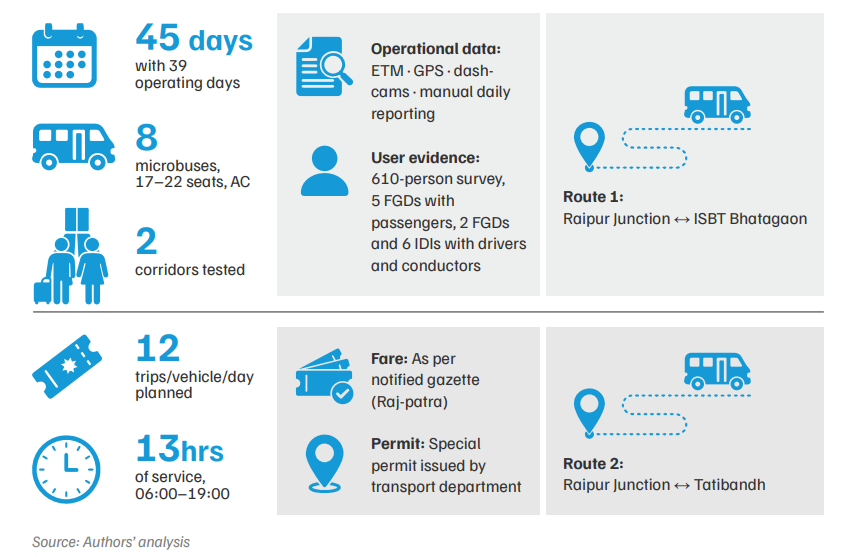
Table ES1. Key pilot findings examines and develops the takeaway for each proposition
| Proposition | Takeaway |
|---|---|
| A. Is the microbus operationally viable for a scheduled stage-carriage service, especially on medium-demand urban corridors? | Yes |
|
|
| B. Are currently available microbus models suitable as per varied stakeholders, and especially on narrow roads? | Partially |
|
|
| C. Do users accept the microbus service and can mostly afford it? | Yes |
|
Source: Authors’ analysis
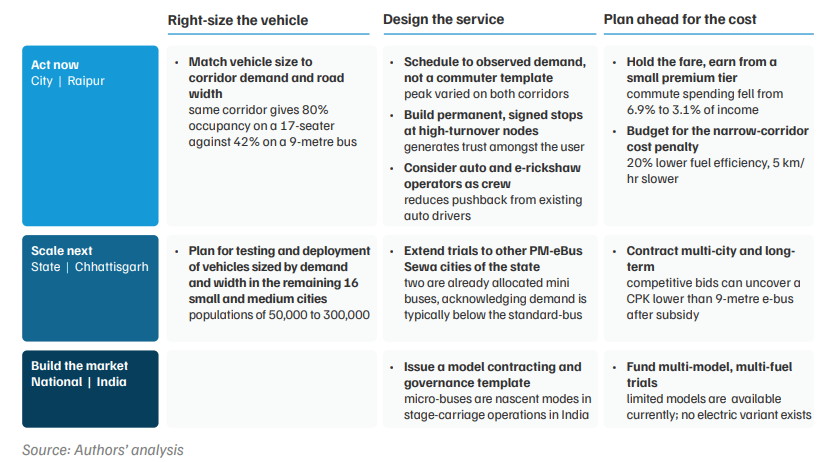
Recommendations: Mode shift delivered net cuts of about 2.23 kg of PM2.5, 20.3 kg of NOx, and 7,249 kg of CO₂ equivalent (CO₂e), modelled for 39 days of operations. Each microbus trip replaced roughly 3.5 auto- or e-rickshaw trips, and formal operation supports about four direct jobs per vehicle. To translate these benefits into action, we developed key recommendations at different governance levels (figure ES2).
Figure ES2. Key recommendations at different governance levels- city, state, and national
Beyond these priorities, the pilot points to a further set of actions.
For Raipur: a permanent, signed network of intermediate stops is critical. The costing of transit systems is different in width-constrained corridors, due to low speeds, delays and low mileage, thus, CTUs must account for it. State government, original equipment manufacturers (OEMs), and vehicle body builders must collaborate to redesign vehicle interiors and ergonomics around boarding, standing passengers, aisle width and seats layout to develop purpose-built vehicles.
The MoHUA must convene to develop microbus vehicle specifications, model-aggregated procurements, and standard contracting templates. We highly recommend a multi-model and multi-fuel trial programme to close the evidence gaps.
In a nutshell, the Raipur pilot demonstrates that the microbus can run as formal, affordable, and wellaccepted city public transport, on precisely the same narrow corridors India’s small and medium cities struggle to serve. Turning the Raipur pilot into a national initiative now rests on two moves; cities and states further test the operations-learnings from the pilot, and the national government funds these pilots and develops the microbuses market with specifications developments, contracting templates and governance models.
In most cities, many of the streets lack the passenger volume for a standard bus and/or have width-constrained roads. A microbus can act as the missing mode between the auto-rickshaw and the full-size bus. At the demand seen in the pilot, a 17-seat vehicle would run at 80 per cent seat occupancy, against 40 per cent for a nine-metre bus. Another CEEW study (Jain et al 2026) estimates that urban India will need about 6.5 lakh microbuses by 2031, with 77 per cent of its demand in small and medium towns.
Microbuses are a newly proposed mode for scheduled city bus services in India, with little or no experience, data, and application case studies. The pilot tested whether existing models can run a formal service on narrow, medium-demand corridors, whether they suit passengers and crews, and whether users accept and can afford them. Its findings will guide the future transit applications in other cities.
The microbus ran a reliable, well-used service. Across 40 operating days, the eight microbuses were available for 98.4 per cent of scheduled vehicle-days. They covered around 36,000 kilometres and over 3,200 trips, completing 88 per cent of planned trips with a bus every 20 to 25 minutes. The service recorded 18,682 boardings, an average of 480 a day. Seat occupancy averaged between 30 and 80 per cent, so the 17-seat vehicle matched demand, though outbound Route 1 was crowded at peak hours. Narrow stretches cut speed to 7.5 kilometres per hour and raised running costs, but the service held without route deviation or any incident attributable to vehicle width. Of the users surveyed, 95.8 per cent were willing to continue using it. The pilot ran through the monsoon and summer vacations, so the report treats ridership as conservative results. However, vehicle design is unsuitable for faster boarding and alighting, movement within the vehicle, and for standee passengers. Design modifications as per different stakeholders are suggested in the report.
Traffic police on-duty, interviewed during the pilot, found the microbus neutral to traffic stress. They qualitatively analysed and highlighted that it did not add to congestion on the pilot corridors. Its smaller footprint let it merge into mixed traffic without crowding other road users. Each microbus trip replaced about 3.5 auto-rickshaw or e-rickshaw trips and 1.5 two-wheeler trips, so fewer vehicles carried the same passengers. Officers also noted that auto-rickshaws, facing a cheaper scheduled service, parked and operated more responsibly.
Microbuses have Mega Demand in Indian Cities
Greenhouse Gas Accounting for On-road Transport Emissions
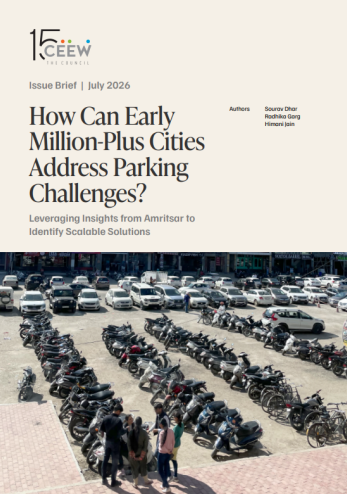
How Can Early Million-Plus Cities Address Parking Challenges?