Council on Energy, Environment and Water Integrated | International | Independent


Suggested citation: Global Heat Health Information Network South Asia Hub. 2026. Living with Heat in Bhutan: Heat-Health Risks, Vulnerability and Emerging Responses
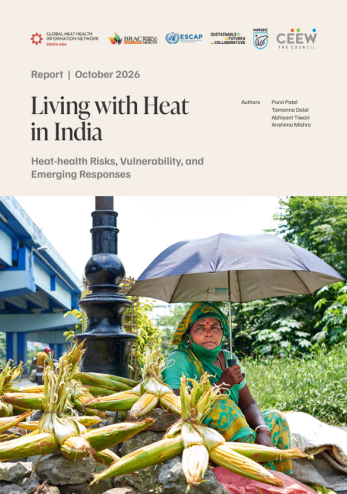
Please access India, Nepal and Bangladesh reports:
This country synthesis report examines Bhutan’s evolving heat risk and its implications for population health. It focuses on changing heat exposure, the populations and places at risk, emerging policy and institutional responses, and civil-society and community-led initiatives for heat action. The report assesses Bhutan’s response to extreme heat, with a focus on heat and health action, identifies gaps in heat-health surveillance, coordination, early warning and preparedness, and consolidates priorities for strengthening long-term heat resilience. It also highlights emerging approaches and considers how evidence can inform practical, scalable and context-specific responses to the health impacts of extreme heat.
The report draws on historical and projected temperature trends, heat-risk data, evidence on heat-related health impacts, socioeconomic vulnerabilities and other factors influencing heat exposure. It examines Bhutan’s heat governance landscape, including the National Adaptation Plan, occupational health regulations, forecasting and warning systems, health-system preparedness, and the role of non-governmental and community-based organisations in heat action. It then identifies four priorities for strengthening heat-health action: establishing heat-health surveillance, integrating existing institutional mandates into a heat action plan, extending existing flood early warning systems to heat, and applying a differential vulnerability lens to heat-health action.
In Bhutan and across South Asia, increases in the frequency, intensity and duration of extreme heat events have become a climate, health and development challenge at once, affecting the overall wellbeing of communities. Rising global temperatures drive the hazard; rapid unplanned urbanisation and entrenched inequality determine who it harms.
Global mean temperature for January–August 2025 stood at 1.42 degree (±0.12°C) above pre-industrial levels, and each of the eleven years from 2015 to 2025 ranked among the eleven warmest in the 176-year observational record (WMO 2025). Heat-related deaths have risen 63 per cent since the 1990s, averaging 546,000 per year 20122021 (Romanello et al. 2025). By 2070, around 520 million people across South Asia could experience at least one month of dangerous heat each year, and under a 1. warming scenario, the region could lose 5.3 per cent of total working hours to heat stress by 2030 (World Bank 2026; ILO 2019).
The findings above identify where heat exposure and burden are concentrated. The next step is to strengthen how existing mandates are translated into coordinated, seasonal action. Responsibilities for heat-related risks already fall across health, labour, hydrometeorological services and human settlements. The key gap is coordination across these areas, supported by routine monitoring and agreed triggers for action. The report identifies four priorities.
The GHHIN South Asia Hub will help address these priorities in Bhutan by convening stakeholders, strengthening the regional evidence base, facilitating knowledge exchange, and building capacities for heat-health action. By connecting Nepal, Bhutan, Bangladesh, and India around shared priorities and solutions, the Hub will foster institutional collaboration and cross-country learning, supporting countries to advance sustained and anticipatory heat-health resilience across South Asia.
Warming has been observed in Bhutan since the 1960s, with annual temperatures rising by just under 1 degree over the twentieth century and daily minimum temperatures rising faster than maxima (WBG and ADB 2021). Daily maximum temperatures already exceed 30 degrees in the south, and prolonged heat stress is expected at least once every five years in lower-altitude areas (GFDRR 2020; World Bank n.d.a). Pemagatshel records around 16 days above 30 degrees a year, followed by Sarpang at about nine, Samtse and Samdrup Jongkhar at about eight, and Zhemgang around seven (World Bank n.d.a).
The same southern dzongkhags that are hottest today gain the most additional hot days. Under SSP2–4.5 for 2040–2059, Pemagatshel rises to about 33 hot days a year and Sarpang to about 20; under SSP5–8.5, Pemagatshel reaches about 40 and Samdrup Jongkhar about 20, with Pemagatshel gaining roughly 25 additional hot days on the historical period (World Bank n.d.a). Northern high-altitude districts may warm by 2–3 degrees by mid-century and by more than 4–5 degrees in places by 2100, while valleys that were previously cooler, like Punakha, Wangdue Phodrang, Monggar, Trashigang and lower Thimphu and Paro, move into higher maximum temperatures, exposing populations not previously exposed to heat (ESCAP n.d.a; ESCAP 2026).
Living with Heat in Bangladesh
Unlocking Finance for Nature-based Solutions (NbS) in Indian Cities