Council on Energy, Environment and Water Integrated | International | Independent


Suggested citation: Global Heat Health Information Network South Asia Hub. 2026. Living with Heat in Bangladesh: Heat-Health Risks, Vulnerability and Emerging Responses
Please access India, Nepal and Bhutan reports:
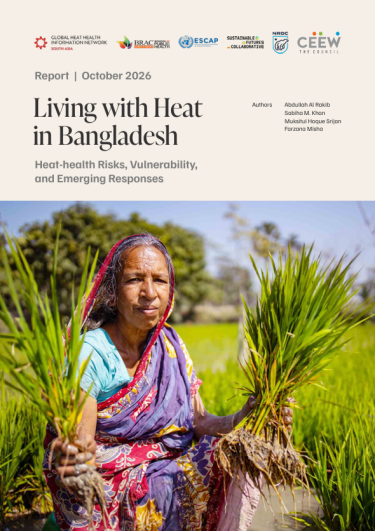
This country synthesis report examines Bangladesh’s evolving heat risk and its implications for population health. It focuses on changing heat exposure, the populations and places most at risk, projection models, vulnerability dynamics, and the policy, institutional and on-the-ground responses, including heat action plans emerging across the country. The report assesses Bangladesh’s response to extreme heat, identifies current scenarios in heat-health surveillance, early warning, heat action plans, coordination and implementation, and consolidates priorities for strengthening long-term heat resilience. It also highlights emerging approaches and considers how evidence can inform practical, scalable and context-specific responses to the health impacts of extreme heat.
The report draws on historical and projected temperature trends, heat-risk data, evidence on heat-related health impacts, socioeconomic vulnerabilities and factors influencing exposure. It examines Bangladesh’s heat governance landscape, including national climate and health frameworks, forecasting and early warning systems, health-system preparedness, local heat action initiatives, and interventions led by non-governmental and community-based organisations. It then identifies priorities for strengthening long-term heat resilience, including developing a National Heat Action Plan, establishing heat-health surveillance, mainstreaming heat risk across sectors and levels of governance, and strengthening protection for workers exposed to occupational heat.
Extreme heat is becoming an increasingly important environmental, urban planning, public health and development challenge in Bangladesh. Rising temperatures are occurring alongside prolonged periods of apparent heat, high humidity, rapid urbanisation, and changing land-use patterns, increasing the potential for heat exposure to translate into adverse health and livelihood outcomes.
The burden is also spatially and socially uneven. Population concentration in major urban centres means that heat risk is particularly important where high thermal exposure coincides with dense settlements and limited access to cooling and essential services. Informal settlements, low-income communities, outdoor and informal workers, and women facing substantial domestic and care responsibilities can experience additional constraints to adaptation.
This country synthesis report examines Bangladesh’s changing heat-risk landscape, the populations and places most exposed, the country’s emerging policy and institutional responses, and the practical approaches being developed by government, civil society, development partners and communities.
Bangladesh needs to move from a growing set of sectoral and local initiatives towards a more coordinated and proactive heat-health framework. Four priorities emerge from our assessment.
The GHHIN South Asia Hub can contribute to this transition by convening stakeholders, strengthening the evidence base, supporting knowledge exchange, advancing heat forecasting and heat-health research, and building institutional capacity for heat-health action. In Bangladesh, these efforts can help connect existing national, local, civil society, and community initiatives into a more coherent approach that is anticipatory, locally informed, and responsive to the populations facing the greatest heat-health risks.
Bangladesh has incorporated heat into national climate and health frameworks, including the National Adaptation Plan and NDC 3.0. The Bangladesh Meteorological Department provides heatwave forecasts and warning bulletins, while the Directorate General of Health Services (with support from UNICEF) has developed the National Guideline on Heat-Related Illness and the B.E.A.T. Heat communication framework. In terms of policy, there is already a recognized heat action plan (HAP) for Narayanganj City Corporation (NCC), with similar initiatives already present for Dhaka, Rajshahi, and other major urban areas.
The report sets out four priorities. First, it calls for a National Heat Action Plan to coordinate climate, health, disaster management, urban planning and local government, with city- and district-level plans that reflect local risk. Second, it recommends a heat-health surveillance system that links Bangladesh Meteorological Department forecasts with Directorate General of Health Services data, so that heat-related illness is tracked and early warnings lead to action. Third, it urges building heat risk into sectoral planning, especially urban and spatial planning, disaster management and public health. Finally, it calls for stronger heat protection at work for outdoor and informal workers, particularly those in hot and poorly ventilated workplaces.
Bangladesh has the building blocks for heat resilience: forecasting, health guidelines, a first city heat action plan, and action by civil society and communities. But these efforts remain fragmented. The priority now is to bring them under one national framework, link heat forecasts with health action, and protect the people most exposed, especially residents of informal settlements and outdoor workers.
Unlocking Finance for Nature-based Solutions (NbS) in Indian Cities