Overview
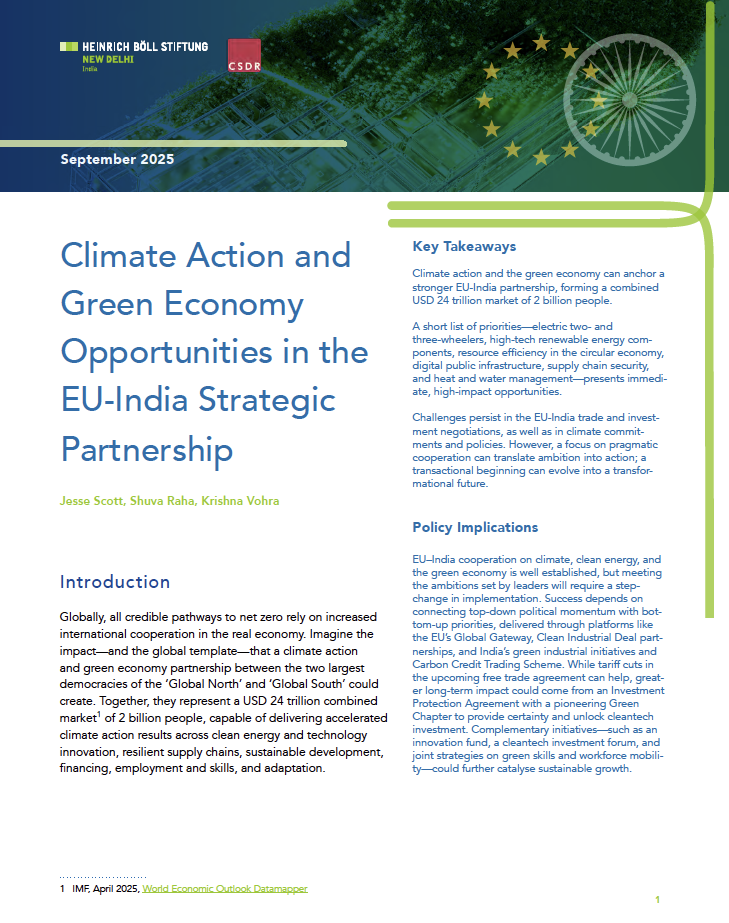
As the European Union and India prepare to update their strategic partnership, climate action and the green economy have emerged as defining priorities for a combined market of 2 billion people worth USD 24 trillion. While both regions face rising climate vulnerabilities , they possess complementary strengths, such as India's manufacturing capabilities in electric two- and three-wheelers and Europe’s advanced green technology and policy frameworks. While cooperation is well-established, meeting the ambitions set by leaders will require a step-change in implementation. The goal is to transform the partnership from a transactional beginning into a transformational future.
To move the partnership from ambition to action, the policy brief proposes a focused shortlist of immediate, high-impact priorities that leverage bilateral strengths. In the mobility sector, India’s world-leading electric two- and three-wheeler industries can scale with European technology, while European cities offer a massive market for Indian e-scooters. Energy infrastructure goals include combining India’s solar PV manufacturing and semiconductor design with European expertise in offshore wind and advanced grid electronics. The circular economy priority targets resource productivity through AI-driven e-waste recycling and European waste-to-energy practices. Furthermore, India’s successful Digital Public Infrastructure (DPI) can be deployed for emissions reporting to help SMEs navigate the EU Carbon Border Adjustment Mechanism (CBAM), as well as for disaster management systems. Finally, climate adaptation efforts center on joint heat and water management solutions, including sustainable cooling and smart grid-supported service delivery.
Success depends on connecting top-down political momentum with bottom-up priorities, delivered through platforms like the EU’s Global Gateway, Clean Industrial Deal partnerships, and India’s green industrial initiatives and Carbon Credit Trading Scheme .