Home
Council on Energy, Environment and Water Integrated | International | Independent

Monsoon Rainfall Increased in 55% of Indian Tehsils in Last 10 Years Amid Climate Change: CEEW

– Climate change is impacting monsoon patterns across India, with short-lived, heavy rainfall on the rise
– Drier areas of Rajasthan, Gujarat, central Maharashtra saw significant increase in rainfall over last 10 years
– 11% tehsils saw a decrease, which are located in rain-fed Indo-Gangetic plain, NE India & upper Himalayan region

New Delhi, 17 January 2024: Majority of India is seeing a surge in southwest monsoon rainfall, with 55 per cent of ‘tehsils’ or sub-districts seeing a significant increase of more than 10 per cent in the last decade (2012-2022), according to a new independent study by the Council on Energy, Environment and Water (CEEW) released today. This includes tehsils in traditionally drier regions such as Rajasthan, Gujarat, central Maharashtra, and parts of Tamil Nadu. Out of these, nearly a quarter of the tehsils are seeing a pronounced rainfall rise of over 30 per cent during the June to September period. The CEEW study, Decoding India’s Changing Monsoon Patterns—which is a first-of-its-kind granular analysis of rainfall in more than 4,500 tehsils across India spanning 40 years (1982-2022)—finds fast-shifting and erratic monsoon patterns in the last decade. This can be attributed to the accelerating rate of climate change.

Moreover, the CEEW study finds that the increased rainfall in these tehsils is frequently coming from short-duration, heavy rainfall, which often leads to flash floods. For instance, 31 per cent of Indian tehsils experienced an increase of four or more days of heavy rainfall per year in the last decade (in comparison to the previous 30 years) during the southwest monsoons. As 2023 was declared the hottest year on record globally, and 2024 is expected to continue that trend, the impacts of the climate crisis will be seen in the form of increased extreme weather events. For instance, in 2023, Chandigarh received nearly half of its total annual rainfall in just 50 hours, while Kerala encountered a near 60 per cent deficit in June (IMD 2023).

The monsoons are crucial for the Indian economy and are often regarded as the backbone of the agricultural sector, which employs over half of India’s population. However, the CEEW study finds that while only 11 per cent of Indian tehsils saw a decrease in southwest monsoon rainfall in the last decade, but they are located in the rain-fed Indo-Gangetic plain, northeast India and the upper Himalayan region. These areas are crucial for India’s agricultural output and contain fragile ecosystems particularly vulnerable to extreme climate events.

Dr Vishwas Chitale, Senior Programme Lead, CEEW, said, “As India readies for the 2024 Union Budget, it will be crucial to focus on future-proofing the economy against increasingly erratic rainfall patterns. The monsoons impact the food we eat, the water we drink and also our energy transition. CEEW’s study not only maps monsoon variability—both southwest and northeast—over the past 40 years across India, but also provides openly-accessible tehsil-level rainfall information for decision-makers to assess risks at the local level. With increasing extreme weather events, hyper-local climate risk assessments and action plans are the way to go for India to keep leading in climate action and disaster risk reduction. This will help save lives, livelihoods and infrastructure.”

Further, the CEEW study finds that the increase in rainfall is not well distributed throughout the seasons and months. Out of the total tehsils that saw a decrease in southwest monsoon, 87 per cent of them, located in states such as Bihar, Uttarakhand, Assam, and Meghalaya, saw a decline in rainfall during the initial monsoon months of June and July, which are crucial for sowing kharif crops. On the other hand, 48 per cent of tehsils in India saw an increase in October rainfall by more than 10 per cent, which could be due to the delayed withdrawal of the southwest monsoon from the subcontinent. This has direct implications for the sowing of rabi crops during this time.
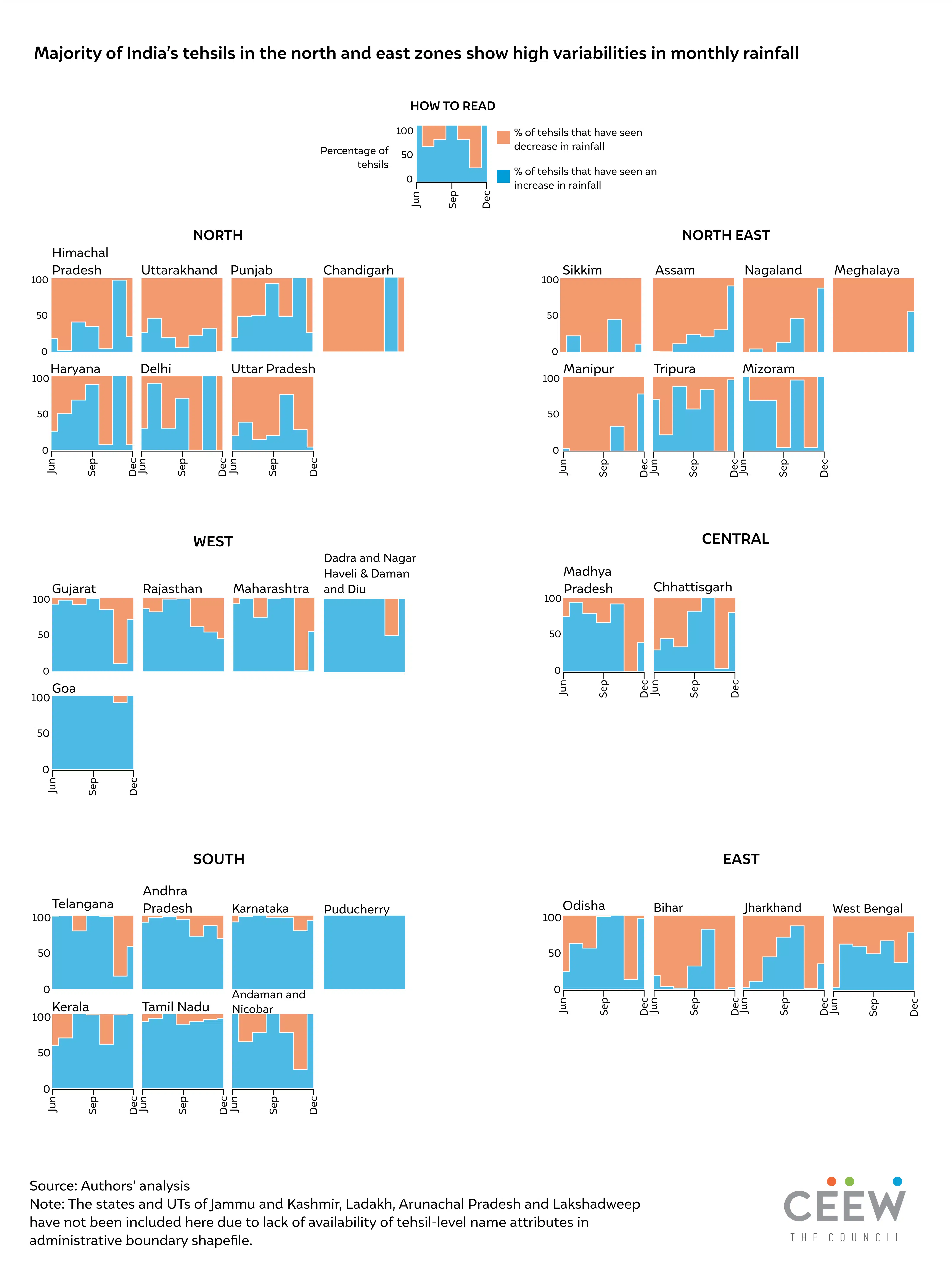
The study also shows changing patterns in the northeast monsoon—from October to December—which is particularly crucial for peninsular India. The northeast monsoon rainfall has increased by more than 10 per cent in the last decade in approximately 80 per cent of tehsils in Tamil Nadu, 44 per cent in Telangana, and 39 per cent in Andhra Pradesh. Further, Odisha and West Bengal on the East coast and Maharashtra and Goa on the West coast are seeing an increase in rainfall during this period.

Shravan Prabhu, Research Analyst, CEEW, said, “The occurrence of extreme weather events in India such as droughts and floods is closely linked to Indian monsoons. Our research reveals that the Indian monsoons, which inherently show high variability, are seeing even more intense changes over the last decade, showcasing a swapping pattern. To effectively address these emerging challenges, the impacts of monsoon variability on key sectors such as agriculture, water, and energy should be mapped and integrated into climate action plans at all levels — from states to districts.”

Finally, while India experienced 29 ‘normal’ southwest monsoons in the last 40 years, the CEEW study demonstrates the need to analyse it at a more granular district or tehsil level. Using the finest resolution data from the National Monsoon Mission by the Ministry of Earth Sciences, the study finds that approximately 30 per cent of India’s districts witnessed a high number of deficient rainfall years and 38 per cent witnessed a high number of excessive rainfall years over the last 40 years. Of this, 23 per cent of districts such as New Delhi, Bengaluru, Nilgiris, Jaipur, Kachchh, and Indore, witnessed both a high number of deficient as well as excessive rainfall years. Therefore, the development of district-level climate action plans incorporating tehsil-level climate risk assessments is crucial to implement adaptation strategies at the sub-national level.

For media queries contact: Tulshe Agnihotri – [email protected] | +91 9621119643 / +91 7905717812

REPORT
17 January, 2024 |

HAVE A QUERY?

Frequently Asked Questions

  • When is the monsoon season in India? Which type of monsoon is mostly seen in India?

    The southwest monsoon is the primary monsoon affecting India, which occurs from June to September. Around June, the monsoon hits Kerala on southwestern coast, gradually progressing across the country. The monsoon's arrival is eagerly awaited as it marks the end of scorching summer heat, providing relief and contributing significantly to India's diverse ecosystems and economy, especially the growing of kharif crops. India is also impacted by the northeast monsoon, also known as the winter monsoon or retreating monsoon, which affects the peninsular India and occurs from October to December. This monsoon is less intense compared to its southwestern counterpart but plays a crucial role in growing rabi (winter) crops and helps recharge groundwater.

  • How has the monsoon pattern changed in India?

    The natural variability of Indian monsoons is further influenced by climate change, as revealed in our study. Traditionally monsoon-rich regions like Northeast India, the Indo-Gangetic plains, and the Indian Himalayan region experienced a decrease in the past decade. Conversely, traditionally drier areas, including Rajasthan, Gujarat, central Maharashtra, and Tamil Nadu, witnessed an increase in southwest monsoon rainfall. The northeast monsoon intensified in Tamil Nadu, and states such as Odisha and West Bengal on the east coast, as well as Maharashtra and Goa on the west coast, observed heightened October to December rainfall.

  • What are the factors affecting monsoons in India?

    Several factors influence the monsoon patterns in India. The primary driver is the differential heating of the land and sea. During summer, the Indian subcontinent heats up, creating low-pressure areas. Meanwhile, the surrounding oceans maintain relatively lower temperatures, creating high-pressure zones. The resulting pressure gradient triggers the southwest monsoon, drawing moist air from the Indian Ocean. Other factors include the El Niño-Southern Oscillation (ENSO), with El Niño leading to drier conditions and La Niña enhancing the monsoon. The Indian Ocean Dipole (IOD) also plays a role, impacting sea surface temperatures. Additionally, features like the Tibetan Plateau, Western Ghats, and Himalayan mountains influence wind patterns, affecting rainfall distribution across regions.

  • How will the Indian monsoon change in the future?

    As Earth's surface temperatures rise globally, the scientific understanding is that increased evaporation leads to a rise in overall precipitation. This phenomenon is anticipated to result in increased rainfall in various regions globally due to a warming climate. Projections over India align with this trend and an increase in both southwest and northeast monsoon rainfall in the country is expected, accompanied by more heavy rainfall days. Climate change projections for India indicate a substantial 10-14 per cent rise in southwest monsoon rainfall by the close of the twenty-first century.

  • How can India adapt to changing monsoon patterns?

    Adapting to the evolving monsoon patterns necessitates a comprehensive approach, integrating policy, research, and citizen science. Initially, fostering more localised decision-making is essential, emphasising the creation of district and city-level climate action plans. These plans should incorporate climate risk assessments tailored for key sectors like agriculture, water, and energy. Secondly, critical sectors must undergo a strategic reevaluation and adjustment of their approaches in response to the shifting patterns. This entails recalibrating crop cycles and disaster management calendars, to align with the dynamic nature of the changing monsoons.

  •  

HAVE A QUERY?

Sign up for the latest on our pioneering research

The Green Credit Strategy — Potential and Pitfalls

Why India’s Sustainability Policy Needs To Factor Food, Water and Land Together

Developed Countries Will Have To Come Forward To Reduce Carbon Emissions

धरती बचाने के लिए काफी नहीं वैश्विक जलवायु वार्ता के नतीजे

After Dubai, the Race Against the Climate Crisis

UAE Consensus Didn’t Deliver on Its Ambition

REPORT
31 January, 2024 |

HAVE A QUERY?

Frequently Asked Questions

  • Why are oceans important for the environment?

    The ocean enables fundamental geoscience mechanisms critical for the survival of life on Earth, including producing over half of the world's oxygen, absorbing nearly 50 times more carbon dioxide than the atmosphere, storing over half of the global carbon reserves in the deep ocean, and redistributing heat across the globe to regulate the climate and weather patterns (Fleming, 2019; Bates 2019; Bigg et al. 2003). The ocean also provides income and employment to millions and fulfils the nutritional needs of nearly three billion people globally. By 2030, it is estimated that the global value added by the ocean economy will peak at USD 3 trillion, providing 40 million full-time equivalent jobs (OECD 2016).

  • How does the ocean act as a carbon sink?

    The ocean is the largest carbon sink in the world, with a capacity of 38,100 GtC, almost 16 times greater than soil and vegetation (2,410 GtC) and 50 times more than the atmosphere (760 GtC) (Sallée 2018). This involves physical, chemical and biological processes to absorb CO2 from the atmosphere and store it in the deep oceans. The most abundant form is dissolved inorganic carbon, which enters the ocean through seawater interacting with sediments, land weathering, and gas exchange with the atmosphere. The biological carbon pump in the ocean's surface layers is another way to store carbon in the ocean. The phytoplankton convert the CO2 from the atmosphere and the dissolved CO2 in seawater into biomass through photosynthesis, a part of which sinks to the bottom of the ocean. However, studies suggest that ocean warming will increase the temperature gradient between the surface water and lower layers, reducing vertical mixing and resulting in greater stratification. This will negatively affect CO2 solubility in surface water. Without ocean CO2 uptake, current atmospheric CO2 concentrations would have risen to well over 450 ppm, driving far more adverse climatic impacts than those witnessed today (Quéré et al. 2015; Doney et al. 2009; Sabine and Feely 2007).

  • What is the meaning of ocean governance?

    International environmental governance requires societal transformations of all economic actors and negotiations among various interested parties and stakeholders (Najam, Christopoulou, and Moomaw 2004). In the context of the ocean, this inclusive form of planning is described as ‘integrated ocean governance’, where different marine sectors and stakeholders aim to maximise their benefits while minimising their adverse environmental impacts (FAO 2016).

  • What are the issues in ocean governance?

    The current ocean governance framework is loosely linked, resulting in overlapping interests among different groups, unplanned and uncoordinated management, lack of compliance, poor implementation, and limited monitoring and enforcement. Some significant challenges include lack of information, unclear ownership and responsibility of the high seas, overexploitation of marine resources, and absence of adequate adaptation and management mechanisms to protect marine resources in a changing world. This is fuelled by unsustainable human activities driven by the growing demand for energy, food, trade, transportation, and recreation and made worse by climate change, biodiversity loss, and pollution.

  •  

HAVE A QUERY?

Sign up for the latest on our pioneering research

Loss & Damage Must Not Become a Lost Cause: When Gavel Comes...

Pages