Home
Council on Energy, Environment and Water Integrated | International | Independent
Report Launch
Access to Clean Cooking Energy and Electricity: Survey of States 2018

21 Nov 2018   |   0930 – 1400

Organised by CEEW and Shakti Sustainable Energy Foundation (SSEF)

About the Event

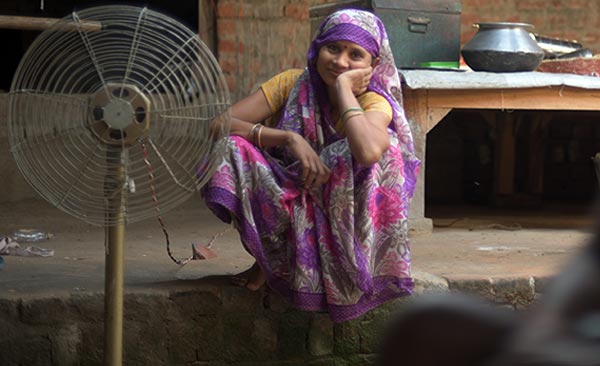
At the ACCESS report launch, we discussed how access to energy in India has changed over the last three years and highlighted the bottlenecks that people face in accessing cleaner forms of energy today. We launched our flagship study 'Access to Clean Cooking Energy and Electricity: Survey of States (ACCESS) 2018' with results from the second phase of the ACCESS Survey. ACCESS is India’s largest multi-dimensional energy access survey, covering more than 50 districts, 750 villages, 9000 households across six of the most energy-deprived states – Bihar, Jharkhand, Madhya Pradesh, Odisha, Uttar Pradesh, and West Bengal. In total, over 2.5 million data points have been collected.

The first phase of ACCESS was conducted in 2015. Our findings at that time drove the need to look beyond connections for enabling access to modern forms of energy. In 2018, we revisited the households to understand the changes in their energy access situation over the last three years and to study the impact of government policies during this period. The analysis from the collected data provides a multi-dimensional longitudinal view on energy access in India.

ACCESS provides a first-of-its-kind multi-dimensional evaluation of the state of energy access in India and highlights multiple nuances associated with electricity access and cooking energy access such as the duration of supply, quality, reliability, affordability, availability, health and safety, and even legal status of the connection.

For Event Queries

Riddhima Sethi

Communications Associate

[email protected]

Key Speakers

Venue

Workshop
Renewable Hydrogen for Industry and Beyond

14 Nov 2018   |   0930 – 1600

Organised by CEEW and International Energy Agency (IEA)

About the Event

The CEEW-IEA Workshop on ‘Renewable Hydrogen for Industry and Beyond’ aims to strengthen the National Hydrogen Energy Roadmap launched by the Government of India and to find conformity with India’s ambitious renewable energy targets.

Green hydrogen, generated via renewable energy, has the potential to be a complementing energy vector at certain locations and with specific applications. The workshop will focus on applications in and around three potential end-use sectors: ammonia, methanol, and steel manufacturing.

The Workshop will bring together several national and international experts in the sector to deliberate on the possibility of using ammonia, methanol and green hydrogen as feedstock and fuel, and discuss potential challenges and drivers.

For Event Queries

Riddhima Sethi

Communications Associate

[email protected]

Key Speakers

Venue

International
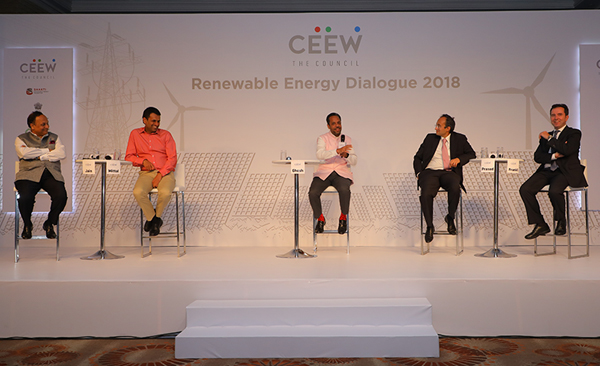
CEEW Renewable Energy Dialogue 2018

29 Jun 2018   |   1000 – 1600

Organised by CEEW, Shakti Sustainable Energy Foundation (SSEF), Ministry of New and Renewable Energy (MNRE), International Energy Agency (IEA), International Solar Alliance (ISA), Renewable Energy Policy Network for the 21st Century (REN21)

About the Event

The CEEW Renewable Energy Dialogue offers a platform for engaged deliberations on the role of different stakeholders in advancing renewable energy deployment, balancing both domestic priorities and international mitigation ambitions and commitments.

The Dialogue brings together several national and international stakeholders from the renewable energy community to deliberate on the drivers and challenges facing the sector, both in India and globally.

The second edition of RE Dialogue will have a specific focus on market needs, creation and trends. With participants from all relevant stakeholder communities and multiple geographies, the Dialogue will aim to reduce information asymmetries and make incisive calls for impactful actions.

For Event Queries

Riddhima Sethi

Communications Associate

[email protected]

In Pictures

Powered by flickr embed.

Key Speakers

Venue

Common Risk Mitigation Mechanism

Feasibility Study


November 2017 |

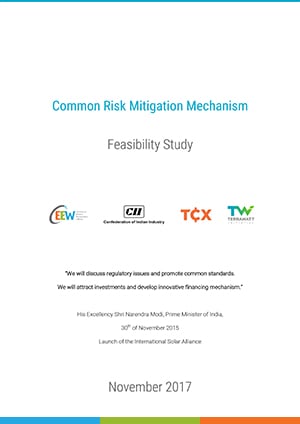
Citation: Council on Energy, Environment and Water, Confederation of Indian Industry, The Currency Exchange Fund, and Terrawatt Initiative. 2017. Common Risk Mitigation Mechanism Feasibility Report. New Delhi: Council on Energy, Environment and Water.

Overview

This feasibility report on the Common Risk Mitigation Mechanism (CRMM) has been driven by governments of 17 nations with strong solar potential as a way for scaling investments in solar power generation in their countries and in other developing countries. In May 2017, these nations mandated a multi-stakeholder Taskforce consisting of the Council on Energy, Environment and Water (CEEW), the Terrawatt Initiative, The Currency Exchange Fund (TCX), and the Confederation of Indian Industry (CII), to conduct a study on the feasibility of implementing CRMM, including broad based consultation with relevant stakeholders.

The study is in line with the framework of the International Solar Alliance (ISA), and specifically addresses its mandate to aggregate and harmonize frameworks for investment. In particular, this study aims to operationalise ISA's programme for ‘Affordable Finance at Scale,’ initiated by both India and France.

The study outlines the economic, legal, and operational feasibility conditions for the successful implementation of the Common Risk Mitigation Mechanism. It was released at COP23 in Bonn in November 2017.

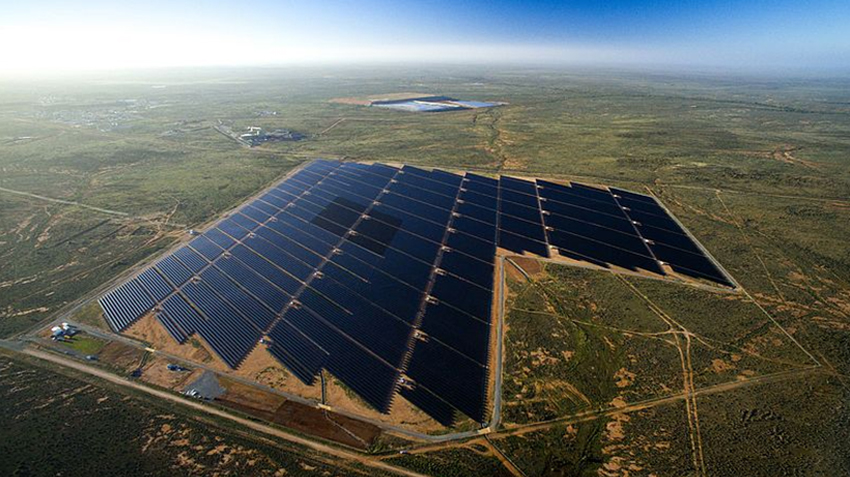
Broken Hill solar park in New South Wales, Australia (Source: Wikimedia Commons)

Key Findings

The study is based on the following findings of the Taskforce

  • Financing of solar power generation assets in the majority of developing countries suffers from inadequate availability of risk management tools, a high perception of risk, high transaction costs, small project sizes (granularity) and lack of scale.
  • Investors, developers, and other stakeholders require transparency and clarity of process – which in some countries often is missing.
  • The international development community and private commercial financiers are eager to participate in the creation of a global solar market.
  • Development Finance Institutions have created a successful track record in leveraging private sector capital through risk mitigation mechanisms, and are now seeking to scale-up this leveraging to even larger levels under the theme of “billions to trillions”, including mainstream deployment of local capital and savings.
  • Private and institutional capital markets have successfully deployed green bonds and innovative structures for securitising receivables from various sources, including renewable power investments.

All the ingredients for expanding access to affordable solar energy in developing countries already exist. These efforts could accelerate more rapidly for the benefit a large number of countries, if they are conducted in a coordinated manner at scale, and within a common platform.

Key Recommendations

The Taskforce has presented the following recommendations for formulating and implementing the Common Risk Mitigation Mechanism:

  • Develop an easily accessible first demand financial guarantee instrument (comprising a bundle of different risk management instruments ranging from guarantees, insurance, to swaps, which will cover risks in both local currencies and hard currencies) intended to provide private institutional investors (investors) in Solar PV investments in developing countries with a high level of security against (i) the risks of currency exchange, (ii) the risks of transfers and inconvertibility, (iii) the risks of electricity purchasing counterparties, and (iv) the political risks (together the Guaranteed Risks) while crowding-in existing specialized instruments for risk mitigation.
  • Establish a Guarantor Entity benefiting from a strong investment grade credit rating, and which is well capitalized by public and private funds (including from States, Development Finance Institutions and any other public or private investor wishing to participate) with cash, lines of credit and sovereign guarantees.
  • Establish an independent company which operates a digital platform with a management mandate from the Guarantor Entity.
  • Launch a pilot project in 2018, which will be completed within 3-5 years from inception. The aim of the pilot is to achieve a critical size and demonstrate its cost effectiveness in pooling and aggregating capital, and mitigating risks at an international level. Its progressive deployment will target an ultimate USD 1 billion Guaranteed Entity capitalization and an underlying asset portfolio of approximately USD 15 billion in some twenty volunteer countries by the end of the Pilot Project. Simulations in median scenarios demonstrate limited requirement for the capitalisation of the Guarantee during the first 2 years.
  • Designate a multi-stakeholder working group to prepare a detailed project implementation plan and implement it within 9 to 15 months.

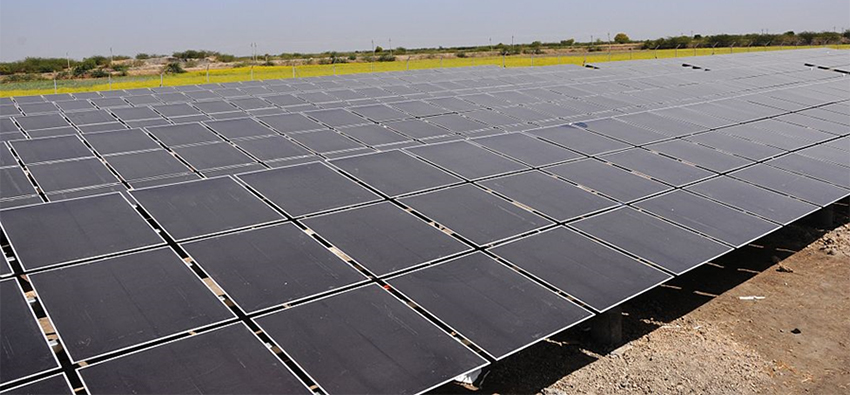
The Charanka solar park in Patan, Gujarat (Source: Wikimedia Commons)

Sign up for the latest on our pioneering research

Dialogue
India's Energy and Climate Policy: Pathways towards NDC and Mid-Century Strategy

28 Feb 2018   |   0930 - 1300

Organised by CEEW

About the Event

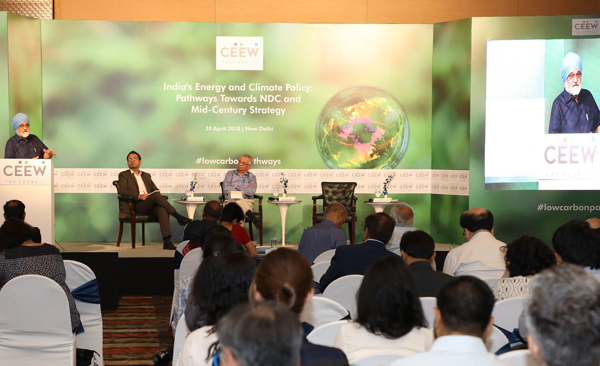
At the Dialogue, The Council released its study 'Sustainable Development, Uncertainties, and India's Climate Policy: Pathways towards Nationally Determined Contribution and Mid-Century Strategy’. This is the first-in-depth modelling-based analysis of India’s energy and climate policy and presents insights from uncertainty assessment of 220+ scenarios.

  • The future of coal, solar, and other energy sources in India's electricity generation mix for up to 2050.
  • The cost implications of integrating solar and renewable energy into India's electricity generation mix.
  • The implications of uncertainties related to energy efficiency improvements, as well as a higher rate of energy demand growth in the end-use sectors for India's emission intensity.
  • India's progress towards 'Nationally Determined Contribution' targets related to non-fossil energy's share in electricity generation capacity, as well as emission intensity of GDP.
  • The transformation required in India's energy systems to achieve some 2-degree C compatible pathways, and insights for Mid-Century Strategy.
  • The synergies and trade-offs between stringent climate policy and sustainable development.

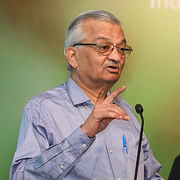
In his opening remarks, Dr Anil Kakodkar, Trustee, CEEW, and Former Chairman, Atomic Energy Commission, said, "India's future energy mix must focus on universal energy access, social development, and economic growth. We must consider nuclear energy, as it is the only reliable non-fossil fuel source of electricity. All other energy sources are unpredictable and variable. We need to set up 20 nuclear plants with a 32 GW capacity, with international collaborations. In addition, we must focus on other technologies, including coal-bed methane, coal gasification, splitting water for hydrogen, solar thermal, etc."

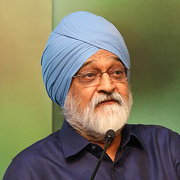
During his keynote address, Mr Montek Singh Ahluwalia, Trustee, CEEW, and Former Deputy Chairman, Planning Commission, Government of India, said, “Historical responsibility matters and we need to build a basis of differentiated responsibility. In recent years, climate change discourse has seen the focus shift to renewable energy. Going forward, equal importance must be given to energy-efficient technologies. I compliment The Council's research focusing on internalising our longstanding sustainability goals."

Key Discussion Points

  • India’s NDCs can be enhanced – if policymakers find solutions to the crucial question of who will pay the cost of integration and other costs.
  • Non-fossil fuel energy sources will garner a share of at least 48 per cent in India's electricity generation capacity by 2030.
  • The energy sector carbon dioxide emissions intensity of GDP will decline by at least 48 per cent between 2005 and 2030, on the back of significant developments in energy efficiency of end-use sectors such as residential, transportation, and industrial sectors.
  • Cost of integrating variable renewable energy into the electricity grid is a key element of India's energy transition to a low-carbon economy.
  • To be consistent with the 2 Degrees C target, India needs to cut CO2 emissions by at least 4.5 per cent per annum post-2030 to adhere to an emissions budget of 145 GtCO2, based on techno-economic analysis.
  • While meeting climate commitments, implications for energy access, jobs, industrial competitiveness, and water are important for informing the mitigation choice.
For Event Queries

Riddhima Sethi

Communications Associate

[email protected]

In Pictures

Powered by flickr embed.

Key Speakers

Venue

Screening and Panel Discussion
A Planet Without Plastic

04 Jun 2018   |   1730 – 2100

Organised by Women in Sustainability at CEEW

About the Event

On the eve of World Environment Day 2018, the Women in Sustainability (WiS) initiative at The Council hosted a screening of the award-winning documentary on plastic pollution – ‘A Plastic Ocean’, followed by a panel discussion. The screening was organised in support of #BeatPlasticPollution, the theme of UN World Environment Day 2018, urging governments, industries, communities, and individuals to refuse single-use plastic - polluting our oceans, threatening human health, and endangering marine life.
Described as ‘the most important film of our times’ by Sir David Attenborough, ‘A Plastic Ocean’ brings to light the harsh consequences of our global disposable lifestyle. Directed by Australian journalist Craig Leeson, the documentary dives deep and brings to the surface grave glimpses of the impacts of plastic on our environment, oceans and marine life. Filmed in 20 locations around the world, ‘A Plastic Ocean’ documents the irreversible effects of global plastic pollution through footage of marine species affected by plastic debris. The documentary, with its diverse team of adventurers, researchers and ocean ambassadors, also introduces workable technology and policy solutions that can change outlooks and the world for better.

Key Discussion Points

  • The global plastic pollution crisis and its impact on our environment, oceans, and marine life.
  • Importance of such timely documentaries that bring forth the issues we are grappling with as the habitants of this world.
  • Government policies on waste-management and notable achievements of various non-governmental organisations working on waste management in different states of India. The nature of demand-supply curve in big corporations and their choices to continue using single-use plastic as packaging material.
  • The way forward with a conscious decision to refuse single-use plastic and switching to reusable, recyclable plastic, and its alternatives.

For Event Queries

Riddhima Sethi

Communications Associate

[email protected]

In Pictures

Powered by flickr embed.

Key Speakers

Venue

Emailer Signup

Sign up form

National Dialogue
Solar for Irrigation in India

18 Jan 2018   |   1000 - 1600

Organised by CEEW, Shakti Sustainable Energy Foundation (SSEF), Ministry of New and Renewable Energy (MNRE), and Swiss Agency for Development and Cooperation (SDC)

About the Event

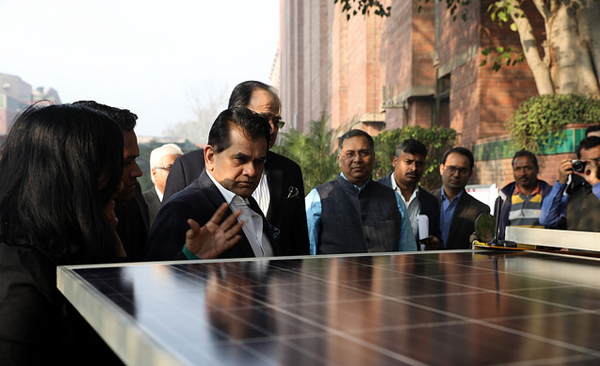
In collaboration with the Ministry of New and Renewable Energy, Shakti Sustainable Energy Foundation, and the Swiss Agency for Development and Cooperation, CEEW organised the first National Dialogue on ‘Solar for Irrigation in India’. Amitabh Kant, CEO, NITI Aayog delivered the keynote address and released three CEEW studies on solar pumps, capturing three years of research on the subject.

The Dialogue brought together multiple stakeholders including researchers, policymakers, financiers, entrepreneurs, and farmers to share their respective experiences and synthesise a way forward for scaling sustainable deployment of solar for irrigation. One of the major highlights of the Dialogue was the live demonstration of a trolley and rickshaw-mounted mobile solar pump, deployed by Claro Energy as a pumping service in Bihar. The opening panel discussion featured grassroots stakeholders - farmers, NGO representatives, and sales representatives of manufacturers.

Delivering the keynote address, Mr Kant, said, “Solar pumps can strengthen Indian agriculture by fulfilling unmet irrigation needs while reducing the burden of subsidies on the government and increasing farmers’ resilience to climate change. To scale-up solar pumps, we must strive to create bottom-up demand by focusing on technology demonstration and raising awareness levels among farmers. I congratulate CEEW and Shakti Sustainable Energy Foundation on the release of these studies. These are policy pertinent research studies and present actionable recommendations."

He also released three reports ‘Adopting Solar for Irrigation: Farmers' Perspectives from Uttar Pradesh', ‘Solar for Irrigation: A Comparative Assessment of Deployment Strategies’, and ‘Financing Solar for Irrigation in India: Risks, Challenges, and Solutions’ at the Dialogue.

Key Discussion Points

  • Last mile challenges in sustainable deployment of solar for irrigation.
  • Understanding various deployment approaches from the perspectives of social, economic, and environmental sustainability.
  • Risks and opportunities in financing solar-based irrigation systems.
  • The way forward for solar- based irrigation – policy and pathways towards sustainable deployment.

For Event Queries

Riddhima Sethi

Communications Associate

[email protected]

Key Speakers

Venue

Pages