Council on Energy, Environment and Water Integrated | International | Independent



Twenty-eight-year-old Sricharan Malik has fond childhood memories of his coastal village in northern Odisha. Living in one of the seven villages under the Satabhaya gram panchayat, Sricharan’s family and other villagers depended on farming, cattle rearing and fisheries for livelihood. Despite being cut off from the closest town due to patchy roads, the villagers were self-sufficient and led a peaceful life surrounded by the Bay of Bengal, lush paddy fields, a river and marshy forest land.
However, Satabhaya is no longer home for Sricharan and numerous others. Living in the gram panchayat had become risky after rapid coastal erosion. Sricharan says village elders remembered the sea being nearly four kilometres away in their childhood. Over the years, the region has also increasingly become cyclone prone.
According to the National Centre for Coastal Research, Odisha lost 28 per cent of its 485-km-long coastline between 1999 and 2016 to seawater intrusion. CEEW analysis found that Kendrapara district has recorded a 3X and 2X increase in the frequency and intensity of extreme floods and cyclones, respectively, since 2000.
In 2018, the state government relocated over 530 families from Satabhaya to Bagapatia. Sitting in front of the house allotted by the government as part of the Indira Awaz Yojana, Sricharan has mixed emotions. “Our lives are secure now, but our means of livelihood is lost. We now have to pay for everything, including drinking water,’’ Sricharan says while being grateful to the government for the new house.
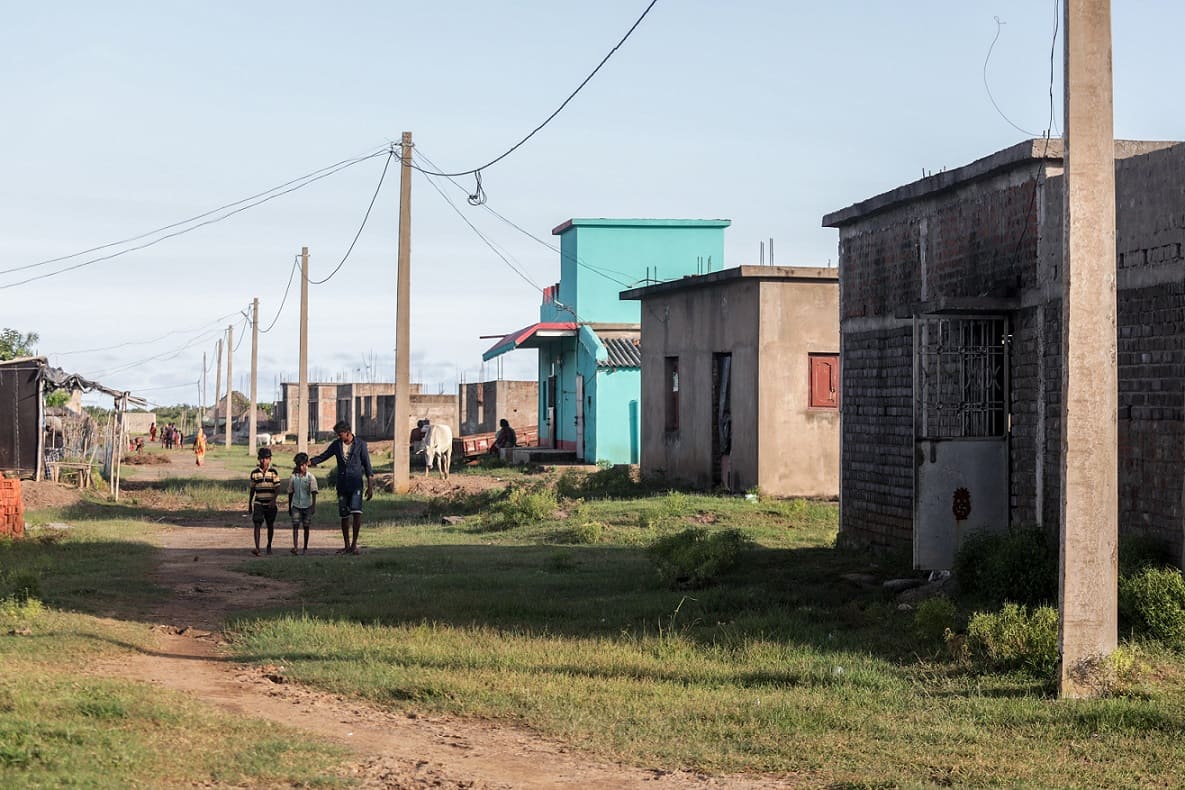
Families relocated from Satabhaya due to coastal erosion have been allotted homes in Bagapatia. Photo: Shawn Sebastian
With a lack of access to agricultural land and fisheries and no means available for cattle rearing, most youngsters were forced to migrate to states such as Kerala, Maharashtra and Delhi in search of livelihoods, primarily as wage labourers.
Sudarshan Raut, a social worker and the former Sarpanch of Satabhaya, appreciates the rehabilitation efforts of the government. However, he points out that the government must go beyond saving lives as unemployment rates have spiked in the community.
“We have a safe shelter above our heads, and our lives are secure. Now, we need livelihood support and infrastructure development in Bagapatia to stop the outward migration,’’ Sudarshan says. The villagers have made a plea to the government to provide two acres of land for all the families who were displaced, he adds.
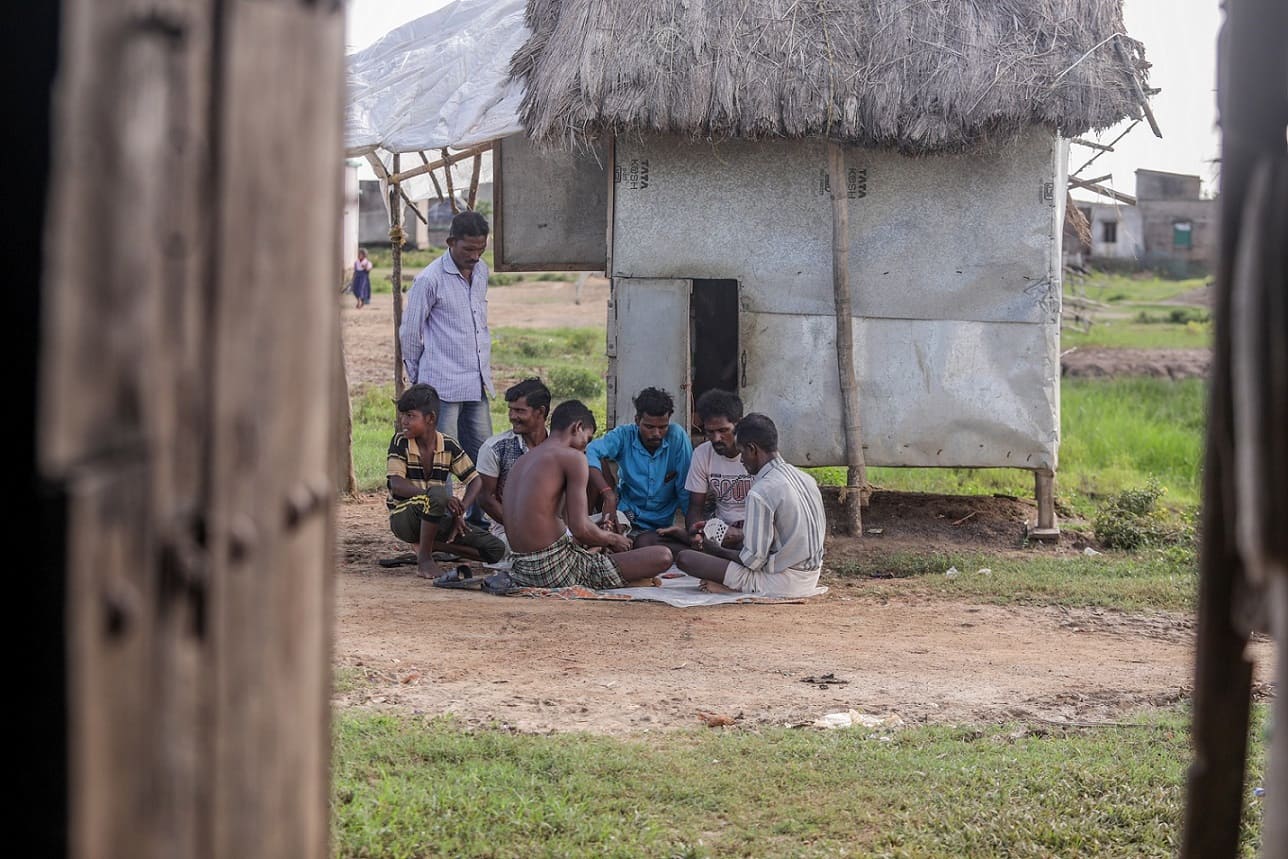
Young men play a round of cards in Bagapatia. Ever since the resettlement, unemployment severed-forcing many young to migrate out for work. Photo: Shawn Sebastian
Sarda Malik, a 47-year-old farmer, also lost his two-acre paddy field to coastal erosion in Satabhaya. Like several other young adults in the village trying to support their families, his son is also a migrant labourer in Kerala. Sarda hopes that his son can return home before long. He feels that gaining access to agricultural land can help secure their livelihoods in Bagapatia.
Meanwhile, Sricharan, who was on a one-month break from his workplace in Kerala, has to return soon. This time, he is taking his younger brother along as it will help his family with additional income.
“It’s always sad when the train departs from Odisha. “Once there are employment opportunities or land to farm here, I wish to come back and live with my family,” Sirchan says.
Watch the full film here.
Smoggy skies in Delhi have once again put the spotlight on Punjab’s annual ritual of paddy residue burning. The problem is not new and neither are its solutions. But what has changed since the past year, when post-Kharif farm fires were at a five-year high? In our two-part blog series, we examine the situation on the ground in Amritsar and Tarn Taran.
Farm fires in the state start in the north-western Majha region, comprising Amritsar, Gurdaspur, Pathankot, and Tarn Taran, and then fires move southwards to the larger Malwa region. Recognising this trend, we spoke to district-level officials from the state’s Department of Agriculture and the Krishi Vigyaan Kendra. Our interactions revealed that little has changed in the region over the last year.
Officials indicate that the crop mix in the region has remained the same. Because of rewarding prices in the free market, farmers in Amritsar have continued to use the Basmati varieties of 1121 and 1509. In contrast, farmers in Tarn Taran remain committed to non-basmati varieties including PR 121, PR 126, and PR 110 counting on assured procurement.
This contrast in seed types also reflects in the fire counts1 of the two districts. Despite having identical areas under paddy2, Tarn Taran registered 3,799 fires compared to Amritsar’s fire count of just 2,148 fires last year.
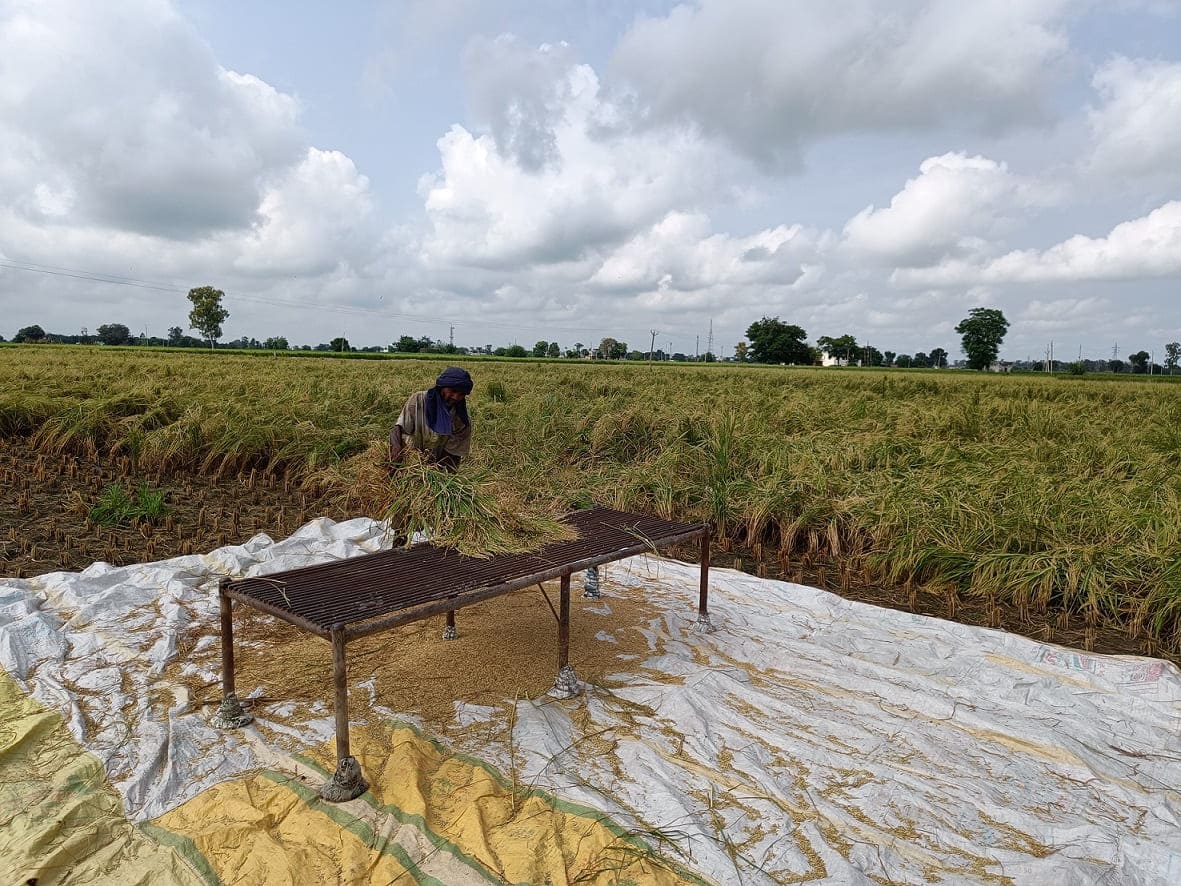
A farm labourer harvests Basmati crops manually leaving little stubble on the farmland. Source: CEEW
Our interaction with farmers in the Amritsar region revealed a major lacuna in the available technical solutions to manage residue burning. The introduction of short-duration varieties of paddy was meant to reduce water use and provide extra time for residue management. Varieties like the PR 121 and PR 126 mature in 140 and 123 days respectively. These varieties theoretically offer 3 to 6 weeks of added time for environment-friendly residue management compared to the PUSA 44 variety, which matures in about 160 days.
However, farmers use the extra time to grow vegetables like potatoes, peas, and beans. Vegetable cultivation and in-situ crop residue management (CRM) are not being used in tandem and thus farmers resort to burning the residue generated by cultivating short-duration varieties of paddy.
Moreover, in-situ CRM machines remain the focal point of public policy aimed at reducing farm fires in Punjab. As per data from 2021, Amritsar and Tarn Taran have at least 2,400 and 4,000 such machines3 respectively. However, despite 2022 being the fifth year that such machines are being distributed, farmers are yet to be acquainted with their impact.
Members of the Bhojjian Village Co-operative Society in Tarn Taran admit that burning is the most prevalent method for crop residue management. They attribute this to the problems farmers face when using in-situ machines like happy and super seeders.
A spokesperson from the society explains “The super seeder (SS) was very popular. But unfortunately, most farmers suffered due to pest infestation. In addition, no one wants to spend INR 2,500 per acre to manage residue. The upfront cost of a SS is INR 2,70,000 whereas the maximum subsidy for it is INR 1,05,000. Farmers have to take loans with interest of up to 11 per cent to buy these machines. Some of our members have been selected for subsidy but we will not claim them due to costs over and above the subsidy.”
The persistence of crop residue burning creates an impression that little has changed in the status quo. However, we did encounter effective small-scale solutions, including a paddy residue based paper mill and the local ‘Gujjar’ (herder) community.
The herder community, widely present in Amritsar, uses paddy residue for fodder. Local community members explain that a single animal from their cattle can consume paddy residue up to 0.7 acres; one herder can cover an area within 10-15 km around their settlement. However, their limited scale of operation prevents the community from having any significant impacts on residue burning.
Meanwhile, Sharma’s Paper and Board Industries uses paddy straw, sludge, and gunny (jute) bags in a ratio of 70:20:25 to produce paper and cardboard. Located in Dalam, Amritsar, the industrial unit has been operational for three decades. Each year, the unit can consume up to 1,500 metric tonnes of paddy residue.
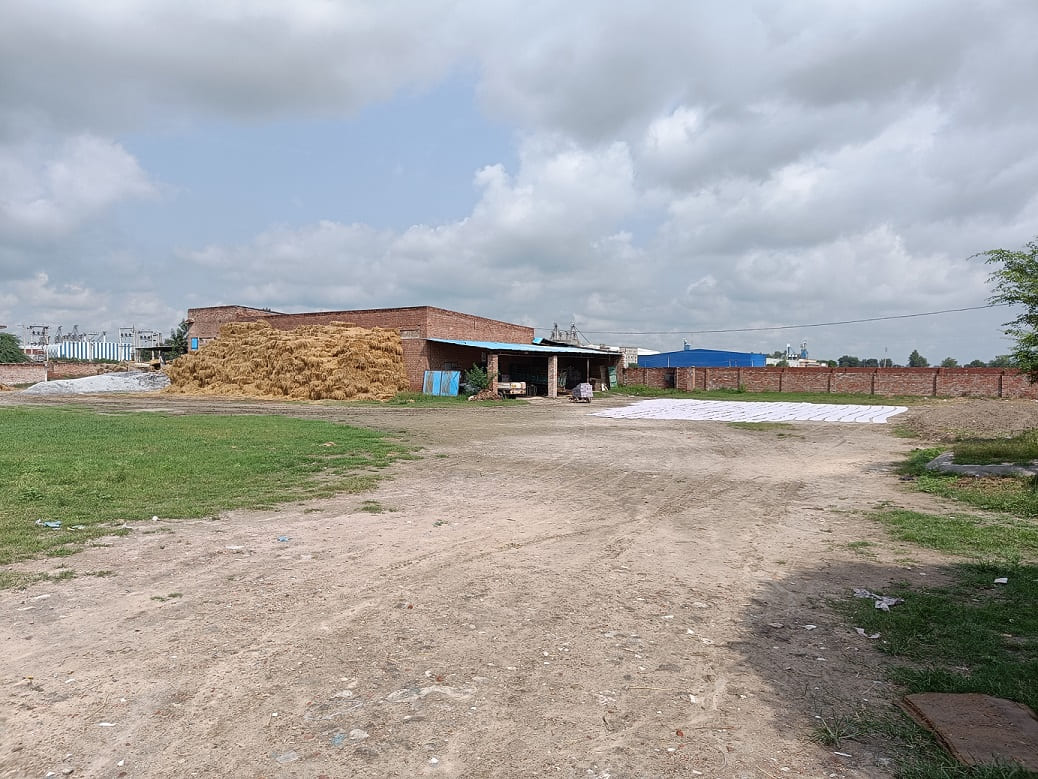
Paddy straw storage at Sharma’s Paper and Board Industries. Source: CEEW
However, the entrepreneur, Mr. Rajinder Sharma, indicates that such units face several hurdles in scaling up. These include high moisture content in paddy residue, unavailability of standard-size bales, and the lack of land required for storing and drying the paddy residue.
Irrespective of the scale of these ex-situ solutions, farmers and experts in the two districts identified ex-situ utilisation as the best method for CRM.
While in-situ and ex-situ CRM options present short and medium-term options, some farmers are cultivating alternate crops in a bid to break away from the paddy-wheat monoculture.
The Punjab government’s announcement of procuring summer moong4 presented an opportunity for farmers to get acquainted with a new crop. However, the lack of procurement appears to have created more apprehensions toward crop diversification.
Between May and October 2022, 1,638.7 metric tonnes5 of moong arrived at mandis in Amritsar. Of this, 92.12 per cent was procured by private players. During the same period, 98 per cent of the 729.3 metric tonnes of moong at mandis in Tarn Taran was procured by private players. A district-level agriculture officer sums up the moong experiment in the following words, “The new thing this year was moong. Some farmers had planted the crop with a view to diversify. But there was very little government procurement, as most farmers’ crops did not meet the stringent quality requirements for government procurement at the minimum support price. This will discourage farmers from future attempts at diversification.``
Farmers who experimented with moong are not the only ones who feel the lack of policy support. In Tarn Taran, Surinder Pal Singh Manawa, an advocate by profession, convinced his family of farmers to sow horticultural crops like pear, plum, guava, and some citrus fruits on nine acres of their land. But their experiments with horticulture have failed twice.
Adv. Manawa points to the lack of extension services6 as the reason for his crop failure. He says, “We did not have access to extension services from the government or from agricultural experts. As a result, we kept making mistakes, which led to significant losses.”
Accepting that there has been little change in the status quo is a humbling experience for all those working towards combating Punjab’s stubble burning conundrum. However, local stories of success provide both inspiration and options for the continued struggle against the problem.
Veteran farmer Gurbachan Singh of Burj Deva Singh village in Tarn Taran has led the adoption of short-duration varieties of paddy in his village. Apart from selecting environment-friendly varieties of paddy, he has also been using the Happy Seeder since 2007, long before the existence of any policy support for such machines.
Shunning the popular concerns around the Happy Seeder, Singh has stopped using fertilisers due to an improvement in soil quality. He has also persuaded 40 other farmers from his village to abandon the stubble-burning practice. Mr. Singh has emerged as a torch-bearer of improved crop residue management; the Prime Minister also recognised his efforts in his ‘Mann Ki Baat’ address in October 2018.
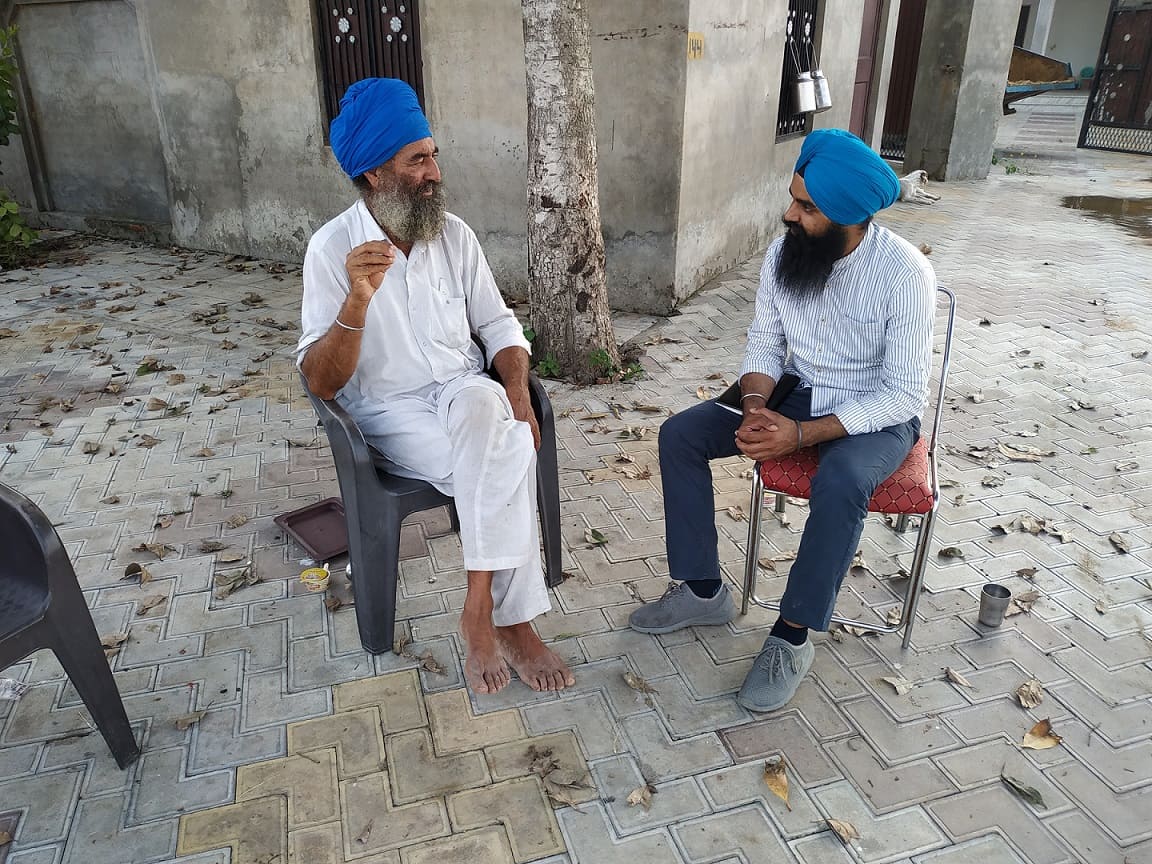
CEEW’s Ramandeep Singh interacting with Mr. Gurbachan Singh on his CRM initiatives. Source: CEEW
Our interactions with stakeholders in the Majha region revealed that existing solutions are unable to tackle the stubble-burning problem. Operational costs and the lack of scalability continue to be the most important barriers.
However, the existence of local solutions and the pioneers implementing these solutions leave us with the question: “Is it time to shift from top-down policy-making and proactively enable farmers to scale up best practices and innovations?”
Notes
1 Basmati varieties are harvested manually, which leaves little crop stubble on the field. The residues from basmati varieties are used as fodder. These factors result in lower burning of basmati residue as compared to non-basmati paddy, which is harvested mechanically.
2 MoAFW. 2021. “Cultivation of Paddy.” MINISTRY OF AGRICULTURE & FARMERS WELFARE. https://pqars.nic.in/annex/254/AU2095.pdf.
3 MoAFW. 2021. “Agriculture Mechanisation for In-Situ Management of Crop Residue.” MINISTRY OF AGRICULTURE & FARMERS WELFARE. https://pqars.nic.in/annex/254/AU1297.pdf.
4 Jagga, Raakhi. 2022. “Punjab CM Bhagwant Mann Announces MSP for Moong Dal, but with a Rider.” The Indian Express (blog). May 6, 2022.
https://indianexpress.com/article/cities/chandigarh/punjab-cm-bhagwant-mann-announces-msp-on-moong-dal-7903858/.
5 Punjab State Agricultural Marketing Board. 2022. “Daily Arrival, Today’s Purchase and Progressive Report.” October 10, 2022. https://emandikaran-pb.in/AspxPage/Open.aspx?name=15&commodityid=53.
6 Punjab State Agricultural Marketing Board. 2022. “Daily Arrival, Today’s Purchase and Progressive Report.” October 10, 2022. https://emandikaran-pb.in/AspxPage/Open.aspx?name=15
7 Extension services refer to the extension education programmes for farmers that are run by the department of agriculture and Krishi Vigyaan Kendras. These extension programmes provide technical information on cultivation practices, machinery and post-harvest management to farmers.
8 FE Online. 2018. “How Gurbachan Singh Praised by PM Modi in Mann Ki Baat Is Leading the Fight against Stubble Burning | The Financial Express.” October 28, 2018.
https://www.financialexpress.com/india-news/delhi-air-pollution-how-a-punjab-farmer-is-leading-the-fight-against-stubble-burning/1349956/
Ramandeep Singh is a Research Analyst at the Council on Energy, Environment and Water (CEEW), an independent not-for-profit policy research institution. Send your comments to [email protected]

New Delhi, 28 October 2022: Dr Arunabha Ghosh, internationally recognised public policy expert and CEO of the Council on Energy, Environment and Water (CEEW), one of Asia’s leading think tanks, was honored with the 2022 Asia Game Changer Award in New York yesterday. The Award is in recognition of his contribution to climate change and sustainability issues in India and across the world. Each year, the Asia Society presents the Game Changer Awards to leaders who have made outstanding contributions to the future of Asia and the world.
Some of the other recipients of the ninth annual edition of the Awards include Michael Bloomberg (former New York City Mayor), Alok Sharma (President of COP26), Kathy Jetnil-Kijiner (poet and climate activist from the Marshall Islands), Ma Jun (Director of the Institute of Public & Environmental Affairs), Nanette Medved-Po (Founder and chairwoman of the HOPE and PCX Groups), Raj Shah (President of the Rockefeller Foundation),and Janet Yang (President of the Academy of Motion Picture Arts and Sciences).
Speaking at the Award ceremony, Dr Arunabha Ghosh, CEO, CEEW, said, “I am truly humbled to receive this honour. Climate change is only the second greatest challenge facing humanity. The greatest challenge is a lack of empathy, a lack of understanding of fellow humans of other colours, cultures, genders, and geographies. To fight climate change, we must walk in the shoes of the vulnerable. We must create the conditions from which common ground can be found. Further, to solve wicked problems, we must build institutions more proximate to the people whose problems we claim to understand.”
Dr Ghosh has worked as an advisor for various governments, industries, civil society and international organisations worldwide. He currently serves on the Government of India’s G20 Finance Track Advisory Group and advises the Sherpa Track for India’s G20 Presidency in 2022-23. In 2022, the UN Secretary-General appointed him to the High-level Expert Group on the Credibility and Accountability of Net-Zero Announcements by Non-State Actors. Since 2018, on the UN Secretary-General’s nomination, Dr Ghosh has served on the UN Committee for Development Policy. Arunabha is also a member of the Global Commission on the Economics of Water. In 2020, the Government of India appointed him Co-Chair of the energy, environment and climate change track for India’s Science, Technology and Innovation Policy (STIP2020). He was also appointed the Co-Chair of the T20 Task Force on climate and energy for Indonesia’s G20 Presidency in 2022.
He further said, “It is in the Global South where most of the people reside, where their hopes and aspirations need to be kindled, and where the action is unfolding. My dream is that the daughter of a coal miner born in 2022, when India is celebrating 75 years of independence, becomes a clean energy billionaire when independent India turns 100.”
Previous Asia Game Changer Award winners include His Highness the Aga Khan; Alibaba Founder Jack Ma; Nobel Peace Prize laureate Malala Yousafzai; Tennis champion and advocate Naomi Osaka, the iconic architect I.M. Pei; former Pepsi CEO Indra Nooyi; the great cellist YoYo Ma; among others.
More information on the Asia Game Changers and complete list of honourees at this link.
Contact: Riddhima Sethi (CEEW), [email protected]; Mihir Shah (CEEW), [email protected]
National Highway 11, which connects Jodhpur to Bikaner in the Indian state of Rajasthan, wears a near-deserted look on an April day scorching at 45 degree Celsius. Occasionally, one spots truckers taking a break or a herd of livestock. As one gets used to the scanty vegetation dotting the highway, a stretch of greenery a few kilometres ahead of Bap block in the Jodhpur district is a refreshing sight. The foliage is only an introduction to what lies ahead — an oasis created by the community at Badi Dani village.
Drought-prone Badi Dani has adapted to climate change and built resilience by restoring several ponds over the years. The story dates back more than two decades when water scarcity had affected farming and villagers’ incomes dried up. Many people had no choice but to migrate to neighbouring states to earn a living.
According to CEEW analysis, over 90 per cent of districts in Rajasthan, home to 68.8 million people (2011 census), are vulnerable to droughts.
“Rainfall has declined while the temperatures have risen substantially. This made our water sources, such as natural ponds, dry up quickly,’’ 70-year-old Bai Khan, the head of the Village Development Committee, says. “Villagers, especially women, had to fetch water from as far as Bap block, about 10 kilometres from the village,” he adds.
When the villagers felt they needed to find a sustainable water source one way or another, the community came together to find a solution. Teaming up with a grass-roots level organisation — Gravis — they began work on watershed management in 2001. The next step was the restoration of natural ponds that had dried up around the village.
“We started with restoring ‘Bartasar’ pond,’’ recollects Khan.
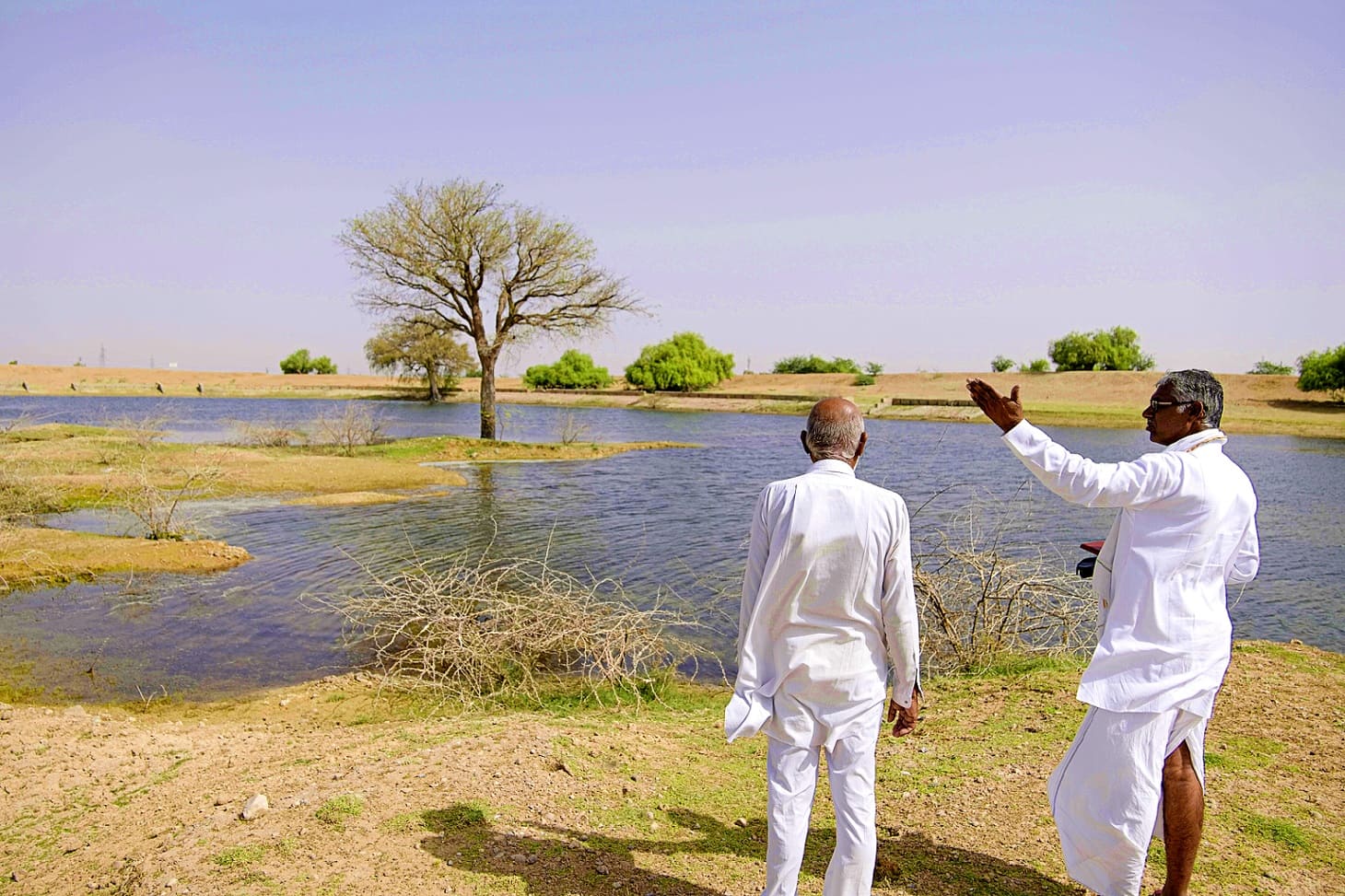
After its restoration, the Bartasar pond can hold water throughout the year. Photo: Shawn Sebastian
The community started by increasing the depth of the nearly 200 years old pond, which had begun drying up quickly because of scanty rainfall. They also extended the embankment.
“The depth and creation of an embankment are essential for a pond to survive,” says Bhura Ram, Field Coordinator, Gravis. Ram, who has worked in rural Rajasthan for over two decades, primarily in watershed management, says an embankment helps to widen the pond’s catchment area.
As the silt was removed and the Bartasar pond became deeper, the water retention capacity increased. “Now, whenever it rains, there is sufficient capacity for the pond to hold the water,’’ Ram says, adding that ponds play a crucial role in fighting droughts.
Today, the Bartasar pond is a water source for humans and animals. A group of migratory birds descend to rest on tree branches and dip in the pond. An elderly shepherd leads his herd to the pond to quench their thirst. Meanwhile, a tanker is refilled beside the pond to supply water to Badi Dani village.
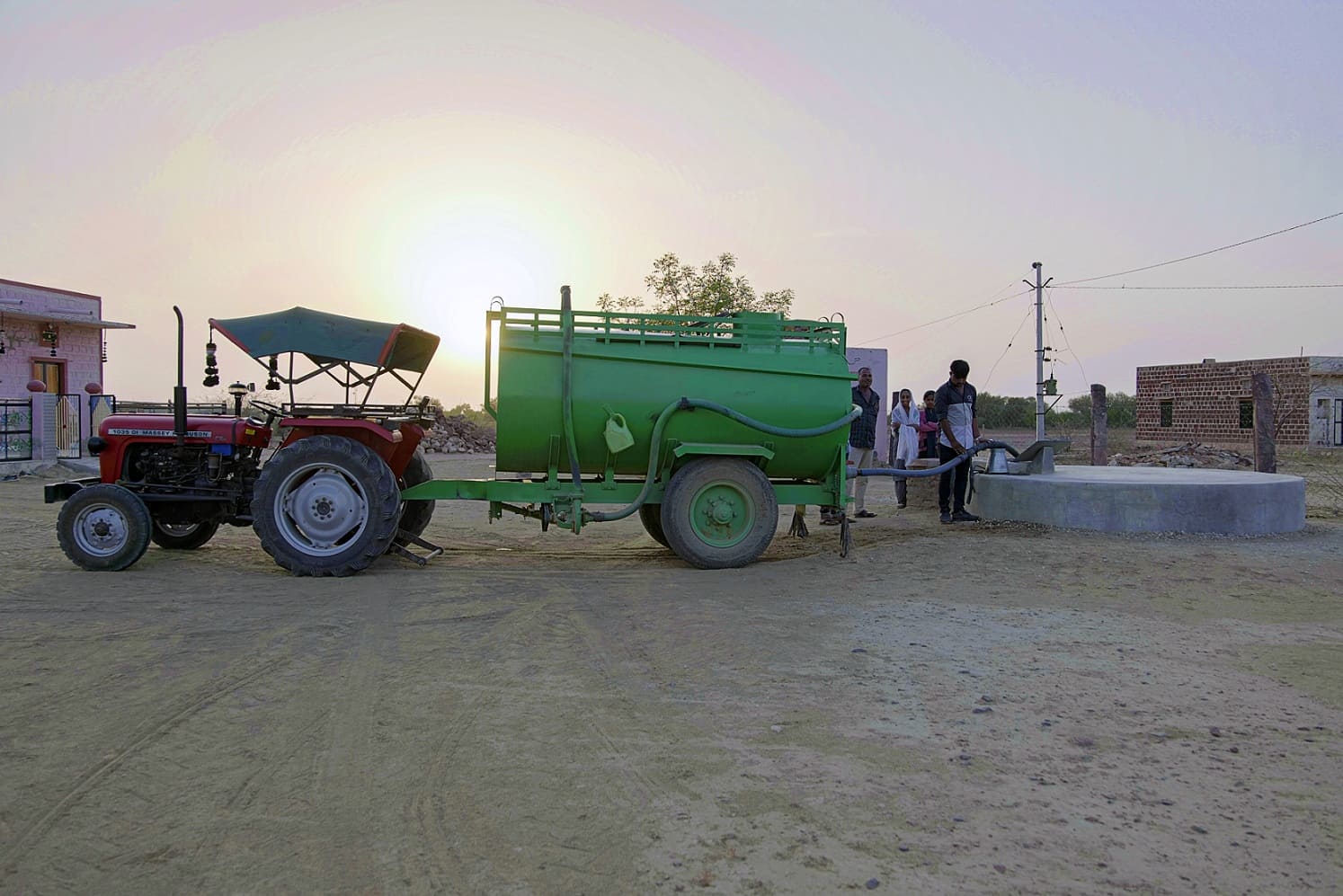
Water from the Bartasar pond is supplied to Badi Dani in a tanker. Photo: Shawn Sebastian
Khan gives credit to the watershed management practices for restoring several natural ponds in the locality. “Initially, the pond could hold water for only three to four months. Now, the pond holds water throughout the year,’’ a proud Bai Khan says.
The ponds continue to be managed by the community. They have also devised rules to ensure that the catchment area is clean. The village development committee members conduct frequent inspections to ensure compliance.
“Our village is no longer water-stressed. Lives shall not be lost for want of water anymore,” says a jubilant Khan. Badi Dani’s example amplifies the fact that restoring and maintaining traditional water management infrastructure can build resilience against droughts.
Watch the full film here.
Thirty-one-year-old Poonam Rawat’s voice is recognisable across five districts in the Indian state of Uttarakhand’s Garhwal region. For someone who identifies herself as an introvert, Poonam now has an audience of nearly 3.5 lakh, who tune in to her bulletins and programs regularly. Poonam’s life took a turn eight years ago when she joined Mandakini ki Awaz, a community radio station in Sena Gadsari village in Rudraprayag district.
Given that the Garhwal region is prone to floods, landslides and forest fires, the station lays a special emphasis on broadcasting public service announcements (PSAs) related to these climate extreme events. According to CEEW analysis, there has been a four-fold increase in the frequency and intensity of floods and associated events like landslides in Uttarakhand since the 1970s.
“Before, during and after a disaster, we sensitise the community through our programs,’’ says Poonam, a communications head and one of the leading radio jockeys at the station.
The radio station, which began operations in 2014, was conceived by the non-governmental organisation — Mandakini ki Awaz Kalyan Sewa Samiti — with the support of a Bangalore-based organisation, People’s Power Collective. It was named after the ‘Mandakini’ river, which flows nearby. Mandakini Ki Awaz is run and managed by the community and produces programs on topics such as agriculture, culture, education, health and livelihoods, especially with a hyperlocal focus. The programs are broadcasted in the Garhwali language.
Over the years, the radio station has become an invaluable link between the government and the communities in enhancing disaster preparedness. The India Meteorological Department, Dehradun, provides the station with accurate and up-to-date weather information. They also often correspond with the State Disaster Management Authority (SDMA), which relies on the station to air key messages and early warnings.
The 2013 Kedarnath flash floods, which left over 5,000 dead, were a grim reminder of the vulnerability of the region. Recalling the challenges in disseminating accurate information during that time, Poonam says that her team took a deliberate decision to focus more on disasters.
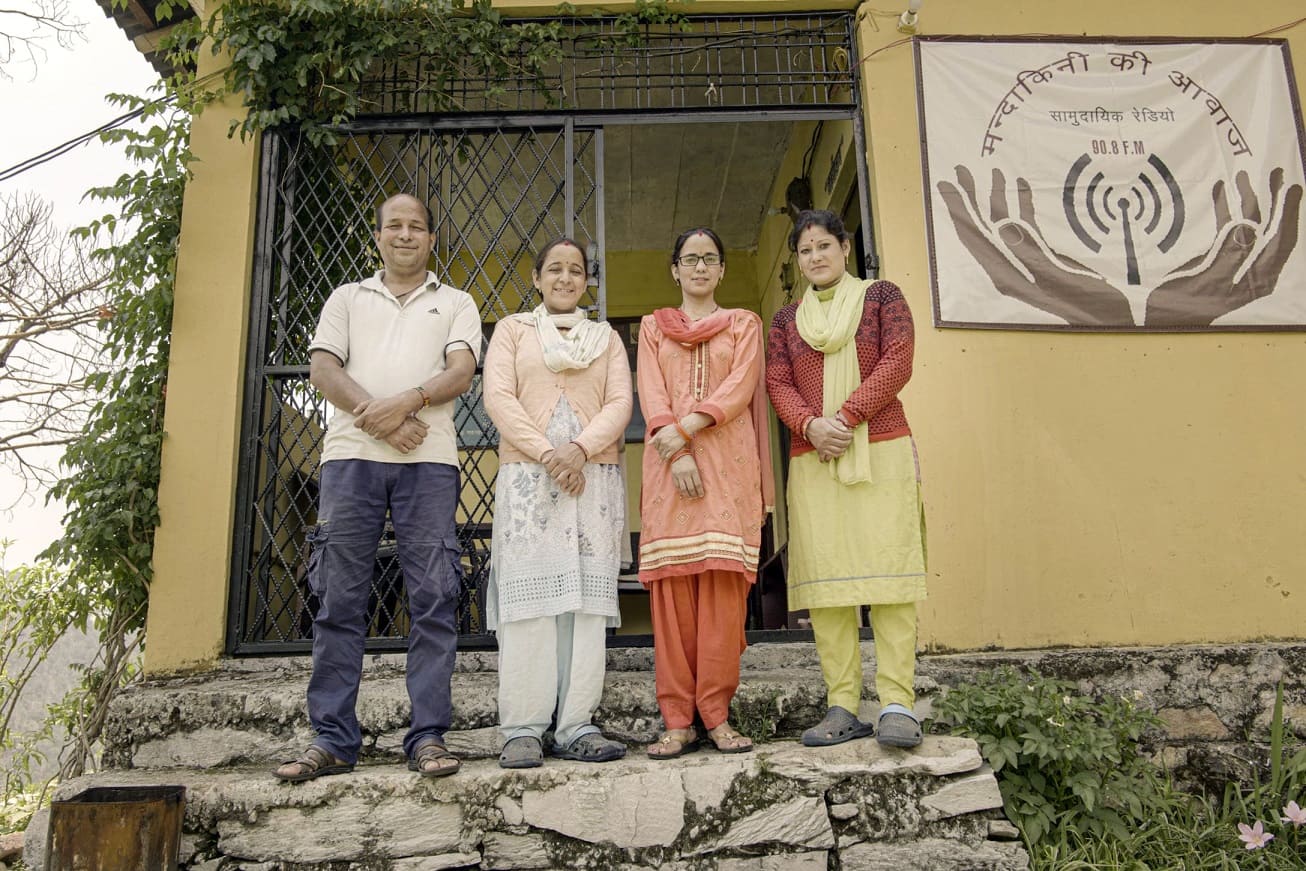
Poonam Rawat (second from left) and her team at Mandakini Ki Awaz. Photo: Shawn Sebastian
“There was no facility for connectivity. People could not receive information and important messages,” says Poonam. She feels that a well-established last-mile communication infrastructure, which issues early warnings and timely weather information, could have saved several lives. “Later, the community themselves demanded that we make more programs on disasters,” she adds.
“We started making two-minute PSAs,’’ says Poonam, adding that some of the slightly humorous, character-centric PSAs have made a big impact among the local community. For example, one such PSA, with a witty head priest as the protagonist, managed to discourage people from constructing houses along the river banks.
Before the onset of monsoon every year, the station airs precautionary measures the villagers must take. These include clearing canals to facilitate the smooth flow of rainwater and keeping an emergency kit handy at home.
The local communities have increasingly become reliant on the radio for accessing news. Yogamber Singh Rawat, a retired school teacher, who is a regular listener, says, “Many, including non-literates, depend on it for information on weather and disasters.’’ Tuning to 90.4 FM — the frequency of Mandakini ki Awaz — he adds, “Those who go to the forest or those who venture out for grazing get clarity about the weather conditions through the radio broadcasts. They can then take precautionary measures and safeguard themselves.’’
“Unlike earlier, we now know exactly what must be done in the event of a disaster so that we can save our lives,” Yogamber says with an air of confidence.
Meanwhile, at Mandakini ki Awaz, Poonam is gearing up to begin her live broadcast. She browses through the day’s newspaper on her smartphone to choose relevant pieces of information for her listeners. At the end of the bulletin, she concludes with the motto of the station: “We will always be with our listeners. We will strive to reduce the impacts of disasters on the local community.”
Watch the full film here.
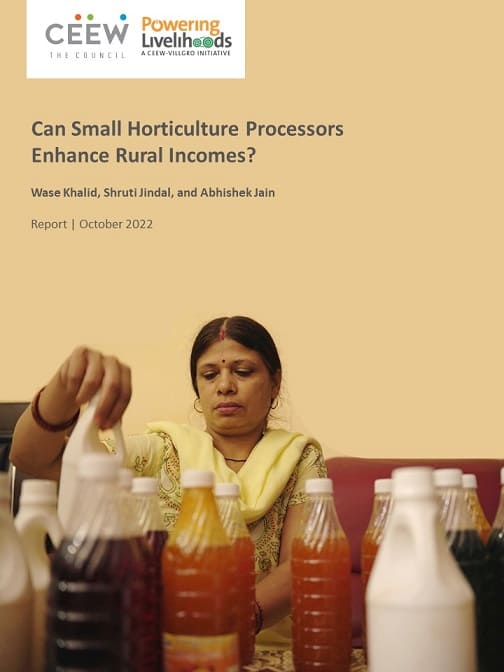
Wase Khalid, Shruti Jindal, and Abhishek Jain
October 2022 |
Suggested citation: Khalid Wase, Shruti Jindal and Abhishek Jain. 2022. Can Small Horticulture Processors Enhance Rural Incomes? New Delhi: Council on Energy, Environment and Water.
This Powering Livelihoods market research report analyses the value chain, market segmentation, and policy associated with small horticulture processors. The report aims to boost sectoral growth by providing insights to entrepreneurs, investors, and policymakers targeting decentralised horticulture processing.
Powering Livelihoods, a USD 3 million (INR 21 crores) initiative by CEEW and Villgro, is mainstreaming clean energy-based solutions in India’s rural economy. It provides capital, technical, and sectoral growth support to help social enterprises deploy many clean energy-based livelihood solutions in a gender-inclusive manner.
District-wise distribution of market opportunity
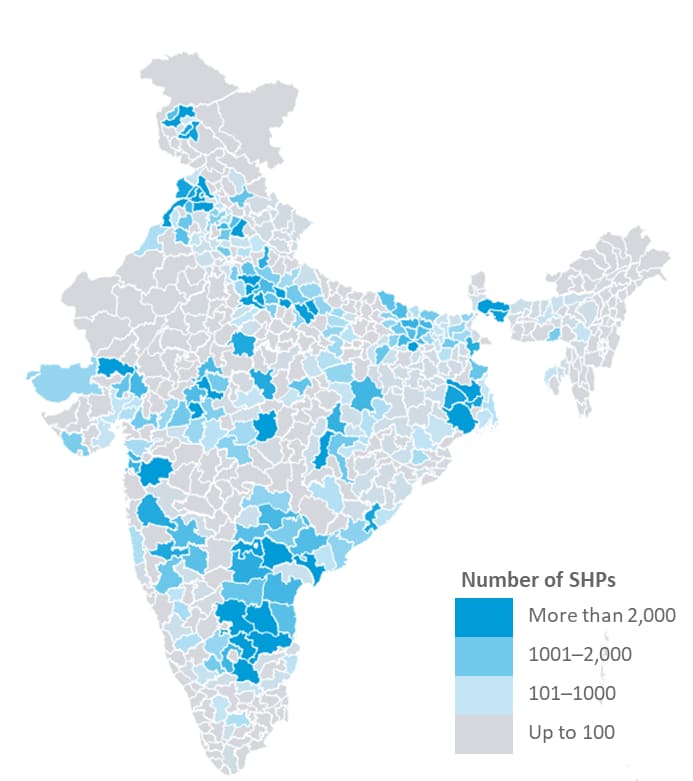
Source: A complete list of districts is available here