Home
Council on Energy, Environment and Water Integrated | International | Independent
Dialogue
‘How Can Technology Help Strengthen India’s Disaster Preparedness?’

13 Jul 2023   |   0930 – 1400 IST

The Expert Dialogue on 'How can technology help strengthen India's disaster preparedness?' is an initiative of the Council on Energy, Environment and Water (CEEW) to address the urgent need for a people-centric and comprehensive Multi-Hazard Early Warning Systems (MHEWS) at the national and sub-national levels to increase the resilience of India’s most vulnerable communities to extreme hydro-met disasters.

The Council on Energy, Environment and Water (CEEW) is pleased to invite you to a Dialogue on 'How can technology help strengthen India's disaster preparedness?' on 13 July 2023, 0930 - 1400 IST at Juniper Hall, India Habitat Centre, New Delhi.

The session aims to bring together key stakeholders, including central agencies like the National Disaster Management Authority (NDMA) and India Meteorological Department (IMD), State Disaster Management Authorities (SDMAs), meteorological agencies, and private sector stakeholders. This Dialogue aims to encourage accurate and timely warnings to vulnerable communities to improve impact-based forecasting and end-to-end information dissemination. We will also discuss the gaps around the availability, accessibility and effectiveness of EWS/MHEWS that need to be addressed to enhance community and organisational resilience and the best practices to climate-proof lives, livelihoods, infrastructure and economies.

For Event Queries

Richa Mehta

Consultant

[email protected]

Key Speakers

By Embracing the High Seas Treaty, India Can Cement Role in Ocean Governance
World's first High Seas Treaty safeguards marine biodiversity beyond borders. It can unlock several benefits for India.

,
07 July 2023

The world finally has a High Seas Treaty. Adopted by the Intergovernmental Conference on Marine Biodiversity of Areas Beyond National Jurisdiction (BBNJ), this first-of-its-kind treaty will serve as the legal basis for the conservation and sustainable use of marine biodiversity in areas beyond national jurisdiction. It offers a remarkable opportunity to protect 30 per cent of the world's oceans and lands by 2030. The High Seas Treaty takes a significant leap over the UN Convention on the Law of the Sea by serving as the first legal framework to address the triple threats of climate change, biodiversity loss, and pollution. Moreover, surpassing the threshold of 1.5°C warming will result in the collapse of 70 to 90 per cent of coral reefs globally. The High Seas Treaty aims to reverse this trend by establishing robust conservation measures. As one of the world's most populous and rapidly developing countries, India has a significant stake in protecting the environment for future generations. We should leverage this opportunity to lead global efforts and capitalise on the potential of nature based solutions (NbS) by becoming a signatory to the High Seas Treaty.

The High Seas Treaty offers an opportunity to combat climate change, as healthy marine ecosystems act as carbon sinks, absorbing significant amounts of carbon dioxide from the atmosphere. The marine ecosystem also supports the dietary requirements of more than 3 billion people and provides livelihoods to an estimated 60 million people through the fisheries and aquaculture sector. This ambitious goal is essential for conserving biodiversity, safeguarding critical habitats, and protecting livelihoods. The Treaty also addresses critical gaps in existing international frameworks and provides a platform for nations to collaborate, share resources, and develop strategies to combat the pressing challenges faced by our oceans.

The USP of the High Seas Treaty is that it focuses on four key interventions, one of them being the establishment of area-based management tools that includes marine protected areas. Such tools are a part of NbS and are a key step towards achieving the ‘30 by 30’ target identified in the Kunming Montreal Global Biodiversity Framework. Even though several countries across South and Southeast Asia have explored coastal area-based NbS, including coral reef management and mangrove conservation, the scope of ocean-based NbS remains underexplored. By ratifying the treaty, India can unlock numerous benefits.

First, India stands to gain economically. India's blue economy contributes an estimated 4 per cent to its Gross Domestic Product (GDP) and supports 95 per cent of the country's businesses through transportation. The conservation and sustainable use of marine resources can generate revenue through eco-tourism, fisheries, and the development of blue economy sectors. Marine tourism is also a sector that has been one of the fastest growing globally and in India. Particularly in coastal states like Kerala, the total number of jobs created directly and indirectly by the sector between 2009 and 2012 turned out to be around 23 per cent of the total employment. Furthermore, The Government of India launched the Pradhan Mantri Matsya Sampada Yojana (PMMSY), in May 2020, with an investment of INR 20,050 crore (USD 2.5 billion) to bring about a Blue Revolution through sustainable and responsible development of the country's fisheries sector. Thus, investing in the conservation and sustainable development of India's blue economy holds the potential to create numerous employment opportunities and drive the country's economic growth.

Second, ratifying the High Seas Treaty aligns with India's commitments under the Sustainable Development Goals (SDGs), specifically SDG 13 (Climate Action) and SDG 14 (Life Below Water). It also reinforces India's National Determined Contributions (NDCs), the recently launched Mission LiFE and its actions within the G20 framework. The value of the ‘natural capital’ of the Blue Economy is estimated to be around USD 25 trillion, with the annual value of produced goods and services estimated to be USD 2.5 trillion annually, and countries such as China, India, Korea, and Japan are the major players from Asia. By becoming a voice of the Global South, India can ensure that the concerns and perspectives of developing nations are adequately represented in international discussions and decision-making processes. India can also serve as a role model for other nations by proving that Blue Economy is not just an altruistic intent, but a development imperative from the perspective of the Global South.

Finally, the High Seas Treaty, coupled with the adoption of NbS such as seascape restoration, presents a unique opportunity to protect our oceans and combat the interconnected challenges of climate change, biodiversity loss, and pollution. India, as a responsible global player, should seize this opportunity by becoming a signatory to the treaty. By doing so, India can lead global efforts, and safeguard its own economy and biodiversity. Let us harness the power of nature and work collectively to secure a brighter future for our aquatic ecosystems and the generations to come.

Shreya Wadhawan is a Programme Associate and Aryan Bajpai is a Consultant at the Council on Energy, Environment and Water. Send your comments to [email protected].

,

Sign up for the latest on our pioneering research

Energy System Models Can Inform the Design of India’s Carbon Emission Trading Scheme
The process of developing and operationalising an effective carbon market is a complex one. Modelling tools can help.

,
07 July 2023

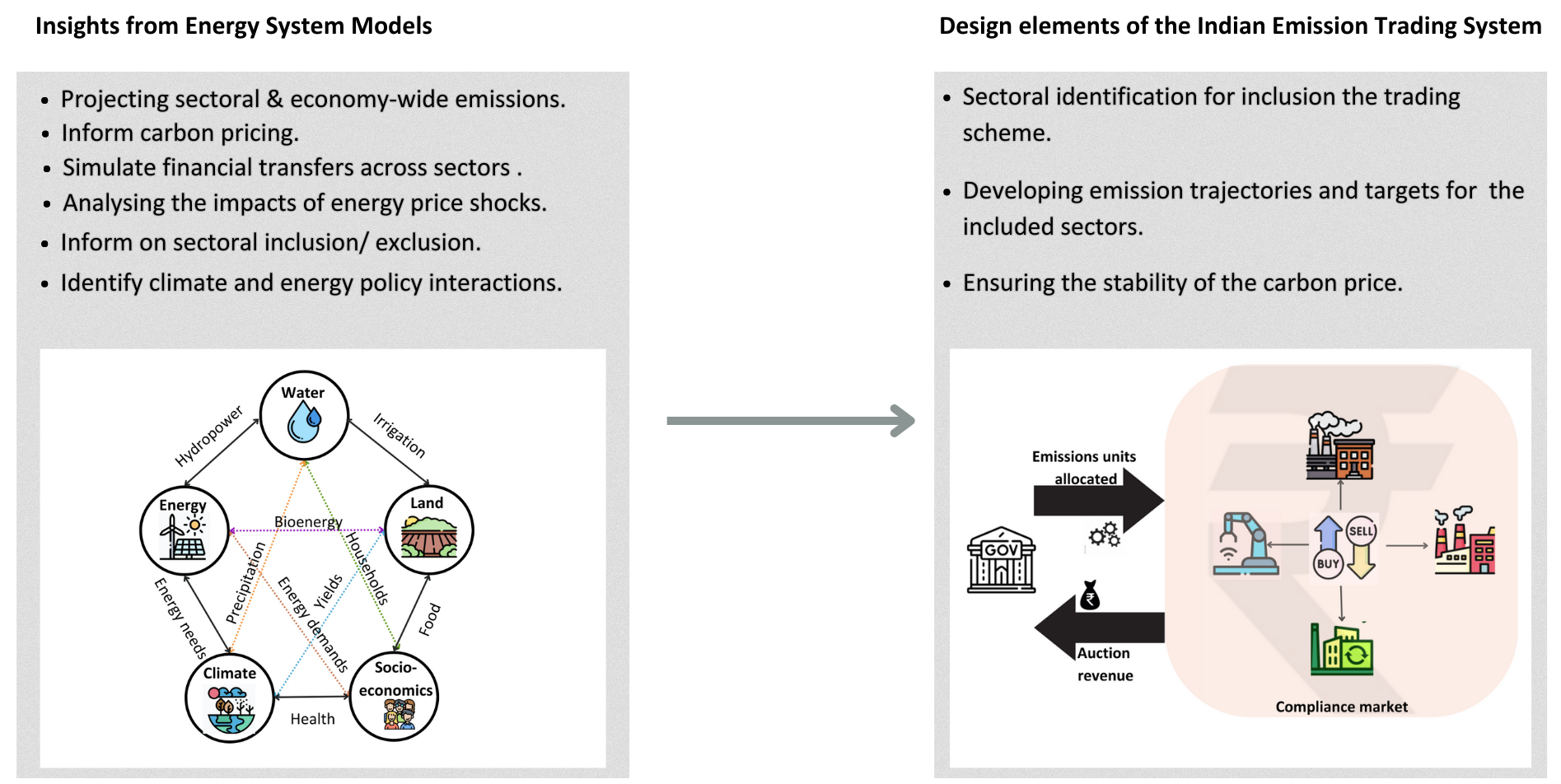
India will likely roll out the framework of its domestic carbon market in a fortnight, said Union power minister RK Singh recently. Covering approximately 72 per cent of India’s total CO2 emissions1, the domestic emission trading scheme will have far-reaching implications on the country’s journey to net-zero carbon emissions by 2070. It will, however, enter into full force by 2026 and the main design elements of this policy instrument are still being discussed. As mentioned in the recent gazette notification on Carbon Credit Trading Scheme (CCTS), these include - i) identifying which sectors to be included in the trading scheme, ii) developing emission trajectories and targets for the sectors to be included, and iii) developing mechanisms to ensure the stability of the carbon price. We explain how energy system models can inform the design of India’s carbon emission trading scheme, both in the initial phase and for years to come.

Energy system models (ESM) are modelling tools used to simulate and analyse the behaviour of energy systems and their interaction with global land, water, and climate systems. By taking into account energy demand and supply, costs of technologies, and environmental constraints, they can help researchers and policymakers understand how different energy sources, technologies, and policies interact. These models are useful for long-term energy planning, optimising energy systems, and exploring the transition to renewable energy sources. ESMs have been around for more than 40 years and have been heavily used in Intergovernmental Panel on Climate Change (IPCC) reports, although their structured use in India has been more recent, for example through the India Climate and Energy Modelling Forum (ICEMF)2.

So, how can these energy models help in informing the design of carbon markets?
Source: Authors' analysis

Calculate future emissions from different sectors and the whole economy. The first step in designing an ETS is assessing the future carbon emissions for the participating sectors in a country. Energy system models clearly and coherently represent the drivers of energy services (such as heating, cooling, and transport) and material services (such as steel, cement, and fertiliser) for the economy. This demand is then met through specific industries using inputs – energy fuels, electricity, and raw materials, based on specific technologies. By calibrating the models to the current fuel and technology used, and the associated emissions, and then fulfilling future demand, energy models can show how emissions for each sector and the whole economy will evolve over time.

Inform carbon price dynamics. One of the important indicators of the effectiveness of an ETS is the carbon price. A low carbon price often implies a weak emissions target, which may not provide an incentive for the industry to invest in more expensive decarbonisation technologies. As ESMs have information on the capital cost, lifetime, energy costs, and emissions intensity of the technologies used in various industrial sectors, they can compare abatement costs across sectors, and find a carbon price at which the emissions cap/constraint is met cost-effectively.

Simulate financial transfers across sectors. Although the auctioning of emission allowances is the most efficient method of operating an ETS, jurisdictions often provide free allowances or set sector-specific targets in the initial phase of the ETS. This is done to ease the transition to a carbon-constrained economy but also protect industries with high emission intensities from higher production costs, which in turn could affect their competitiveness. Since energy systems models by default choose the lowest cost of reaching a particular emissions cap, the ESM can provide information on the direction and quantity of emission permits that can be traded across sectors.

Show the impact of energy price shocks on emissions reduction and carbon price. ESMs also account for the international trade in energy fuels (coal, oil, gas, and biomass) between nations or world regions, and can thus simulate how (real or experimental) economic and energy price shocks to an economy can affect its energy demand, which in turn would affect the emissions and the carbon price.

Help decide which sectors to include in the emissions trading system. Countries usually choose to start their ETS with only one or a few sectors. As domestic experience grows, more sectors are brought under the regulation. Both the type and the size of a sector can influence the carbon price. For example, adding a sector with a lower marginal abatement cost and with a large potential such as electricity can reduce the carbon price as it makes overall mitigation cheaper. Thus, ESMs can inform the effect on overall mitigation costs and carbon price through the addition or exclusion of sectors into an ETS.

Identify interactions between climate and energy policies such as energy efficiency targets, taxes on fossil fuels, and renewable energy purchase obligations. ESMs are capable of simulating and implementing a number of high-level climate and energy policies and targets thereby allowing us to understand their interactions and outcomes on emissions, energy use, and energy prices. Moreover, countries, including India regularly use a mix of energy and climate policies to achieve climate-related and development objectives. ESMs can also be used to understand the impact of other policies on carbon prices in the ETS, thereby aiding in ETS design.

Limitations of ESMs

Although ESMs can be useful in designing an ETS, as with all models, there are limitations to their use. First, ESMs represent technologies and sectors in a simplified form. This entails that the marginal abatement cost for, say, the iron and steel sector, can differ compared to bottom-up estimates that look at all possible decarbonisation options. Second, ESMs generally function using time intervals of 5 or 10 years, focussing mainly on broader, long-term dynamics. Consequently, factors like short-term oil price changes carry less relevance within a 5-year timeframe. This also means, for example, that ESMs cannot be used as a forecasting tool for financial traders, who are often interested in developments over 1-2 years. Third, ESMs differ in their capability to represent policies. Policies especially on the demand side, such as behavioural changes or energy efficiency measures, can only be represented in a stylised manner, without understanding how these policies drive emission reduction. Lastly, models are only as good as the assumptions they use. Models utilise a number of assumptions relating to future socioeconomic conditions, especially GDP and population, but also the cost of technologies and policies. Therefore, an uncertainty analysis is essential to assess the robustness of the results.

The process of developing and operationalising an effective carbon market is a complex one. Although, both domestic as well as international experience from countries with a longer history of running a carbon market can aid in designing an ETS, energy system models can additionally serve as useful tools to generate insights on ETS design. They are, however, not intended to forecast any variable, be it price or quantities, and therefore care must be taken to interpret their results. The Indian government, particularly the Bureau of Energy Efficiency, which is the main regulator of the Carbon Credit Trading Scheme, should consider using their capabilities to explore insights on ETS.

Aman Malik is a Programme Lead and Nikita Shukla is a Research Analyst at the Council on Energy, Environment and Water (CEEW). Send your comments to [email protected].

1Number based on emissions in 2016 and includes total emissions from all entities in these sectors. In reality, an ETS is often limited to large entities, i.e., small and medium-size industries are excluded.
2https://icemf.niti.gov.in/about-us

,

Sign up for the latest on our pioneering research

REPORT
03 July, 2023 | ,

HAVE A QUERY?

HAVE A QUERY?

Sign up for the latest on our pioneering research

Workshop
How Can We Operationalise Equity in the Global Stocktake (GST) Debate?

11 Jul 2023   |   1030 – 1400 IST

The Global Stocktake lies at the heart of the Paris Agreement. It is expected to assess collective progress on the long-term goals of the Paris Agreement to limit global average temperature rise to well below 2°C above pre-industrial levels and to limit the temperature increase to 1.5°C above pre-industrial levels. The GST will evaluate progress made across mitigation, adaptation and means of implementation (finance, technology and capacity building) in the light of best available science and equity, to spur increased ambition and international cooperation.

Equity and historical responsibility always takes centre stage in climate change negotiations and the principle of common but differentiated responsibilities and respective capabilities (CBDR-RC) is enshrined in the United Nations Framework Convention on Climate Change (UNFCCC). However, climate equity in reality is far from achieved. There is historic inequity that will need to be addressed, followed by current inequity and finally future inequities that will continue with unambitious net-zero targets of developing countries. Historically, between 1850 and 2019, the EU emitted 6.5 times more than India. Further, current world per capita emissions are 2.5 times higher than India. Lastly, with a proposed 2060 target, China alone would consume 28 per cent of the remaining carbon budget to be below 1.5°C. Until all these aspects are not addressed, equity in climate change will not be addressed.

This workshop will explore how to operationalise equity in the GST and how finance can play a role. This is specially important as GST will take stock of collective action, and countries will not be named. While the GST will deliver recommendations and political messages, equity must be reflected in all of those. With rising developmental needs and voices from the global south, the workshop will discuss the opportunities for the GST to deliver on equity and accountability.

For Event Queries

Sonam Gairola

Senior Communications Associate

[email protected]

Key Speakers

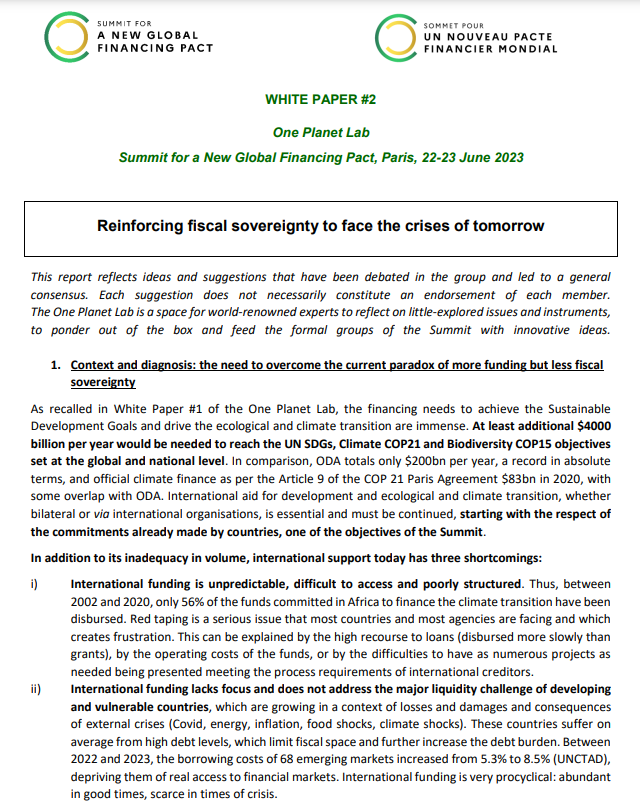
Reinforcing Fiscal Sovereignty to Face the Crises of Tomorrow

One Planet Lab
June 2023 |

Suggested citation: One Planet Lab. 2023. Reinforcing Fiscal Sovereignty to Face the Crises of Tomorrow. One Planet Lab.


Overview

At least an additional USD 4 trillion would be needed to reach the UN SDGs, Climate COP21 and Biodiversity COP15 objectives set at the global and national levels, says One Planet Lab’s white paper released ahead of French President Emmanuel Macron’s Summit for a New Financing Pact in Paris. But in 2022, only $204 billion came in through official development assistance, which was a record in itself. International climate support today has three shortcomings: International funding is unpredictable, it does not address the liquidity challenges of developing countries, and it restricts the fiscal sovereignty of recipient countries. The outcome? Developing countries end up paying for their own development and ecological transitions through public funding. Further, tax structures of developing countries, illicit finance flows and institutional difficulties further limit the fiscal space of these countries.

Key Recommendations

Developing countries need support to increase their fiscal space. This can be done in several ways.

  • Tackle illicit finance flows: Illegal cross-border movement of money constitutes a major drain on capital and revenue, particularly in Africa, which further undermines the productive capacity and the continent’s prospects of mobilising its own resources for climate finance.
  • Better tax administrations and policies: New technologies can help countries move away from paper-based tax administrations to upgraded digital ones. Training tax officials, including on the international dimensions of policies, would yield significant return and better assertion of State sovereignty.
  • Reduce ineffectual fossil fuel subsidies: Ceasing fossil fuel production and consumption subsidies (in particular in fossil-fuel exporting countries) and/or putting in place carbon pricing would help increase revenues. Levies and contributions on polluting activities are also necessary.
  • Support private sector of developing economies: Domestic investors and entrepreneurs often have no access to guarantees and de-risking instruments of multilateral banks, which could be extended to the private sector of developing and emerging countries, and not only just to transnational ones.
​"A balance has to be preserved between international support and national resources, so as to maintain or bolster the fiscal and political sovereignty of developing countries."

Sign up for the latest on our pioneering research

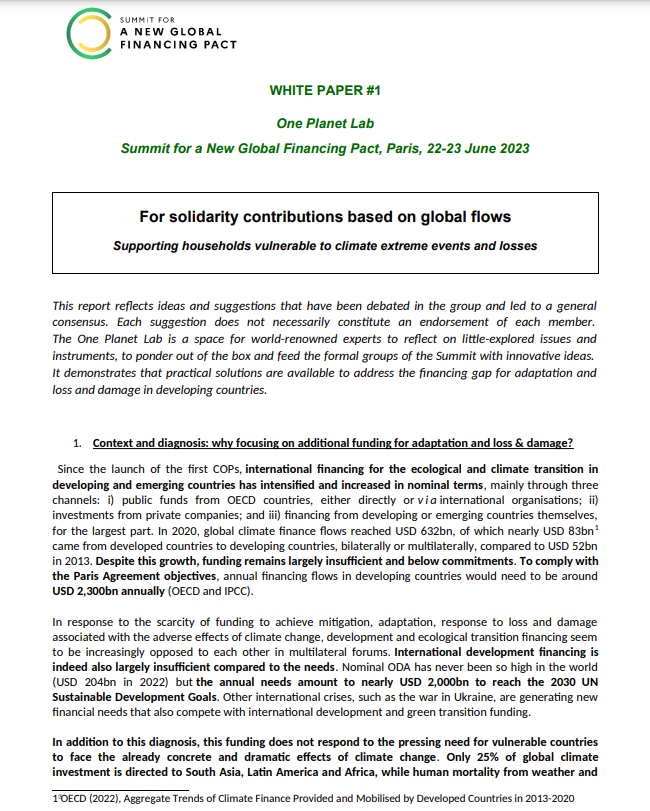
For Solidarity Contributions Based on Global Flows

Supporting Households Vulnerable to Climate Extreme Events and Losses

One Planet Lab
June 2023 |

Suggested citation: One Planet Lab. 2023. For Solidarity Contributions Based on Global Flows: Supporting Households Vulnerable to Climate Extreme Events and Losses. One Planet Lab.


Overview

Climate finance for developing countries is still largely insufficient and below commitment levels. This white paper by One Planet Lab, released ahead of French President Emmanuel Macron’s Summit for a New Financing Pact in Paris, argues that developing countries affected by the dire consequences of climate change need additional financing for adaptation, and access to emergency funding to respond to loss and damage. The barriers to that have been lack of investment from private actors, public financing in developing countries, and low resource mobilisation. Addressing these need solidarity contributions based on global flows against climate extreme events and losses. There are several advantages to global flows of finance: It does not impinge on the fiscal sovereignty of countries, it has limited inflationary effects, and it targets unevenly taxed carbon flows, whether goods, services or assets.

Key Recommendations

The paper suggests new ways to mobilise new resources by tapping into global flows.

  • From production of fossil fuels: The easiest would be a contribution charged for each ton of coal, barrel of oil or cubic meter of gas extracted at a level that would reflect how much CO2 is embedded in each ton of fossil fuel extracted. A $1 contribution per barrel of oil would generate around USD 30 billion per year. Another option would be the creation of voluntary one-off solidarity contributions from fossil fuel exporters and large State-owned companies, calculated on the turnover related to extractive activities.
  • From maritime transportation of goods: Despite accounting for 3 per cent of greenhouse gas emissions, maritime transport is under-priced for its externalities on a global scale. The One Planet Lab suggests an international carbon tax or excise duty on international shipping activity and linked to carbon emissions. By taxing more than 1,000 MtCO2 emitted annually by the sector, this global minimum tax could generate up to USD 100bn per year.
  • From transportation of fossil fuels: This could entail the introduction of a solidarity contribution on tankers, as a condition for access to insurance. The contribution should remain low, in order to avoid an increase in energy costs and affect the trade competitiveness of the countries from which the energy originates, which are often developing countries.
​"Only 25% of global climate investment is directed to South Asia, Latin America and Africa, while human mortality from weather and climate extreme events was 15 times higher in these regions."

Sign up for the latest on our pioneering research

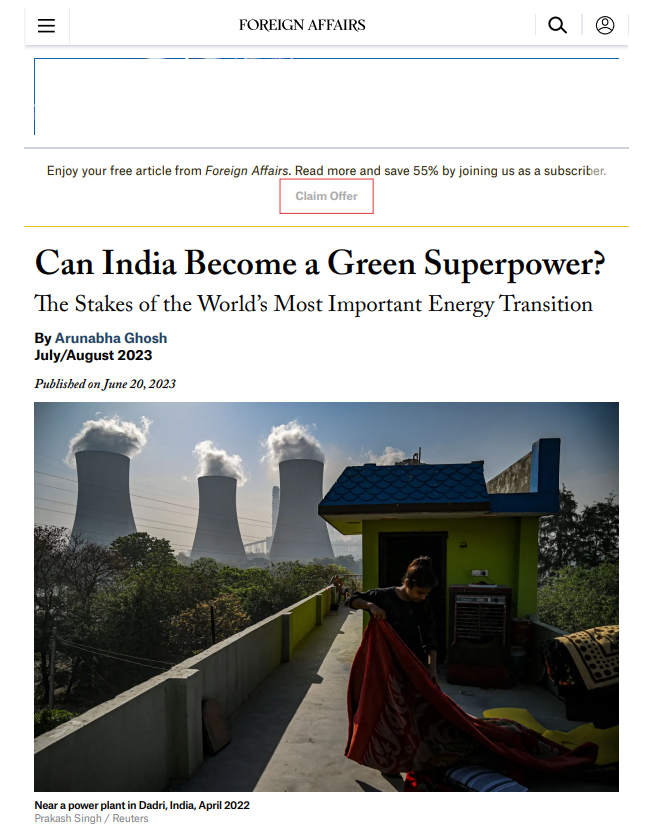
Can India Become a Green Superpower?

The Stakes of the World’s Most Important Energy Transition


June 2023 |

Suggested citation: Ghosh, Arunabha. 2023. Can India Become a Green Superpower?: The Stakes of the World’s Most Important Energy Transition. Foreign Affairs.


Overview

To meet its net-zero carbon emissions by 2070 targets, India will have to grow in a way no major economy has done before – developing fast without spewing more carbon into the atmosphere. But if New Delhi can succeed, argues this piece in Foreign Affairs Magazine, India will not only reduce its own carbon emissions, but also become a global energy player in its own right— one that carves out a low-carbon, sustainable pathway for high levels of economic development that the rest of the Global South can follow. The country's path to becoming a superpower goes through making itself into an indispensable and reliable node in the global marketplace for clean energy products and services.

Key Highlights

  • Provide access to energy, but make it clean: To achieve net zero, India must dramatically up its clean energy sources. But it is doable. In 2010, the country had less than 20 megawatts of solar power capacity, now it has 67,078 megawatts.
  • Grow in a green manner – from LED bulbs to steel: India has incorporated green energy and energy efficiency significantly in its economic development charter. Whether it be through the Saubhagya scheme (household electrification), Ujjwala scheme (to provide LPG cylinders), or its ambitious green hydrogen mission.
  • International investors ought to be swarming around India’s energy sector: Given India's size, it isn't just investors who should pay attention. Policymakers everywhere will need to make sure that the world's energy security architecture responds to India's needs—and then meets them with the fuels of the future.
​"India has set out to do the near impossible: simultaneously provide energy access to hundreds of millions of people, clean up one of the world’s largest energy systems, and become a green industrial powerhouse."

Sign up for the latest on our pioneering research

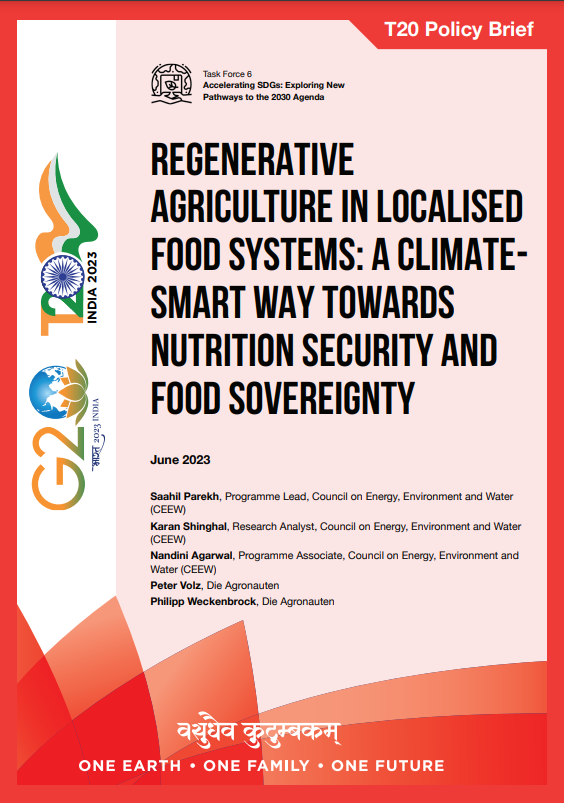
Regenerative Agriculture in Localised Food Systems

A Climate-Smart Way Towards Nutrition Security and Food Sovereignty

Saahil Parekh, Karan Shinghal, Nandini Agarwal, Peter Volz, Philipp Weckenbrock
June 2023 | ,

Suggested citation: Parekh, Saahil, Karan Shinghal, Nandini Agarwal, Peter Volz, Philipp Weckenbrock. 2023. Regenerative Agriculture in Localised Food Systems: A Climate-Smart Way Towards Nutrition Security and Food Sovereignty. T20 Policy Brief.


Overview

This paper, published by the T20 India Task Force, discusses the potential of regenerative agriculture in the context of local food systems and why it can be a potential solution to fulfil nutrition security and food sovereignty. Food security has been at the centre of global agriculture cooperation, but achieving it has resulted in a dichotomy where consumers are exposed to global foods, but the traditional diversity of crops on the farm has dwindled, and local communities' food sovereignty has eroded. The problem is that food security and sovereignty are pitched against each other. This policy brief highlights how local food systems with regenerative farming practices can offer scalable alternatives to this deadlock and what the G20 can do to enable this.

Key Highlights

  • The global food system produces approximately 500 more kilocalories of food per person per day than recommended in the EAT’s Planetary Health Diet. However, an estimated 768 million people worldwide do not have enough food to meet their daily energy needs, while an estimated 2.3 billion people are overweight or obese. Reducing this inequity in access to healthy, nutritious food remains a pertinent challenge for the global food system.
  • The Green Revolution created economies of scale that promoted mono-cropping practices, sustained by increasing chemical inputs. This was further entrenched by an agricultural support system that subsidised their use. Mono-cropping agricultural systems negatively impact land use, land cover, and freshwater sources and degrade biodiversity, soil health, and water quality and are responsible for 21–37 per cent of total agriculture emissions globally.
  • While the industrialised food production system has increased the availability of processed food globally, it has curtailed the food sovereignty of local communities as they succumb to existing market structures. This affects both their production and consumption choices.
  • The G20 countries contain most of the world’s agricultural land and most food-related trade, making them crucial stakeholders in advancing solutions for sustainable food systems. Despite the G20’s considerable focus on food security and combating the threat posed to agriculture by climate change, the pandemic and the Ukraine war brought a wave of malnutrition, a consequence of broken global food supply chains. The G20 responded with the Matera declaration and emphasised the importance of food systems that can generate nature-positive outcomes, halt and reverse biodiversity loss, and adopt measures that strengthen local and indigenous food systems and supply chains.

Recommendations

  • Repurpose existing agricultural support systems and parameters of accounting. To mainstream local food systems and regenerative agricultural practices, policymakers need to re-evaluate how the effectiveness, productivity and output of food systems are measured. We recommend employing the True Value Accounting (TVA) method that considers all externalities and resources that a food system affects and uses respectively.
  • Promote sustainable food choices: To encourage sustainable food choices, the G20 should catalyse investments that: (i) are geared towards awareness creation, (ii) repurpose the support towards the procurement and provision of food in public institutions to include locally sourced, regeneratively grown produce, and (iii) facilitate platforms that can amplify success stories and best practices.
  • Create enablers that facilitate localised, sustainable, and small-scale farming-friendly food system transformations: The G20 can enable such a transformation by leading the facilitation of an effective mechanism and catalysing the finance through the following steps: (i) establish a task force to develop strategies for transformation, (ii) create mechanisms for improving research, innovation, and knowledge dissemination systems under the leadership of the Meeting of Agricultural Scientists (MACS), (iii) facilitate convergence on these actions with other global forums such as COPs and the UN Food Systems Summit.
​"Several G20 presidencies have alluded to the need for nature-positive, context-specific, and small-scale friendly solutions, all of which are characteristics of local food systems, but the action remains limited. The Indian G20 presidency should strive to present a roadmap to mainstream them through repurposing existing agricultural support, catalysing sustainable food consumption choices, and facilitating this transformation through enablers."

Sign up for the latest on our pioneering research

Harnessing the Wind for India’s Ambitious Energy Transition
India ranks fourth globally in total wind installations, but it’s time to step on the accelerator.

,
15 June 2023

India is racing towards 500 GW of clean power capacity by 2030, and betting on wind as one of its two mainstays to meet this milestone. From 9.3 GW in 2008 to more than 43 GW today, India ranks fourth globally in total wind installations. By 2030, the target is to reach 100 GW of onshore wind and bid 37 GW of offshore projects. But there is still a long way to go. Research by the Council on Energy, Environment and Water (CEEW) shows that India will need a wind capacity of 557 GW by 2050 and 1,792 GW by 2070 to meet its net zero carbon emissions target. However, wind capacity additions have slowed down since 2017. It is now time to step on the accelerator.

What limits the speed and scale?

Wind power development in India gained momentum since 2005, although turbine installations date back to the 1980s. Projects were small in size and received significant fiscal support in the form of accelerated depreciation, tax holidays, as well as generation-based incentives. They were connected to the state grids, and the power was bought by host state discoms at tariffs (known as Feed-in-Tariffs or FiTs) pre-determined by the state regulatory commissions. In 2016-17, India deployed 5.5 GW of wind capacity, an all-time high in history. However, during the FiT regime, the tariffs continuously increased. These high tariffs triggered the move to competitive bidding or the reverse auction mechanism in 2017, a transparent way of discovering market-reflective prices. The transition from FiT to reverse auctions is said to have been a key factor impeding the pace of deployment – an average of 1.6 GW annually between FY2018 and FY2022, compared to 3 GW between FY2013 and FY2017.

Competition during reverse auctions showed tariff reductions, a much-desired outcome with the implementation of the bidding regime. The first auction, conducted by the Solar Energy Corporation of India (SECI), discovered a tariff of INR 3.46, which was lower than the prevailing FiTs1. The tariffs reduced further with the next few rounds of SECI auctions, before stabilising between 2018 and 2021. Subsequent vanilla wind auctions have seen slight tariff increases2.

However, there were some side effects of this approach. The wind energy industry preferred only two states, Gujarat and Tamil Nadu. As a result, almost half of India’s total wind capacity is located in these states only. The geographical concentration of these projects poses logistical, infrastructural and operational constraints. Further, project commissioning timelines were impacted, the number of investors present in the sector reduced in recent years, and locations in other wind-rich states with higher tariffs became less attractive for price-sensitive buyers. States also asked successful bidders to match the lowest-quoted tariffs in the bidding process, which typically impacts project viability. This approach also does not help leverage the natural complementary patterns in wind resources across geographies, which is desirable for cost-effective grid operations. All these signs made India’s wind targets distant.

India steps in for wind energy

The Indian government recognised these challenges and took several measures in 2022 to accelerate the growth of the wind sector. Some of them were:

  • Dedicated Renewable Purchase Obligation (RPO) trajectory for wind energy to create demand for the power generated across states3. The government also supplemented this by notifying an advanced bidding schedule of 10 GW of capacity every year, between FY24 and FY28.
  • Uniform or pooled tariffs for wind projects in different states through central auctions so that buyers are not averse to taking power from projects other than those with the lowest tariffs while also benefiting from future tariff declines.
  • Single-stage closed bidding for the wind sector instead of reverse auctions, along with mandatory capacity bidding for all the windy states for faster deployment4.
  • Draft National Repowering Policy for Wind Power Projects, 2022, which aims to replace turbines of less than 2 MW capacity with advanced technologies that can generate more power from existing resource-rich sites.

Avenues for accelerated, diversified and inclusive growth

Wind sector plays a crucial role in India's economic and energy transition journey. As of FY21, the sector employed a workforce of 25,500, which is expected to rise six times by 2030. It already has 15 GW of annual domestic manufacturing capacity, exporting equipment to countries such as Australia, the United States, Europe, Brazil, and others, besides meeting internal demand. We highlight actions that can help realise the massive potential and reap the associated socio-economic benefits.

  • Enable systems for regularly updated and robust wind resource and land-related data. The National Institute of Wind Energy has estimated the onshore wind potential of India to be 695 GW at a height of 120 metres. Efforts to regularly develop, update and publish wind resource maps and identification of eligible land areas across states are critical to de-risk new investments. Models to ensure collection and analyses of granular resource data from existing project sites can help create databases for robust sector planning and conducting resource adequacy assessments at the system level. Project deployment can be fast-tracked if central government agencies such as SECI and the Central Electricity Authority, in collaboration with transmission utilities, dynamically facilitate information on sub-station capacities and augmentation plans for the future.
  • Repower old wind turbines on the best sites. Central, state or private sector-driven models for aggregating and buying out old wind energy assets will be key. This could be done through special purpose vehicles or collaboration between institutional investors and the OEMs. Regulatory commissions must allow for selling additional power to commercial and industrial consumers in the state, besides the discoms who would wish to meet their RPO. Karnataka is a good example, where KERC has allowed excess electricity generated from the repowered projects to be sold under third-party open access, captive and group captive modes.
  • Promote decentralised wind projects for diversified and inclusive deployment. The Centre and states must coordinate to enable the deployment of wind farms of up to 50 MW that connect to the state grids by utilising spare capacities on the existing substations. Smaller projects can attract many small and medium investors and can lead to distributed growth, local job creation, distributive supply chain development, and the inflow of domestic capital. Therefore, a fixed percentage of 10 GW of annual wind capacity bidding can be reserved for such projects, and appropriate tariff determination methods can be devised to accommodate the margins required by such players who have lower risk-taking capabilities.
  • Support the development of offshore wind supply chains. India plans to set up offshore wind projects along Gujarat and Tamil Nadu coasts. The estimated potential in these states is more than 70 GW. Although the technology is commercially advanced and has high capacity utilisation factors, scaling it is challenging because of the high cost of generation. A critical cost reduction strategy for India is to enable the establishment of domestic supply chains and the development of manufacturing and procurement facilities at ports. Demand-side policies and offtake assurances may be needed for some of the world’s most prominent offshore wind companies to design turbines suitable for India’s offshore resources and manufacture various components and equipment within India.

Disha Agarwal is Senior Programme Lead and Anurag Dey is a Research Analyst at the Council on Energy, Environment and Water (CEEW). Send your comments to [email protected].

1 For instance, 2017 FiTs in Gujarat and Tamil Nadu were INR 4.72/kWh and 4.16/kWh, respectively.
2For instance, the tariffs under SECI tenders in May and Dec 2022, for pan-India projects ranged between INR 2.89 to 2.95, and a Gujarat Urja Vikas Nigam Limited (GUVNL) tender of 500 MW concluded in July 2022 discovered tariffs between INR 2.84 - 3.27.
3Only projects that are commissioned after 31 March 2022 to be considered for compliance
4Tamil Nadu, Andhra Pradesh, Karnataka, Gujarat, Rajasthan, Maharashtra, Madhya Pradesh, Telangana

,

Sign up for the latest on our pioneering research

Pages