Home
Council on Energy, Environment and Water Integrated | International | Independent
Integrating Circularity in Global Value Chains to Anchor Sustainability in Production Systems

Tulika Gupta, Shuva Raha, Ankur Rawal, Vanesa Rodriguez Osuna and Hemant Mallya
June 2023 |

Suggested citation: Gupta, Tulika, Shuva Raha, Ankur Rawal, Vanesa Rodriguez Osuna, and Hemant Mallya. 2023. Integrating Circularity in Global Value Chains to Anchor Sustainability in Production Systems. T20 Policy Brief.


Overview

Integrating circularity in product value chains needs a fundamental shift in how products are conceived and managed by designers, producers, consumers and policymakers. This Policy Brief uses a common appliance—the refrigerator—to explore the steps needed to embed circularity in global value chains (GVCs). It explores how G20 countries can drive industrial and governance collaboration to embed circularity in GVCs to improve resource efficiency and promote sustainable production and consumption.

Key Highlights

  • The linear economy depletes the earth’s finite materials and emits a large share of the global greenhouse gas (GHG) emissions. The volume of extraction and materials use over the past six years is almost as much as the entire twentieth century. A rapid transformation into a low-carbon, circular economy (CE), with sustainable production and consumption patterns is thus a multilateral imperative.
  • About two-thirds of cross border trade uses GVCs, which are lengthy and complex, covering multiple jurisdictions, and are influenced by factors such as policies and regulations; innovation and technology; design, standards and specifications; and economics, markets, competition and trading mechanisms.
  • Integrating circularity in global value chains (GVCs) requires reimagined product design; sustainable extraction, processing and production of input materials; access to clean energy and low-carbon transport systems; after-sales services for maintenance, refurbishment and repair; coordinated end-of-life handling; and producer and consumer incentives to increase uptake.
  • The active buy-in of G20 economies – which drive 80 percent of the global trade – is critical to embedding circularity in GVCs. This Policy Brief explores how G20 countries can drive industrial and governance collaboration to embed circularity in GVCs to improve resource efficiency and promote sustainable production and consumption, thus lowering environmental footprints.

Recommendations

  • A Resource Efficiency and Circular Economy Industry Platform (RECEIP) – proposed under India’s G20 Presidency – can connect producer and supplier companies, logistics operators, financiers, technology providers, and training and staffing agencies across the G20 to leverage its economic network and interlocked GVCs.
  • The RECIP can collate industry-wide feedback on challenges to GVC transition and help leading G20 markets in specific sectors disseminate – and other markets prepare for – emerging designs, standards and specifications. The RECIP can be housed in the Business 20 (B20) Engagement Group to foster dialogue and exchange of knowledge between the G20 countries and their business sectors.
  • The G20 Resource Efficiency Dialogue (RED) can also be utilised to annually convene key stakeholders, including guest countries and industry experts (via the B20), to integrate political, economic and industrial discussions on the transition from linear to circular GVCs. G20 RED discussions on best practices, principles and protocols can help individual countries develop their own mechanisms and priorities.
​"Industrial innovation, investment and agility must be supported by timely, coherent and consensus-led policies and fair regulations to drive producer and consumer shifts towards circular Global Value Chains."

Sign up for the latest on our pioneering research

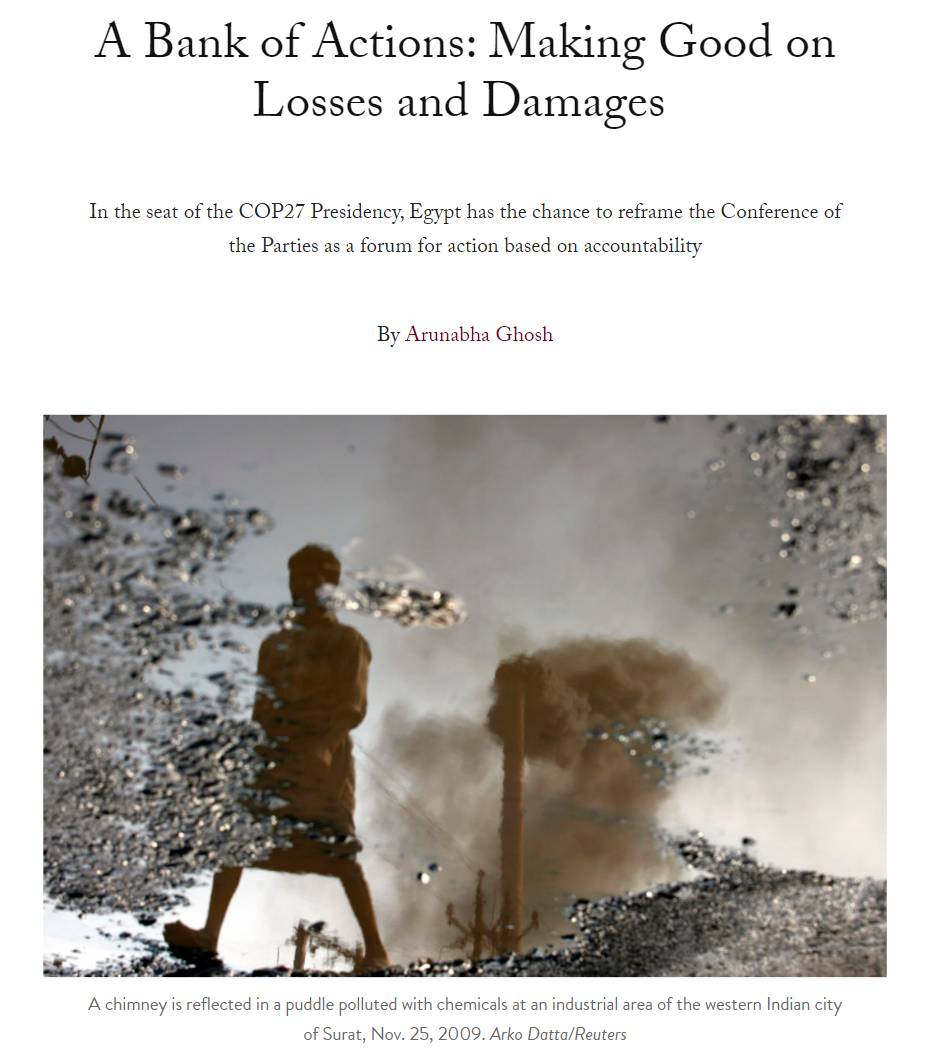
A Bank of Actions: Making Good on Losses and Damages

Arunabha Ghosh
May 2023 |

Suggested citation: Ghosh, Arunabha. 2023. A Bank of Actions: Making Good on Losses and Damages. The Cairo Review of Global Affairs.


Overview

This article, published in The Cairo Review of Global Affairs' Spring 2023 edition, emphasises how Egypt’s COP Presidency–which will last till November 2023– can begin the transformation toward making UNFCCC a bank of just, credible, and accountable actions. It is time to orient the Conference of Parties away from conversation and commitments and toward action and accountability. The article gives key recommendations on how this can be done: prioritising loss and damage finance, promoting multilateralism, increasing transparency, and ensuring compliance.

Key Highlights

  • The global climate regime is complex and multi-institutional. At its heart sits a bank called the UNFCCC. In effect, it has now become a vault for more and more valuable deposits, including commitments for net zero emissions. If the near-term returns remain poor, the long-term commitments will likewise become post-dated cheques on a failing bank. The first test of UNFCCC’s conversion into a bank of actions would be how the decision on loss and damage financing is implemented.
  • Develop a Global Vulnerability Index to quantify vulnerability to the adverse effects of climate change. In 2021, the Council on Energy, Environment, and Water (CEEW) developed a Climate Vulnerability Index for India, which found that over 80 per cent of Indians are highly vulnerable to extreme climatic disasters. Such data help map critical vulnerabilities and plan strategies to build resilience by climate-proofing communities, economies, and infrastructure.
  • Egypt’s COP presidency and India’s Group of Twenty (G20) presidency can collaborate on promoting multilateralism for chronic risks by proposing a Global Resilience Reserve Fund (GRRF) that goes beyond disaster relief. Capitalised by International Monetary Fund (IMF) Special Drawing Rights, or reserve assets maintained by the IMF to support its members, the GRRF could pool risks across vulnerable regions and leverage public funds to fix a market failure of lack of insurance coverage for much of the Global South.
  • Another structural challenge the UNFCCC has faced is that some of the biggest polluters have bailed out on their commitments or even exited agreements with impunity. One way to minimize such instances is to enhance the scope of the Compliance Committee under Article 15 of the Paris Agreement. Further, increasing the integrity of commitments and credibility actions of corporations, cities, and regions could counteract non-performance by Parties.
  • Ultimately, the COP process will draw legitimacy not only from how emissions were abated, but how energy was provided to billions of people who remain energy poor. In the developing world, distributed renewable energy (DRE) systems can provide energy access at far lower costs than extending existing grids.
​"The success in negotiating an L&D financing facility is also an admission of the gravest failure of the COP process: accountability. Future COPs must focus almost exclusively on ensuring delivery and holding laggards accountable."

Sign up for the latest on our pioneering research

The Myth of Mobilising Private Finance for Climate Action and Pivoting to Scale

Manon Fortemps, Jens Sedemund, Özlem Taskin, Amarendra Bhattacharya, Arjun Dutt, Arunabha Ghosh and Paulo Esteves
May 2023 | ,

Suggested citation: Fortemps, Manon, Jens Sedemund, Özlem Taskin, Amarendra Bhattacharya, Arjun Dutt, Arunabha Ghosh, and Paulo Esteves. 2023. The Myth of Mobilising Private Finance for Climate Action and Pivoting to Scale. T20 Policy Brief.


Overview

This paper, published by the T20 India Task Force, examines the challenges in mobilising private capital for climate action and proposes solutions to unlock flows at scale. Developing countries need USD one trillion per year in external finance for climate action by 2030. However, both real and perceived risks impede the mobilisation of private climate finance at scale. This policy brief proposes a framework of solutions for the G20 to make blended finance work for climate action and development by undertaking actions in three areas: (i) enabling environments; (ii) instruments; and (iii) institutions.

Key Highlights

  • Developing countries should be the focus of the global transition to sustainability. These countries are projected to account for the majority of future global infrastructure investments and more than three-quarters of future greenhouse gas emissions.
  • Developing countries will be unable to meet the associated investment requirements from domestic resources and need an estimated USD one trillion per year in external finance for climate action by 2030. In order to mobilise investment at such a scale, there is broad recognition of the need to unlock private finance for investments in developing countries.
  • Private capital flows to developing countries have been constrained by both real and perceived risks, which if not managed, will lead to a significant escalation of the cost of capital, further hindering capital flows. Against this backdrop, expectations have been pinned on enhanced mobilisation of private climate finance through the development of finance interventions and instruments, broadly captured under the concept of 'blended finance'.
  • Private capital mobilisation by existing blended finance interventions remains limited. Per the OECD, only USD 120.8 billion was mobilised from the private sector by official development finance interventions from 2016 to 2021.
  • In this regard, solely a transaction-based approach to private capital mobilisation has inherent limitations. For greater effectiveness, mobilisation needs to be situated in a broader context of support to developing countries — notably the creation of an effective enabling environment, both through regulatory and policy measures as well as enhanced capacities, de-risking instruments, and institutional development.

Recommendations

  • Establish country or sector platforms, with a focus on the energy transition, that bring together key stakeholders in support of country-led investment and transition strategies (such as the Just Energy Transition Partnership model). Such partnerships can incentivise a country to set out clear strategies and investment programmes, tackle policy impediments, put in place structures for scaling up project preparation, and create replicable and scalable models of financing.
  • Deploy blended finance solutions such as guarantees, insurance, and hedging to mitigate systemic challenges such as exchange rate risks and lower intermediation costs. Potential solutions to improve the strategic use of blended finance include scaling up portfolio approaches in order to aim for both impact and volume. The IFC Managed Co-Lending Portfolio Program (MCPP) and the proposed Global Clean Investment Risk Mitigation Mechanism (GCI-RMM) are examples of replicable structures that adopt a portfolio approach to mobilise new sources of capital for sustainable infrastructure.
  • Reform the international development finance system to adopt a stronger focus on mobilising additional private finance. Multilateral development banks remain insufficiently focused on mobilisation and their incentive structures create a risk of ‘crowding out’ private capital instead of driving co-investment and mobilisation of additional private capital. Integrating mobilisation indicators in corporate scorecards and considerations of career advancement paths of individual officers could be key to aligning incentive systems with mobilisation objectives.
  • Utilise emerging sustainable finance hubs in large developing economies, such as the Gujarat International Finance Tec-City International Financial Services Centre (GIFT IFSC) in India, to link international capital with investment opportunities in the Global South. Developing such initiatives as conduits of capital to countries beyond their immediate jurisdictions can help bridge the gaps in the financial systems of developing countries. In order to do so, these initiatives should be encouraged to expand their focus beyond vanilla debt and equity to blended finance.
​"The mobilisation of the vast amounts of private capital needed for global climate action requires concerted interventions spanning instruments, institutions and enabling environments."

Sign up for the latest on our pioneering research

Driving Sustainable Consumption through Policy Innovations in Value Chains

Elisabeth Hoch, Maximiliaan Tetteroo, Rijit Sengupta and Sabarish Elango
May 2023 |

Suggested citation: Hoch, Elisabeth, Maximiliaan Tetteroo, Rijit Sengupta, and Sabarish Elango. 2023. Driving Sustainable Consumption through Policy Innovations in Value Chains. T20 Policy Brief.


Overview

This paper, published by the T20 India Task Force, discusses the need for policy interventions in value chains to increase the availability and consumption of more sustainable products. Consumers are increasingly interested in buying sustainably produced products. However, the supply of such products and services remains limited and is restricted. This 'intent-action gap' needs to be addressed to achieve the goals of Mission LiFE.

Key Highlights

  • The market for sustainable products remains limited, despite the increase in consumer preference for sustainable products. Consumers’ awareness of sustainability issues and their intentions to buy sustainable products have not significantly impacted sustainable purchasing.
  • The proliferation of sustainability labels and claims in some markets confuse consumers and increase the possibility of 'greenwashing' by businesses. Adoption of sustainability standards that include in-built traceability systems can support the credibility of such labels and claims, alongside coordinated regulatory action against greenwashing.
  • Regulations in advanced economies to foster sustainable value chains may cause SMEs and small farmers to be further excluded from international markets. More formalised and financially beneficial roles can be created for such local actors to produce and certify sustainable goods at the grassroots level. This will allow the entire value chain to participate in sustainability without acutely disadvantaging the grassroots-level livelihoods.
  • Consumption-based emissions (CBE) accounting can enable more equitable changes in lifestyles by reducing the burden of sustainable decision-making on consumers whose overall consumption is already low. Digital product passports (DPPs) can be introduced, which track the sustainability credentials of a product throughout its value chain for informing the consumer. By combining DPPs and data from consumer behaviour, CBE accounting can be realised.

Policy Recommendations

The G20 can consider:

  • Creating an open-source international repository of good practices by businesses on sustainable consumption (this could be added as a 'new' indicator under SDG Target 12.6.2 (encourage companies, especially large and transnational companies, to adopt sustainable practices and to integrate sustainability information into their reporting cycle).
  • Adopting a common policy for introducing DPPs for key consumer goods by developing common sustainability indices for products based on local emissions inventories. This policy can be expanded in the future to include services.
  • Supporting the creation of a broad data collection, processing, and reporting framework for CBE accounting at an individual level, while ensuring that privacy and freedom of choice are respected and protected.
  • Creating a long-term policy for equitable action on demand-side management for consumption practices by utilising the CBE framework to nudge and disincentivise high (material and energy) intense consumption.
  • Enabling local actors to be involved in the process of development, implementation, and review of international legislation on sustainable global value chains. For example, integrate local verification of information within the application guidance for sustainability related (ESG) reporting.
  • Supporting national market regulators (competition and consumer protection agencies) with a set of international 'guidelines' to address 'greenwashing'.

Additionally, the G20 working groups and engagement groups can consider:

  • Strengthening the role and benefits of local actors upstream for effective global supply chain legislations (Trade and Industry Working Group, Sherpa Track.
  • Creating participatory and traceable standards to help track specific Sustainable Development Goals (SDGs) (Development Working Group, Sherpa Track).
  • Encouraging individual accountability using emission accounting (the G20's Mission LIFE agenda).
  • Enhancing the credibility of claims and action against greenwashing (the G20's Mission LIFE agenda).
​"The G20 countries can work together to incentivise sustainable consumption practices, shift consumption patterns, and reform consumption and production behaviour by driving policy innovations in global value chains."

Sign up for the latest on our pioneering research

REPORT
17 May, 2023 |

HAVE A QUERY?

author image
Programme Associate

HAVE A QUERY?

author image
Programme Associate

Sign up for the latest on our pioneering research

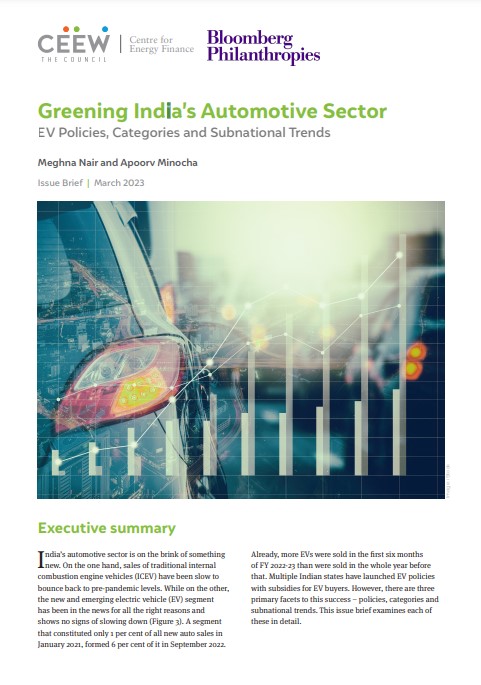
Greening India’s Automotive Sector

EV Policies, Categories and Subnational Trends

,
March 2023 | ,

Sign up for the latest on our pioneering research

REPORT
16 February, 2023 |

HAVE A QUERY?

HAVE A QUERY?

Sign up for the latest on our pioneering research

National Dialogue
National Dialogue on Emerging Trends in E-Mobility

06 Mar 2023   |   1000 - 1700 hrs IST
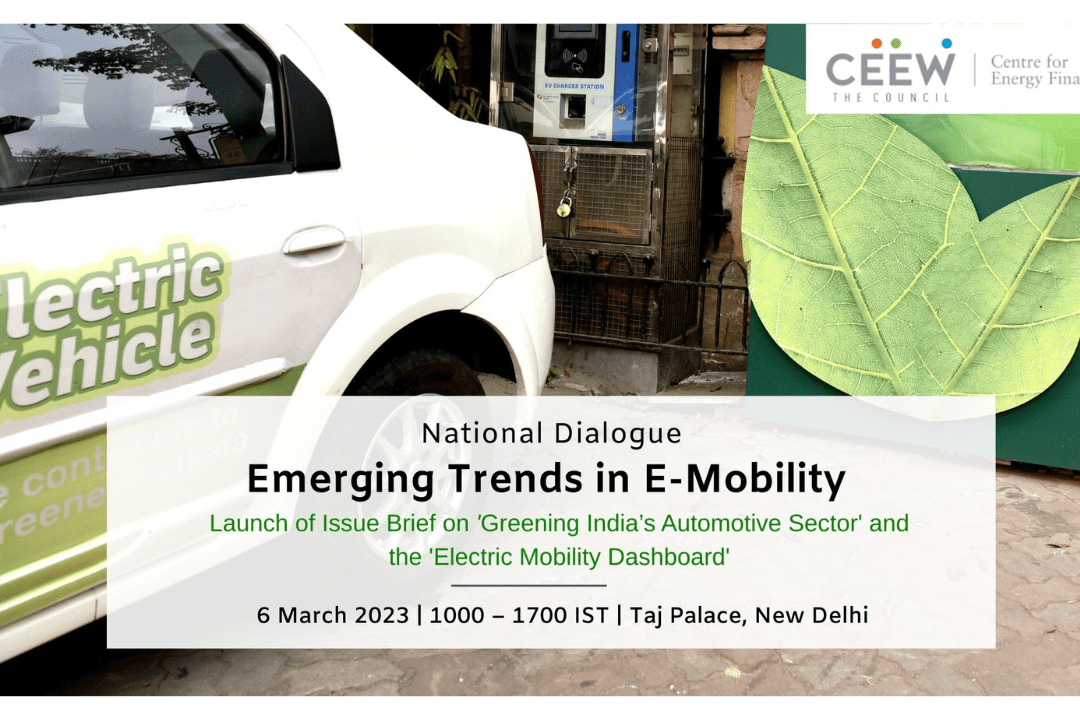
The Centre for Energy Finance at the Council on Energy, Environment and Water (CEEW-CEF) is pleased to invite you to the National Dialogue on Emerging Trends in E-Mobility on 06 March 2023, 1000-1700 IST at Mumtaz Hall, Taj Palace, 2 SP Marg, New Delhi.

As India celebrates its 75th year of Independence and sets priorities for the upcoming decades in its G20 presidency year, the energy transition is becoming integral to policy making. As the third largest auto market in the world, the spotlight is firmly on India to successfully green its auto sector.

Through this Dialogue, we will reflect on the trajectory that e-mobility is expected to take over the next few decades, with policymakers, Original Equipment Manufacturers (OEMs), investors, Charge Point Operator (CPOs), amongst others. The session will also see the release of our issue brief on 'Greening India’s Automotive Sector' and the 'CEEW-CEF Electric Mobility Dashboard'. It will feature two panel discussions on 'Data as a catalyst for E-Mobility' and 'Achieving India's USD 206 Billion EV Market opportunity', a CEO debate and a Ministerial Town Hall.

For Event Queries

Richa Mehta

Consultant

[email protected]

Key Speakers

ISSUE BRIEF
21 February, 2023 |

HAVE A QUERY?

Sign up for the latest on our pioneering research

India Has New Rules to Maintain Power Grid Security. We Explain the Deviation Settlement Mechanism
Increasing share of renewables while ensuring grid security is a challenge for India. DSM regulations 2022 hold promise.

,
02 December 2022

Maintaining the security of any power system is non-negotiable. World over, and in India too, power system operators do so by applying strict controls over the grid frequency, which requires ensuring a near-perfect balance between electricity supply and demand. We deconstruct the Deviation Settlement Mechanism (DSM) – a regulatory mechanism to maintain grid frequency in India.

Source: Authors' illustration of the concept of demand-generation balance in a power system.

We take Uttar Pradesh (UP) as a case for analysis. UP incurred INR 374 crore1 during the first half of FY232 (H1 FY23) as DSM charges, one of the highest in the northern region. Could the state have saved on these costs? And, what changes does the new DSM regulation, effective 5 December 2022, bring forth?

What is the Deviation Settlement Mechanism?

Any demand-supply imbalance of electricity leads to a fluctuation in the grid frequency from the standard value, which is set at 50 Hertz (Hz) in India. A significant drop or rise in frequency could lead to a power system blackout. Therefore, the Indian Electricity Grid Code (IEGC) 2010 restricts the operational frequency between 49.90 to 50.05 Hz. To maintain the frequency within the band, the power distribution companies must predict demand accurately and schedule supply accordingly.

Grid operators use ancillary services to maintain grid frequency and ensure system security at all instances and restore system security in real time. Therefore, ancillary services are naturally more expensive than the energy scheduled to flow otherwise.

Uncertainties in a large electricity system, such as that of UP, are inevitable. In 2021-22, UP had the second-highest electricity requirement in the country, and contributed to 12.3 per cent of the national peak demand3. In such a large-scale system, consumer behaviour or tripping of a transmission line can be hard to predict. Therefore, the use of ancillary services cannot be avoided. However, it can be minimised if (i) demand and generation is forecast as accurately as possible and (ii) all suppliers or generators stick to their given schedules. The DSM instils discipline on these two fronts through penalties and incentives. Hence, the Central Electricity Regulatory Commission (CERC) notified DSM regulations in 2014 (referred to as DSM 2014). The charges, payable to or receivable by states, are managed through a common DSM pool. This pool of money is used to procure the ancillary services needed to balance the system.

The CERC has now updated the DSM regulations (DSM 2022). Based on the Council on Energy, Environment and Water (CEEW)’s ongoing research on power system dispatch, we explain the existing and the upcoming regulations below.
How the current regulation works

The DSM 2014 regulation is designed to have three cost components:

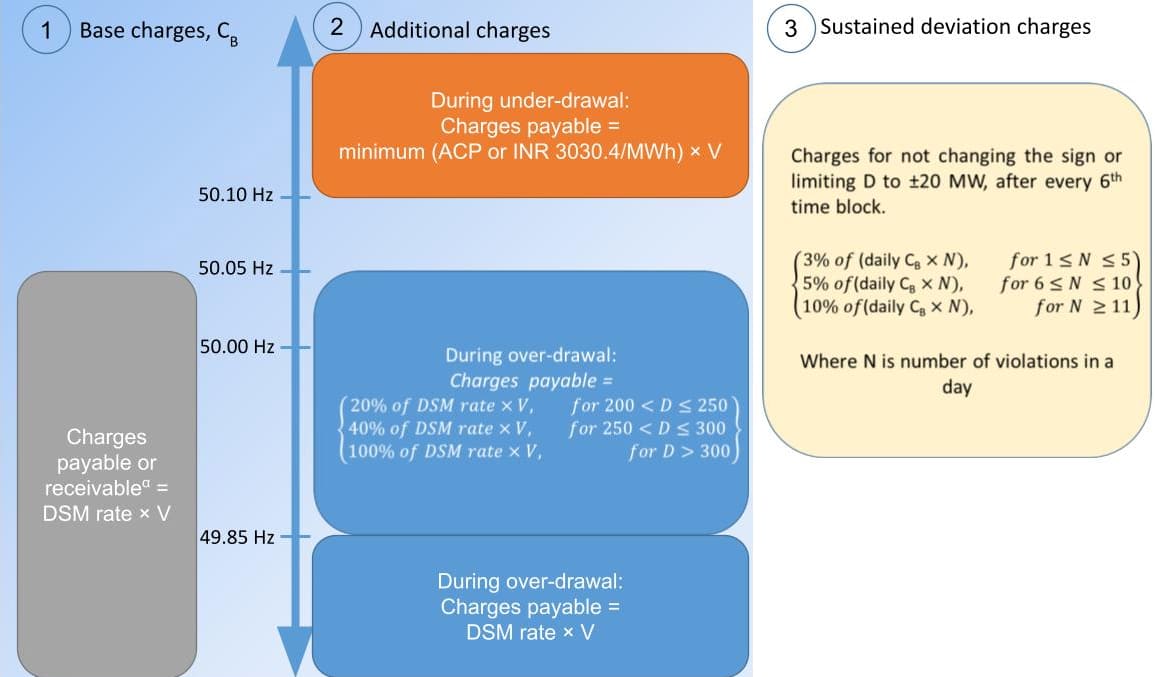
  • Base charges are the amount payable for all the extra units of electricity drawn over the final schedule, termed as ‘over-drawal’ (OD) or amount receivable for all the units of electricity drawn less than the final schedule, known as ‘under-drawal’ (UD). These charges are only applicable in time blocks with frequency < 50.05 Hz.
  • Additional charges are frequency-dependent. They are further defined as below
    • For frequencies between 49.85 to 50.5 Hz, additional charges are levied over and above the base charges for any deviations beyond pre-defined limits. These limits are set in megawatts (MW), and differ for renewable-energy rich and renewable-energy deficit states.
    • For frequencies lower than 49.85 Hz, the state incurs an additional charge, which is equal to the base charge, for each unit of electricity drawn over the schedule. This frequency band puts the grid at high risk, and therefore the charges for over-drawing are equivalent to a double penalty (i.e. base + additional charges)
    • For frequencies ≥ 50.10 Hz, the state incurs an additional charge for all units of electricity drawn less than scheduled. The applicable charges are given in figure 1 below.
  • Sustained deviation charges are levied to restrict continuous over- or under-drawals from the grid. If an entity continuously over-draws or under-draws for more than six 15-minute time blocks, it is counted as a violation and the entity is penalised. More the number of violations during one day, the higher is the penalty.

These cost components are illustrated in Figure 1, indicating the limits defined for UP.

Figure 1: Summary of DSM cost components for Uttar Pradesh
Source: Authors’ compilation based on DSM 2014.
Notes -
1. D is deviation quantum in MW (difference between the actual and scheduled drawal)
2. V is volume in MWh corresponding to D in MW
3. ACP is the daily weighted average Area Clearing Price (ACP) of the Day-ahead market (DAM).
4. αReceivable base charges are capped at volumes corresponding to under-drawal of up to 200 MW less than the schedule

As illustrated in Figure 1, base charges and additional charges are determined according to the DSM rate. The sustained deviation charges are calculated as a proportion of the sum of total base charges applicable for a day, based on the number of violations observed during that day.

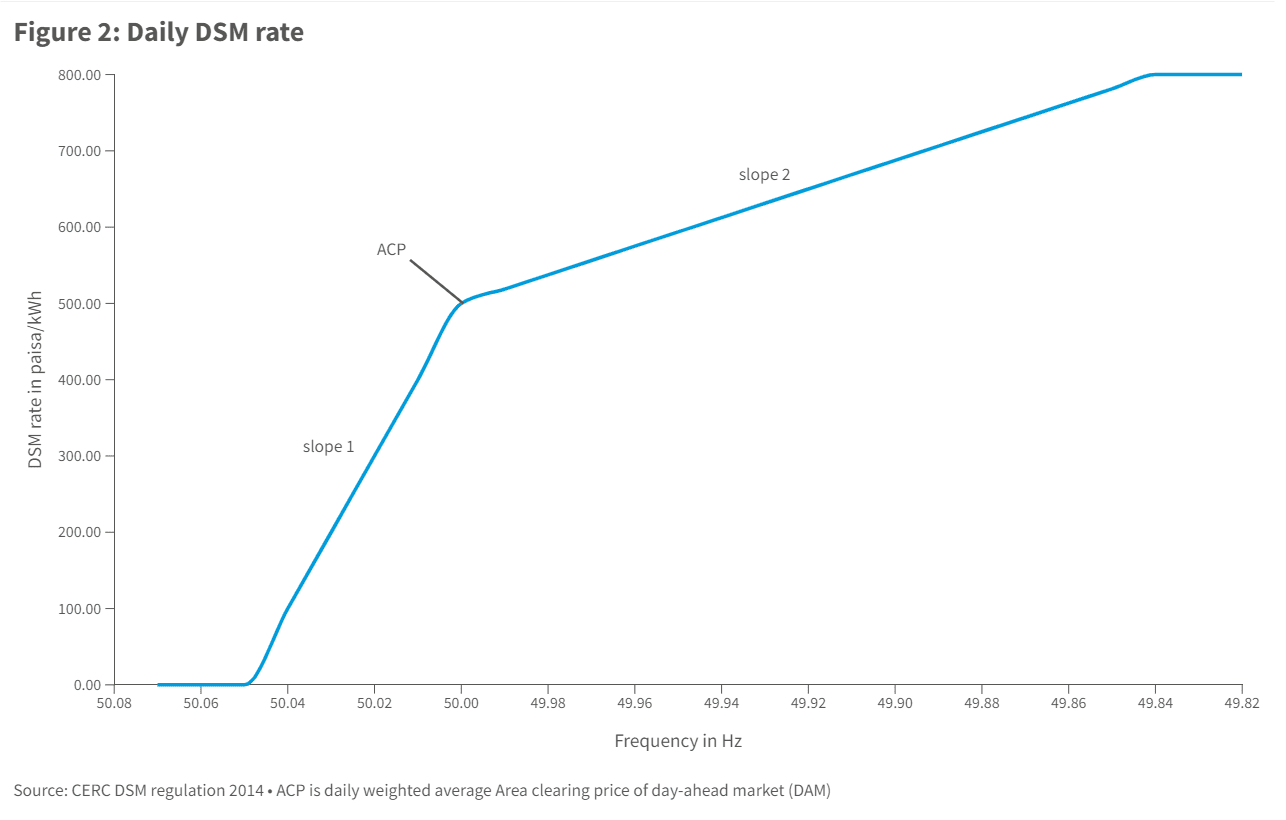
The DSM rate is determined on a daily basis. It is linked to (i) the grid frequency and (ii) the weighted average Area Clearing Price (ACP) of Day-ahead market (DAM), as illustrated in Figure 2. ACP is an indication of congestion and demand-supply position in the area. Higher the ACP, higher will be the DSM rate at low-frequency levels (< 50 Hz).
Over the years, the DSM 2014 regulation has evolved to accommodate variability in the state schedules due to the increasing installation of renewable energy and transmission congestions. The regulations have continuously aimed to narrow the permissible frequency band and ensure randomness in deviation patterns of states.

The upcoming DSM Regulations 2022

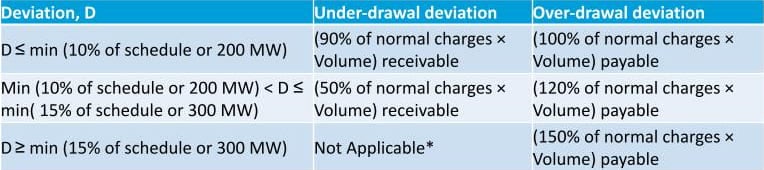
DSM 2022 de-links the determination of charges from frequency, and instead, links them to the prices observed on market platforms.

Table 1: New DSM charges for Uttar Pradesh
Source: CERC DSM regulation 2022
*Per the regulation, the state will not receive any amount if it under draws beyond 300 MW in a time block

For the first year, the ‘normal charges’ for each time block will be either (i) the weighted average ACP of DAM across all power exchanges or (ii) the weighted average ACP of RTM across all power exchanges or (iii) the weighted average ancillary services charge across all regions, whichever is the highest of the three. The charges in table 1 indicate the penalties and incentives to manage grid frequency. However, DSM 2022 does not include any provisions for penalising continuous over- or under- drawals.

We now take a deep dive to understand the implications of DSM 2014 on Uttar Pradesh.

UP incurred INR 374 crore as DSM penalties during H1 FY23

Figure 3 shows the break-up of the charges incurred. Of the INR 374 crore, base charges and additional charges constituted 62 per cent and 31 per cent, respectively. The state incurred penalties worth INR 459 crore for over-drawing electricity, which was four times the payments that accrued for under-drawing.

Figure 4 indicates that 54 per cent of the time in June, the actual drawal deviated by more than the specified volume limit. Of this, 40 per cent of the time, the state overdrew beyond the permissible volume limit of 200 MW, for which it incurred penalties. For the remaining 14 per cent of the time, the state underdrew by a quantum higher than 200 MW, for which it did not receive any incentive. June was also the month that saw the highest additional charges (INR 28 crore). This was majorly because of the violation of volume limits.

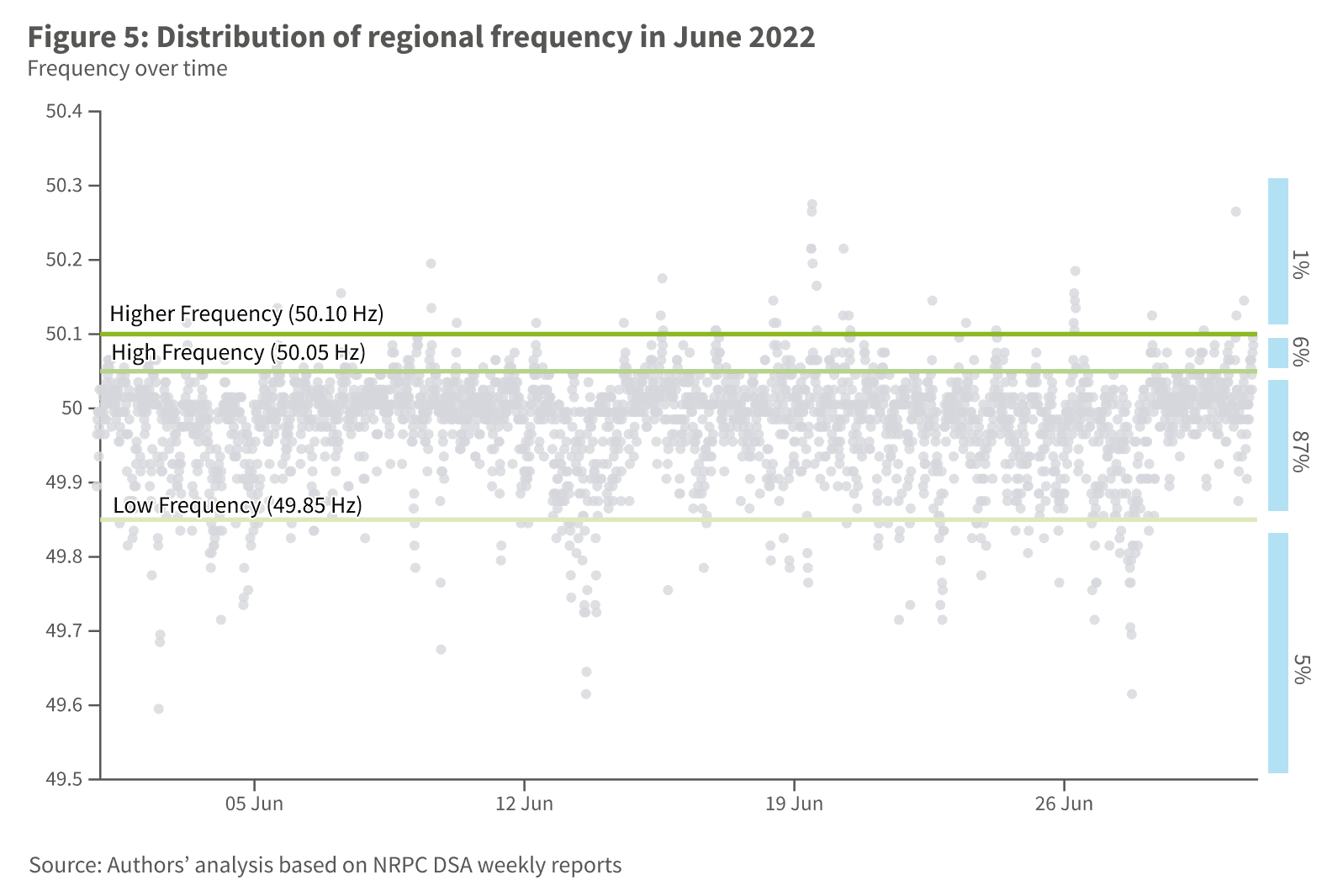
Alongside the observed volume limit violations, 13 per cent of the time in June, the northern region’s frequency was reported to be out of the permissible range, as Figure 5 illustrates. 8 per cent of the time, the regional frequency rose above 50.05 Hz, during which the regulations do not impose any penalties/charges for drawing more electricity than scheduled. We find that the state overdrew 11 million units (MUs) of electricity during these high-frequency instances, for which the regulation imposes no charges. Also, when the grid frequency was between 50.05 Hz and 50.10 Hz, UP drew about 6 MUs of electricity less than their schedule. This could have increased the grid frequency further, putting the grid at risk.

However, the regulations do not impose any penalties for such occurrences.
Based on the above analysis, we conclude that Uttar Pradesh could have avoided incurring the majority of the DSM charges if the deviations were restricted within the specified limit. One way to achieve this is to forecast the electricity demand with higher accuracy.

A saving opportunity of INR 58 crore

We quantify the potential savings if UP forecast its schedules with 95 per cent accuracy and also trading the quantum corresponding to the balance ±5 per cent at the real-time market (RTM)4. The purpose of utilising RTM would be to stay within the deviation limits, i.e. sell instead of underdrawing and buy instead of overdrawing. We find that by doing so, UP could have saved INR 58 crore during H15.

The analysis indicates that it is cheaper for the state to increase the forecasting accuracy that in turn enables them to use markets for deviation management, than to violate limits and pay penalties.

What’s in store with DSM regulations 2022

The upcoming regulations are linked to the electricity market segments, making the optimisation opportunity clearly visible. We attempt to examine if these regulations ensure the desired behaviour from states to support the grid. We do so by applying the new regulations in hindsight and assessing the outcome for possible scenarios.

We observed that when the grid frequency was low, indicating demand is higher than the available generation, the regulations penalise the over-drawal and incentivise the under-drawal, thus improving the frequency. However, concerns arise during high-frequency instances when there is no incentive or penalty for overdrawing or underdrawing, respectively. This can potentially put the grid at risk. There could also be a possibility of high-frequency incidents coinciding with renewable energy generation kicking-in. Therefore, it becomes even more important for DSM 2022 to prevent such occurrences.

Rapidly increasing the share of renewables while ensuring grid security is a challenge that confronts us today. DSM regulations 2022 hold promise to empower system operators to ensure grid discipline and security cost-effectively. Time will tell how the regulations will perform.

Notes

1  Northern regional power committee (NRPC) weekly deviation settlement accounts (DSA) reports retrieved on 10 November 2022.

2  April to September 2022

3  20th Electric Power Survey of India, Central Electricity Authority.

4  The analysis considers the RTM segment of the Indian Energy Exchange (IEX) only. Assuming the quantum to be traded at the IEX RTM is limited based on actual volumes cleared vis-a-vis the sell and buy bids in the respective time block

5  Assuming the bids are cleared at the actual marginal prices observed at RTM segment of the Indian Energy Exchange (IEX).

Arushi Relan is a Research Analyst and Disha Agarwal is a Senior Programme Lead at the Council on Energy, Environment and Water (CEEW), an independent not-for-profit policy research institution. Send your comments to [email protected]

,

Sign up for the latest on our pioneering research

Pages