Home
Council on Energy, Environment and Water Integrated | International | Independent
National Dialogue
Cleaner Air and Better Health: Innovating Pathways to Scaling Solutions

31 Aug 2023   |   0930 - 1400 IST

The Cleaner Air and Better Health (CABH) project and the consortium of partners are pleased to invite you to a National Dialogue on 'Cleaner Air and Better Health: Innovating Pathways to Scaling Solutions' on 31 August 2023, 1000-1400 IST at Hyatt Regency, New Delhi.

The CABH project is supported by the United States Agency for International Development (USAID). It aims to strengthen air pollution mitigation and reduce exposure to air pollution in India by establishing evidence-based models for better air quality management. In support of the National Clean Air Programme (NCAP), the consortium partners are working towards accelerating particulate matter reduction in India.

The Dialogue will reflect on convergence across governance tiers in addressing air pollution and the symbiotic relationship between clean air and quality of life. We also look forward to presenting to you our evidence-based recommendations and the related interventions to take comprehensive action on cleaner air and better health.

For Event Queries

Sonam Gairola

Senior Communications Associate

[email protected]

In Pictures

Powered by flickr embed.

Key Speakers

ISSUE BRIEF
03 November, 2021 |

Sign up for the latest on our pioneering research

REPORT
28 July, 2021 |

HAVE A QUERY?

author image
Programme Associate

HAVE A QUERY?

author image
Programme Associate

Sign up for the latest on our pioneering research

REPORT
05 March, 2021 |

Sign up for the latest on our pioneering research

ISSUE BRIEF
27 August, 2021 |

Sign up for the latest on our pioneering research

PAPER
11 October, 2021 |

Sign up for the latest on our pioneering research

Dialogue
How Can the Long-term Strategies (LTS) of the G20 Members Help Forge Partnerships and Decarbonise?

24 Aug 2023   |   1300 - 1800 IST

The Council on Energy, Environment and Water (CEEW) and NewClimate Institute are pleased to invite you to a dialogue on 'How can the long-term strategies (LTS) of the G20 members help forge partnerships and decarbonise?' on 24 August 2023, 1300 - 1800 IST at Juniper Hall, India Habitat Centre, New Delhi.

In 2015, the Paris Agreement was signed by 195 nations, recognising the urgent threat of climate change. It mandates the creation and communication of Long-Term Low greenhouse gas Emissions Development Strategies (LT-LEDS )—under Article 4, paragraph 19— based on Common But Differentiated Responsibilities and Respective Capabilities (CBDR-RC) to accommodate each country's unique circumstances.

With 85% of global GDP, 75% of trade, two-thirds of the world's population, and around 80% of greenhouse gas emissions, the G20 shapes climate change discourse. The Council on Energy, Environment and Water (CEEW) and the New Climate Institute have collaborated on analysing G20 LT-LEDS, across mutiple themes like adaptation, mitigation, capacity building, finance, technology, just transition, and governance for enhanced cooperation.

The dialogue aims to disseminate the findings of the analysis conducted while also aiming to unpack key priorities and areas of cooperation amongst the G20 which will help foster stronger partnerships and collaboration in the fight against climate change.

For Event Queries

Sonam Gairola

Senior Communications Associate

[email protected]

Key Speakers

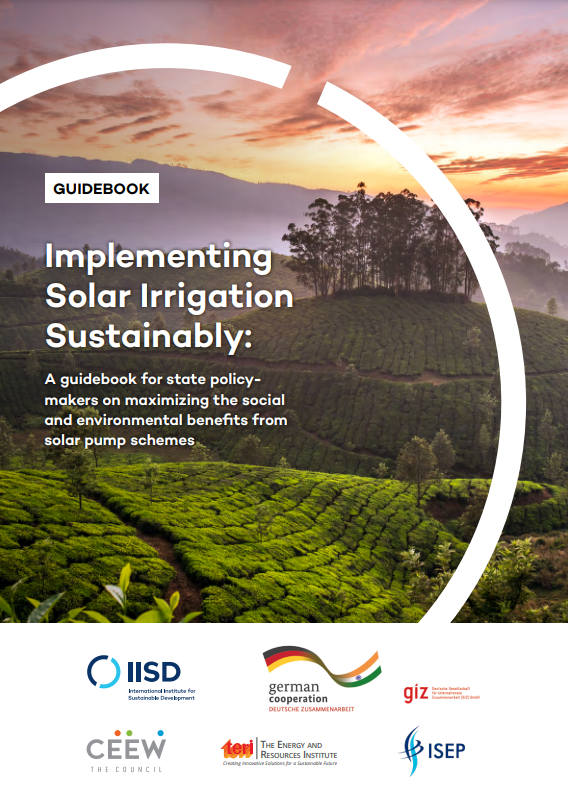
Implementing Solar Irrigation Sustainably

A Guidebook for State Policy-Makers on Maximising the Social and Environmental Benefits from Solar Pump Schemes

Siddharth Goel, Rashmi Murali, Anas Rahman, Prajnashish Swain, Balasubramanian Viswanathan, Shalu Agrawal, Christopher Beaton, Mini Govindan, Abhishek Jain, and Debajit Palit
December 2021 |

Suggested citation: Goe, Siddharth, Rashmi Murali, Anas Rahman, Prajnashish Swain, Balasubramanian Viswanathan, Shalu Agrawal, Christopher Beaton, Mini Govindan, Abhishek Jain, and Debajit Palit. 2021. Implementing Solar Irrigation Sustainably: A guidebook for state policy-makers on maximizing the social and environmental benefits from solar pump schemes. International Institute for Sustainable Development.


Overview

In 2019, India launched the PM-KUSUM scheme — a major initiative to promote solar-powered irrigation, thereby boosting farmer well-being and transitioning to clean energy. This guidebook has been developed in cooperation with the Ministry for New and Renewable Energy (MNRE) and provides concrete recommendations on how state officials can sustainably deploy standalone solar pumps. On social outcomes, the guidebook looks at how schemes can maximise benefits for low-income farmers. Environmentally, it examines how schemes can minimise risks of over-withdrawal of groundwater.
Key Findings

  • Cost-effective and reliable irrigation can significantly improve farmer incomes and well-being. Moving away from subsidised grid electricity can relieve financial pressure on utilities. Solar power helps India shift to clean energy, and reduce air pollution and greenhouse gas emissions.
  • Solar pumps need to be deployed in a sustainable manner to maximise the benefits for farmers and avoid negative environmental impacts.
  • Focused on standalone and grid-connected pumps, the guidebook provides practical suggestions for state policy-makers and implementing agencies with illustrative examples, drawing on a combination of secondary and primary research.
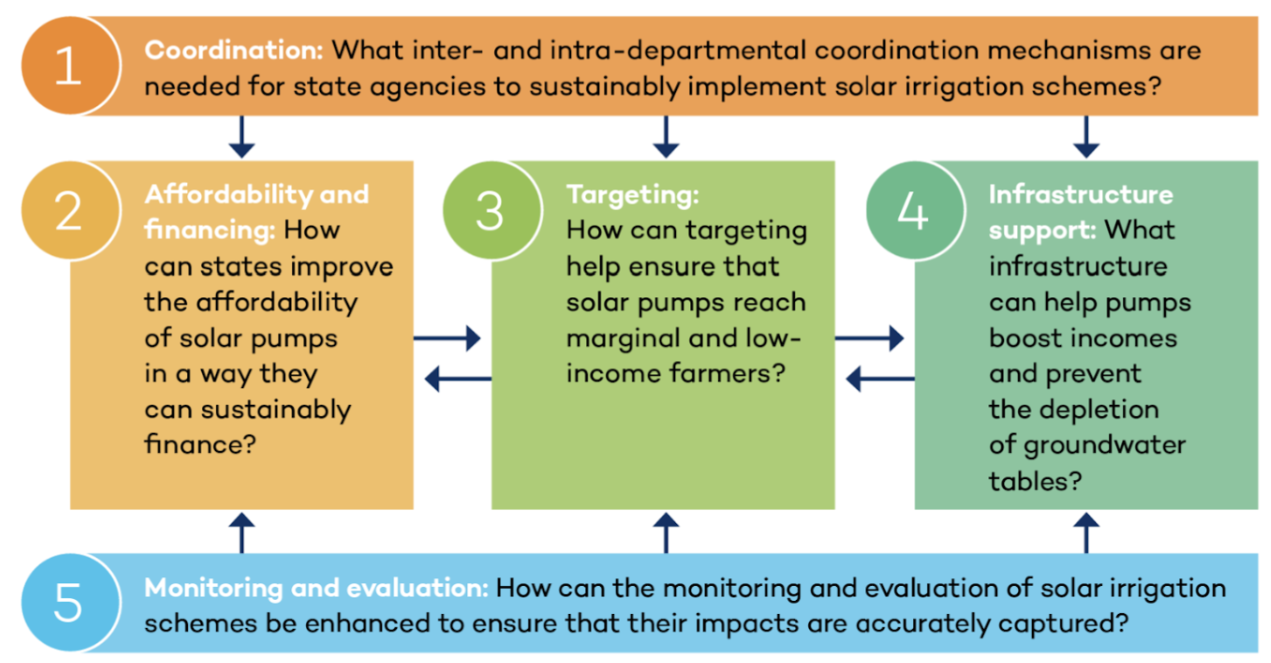
  • The guidebook provides practical and concise recommendations by drawing on practitioner experience through consultations with state officials and other stakeholders, as well as synthesising previous research on state experiences with solar irrigation and the water–energy–food (WEF) nexus. This is focused into guidance and illustrative examples of good practice over five main focus areas.

​"Using solar pumps in agriculture can help India achieve its clean energy targets. But care must be taken to implement solar irrigation sustainably, given the complicated interconnections between water, energy and food."

Sign up for the latest on our pioneering research

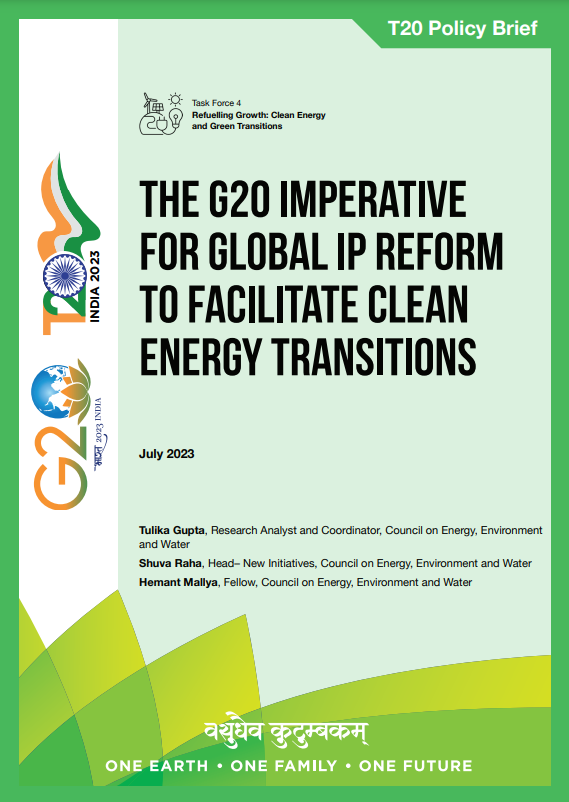
The G20 Imperative for Global IP Reform To Facilitate Clean Energy Transitions

Tulika Gupta, Shuva Raha, and Hemant Mallya
July 2023 |

Suggested citation: Gupta, Tulika, Shuva Raha, and Hemant Mallya. 2023. The G20 Imperative for Global IP Reform To Facilitate Clean Energy Transitions. T20 Policy Brief.


Overview

This T20 policy brief establishes why the technology-rich and market-oriented G20 should create a Tech20 Engagement Group to establish norms for technology access, sharing and co-development.

Much of the energy transition depends on timely, affordable, shared, and scaled-up access to emerging green technologies. Developed countries own most green technologies, leverage Intellectual Property (IP) rights, and subsidise domestic deployment, while also erecting trade barriers to protect their own industries. This technology dominance creates an immediate and overwhelming barrier, stalling the energy transition for billions of people, especially in developing countries.

Highlights

  • Globally installed renewable energy (RE) capacity must triple in the next seven years for the world to remain on track to achieve net zero emissions around mid-century. However, solar, wind, and biofuel-based RE accounts for just ~5 per cent of global energy consumption, nearly all of which (~93 per cent) is collectively consumed by G20 countries. Exponentially increasing installed RE capacity and its share in the global energy mix will require equitable access to emerging technologies.
  • G20 countries own ~91 percent of the patents granted under the Patent Cooperation Treaty (PCT) in environmental technology (solar, wind, hydro, geothermal, fuel-cell, and waste management) between 2000 and 2021, with just five G20 countries (China, Japan, USA, the Republic of Korea, and Germany) accounting for ~85 per cent of those patents.
  • Indigenous capacity building policies such as subsidies and local content requirements in Canada and India were restrained by WTO rulings. Now that the WTO lies inert due to a veto on Appellate Body member appointments, developed countries are using subsidies to boost domestic industry and undercut international competitors, while also erecting new trade barriers to protect their green industries.
  • Recognising the threat posed by technology and finance gaps, developing countries have long pushed to include ‘technology transfer’ in international trade and climate agreements. Yet, technology and patent sharing provisions have failed to bridge access gaps even during the COVID-19 pandemic.
  • The G20 has addressed the question of technology cooperation, transfer, co-development, and IP sharing several times since 2014, especially for sustainable energy and innovative technologies.
  • India’s G20 Presidency has highlighted the need for international cooperation to close clean energy technology gaps in emerging areas such as carbon capture, utilisation, and storage, electrolysers for green hydrogen, high efficiency fuels cells, advanced cell chemistry for battery storage, and small modular nuclear reactors.

Recommendations

  • Establish a Tech20 Engagement Group. This can comprise G20 country representatives, industry leaders, and civil society members, to facilitate technology cooperation, co-development, sharing, and IP reforms.
  • Create a voluntary, open-access patent pool for green technologies through Tech20. This will allow individual member countries to contribute patents to, and draw from the pool/bank.
  • Collaborate with the Research and Development 20 (RD20) Engagement Group to transition from facilitating exchanges between G20 scientific institutions to a knowledge exchange and collaboration platform, mandating the co-ownership of any resulting technology.
  • Discuss the scope and procurement of technology finance. The Tech20 can also be a platform to discuss financing for indigenous development and deployment of green technologies and infrastructure by the G20, suited to different countries’ specific circumstances.
​"This technology stockpile, if not shared now – first within the G20, and then worldwide – will be of little use if the 1.5°C mark is breached, leading to devastating socio-economic consequences for future generations."

Sign up for the latest on our pioneering research

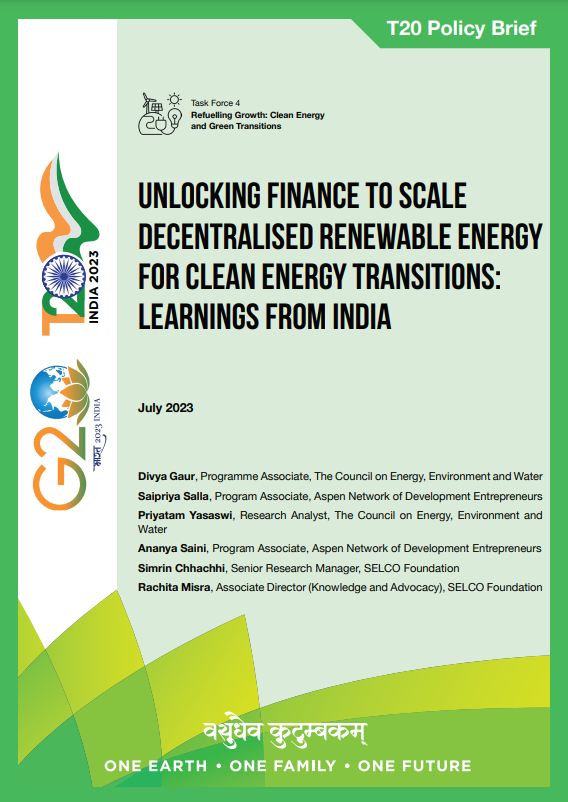
Unlocking Finance to Scale Decentralised Renewable Energy for Clean Energy Transitions

Learnings from India

Divya Gaur, Saipriya Salla, Priyatam Yasaswi, Ananya Saini, Simrin Chhachhi, Rachita Misra
July 2023 |

Suggested citation: Gaur, Divya, Saipriya Salla, Priyatam Yasaswi, Ananya Saini, Simrin Chhachhi, Rachita Misra. 2023. Unlocking Finance to Scale Decentralised Renewable Energy for Clean Energy Transitions: Learnings from India. T20 Policy Brief.


Overview

Decentralised Renewable Energy (DRE) technologies enable an equitable energy transition and ensure energy security for many emerging and developing economies. Unlocking finance for users and enterprises is critical to mainstreaming these technologies for a just energy transition. This policy brief, published by the T20 Taskforce, outlines the challenges with financing currently faced by the ecosystem stakeholders. It builds upon the policy framework released by the Ministry of New and Renewable Energy (MNRE), Government of India, for scaling the adoption of DRE livelihood technologies in India. It explores how DRE can be mainstreamed in the energy transition conversation and scale the adoption of these technologies leveraging the G20 network and resources.

Key Highlights

  • In many low-and middle-income economies, the livelihoods of millions of marginalised populations are strained due to a lack of access to reliable and affordable energy. According to the IEA, around 75 million people will likely lose access to electricity due to rising prices.
  • Globally, G20 economies account for approximately 80 per cent of greenhouse gas emissions and 76 per cent of these come from the energy sector. Moreover, as per data from IEA, G20 countries produce 85 per cent of coal, 64 per cent of crude oil, and 65 per cent of fossil gas, highlighting the importance of prioritising clean energy transitions within G20 countries.
  • DRE provides affordable and reliable energy access while supporting a variety of livelihoods. There is a potential USD 53 billion market for clean energy technologies in India and a USD 11 billion market across Africa. DRE can also help play a crucial role in job creation in developing economies, thereby driving economic growth.
  • A significant obstacle in the widespread adoption of DRE-based livelihood solutions is their perception as capital-intensive. This, coupled with the gap in awareness owing to a need for more evidence on the impact on diverse stakeholders, makes enabling evidence-backed financial support for enterprises and end-users essential for large-scale deployment.

Recommendations

  • Create a sub-group focussed on DRE for green growth under the Energy Transition Working Group (ETWG) to actively plan and support the scaling up of DRE technologies. The process should be geared towards providing initial energy access to support a clean energy transition and job creation.
  • Encourage countries to provide financial support to projects that help scale up DRE technologies. Developed countries could offer affordable financial instruments to enterprises and end-users in high market-potential countries, leveraging the experience of countries like India, among others.
  • Enable international cooperation across sectors for an equitable exchange of knowledge and resources essential for scaling DRE technologies.
  • Get buy-ins from financiers, policymakers, and implementing organisations based on evidence from proposed innovative use case interventions.
​"Enabling low-cost finance for users and manufacturers of clean energy technologies can help marginalised communities improve their lives, education and health worldwide. The Indian G20 presidency should endeavour for enhanced cooperation among other G20 countries to make this happen."

Sign up for the latest on our pioneering research

Pages